Author: Feng Ning
Over the past two years, the explosive growth in demand for AI computing power has made GPUs and CPUs the most sought-after hardware. However, what most people have not noticed is that this buying frenzy has been transmitted upstream in the industry chain - the advanced process production capacity of chip foundries is experiencing unprecedented tightness.
The foundry industry has been experiencing a wave of price hikes since the second half of 2025, and this trend has shown no signs of abating by the second half of 2026, instead becoming even more intense.
Samsung, TSMC Prices Surge by as Much as 25%
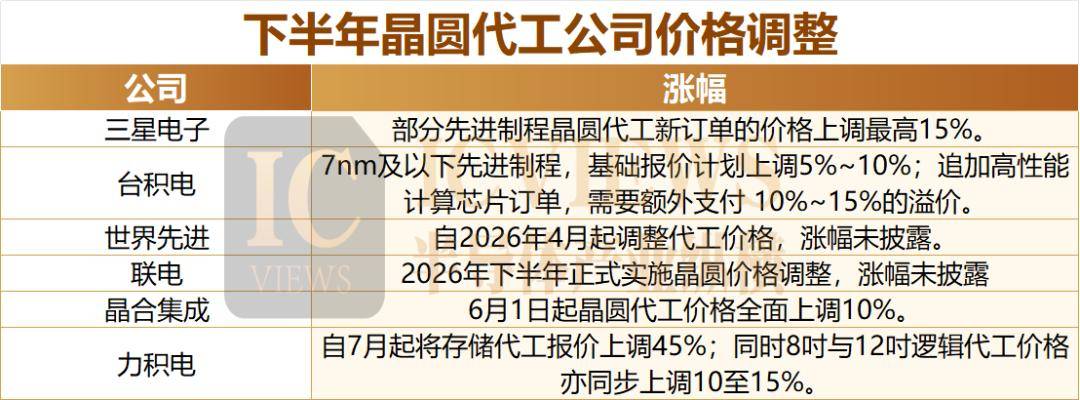
It is reported that Samsung Electronics has raised the prices of some advanced process wafer foundry new orders by up to 15%, due to the surge in demand for AI chips, which has led to continued tight production capacity. Insiders revealed that Samsung raised the prices of chips produced using the 4-nanometer process (SF4) in July. The prices of SF4 orders from mainland Chinese and US clients increased by 10% to 15% from the previous month, while the price increase for clients from Taiwan was 5% to 10%, as they are located in the same region as TSMC. Additionally, the prices of 5-nanometer process wafers also rose by 10% to 15%, and the prices of 8-nanometer process wafers increased by nearly 10%.
Insiders said demand from mainland Chinese clients was particularly strong, but Samsung was unable to fulfill all orders as it had to supply US clients at the same time and reserve some production capacity for its own chip production, with mainland Chinese clients being one of the groups that accepted the largest price increases.
In a similar move, TSMC also plans to comprehensively raise the prices of its chip contract manufacturing services in 2027, covering both advanced and mature process technologies.
The specific price adjustment range is set in two tiers.
TSMC plans to raise the base price of its 7nm and below advanced processes by 5% to 10%, with the final value varying depending on the specific process node and customer. If customers need to add production capacity for high-performance computing chips beyond their original order quantities, they will have to pay an additional 10% to 15% premium on top of the standard price increase.
Two cumulative calculations show that the overall increase for some additional orders can reach as high as around 25%. For mature nodes, including 12nm, 16nm, and 28nm, as well as other existing processes, the increase can be as high as 10%, with smaller adjustments for some nodes.
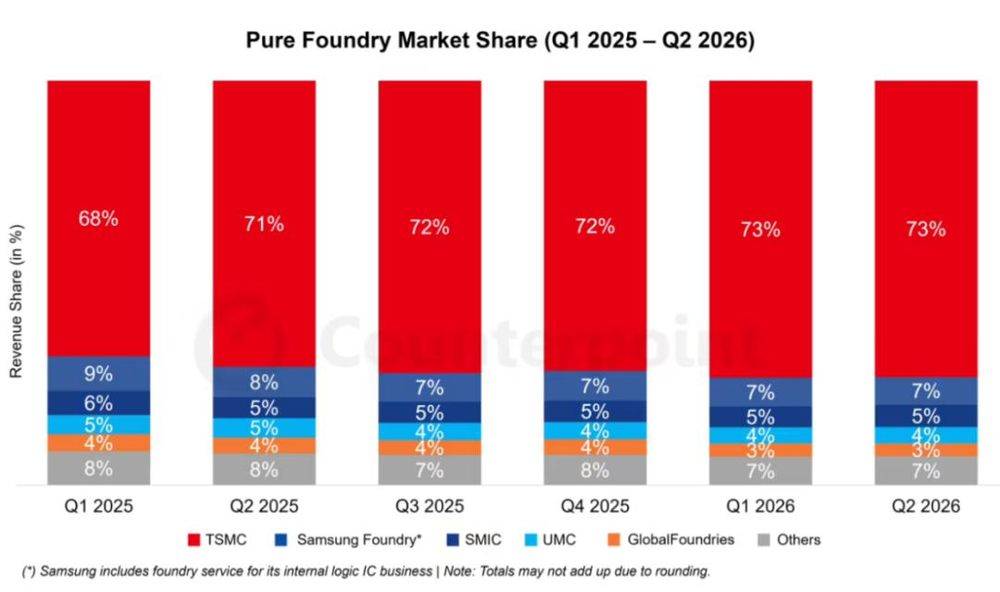
Notably, according to the latest data released by market research firm Counterpoint Research on August 27 local time, the global pure-play foundry market grew 29% year-over-year in the second quarter of 2026. Among them, TSMC ranked first for two consecutive quarters with a 73% market share, approximately ten times that of second-place Samsung, which had a 7% share.
As TSMC and Samsung's production capacity is fully loaded and they raise their foundry prices, orders that cannot be digested may be diverted to Intel.
Recently, Intel's foundry business has released a series of positive signals. Not only has it won design orders from multiple tech giants on its 18A and 14A process nodes, but its advanced packaging technology EMIB has also seen its yield rate rise to the "gold standard" of 98%. The yield rate for its 18A node has reached 85%, with capacity expansion proceeding in tandem, providing a new option for the semiconductor foundry market. In terms of customers, Intel has secured 18A and 14A design orders from leading enterprises including AMD, NVIDIA, Marvell, Microsoft, Micron, OpenAI, Apple, and Meta.
Additionally, according to a report by the Korea Herald, Intel's foundry business is expected to win an order to manufacture the base wafers for SK Hynix's HBM4E memory. The report stated that SK Hynix is considering changing its current reliance on only TSMC for supply, and instead adopting a dual-supply strategy with both TSMC and Intel, with Intel's foundry potentially securing a significant portion of the orders.
Mature Processes Also Face Intense Heat
It's not just advanced processes that are experiencing a price increase cycle, as several mature process foundries have announced price adjustments since the first half of this year.
On March 13, World Advanced issued a price adjustment notice, which stated that starting from 2025, the company has significantly increased its production capacity to meet growing customer demand, but the prices of semiconductor equipment, raw materials, energy, and precious metals have continued to rise, and labor and transportation costs have also been increasing. To maintain the company's healthy operations and meet customers' future capacity demands, the company "must seek customers' understanding and support to jointly absorb the rising costs" and plans to adjust its foundry prices starting from April 2026.
In April, UMC stated in a letter to customers that the company will formally implement a price adjustment for wafers in the second half of 2026. UMC attributed the price increase to the continued rise in costs of raw materials, energy, logistics, and key manufacturing equipment procurement, while emphasizing that the move aims to continuously improve manufacturing efficiency and ensure high-quality wafer supply for customers. The price adjustment notification has a wide range of impact, with UMC's major customers including MediaTek, Intel, Qualcomm, Broadcom, Realtek, UNISOC, Texas Instruments, and many small and medium-sized chip companies.
Mainland manufacturers are also following this trend, with Jingheng Integrated announcing on March 12 that wafer foundry prices will be increased by 10% across the board starting June 1.
Lihom Technology General Manager Zhu Xianguo stated at a recent earnings explanation conference that the company will raise storage foundry quotes by 45% starting in July, with the price hike expected to be reflected in revenue beginning in November, and that 8-inch and 12-inch logic foundry prices will also be increased by 10% to 15% simultaneously.
In the current round of global foundry price hikes, domestic chipmakers have taken a relatively cautious stance and have not collectively released price adjustment signals. However, SMIC had already taken the lead in completing a round of process quote hikes as early as December last year.
Based on publicly available industry information, this article summarizes the price adjustment actions and increase standards of major wafer foundries this year:
The latest Q2 financial reports from the country's leading wafer manufacturers have also directly reflected the industry's dividends.
In the second quarter of this year, SMIC's revenue exceeded $3 billion for the first time, reaching $3.006 billion, up 36.1% year-over-year and 20% quarter-over-quarter. Gross profit was $761 million, up 69.1% year-over-year, with a gross margin of 25.3%, and net profit surged 261.7%. Over the same period, HSMC's revenue was $717.5 million, up 26.8% year-over-year, with a gross margin of 16.5%, and net profit increased 385.9% year-over-year, with a capacity utilization rate of 102.8%.
One thing that can be confirmed is that the domestic chip foundry industry is rapidly gaining momentum.
Some readers may have a question at this point: with advanced process orders being aggressively taken up by AI, why are mature processes also being swept up in this wave of price increases?
The reasons can be attributed to three points.
First, the "squeeze effect" on production capacity is far more severe than imagined.
It can be confirmed that the world's leading wafer foundries have almost entirely allocated their most advanced and profitable production capacity to 5nm and 3nm AI acceleration chips. As a result, mature process products that were originally scheduled for production at these large factories have had to be "migrated" outward, flooding into second- and third-tier wafer factories. With this concentrated shift, the supply and demand balance has suddenly become skewed. Meanwhile, the major factories are also scaling back their expansion plans for mature processes, causing the supply side to be compressed from both ends, which has naturally driven up prices due to short supply.
Second, AI chips are not "fighting alone", but rather being "shipped in groups".
An AI logic chip cannot operate independently and requires accompanying power management, signal chains, and storage chips to form a complete system. The currently scarce categories are divided into two ends: advanced processes are lacking GPU, ASIC, and other computing power chips, while mature processes are lacking analog chips, storage chips, and various interface chips. These three types of chips do not have high process requirements, ranging from approximately 180nm to 45nm.
Zhao Haijun, co-CEO of SMIC, cited an example where a cabinet housing 72 GPUs requires over 16,000 components for power management alone, driving demand for 48-volt high-voltage and high-current BCD processes, which has led to an increase in orders for SMIC's 8-inch analog circuits, resulting in a growth of around 40% in revenue from AI supporting, computer and tablet, and industrial and automotive segments on a quarter-over-quarter basis.
For every additional AI chip sold, it means the incremental demand for dozens of supporting chips is generated simultaneously. This is a demand chain that extends from advanced processes to mature processes - the more orders advanced processes receive, the greater the supporting pressure on mature processes.
Third, among the major manufacturers in this round of price increases, many are focused on "specialized processes", which are scarce resources in themselves.
Regardless of whether it's BCD process, high-voltage process, RF SOI, or embedded non-volatile memory process, none can be replaced by standard logic processes. They are widely used in automotive electronics, industrial control, and AI power systems, with narrow process windows, long development cycles, and slow yield improvement, taking two to three years to build a new production line. Once customers complete automotive or industrial certification, they are unlikely to switch foundries easily, as it involves product redesign and re-certification of the entire process. When the AI boom leads to a surge in demand for these devices, supply is unable to respond quickly, making price increases almost inevitable.
So, this round of price increases for mature processes is not a passive response, but rather a structural supply and demand mismatch resulting from the in-depth transmission of the AI industry chain. Counterpoint expects that in the second half of 2026, as the average selling price (ASP) of wafer foundry services continues to rise, the capacity utilization rate of global professional wafer foundries is likely to remain high, with AI demand still being the core driver of market growth.
Chip Design Firms Lament Their Plight
The pressure from the foundry sector has been transmitted layer by layer, making it difficult for chip design companies to remain unaffected. Price adjustments have long been a common topic in the chip design industry.
In August, MCU and power semiconductor giant STMicroelectronics again issued a price increase notice to customers, announcing that it will raise the prices of multiple product lines starting from August 23. This is ST's third price increase in 2026, following two previous adjustments on April 26 and June 28.
In February, Infineon formally notified customers of a price adjustment, announcing that it will raise the prices of some power switch and related chip products starting from April 1, 2026. NXP also issued an internal price increase letter to its partners, announcing that it will adjust the prices of some product combinations starting from April 1, 2026, although the involved product categories and price increase rates have not been specified, but the reason for the price increase points to the significant rise in costs across the entire industry chain. Additionally, companies such as ON Semiconductor, ADI, Vishay, and Alpha and Omega Semiconductor (AOS) have also joined the price increase trend.
Domestic manufacturers have also raised their prices in sync. Since the start of 2026, Chinese companies including China Resources Microelectronics, Silan Microelectronics, Sinomach New Energy, Jianji Microelectronics, Hongmicro Technology, CSMC Technologies, Guoke Microelectronics, Unisoc, BYD Microelectronics, Sino Wealth, and Xidian Microelectronics have announced price hikes for their products, covering categories such as analog chips, power devices, and AIoT-related chips. The price increases are generally concentrated between 10% and 20%, with some high-end packaging products seeing price hikes of over 40%, a magnitude no less than that of international manufacturers.
However, the price hikes by these manufacturers are not entirely due to the impact of the foundry industry, as the rise in upstream raw material prices has also driven up costs, causing corporate costs to continue to soar. So, in the second half of the year, is there an opportunity for the wafer foundry industry to lower prices, thereby giving chip design companies a chance to catch their breath?
Zhao Haijun made a clear judgment: there is no possibility of a price cut within the year. Artificial intelligence directly drives two ends, one end being advanced computing power related to standard logic, and the other end being very mature analog circuits. He believes that the 40nm and 28nm processes stuck in the middle have no products that can directly enter the computing power and data center sector, and can only be driven by the spillover effect after the two ends fill up their production capacity.
According to a study by TrendForce in May, TSMC and Samsung will reduce 8-inch production capacity starting from the second half of 2025. By 2026, the average 8-inch production capacity utilization rate of the world's top ten foundries will have rebounded to nearly 90%. Meanwhile, foundries are shifting their DDIC and CIS production capacity to PMIC, BCD, and power discrete devices. Related clients are transferring their wafer orders to mainland Chinese foundries in pursuit of price and production stability. The institution further judged at the end of June that the price hike effect will extend to 2027.
Under the multiple constraints of unbalanced production capacity and continuously rising upstream and downstream costs, the window for chip price declines has yet to open, and this round of industry cost pressure will continue to ferment, with chip design companies still under pressure in the short term.