
Xingyu Co., Ltd., a leading automotive lighting supplier and A-share listed company, has negotiated contract terminations with 107 newly hired college graduates, sparking strong public backlash.
The storm has largely passed, and the conclusion seems clear, but that thin layer of paper has not been pierced.
The overall market environment, difficulties in corporate operations, the substitution of leadership will for leadership, the lack of crisis awareness in the public opinion of private manufacturing enterprises, and the powerlessness of public relations...
The Changzhou Municipal Human Resources and Social Security Bureau investigated and ordered the company to issue a public apology and rectify its employment procedures. No fines or administrative penalties were imposed, with the matter handled as criticism and education.
Mercedes-Benz, Volkswagen, and other overseas automakers have launched a special investigation into supplier management based on the EU's Corporate Sustainability Due Diligence Directive, which may also result in "criticism and education" measures.
Xingyu Shares is in the crucial window period of its second IPO filing on the Hong Kong stock exchange, with the Hong Kong Exchange highly emphasizing labor and ESG governance, and may require the company to provide a large amount of supplementary explanatory materials.
Around August 8, public opinion emerged, with recordings and accounts of the incident surfacing on social media platforms. On August 25, the Human Resources and Social Security Bureau issued a report, and on August 27, Xingyu Shares released an apology letter, acknowledging management's decision-making mistakes. The company will provide 107 college graduates with three months of living subsidies for job hunting and continue to offer free dormitories.
The company issued its first response roughly 19 days after the online backlash erupted, and two days after the human resources and social security bureau released its findings.
The chairman apologized at the earnings briefing on September 2, while also stating that the company would take legal action against certain false reports.
I asked several public relations personnel from foreign-invested enterprises about how to handle such a situation.
Their reactions were fairly consistent, with contingency plans in place before making decisions, and department heads from human resources, legal, public relations, government relations, investor relations, and finance all discussing together, and it's impossible for things to end up like this.
A foreign friend told me, "Here, it's not just 107 people, even if it were 10 people being laid off, we would go through a very meticulous process."
I said, "This is probably why you lost the competition, following procedures for everything and being too rigid."
Several PR friends in the private manufacturing sector were also asked, and they largely agreed, saying what's strange about that, the boss's words must be carried out, and if not, then you're fired.
The mass layoffs of college graduates are a complex event that touches on the difficulties graduates face in finding employment, the ongoing issue of social fairness that triggers high emotional arousal, the distorted actions of companies under heavy pressure to perform, and the significant advantage that ordinary workers, as the weaker party, hold in public opinion.
But if you ask, how can I not do it "in bulk"? How can I not deter them with other methods? How can I not target "new graduates"?
These factors do not overlap, and the risk will indeed be mitigated.
The management of Xingyu Shares must have considered the risks, and the decision was not necessarily made impulsively, but rather, removing the human resources director from their position may be a case of shifting the blame to the executors rather than the decision-makers, or perhaps HR was also involved in the decision-making process.
Under industry pressure, many companies choose not to extend offers or delay employment starts. However, Xingyu Shares had already completed the signing and onboarding process, and then renegotiated to terminate contracts, leading to the outbreak of conflicts, which is quite unfortunate.
On the day it happened, I was in Changzhou and saw the news, thinking it was an algorithmic hit, and when I arrived in Guangdong that day, a PR colleague in Shunde told me the whole network was discussing it.
It is easy to criticize companies, but consider the difficulties they face: parts suppliers are always at a disadvantage in price negotiations with automakers; project planning is fraught with huge uncertainties; and the recruitment cycle for talent is mismatched with the industry cycle.
The automotive lighting sector where Xingyu Shares operates is experiencing increasingly thin profit margins for traditional lighting products, while the outlook for intelligent lighting is promising, but it requires significant R&D investment and has an uncertain mass production timeline, compounded by OEMs' typical annual price reduction demands of 5-8% on suppliers, which continues to squeeze traditional product gross margins.
Xingyu Shares saw double-digit growth in revenue and net profit in 2025, but a turning point emerged in Q2 2026, with revenue increasing by only 1.87% in the first half of the year and net profit attributable to the parent company decreasing by 5.26%. Net profit for Q2 alone plummeted 18.26%, with a clear disconnect between revenue growth and profit growth.
Multiple contradictions have converged to affect college graduates, with Star Universe hiring 440 college graduates from the class of 2026 while terminating labor contracts with 107 people, as graduates have become a focal point of public opinion on social fairness and equal opportunities.
The HR director, who has received the cost reduction target, has two options: either honestly inform top management and terminate contracts in bulk, which, given the sensitive period of the Hong Kong stock exchange listing, would likely trigger public outcry and necessitate formal negotiations for termination, with full N+1 compensation, and acceptance of higher short-term costs.
Another approach is to simply follow the cost-cutting directive, operate in a gray area, and adopt the method reflected by students as "voluntarily resigning to receive a small compensation, and if they refuse to sign, they will be transferred to a production line", in order to minimize compensation expenditures.
Can HR heads push back against top-down decision-making pressure, a question that manufacturing industry peers can also ask themselves.
Private manufacturing enterprises generally have a structure where business and finance departments hold the highest decision-making power, while public relations, branding, and legal affairs are relegated to backend support roles, primarily responsible for damage control and rarely involved in pre-emptive major decision-making or risk veto.
It's not that there are no public relations positions, it's just that these roles lack the power to make suggestions or decisions.
Of course, as a PR practitioner, I often say that the limited influence of PR personnel within a company is largely a problem of their own positioning and capabilities.
I often attend events held by the Chief Communications Officers' Club of large US enterprises, where I frequently hear the statement that the "CCO, or the number one person in charge of public relations, should have veto power over major events involving the company's reputation."
They are also somewhat idealistic, with the "veto power" being overly simplistic, but the right to question and the responsibility to avoid risk are absolute necessities.
We also want to continue to monitor how companies like Volkswagen, Mercedes-Benz, and BMW, which have strong ESG constraints, manage their suppliers, and what kind of labor-related public opinion will trigger a halt in orders.
I also asked friends from domestic car companies, and they said that they couldn't discuss it openly, but in fact, this kind of thing is not a big deal and doesn't pose any particular constraint.
We are pessimistic about the likelihood of the following events occurring in the industry:
Major personnel optimization in batches, establishment of a prior review process for compliance and public relations, and signing as a necessary approval step.
Integrate ESG and reputation risk into hard performance metrics for senior executives.
Such practices would effectively strip founders and core executives of their operational decision-making authority—a self-imposed limitation that is almost certain never to materialize.
Unless overseas major clients substantially cut orders due to labor public opinion, or regulators introduce restrictive employment rules for similar incidents.
These two things will not happen in the short term either.
Private companies can't do it, and foreign companies will also take a step back; in today's market environment, steady growth has to give way to survival guarantees.
However, public opinion can also be a fatal blow to survival and growth.
As a public relations trainer, I have categorized "mass layoffs of newly hired graduates" as a high-risk operation.
I know companies will ask, we need to lay off graduates in bulk and terminate other employees, how can we do it without triggering public opinion.
Some people say that once public opinion has erupted, it's necessary to quickly issue a statement and apologize in order to seize the initiative in the narrative.
I think that's both right and wrong, if it were me, the first thing I would do after a public opinion explosion is to make a comprehensive report to the government.
Manufacturing companies all think they have extremely strong ties with the local government, but that's not necessarily the case. It's essential to distinguish between everyday situations and public opinion crises. At the tipping point of public opinion polarization, the government may change its stance.
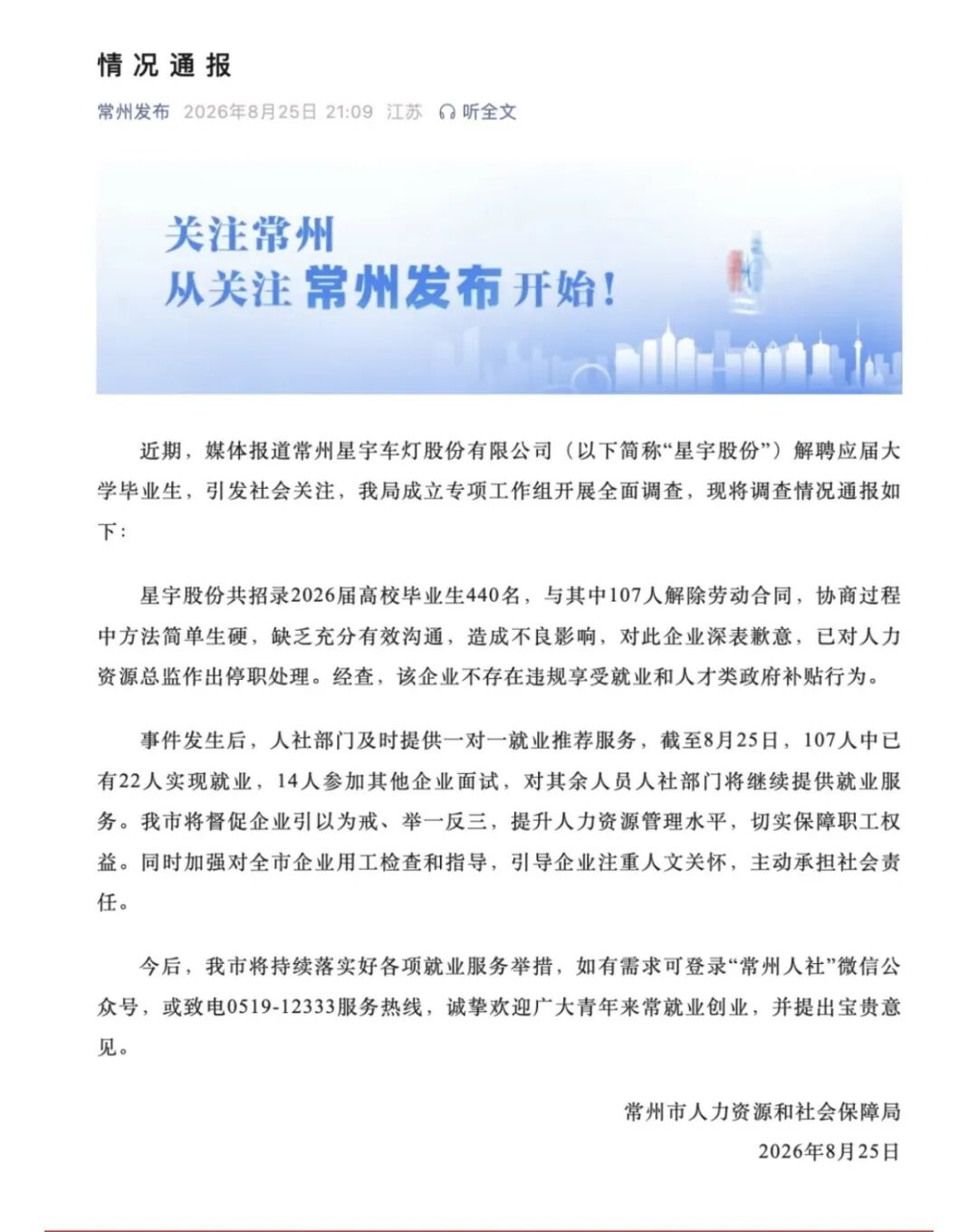
The Changzhou Municipal Human Resources and Social Security Bureau issued a situation report on August 25 to assist enterprises
The company deeply apologizes for the incident and has suspended the Human Resources Director.
As for the public relations response, the performance of the public relations position after the crisis is not important in this incident.
Media outlets have reflected that repeated calls to Xingyu Shares have gone unanswered, with the public relations department seemingly going into hiding.
If I were a spokesperson for STARLUX Airlines, how would I respond to the following question:
Mercedes-Benz has terminated contracts with 107 R&D graduates, with reports suggesting it was due to delays and order cuts in the vehicle headlight project of the main engine plant, is this true?
Our company is currently in the secondary filing period for its Hong Kong IPO, and the market has raised questions about whether we are "beautifying our financial reports by compressing personnel costs." How does your company respond to this allegation?
If overseas clients such as Volkswagen and Mercedes-Benz lower their supplier ratings and suspend new projects, what contingency plans does the company have?
Why is the option of negotiating a settlement accompanied by a plan to transfer to a ordinary post? Is there a situation where pressure is being exerted to force resignation?
For students who have already signed a resignation for personal reasons, are their compensation benefits equally guaranteed?
The company's talent demand forecasting process is as follows: it first assesses business development goals and strategies, then breaks down these goals into specific work tasks and determines the required human resources. However, due to the impact of various uncertain factors, such as changes in market conditions and unexpected project adjustments, the forecasting process often results in significant errors. To avoid this in the future, the company plans to improve its forecasting model by incorporating more accurate and real-time data, as well as enhancing collaboration and communication between different departments to ensure more precise talent demand predictions.
According to the company's official website, there is no "Director" level in the management hierarchy, and when media visited Star Universe employees, they said they were unaware of the position of "Human Resources Director", so who is the Human Resources Director that was removed from office?
Before initiating the mass layoffs, did the company's internal legal, public relations, and ESG departments receive any risk alerts?
Does the company have a head of public relations?
Some problems appear complex but become more confusing the more you try to explain them, while others seem simple on the surface but actually conceal hidden pitfalls.
So it's better not to respond and just issue announcements; perhaps the government doesn't want companies to respond and cause more chaos.
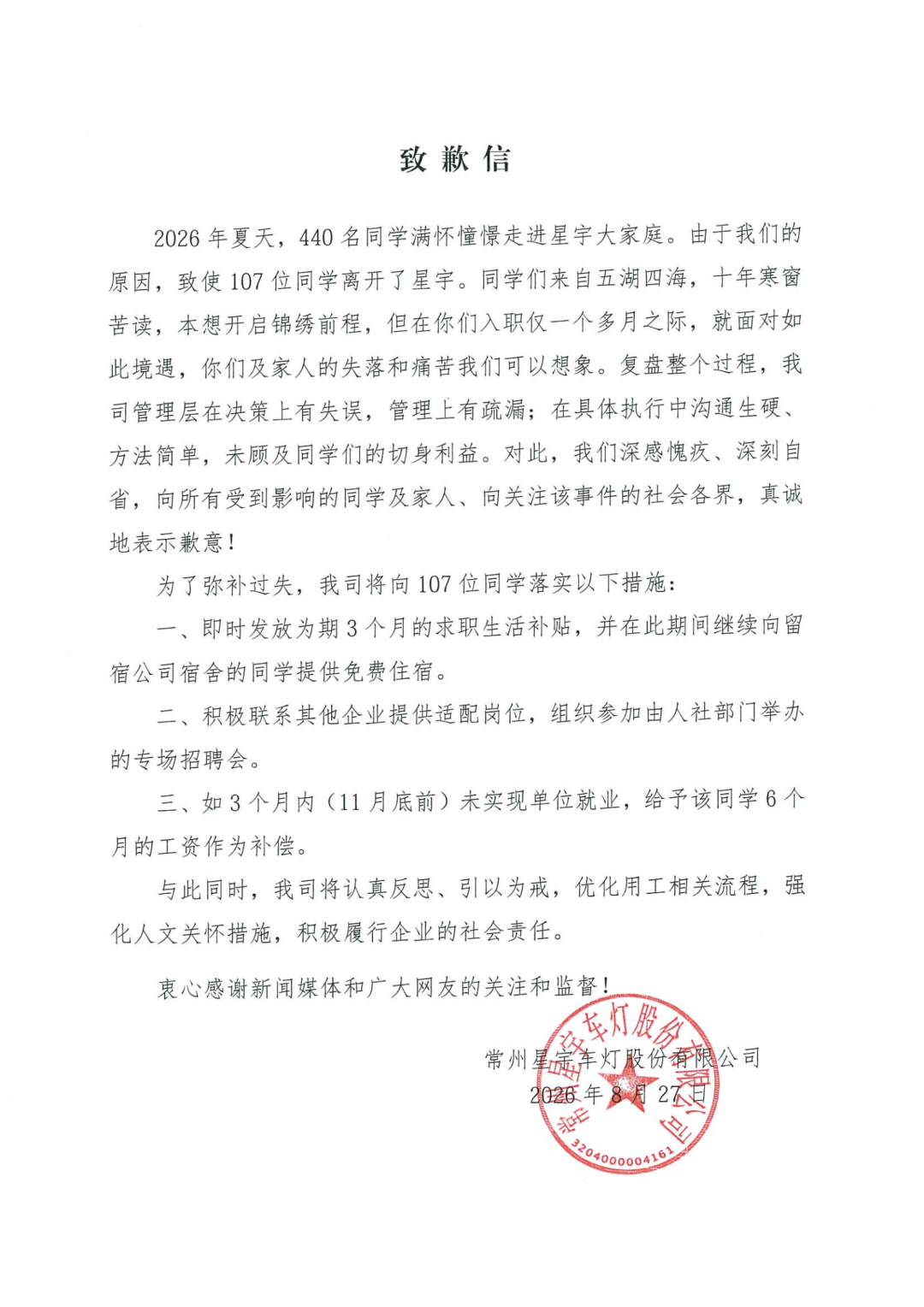
Changzhou Xingyu Automotive Lighting Co., Ltd. issued a statement on August 27, expressing a sincere attitude and clear measures.
Xingyu has passed this hurdle, and the lesson is profound, but for others in the industry, it's just a spectacle that will soon pass.
Last year's Xi Bei incident made all bosses break out in a cold sweat, but they soon consoled themselves, thinking they would never be as extreme as Jia Guolong.
Crises that are obvious to everyone in hindsight, why do they repeatedly occur in different industries with different protagonists?