China's smart driving for cars is entering a somewhat subtle phase.
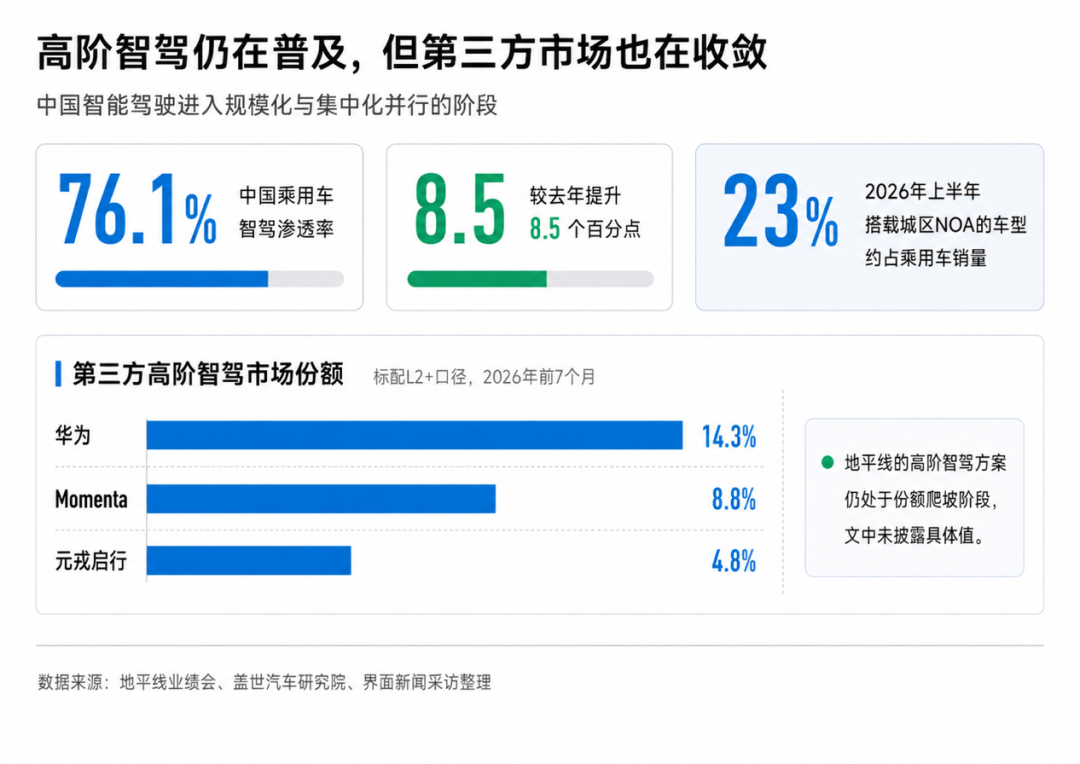
High-end intelligent driving is still rapidly gaining popularity. Horizon disclosed at its latest earnings meeting that the intelligent driving penetration rate of passenger vehicles in China has reached 76.1%, an increase of 8.5% from last year. In the first half of this year, models equipped with urban NOA accounted for about 23% of China's passenger vehicle sales. The large-scale implementation that autonomous driving companies have been waiting for in recent years has become increasingly clear, at least on the vehicle installation side.
However, this business has not become easier as a result, with low-end intelligent driving solutions having large scales but low gross margins, and high-end intelligent driving suppliers themselves undergoing a round of consolidation.
Analysts at Gaishi Automotive Research Institute said in an interview with Interface News that early batches of loss-making intelligent driving algorithm suppliers have gradually withdrawn, and with leading automakers strengthening their self-research capabilities, the number of players in the third-party high-level intelligent driving market has significantly decreased. According to their statistics based on the L2++ configuration, Huawei, Momenta, and Yuanrong Xinghang's market share for the first 7 months of the year were 14.3%, 8.8%, and 4.8%, respectively, while Horizon Robotics' high-level intelligent driving solution is still in the market share growth phase.
Infographic by The Interface News reporter
On August 31, China's leading autonomous driving companies, Momenta and Horizon Robotics, successively released their mid-2026 results. Although they are located in different positions in the intelligent driving industry chain, they have both started to answer the same question: how to further convert the expanding scale of installations into revenue and profit.
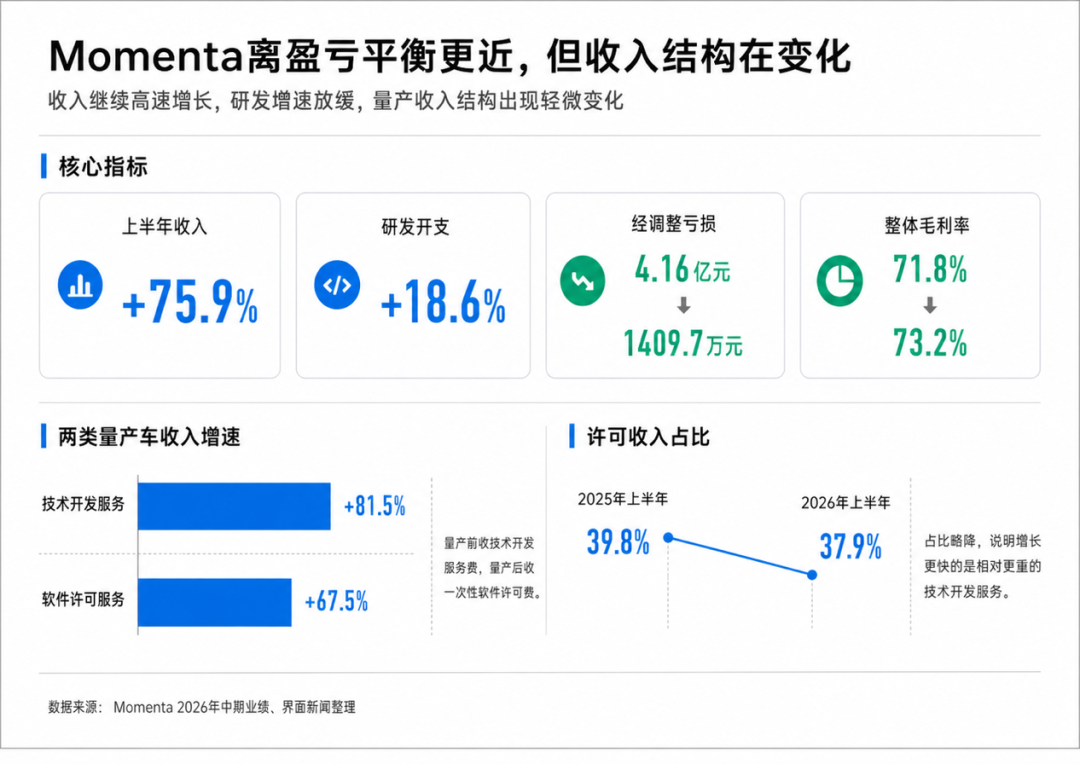
Momenta's first half-year report since its listing has shown some changes. In the first half of the year, the company's revenue was 1.6 billion yuan, up 75.9% year-over-year, with research and development expenses increasing by 18.6%. The adjusted loss narrowed from 416 million yuan in the same period last year to 14.097 million yuan, showing signs of approaching break-even point.
In the first half of the year, Momenta's overall gross margin increased from 71.8% to 73.2%, but the revenue structure that supported the rapid increase in gross margin over the past few years has changed. Momenta's mass-produced vehicle revenue is mainly divided into two parts. Before mass production of vehicle models, the company charges automobile companies a technology development service fee for work such as software and hardware adaptation, testing, and verification; after mass production, it collects a one-time software licensing fee based on actual vehicle installations, which typically has a higher gross margin.
Over the past three years, the proportion of licensing revenue has continued to increase, which has been a key factor in Momenta's rising gross margin. However, in the first half of this year, the growth of technology development services, which has a relatively higher weight, accelerated faster, with revenue increasing by 81.5% year-over-year, outpacing the 67.5% growth of licensing services, and the proportion of licensing revenue decreased from 39.8% to 37.9%.
This improvement in gross margin is more likely to reflect the enhanced delivery efficiency of the technology development projects themselves. Momenta attributes this to the "mainstream platform" that it has repeatedly emphasized over the past few years, where driverless solutions need to be re-adapted for each new project. Momenta hopes to achieve economies of scale through greater engineering standardization.
However, after the scale has expanded, there are two additional accounts to be considered.
First and foremost is the issue of price. Momenta co-founder Sun Huan acknowledged during the earnings call that, due to the price war among domestic car companies, the supply chain cannot remain unaffected, and the average price per vehicle for the system will also be adjusted in the future. He explained that as the installation scale expands and costs decrease, Momenta will share part of the scale benefits with car companies through tiered pricing.
Another issue is where these figures come from. Momenta founder and CEO Cao Xudong repeatedly mentioned the "law of large numbers" during the earnings call. In his view, the automotive market is changing increasingly rapidly, and even car companies themselves find it difficult to accurately predict how many units of a new car will be sold, so Momenta's strategy is to cover as many car companies and models as possible, rather than betting on a few bestsellers.
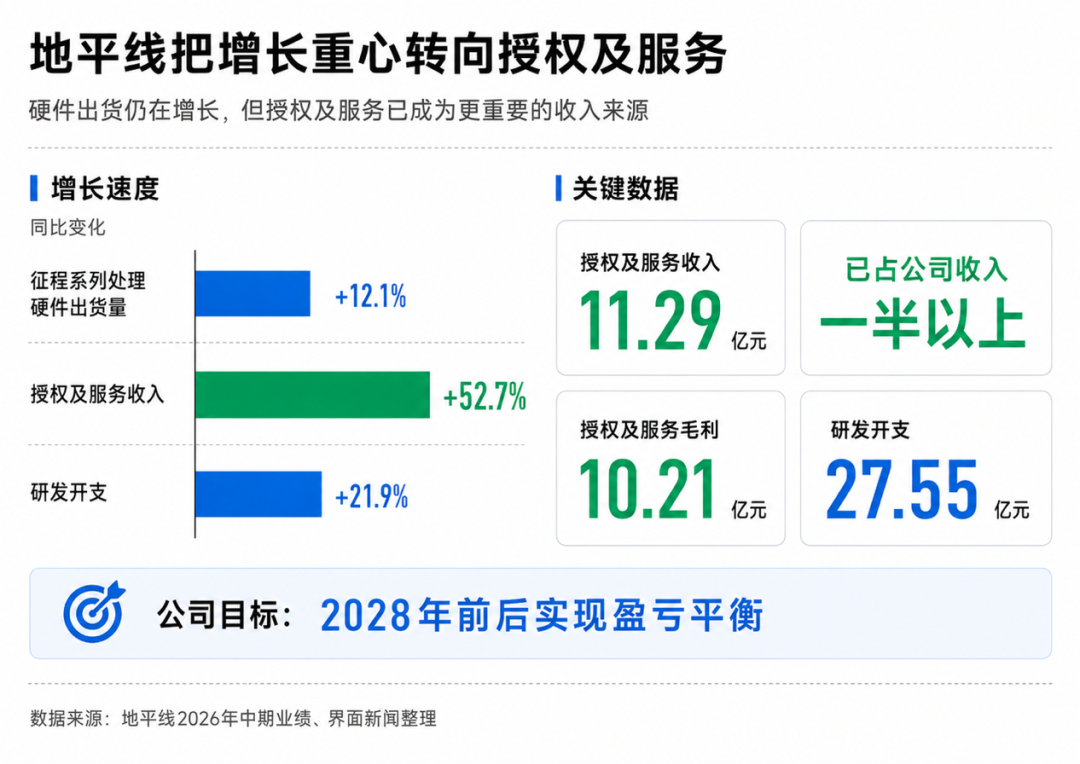
Horizon's situation is different. The company has installed its Journey chips in millions of vehicles, but it has also started to shift its model. Its financial report shows that the shipment of Journey series processing hardware increased by 12.1% year-over-year, while licensing and service revenue grew by 52.7% to 1.129 billion yuan, accounting for more than half of the company's revenue.
This is also the context in which Yu Kai, founder and CEO of Horizon Robotics, has recently been explaining the "ARM+Android" model. In the past, Horizon more often used "Wintel" to describe its business model: generating revenue through the sale of chip hardware while selling Horizon's proprietary NOA solution, HSD.
The "ARM+Android" approach has been taken a step further. As some leading automakers bring chip and algorithm capabilities in-house, Horizon Robotics hopes that even if customers do not directly purchase its complete products, they can still use its BPU architecture, foundation models, software, and toolchains to complete autonomous development on their own.
However, this incremental business is not without cost. The aforementioned analyst believes that what truly needs to be observed is whether the revenue from IP and subsequent upgrade services can offset the loss in chip sales, as well as whether automakers will further replace Horizon's BPU architecture after they master more underlying capabilities. Nevertheless, the proportion of automakers' self-developed intelligent driving chips will not be too high in the short to medium term.
In the first half of the year, Horizon Robotics' licensing and services business achieved a gross profit of 1.021 billion yuan. However, new revenue has yet to change the company's high-investment financial structure: research and development expenses for the same period still reached 2.755 billion yuan, up 21.9% year-over-year.
Yu Kai is not planning to slow down investment because of this. He views intelligent driving as an industry that requires long-term investment and says Horizon will continue to maintain a "high-intensity, saturated" research and development pace. He believes that as the industry develops, only 20% to 30% of the top automakers will be able to persist in self-developing intelligent driving, while most other automakers will ultimately rely more on external suppliers; the company aims to achieve breakeven by around 2028.
Momenta and Horizon Robotics' two distinct business models ultimately converged at the same automaker.
The company is BYD, which is not only China's largest new energy vehicle manufacturer, but also one of the most important incremental markets for high-level intelligent driving to become more popular in the mass market; meanwhile, BYD is also increasingly mastering more intelligent driving capabilities in its own hands.
Momenta has been cooperating with BYD for many years. The two parties once established Dibai Zhihang to develop intelligent driving solutions, and BYD later became a strategic investor in Momenta. Currently, BYD is also one of the most important sources of Momenta's installed capacity growth. According to statistics from the industry media First Electric Network, in July this year, Momenta's urban NOA solution covered 51 models, with the BYD system contributing 52.4% of the installed capacity; from March to July, 75.5% of Momenta's new installed capacity came from BYD.
This presents two sides to Momenta's so-called "law of large numbers". BYD's massive sales volume can quickly push Momenta's software to a larger installation scale, especially as high-end intelligent driving technology is applied to more models priced between 100,000 and 200,000 yuan; however, if one automaker accounts for more than half of the recent installation volume, Momenta's "law of large numbers", which aims to mitigate risk by having a sufficient number of customers and models, has not yet been fully formed.
What's more troublesome is that this major client is increasingly capable of completing tasks that were originally outsourced to suppliers. Over the past two years, BYD has continued to expand its algorithm team and this year released its self-developed intelligent driving chip, XuanYu A3.
Horizon also strongly felt the changes. The two parties' earliest large-scale cooperation first took place at the chip level. In 2024, Journey 6 was designated as a platform supplier by BYD; in February 2025, with the mass production of the "Tiangong Eye C", Horizon publicly stated that it was "one of the two core in-vehicle intelligent computing solution partners of BYD".
Thus, when BYD launched its self-developed automotive-grade 4nm high-computing-power intelligent driving chip, Xuanqi A3, this year, the market naturally questioned how much business would be left for external chip suppliers.
It can be confirmed that after BYD started developing its own chips, it did not stop purchasing external chips and software. The expansion of in-house development by automakers and third-party suppliers is not a simple case of one replacing the other.
"Currently, automakers that develop their own intelligent driving chips are definitely losing money, it's just a matter of how much," said an analyst at Gases Automotive Research Institute in an interview with Jiemian News. The analyst believes that only a few automakers will be able to achieve full-stack self-research in economic terms, and most automakers will likely coexist with self-research, joint development, and external procurement in the long term. Additionally, self-researching automakers like Weilai, can not only reduce the cost of purchasing Nvidia's flagship chips, but also improve the efficiency of software and hardware adaptation and scheduling, and tell a good story to investors through self-research.
However, for Momenta and Horizon Robotics, continuing to expand their share in the auxiliary driving market may still not be the end goal of their business model. What may truly revolutionize their prospects is the advancement of automotive intelligent driving from L2 to L3 and L4.
The charging model for the assisted driving stage is relatively simple. Momenta mainly charges car companies a technology development fee and a per-vehicle software licensing fee. As NOA enters more affordable vehicle models, although the installation scale has expanded, the single-vehicle ASP is inevitably under pressure.
L3 offers an alternative, with Momenta collaborating with automakers to develop L3-level autonomous driving solutions, and the SAIC Audi E7X is set to become the first mass-produced model to feature the technology. Cao Xudong stated that, pending regulatory conditions, L3 models will begin mass production in 2027.
The analysts said L3 is not a simple upgrade from L2++, and the corresponding pricing model may also shift from one-time solution delivery to a combination of "hardware + software licensing + development fees + ongoing services or subscriptions." This is exactly the direction Momenta is beginning to explore. Sun Huan said the company is discussing subscription models for consumer-facing fees with automakers; as the driving experience and liability boundaries further evolve, Momenta hopes its revenue model can also extend from one-time per-vehicle licenses to ongoing subscriptions.
Momenta is also making inroads into L4. As of the first half of the year, the company has been testing or operating autonomous taxi services in six cities across three countries. Its first mass-produced Robotaxi is planned for launch in the fourth quarter of this year, with hundreds of vehicles to be deployed domestically and internationally by year-end, and licenses obtained in over 10 cities. Cao Xudong's timeline is to expand the fleet to thousands of vehicles by 2027, covering more than 30 cities worldwide, and strive to enter the L4 large-scale operational phase by 2028.
He expects the global Robotaxi market size to reach 1 million to 1.5 million vehicles around 2031 and proposes a long-term calculation of $10,000 in gross profit per vehicle per year.
Horizon is also extending its existing technology stack to higher-level autonomous driving, but its role remains more similar to that of a chip and platform supplier.
It is developing the Journey 7 for L3 and L4, with the SoC tape-out expected to be completed in early Q2 2027. Meanwhile, it has licensed its AI foundation model to customers through the "ARM+Android" mode, supporting the development of conditional autonomous driving and high-level autonomous driving systems by car companies. Horizon also plans to launch an L4 Robotaxi pilot project with a leading retail technology and supply chain company this year.
Regulators are also turning this technological path into a clearer set of industry rules.
The aforementioned analyst told Interface News that L3's early-stage redundant hardware, testing compliance, long-term maintenance, and product liability costs are relatively high, and ASP increases do not necessarily lead to synchronized profit growth. Only after achieving platform-based replication of solutions and clarifying responsibility boundaries can L3's high value potentially be converted into higher profits.
Assisted driving is becoming a larger business that requires calculating prices, costs, and customer relationships. L3 and L4 may rearrange the value distribution. For Momenta and Horizon Robotics, scaling is no longer the only issue, but rather how much value they can retain in every increasingly intelligent vehicle in the future.