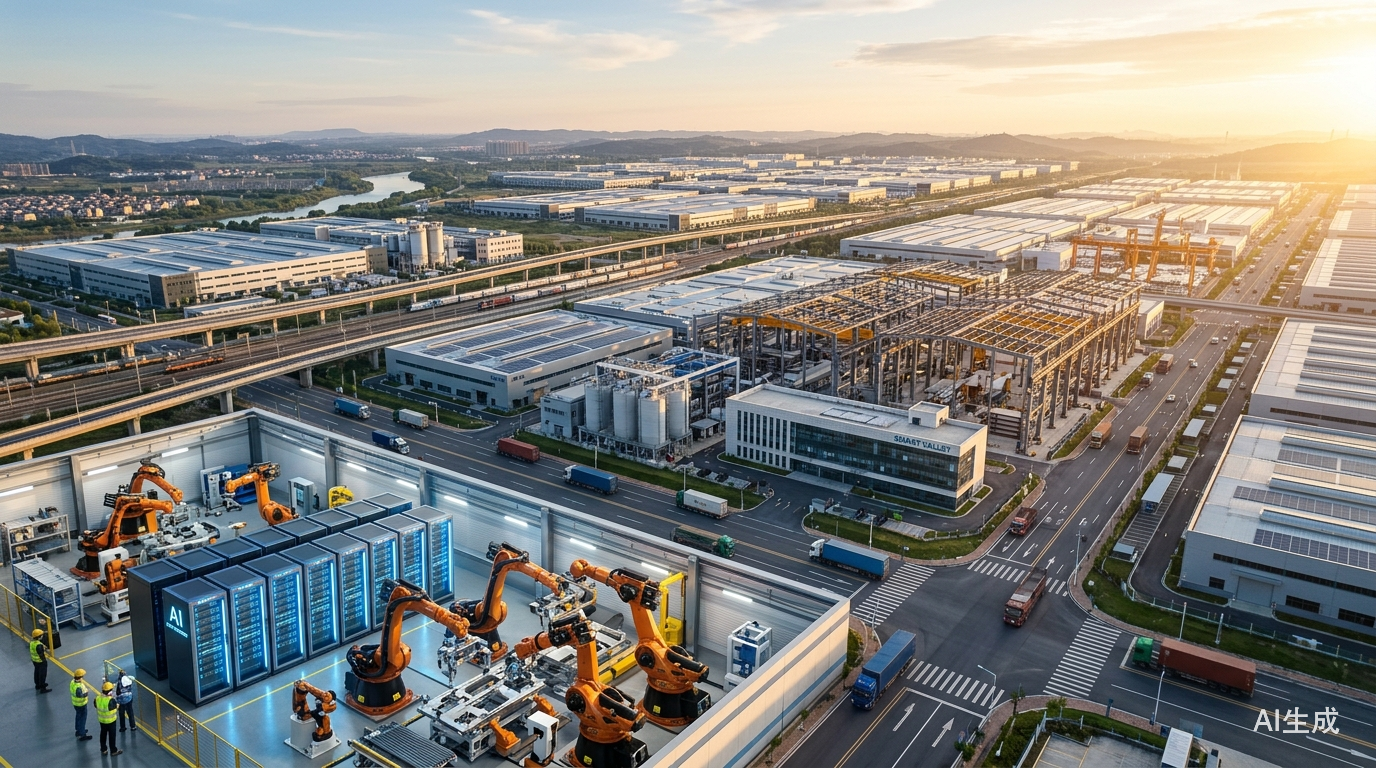
The competitors are fierce, who will cross the finish line first?
Another city has set a timeline for joining the "three-trillion-yuan industrial club."
According to local media reports, Dongguan has officially released the outline of its 15th Five-Year Plan, which sets a target of regional GDP exceeding 1.7 trillion yuan by 2030, with total industrial output value from enterprises above designated size surpassing 3 trillion yuan.
The concept of "industrial 30,000 billion" refers to a city's manufacturing industry reaching a scale of 30,000 billion yuan. As a key indicator for measuring the development level of a city's manufacturing industry, this scale exceeds that of nearly half of the country's provinces, underscoring its significant value.
A review of public reports shows this is not the first time Dongguan has set a "3 trillion" target.
As early as the beginning of 2024, brother city Foshan officially announced that it had become the country's second and Guangdong's first "industrial 3 trillion" prefecture-level city. At the same time, Dongguan's 2024 government work report No. 1 clearly stated that it aims to have an above-scale industrial total output value exceeding 3 trillion yuan by the end of 2027.
In comparison to the two target settings, from striving for the end of 2027 to the latest clear "15th Five-Year Plan" period end, Dongguan's goal of "industrial 300 billion" has been adjusted from a short-term sprint to a longer-term steady achievement, with pressure that is equally not to be underestimated.
Looking across the country, including cities like Wuhan, Changzhou, and Wuxi, there are numerous cities vying to be the next to achieve an "industrial output of 3 trillion yuan". A new round of competition to upgrade industrial capabilities has begun, and the question is whether Dongguan can break through the intense competition and how it will drive the reshaping of the "world factory" value.
Pressure
As two major manufacturing hubs in Guangdong Province, Dongguan and Foshan have long been in close competition, with their industrial strength and economic scale being key areas of comparison. As a result, when Foshan officially announced that it had achieved an "industrial output of 3 trillion yuan", the outside world began to focus on Dongguan's timeline.
More than two years have passed, and Dongguan's efforts to catch up have yielded a phased "answer" - by 2025, Dongguan's above-scale industrial total output value will rank second in Guangdong Province, only after Shenzhen; in the first half of this year, Dongguan's GDP surpassed Foshan by 10.5 billion yuan, marking a historic change in the "third city of Guangdong".
Meanwhile, according to the latest official statement, Dongguan's "industrial 3 trillion" target deadline has been adjusted from the end of 2027 to 2030, a delay of three years. For a major industrial city eager to meet its goals, this is clearly a significant amount of time. What is the issue?
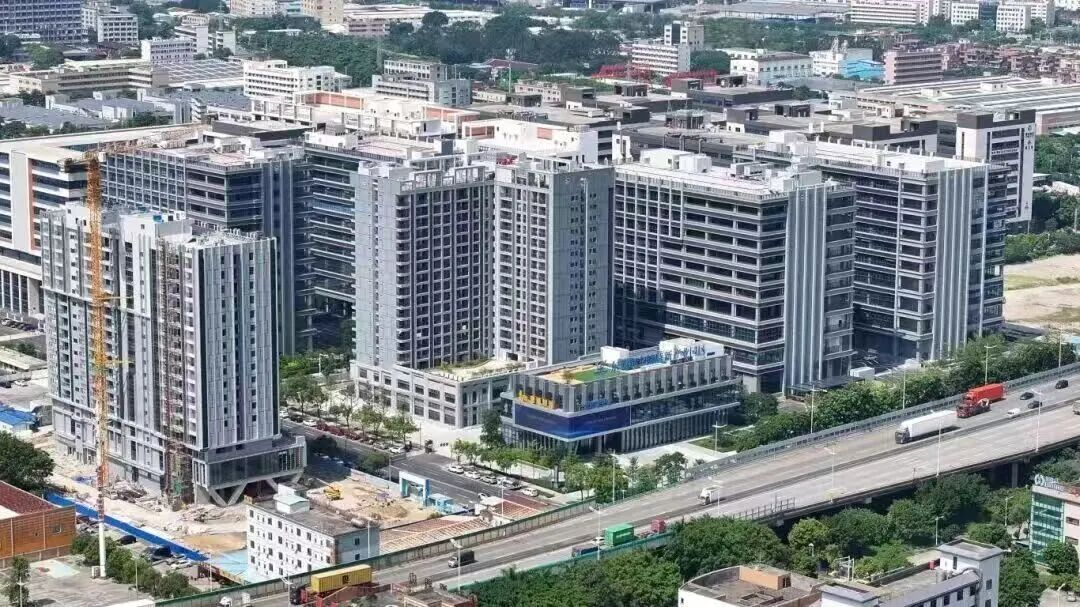
Photo source: Dongguan Release
Let's take a look at Dongguan's "family assets".
Public data shows that in 2025, Dongguan's total industrial output value exceeded 260 billion yuan, with industry contributing over 80% to GDP growth; the number of above-scale industrial enterprises exceeded 14,000, ranking among the highest in the country, meaning that in Dongguan, there is one above-scale enterprise for every 15 industrial enterprises, with a very high density.
During the same period, Dongguan has cultivated over 300 national-level "small giant" enterprises, more than 3,300 provincial-level specialized, refined, special, and new enterprises, and over 6,100 innovative small and medium-sized enterprises, with all three totals ranking first among prefecture-level cities in Guangdong Province. In terms of industrial structure, Dongguan is home to a trillion-yuan electronic information industry cluster, as well as four major hundred-billion-yuan industry clusters in equipment manufacturing, new materials, food and beverages, and textiles and apparel.
However, to go from over 2.6 trillion yuan to exceeding 3 trillion yuan, an incremental scale of over 300 billion yuan, is almost equivalent to creating the industrial volume of a medium-sized city all over again.
Judging from the growth trend of its recent above-scale industrial total output value, it will be extremely difficult to reach 300 billion by 2027.
According to data released in the Dongguan Statistical Yearbook, the total output value of Dongguan's above-scale industries was 2,477.297 billion yuan, 2,460.955 billion yuan, and 2,658.569 billion yuan in 2022, 2023, and 2024, respectively, with an average annual increase of approximately 69 billion yuan.
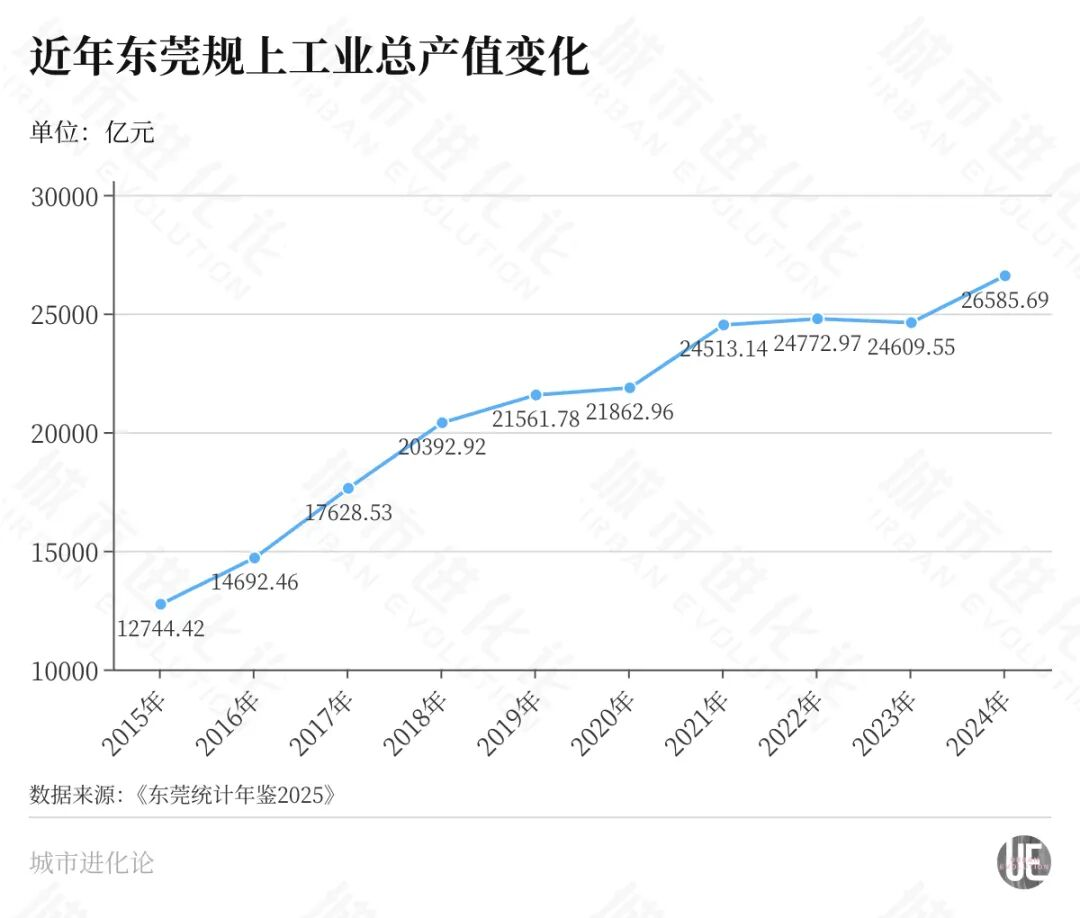
To achieve the target of 3 trillion yuan in the next three years, it means that the annual increment in output value from 2025 to 2027 needs to exceed 1,100 billion yuan, which is a significant gap from the actual increment level.
However, in the view of Lin Jiang, a professor of economics at Lingnan College of Sun Yat-sen University, this adjustment does not mean that Dongguan has lowered its industrial ambitions, but rather has shifted from short-term sprinting to a more pragmatic and higher-quality pace of industrial upgrading, "in fact, reflecting Dongguan's more cautious judgment of the current industrial environment, external market, and its own structural problems".
Lin Jiang analyzed that Dongguan, as a typical outward-facing manufacturing city, had previously relied mainly on global orders, processing and manufacturing, and a complete supporting system to rapidly expand its scale. However, as it enters a new stage, Dongguan's industrial upgrading faces multiple pressures, including the heavy pressure of external demand and the global supply chain, a lack of resilience in its industrial structure, strategic emerging industries still in the initial stage, and increasingly tight labor cost constraints.
Strategic Planning
Beyond the timeline, deeper signs of transformation are worth noting.
Under pressure, what will support the 3 trillion yuan target? The Dongguan "15th Five-Year" planning outline has clarified a specific path, with a focus on 8 strategic emerging industries, 8 traditional industries, and 4 future industries —
bolster the development of next-generation electronic information, high-end equipment manufacturing, new materials, semiconductors and integrated circuits, new energy, biomedicine and high-end medical devices, artificial intelligence, and low-altitude economy;
Optimize the industry and product structures of textiles, apparel, footwear and headwear; food and beverages; furniture; toys, cultural and sports goods; papermaking and paper products; packaging and printing; chemicals; and molds and tooling.
Looking ahead to layout next-generation mobile communications, cutting-edge new materials, embodied intelligence, and future life and health.
Lin Jiang analyzed that the essence of this industrial system deployment is to solve two major core problems: first, to change the relatively single industrial pillar of Dongguan, and second, to build a brand new industrial growth curve.
For instance, it is specifically mentioned that strategic emerging industries should form one trillion-yuan-level, one 500-billion-yuan-level, and three 100-billion-yuan-level industry clusters.
In Lin Jiang's view, this is driven by the consideration of opening up incremental space with strategic emerging industries - the new generation of electronic information will still be the "ballast stone" of Dongguan's trillion-level industry, but at the same time, it will no longer rely solely on traditional electronic manufacturing, instead hoping to cultivate multiple high-growth industrial pillars, with high-end equipment, new materials, semiconductors, new energy, and AI servers all expected to become new growth engines.
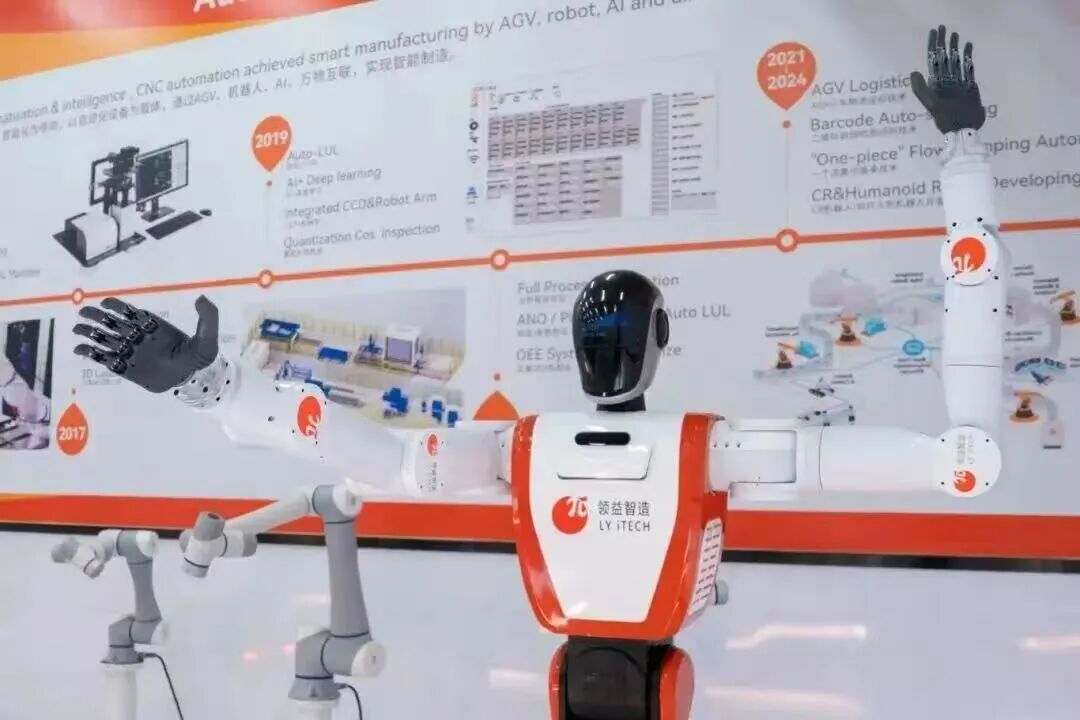
Photo source: Dongguan+
In July this year, Dongguan issued the Implementation Plan for Promoting the High-Quality Development of the AI Server Industry in Dongguan, which clarifies that in the next five years, with investment on a trillion-yuan scale, the city will support the output value of the AI server-related industries (complete machines, components, and related supporting facilities) to exceed 5 trillion yuan by 2030, cultivate 1-2 trillion-yuan-scale enterprises, 3-5 billion-yuan-scale enterprises, and a batch of specialized and innovative supporting enterprises, and build an AI server industry cluster with global competitiveness.
Behind the quest for new large-scale industrial tracks centered on AI computing power hardware, this traditional manufacturing hub has even bigger aspirations - transitioning from "world factory" to "global intelligent manufacturing center".
In May this year, the Overall Plan for Building Dongguan into a Global Intelligent Manufacturing Center (2026-2030) was officially released, and is seen as a blueprint for Dongguan's construction over the next five years. The plan explicitly proposes "recreating the development logic with AI" and will spare no effort in building an intelligent manufacturing center with global influence.
"Recreating the development logic with AI, the core is not just developing the artificial intelligence industry, but using AI to reconstruct the production methods, organizational approaches, and value distribution models of the manufacturing industry." In Lin Jiang's view, this is a key handle for Dongguan to address issues such as thin profits, weak innovation, few brands, and insufficient chain ownership in the manufacturing sector.
Local media commented that this transformation is not just a simple repair and upgrade, but a systemic overhaul - Dongguan is no longer satisfied with being a manufacturing terminal in the global industrial chain, and instead hopes to build an intelligent industrial system that can flexibly schedule and allocate global innovation and manufacturing resources.
From this perspective, the optimization and adjustment of the "industrial 30 trillion" target and its timeline also release a signal that the local area is actively transitioning from a scale- and speed-oriented target to a quality- and capability-oriented target. In Lin Jiang's view, "the key is not just to reach 30 trillion yuan, but to see if this '30 trillion' is backed by more structural optimization, such as advanced manufacturing, high-tech manufacturing, intelligent manufacturing, and high-added-value segments."
Opportunity
Looking across the country, the competition is far more fierce than imagined.
In 2025, Shenzhen's above-scale industrial output value reached 5.44 trillion yuan, maintaining its position as the country's first; Suzhou's above-scale industrial output value reached 4.9 trillion yuan, and it is almost certain to break the 5 trillion yuan mark this year; similarly, in the Yangtze River Delta, Shanghai's above-scale industrial output value reached 4.07 trillion yuan, and is now accelerating its efforts to reach the "5 trillion yuan" mark.
The top tier is almost unshakeable, but the "industrial trillions" has become a pursuit goal for many cities.
For instance, Wuhan officially launched its advanced manufacturing doubling plan in May this year, aiming to achieve an industrial output value of over 3 trillion yuan and an industrial added value of 800 billion yuan by 2030, accounting for around 27% of the city's GDP, and using industrial strength to support the city's GDP in exceeding 3 trillion yuan.
At the beginning of this year, Wuxi issued a document making it clear that by 2030, the city's total output value of above-scale industries will exceed 3.2 trillion yuan, and the number of above-scale industrial enterprises will exceed 10,000. The output value of strategic emerging industries will strive to account for 50% of the above-scale industries, and the future industry scale will exceed 3,000 billion yuan.
In February this year, Changzhou held a city-wide conference to promote the construction of a modern industrial system, with the goal of reaching a total industrial scale of 3 trillion yuan by 2030. The system's support pillars were clearly defined: upgrading new energy to a trillion-yuan landmark industry; doing a good job in strengthening intelligent equipment and new materials, two 500-billion-yuan advantageous industries; cultivating and expanding electronic information, pharmaceuticals and medical devices, and modern light textiles, three 100-billion-yuan growth industries; and making forward-looking layouts for future industries such as artificial intelligence, embodied intelligence, new energy storage, and synthetic biology, to seize the high ground of development.
In Lin Jiang's view, the aforementioned cities are all accelerating their efforts in fields such as new energy, integrated circuits, and artificial intelligence, and the competition to become the next "industrial trillion-yuan" city will be extremely fierce.
So, where are the opportunities in Dongguan?
Lin Jiang analyzed that Dongguan has a complete manufacturing industry ecosystem, which is rare among prefecture-level cities nationwide, and this is the core "moat" of its industry and the source of its competitiveness. At the same time, being located in the heart of the Guangdong-Hong Kong-Macao Greater Bay Area's manufacturing industry, Dongguan can not only undertake technological innovation, capital, and headquarters economy from Shenzhen, but also connect with Guangzhou's industrial and market resources, enjoying a unique geographical advantage.
According to public reports, in the deployment of building a global intelligent manufacturing center in Dongguan, it is explicitly stated that the city will deeply collaborate with Shenzhen, Guangzhou, and other cities in the field of artificial intelligence, carrying out scene co-construction, achievement transformation, and paradigm sharing, and promoting Dongguan's artificial intelligence technology, products, and solutions to "go global".
However, the weaknesses cannot be ignored.
Lin Jiang stated that compared to cities like Wuxi and Changzhou, Dongguan's new emerging industries still need to strengthen their leading and driving force. For example, Wuxi has accumulated deep experience in fields such as integrated circuits, the Internet of Things, and new energy, while Changzhou has formed strong industry labels in areas like new energy vehicles, power batteries, and photovoltaics. In comparison, although Dongguan has a wide range of industries, its strategic emerging industries still require more chain-leading enterprises with national influence and iconic industry clusters.
He particularly noted that as the wave of industrial intelligentization and specialization accelerates, the transformation and differentiation of traditional manufacturing enterprises in Dongguan may further intensify, also known as "K-type growth". For example, in the fields of AI and intelligent manufacturing, some enterprises will leverage technological upgrades to enter higher-value-added segments, while at the same time, some low-end industries and capacities will be phased out.
According to Lin Jiang, for Dongguan to win the next round of industrial competition, the key is no longer simply to increase output value, but to form truly nationally and even globally competitive industrial clusters in new industries, which is also crucial in determining whether it can seize the initiative in the future.
Cover image source: 形象莞 Original content produced by City Evolution. Reproduction or reprinting without authorization is prohibited and will result in legal liability.