People who have been to Japan may have a feeling that:
The place has a mechanical-punk texture to it: the conveyor belt at a kaiten-zushi restaurant can be engineered to run at breakneck speed, and the change machine counts coins with swift, unerring accuracy. That extreme mechanical quality gives everything a sense of exquisite precision.
But when it comes to smart technology, the gap is not just small, it's substantial.
But there is one exception: Japan's acceptance of robots has been remarkably rapid.
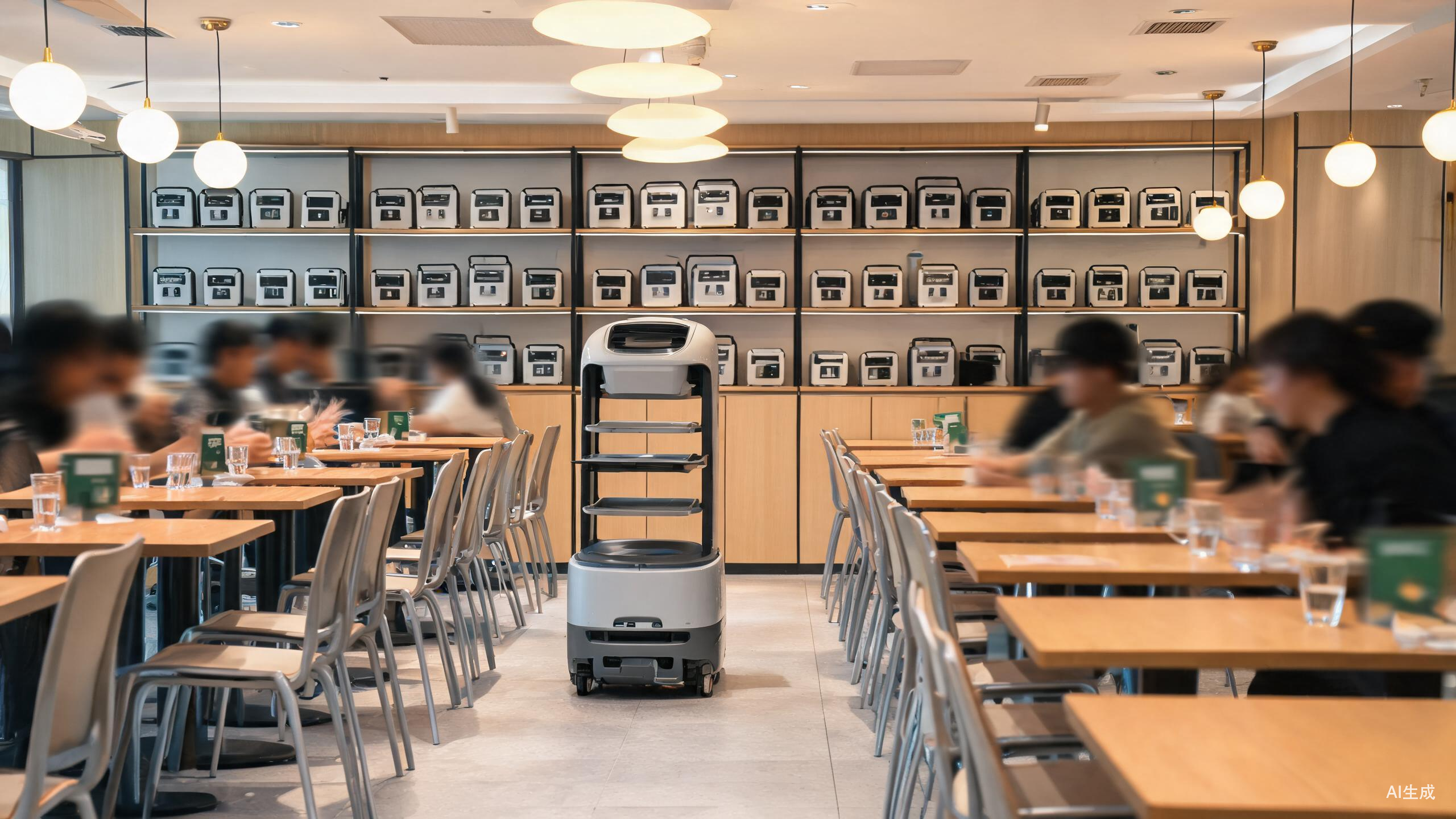
Japan's largest family restaurant chain has been installing robots in its approximately 2,100 stores across the country since 2022, with around 3,000 food serving robots deployed. With the robots, the chain has seen an increase in table turnover rates during peak hours and a reduction in the distance staff need to walk each day, making both owners and employees happy.
And these robots that help them deliver meals and collect dishes come from China.
The distributors who sell these robots are also quite interesting.
Japan's SoftBank, once an avid robotics enthusiast, has developed its own Pepper robot, which was once the face of Japan's robotics industry, and also acquired Boston Dynamics, the legendary US company that inspired a generation of robotics entrepreneurs, including Wang Xing.
It no longer manufactures itself, and has instead become a Japanese distributor for Chinese robots.
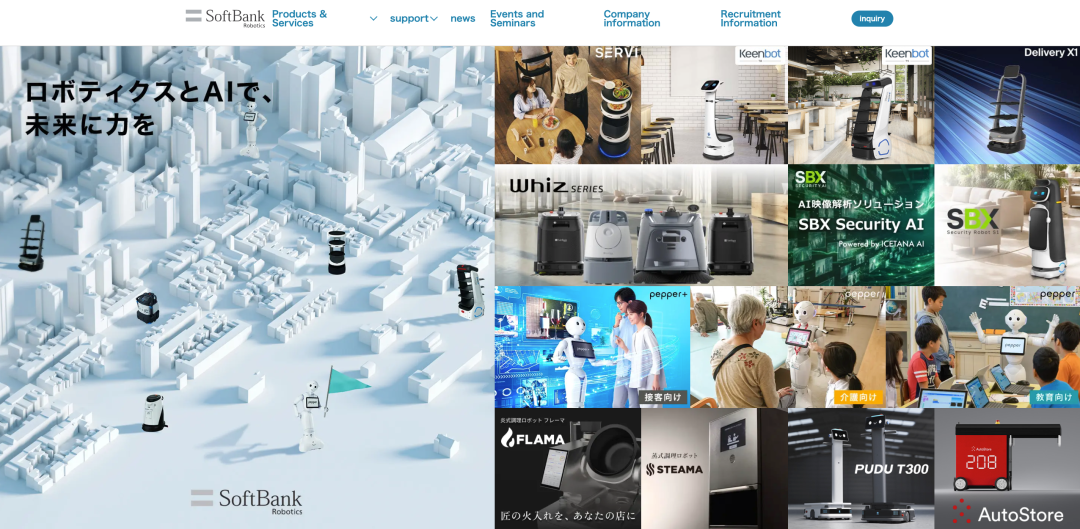
SoftBank Robotics has become the agent for sales in Japan of products from Chinese robot companies, including Pudu and Zhenjin, with other robot products coming from Japan and Norway, among others.
Even the latest humanoid robots are being utilized.
In May 2026, Japan Airlines introduced humanoid robots at Haneda Airport to transport luggage under the belly of large aircraft and load it onto conveyor belts. The humanoid robot industry is currently most concerned about landing application scenarios, with the whole world searching for them, but Japan has placed them in an airport setting where mistakes cannot be made, which is also one of the busiest airports in the world.
Two units have been deployed for this assignment: one stands 1.3 meters tall and comes from Unitree; the other is slightly taller and hails from UBTech. One short, one tall, the pair have clocked in for duty at Haneda Airport as a duo — and by status, they count as two foreign employees.
This is a microcosm of China's manufacturing prowess, which has permeated the daily lives of the Japanese.
Life-Saving Supplies Must be Bought from China
Japan's high frequency of earthquakes is well known. Precisely because tremors are so common, many Japanese households treat earthquake preparedness as a daily routine—water, dried food, and flashlights are all standard household supplies.
In recent years, a new item has been added to the list of essentials. In Japan's disaster prevention community, there's a concept known as "one household, one unit," which refers to each household having a high-capacity outdoor power source to charge mobile phones and emergency lights during power outages. This concept may seem unfamiliar to us, but it's taken seriously in Japan. Outdoor power sources are ranked at the top of the recommended list of disaster supplies, and on e-commerce websites like Amazon, the same brands - Anker, Jackery, and Zhenghao - consistently occupy the top spots, either being Chinese brands or registered in the US but manufactured in China.
At the end of July, a magnitude-7 earthquake struck Kumamoto, a place known for its mascot Kumamon. Fortunately, there were not many casualties, but many roads and bridges were destroyed, and approximately 40,000 households lost power. With continuous aftershocks, evacuation shelters were crowded, and mobile phones were the only means of contacting the outside world, but the battery was draining rapidly, and people were lining up to charge their devices.
It's only at times like these that you seriously consider a question: how much is a reliable high-capacity charging device really worth.
Less than an hour after the earthquake, companies began issuing statements of support. Over the next few weeks, various enterprises and groups sent thousands of portable power sources, hundreds of solar panels, generators, and car refrigerators to the disaster area. Upon closer inspection, the brands were largely the same few companies. In Yatsushiro City, for example, after the earthquake caused continuous water outages, someone used a portable power source to connect to a well pump, and the water supply was restored.
This is not the first time either. At the beginning of 2024, after the earthquake in the Noto Peninsula, Chinese manufacturers sent several hundred power sources to the disaster area. A local small business owner who borrowed a power source said something more accurate than an advertisement: "Water and food can be taken back home from shelters, but electricity couldn't before, now it can."
Later, several power companies, including Anker and EcoFlow, signed agreements with Japan's largest telecommunications groups to ensure emergency power supply in the event of a disaster.
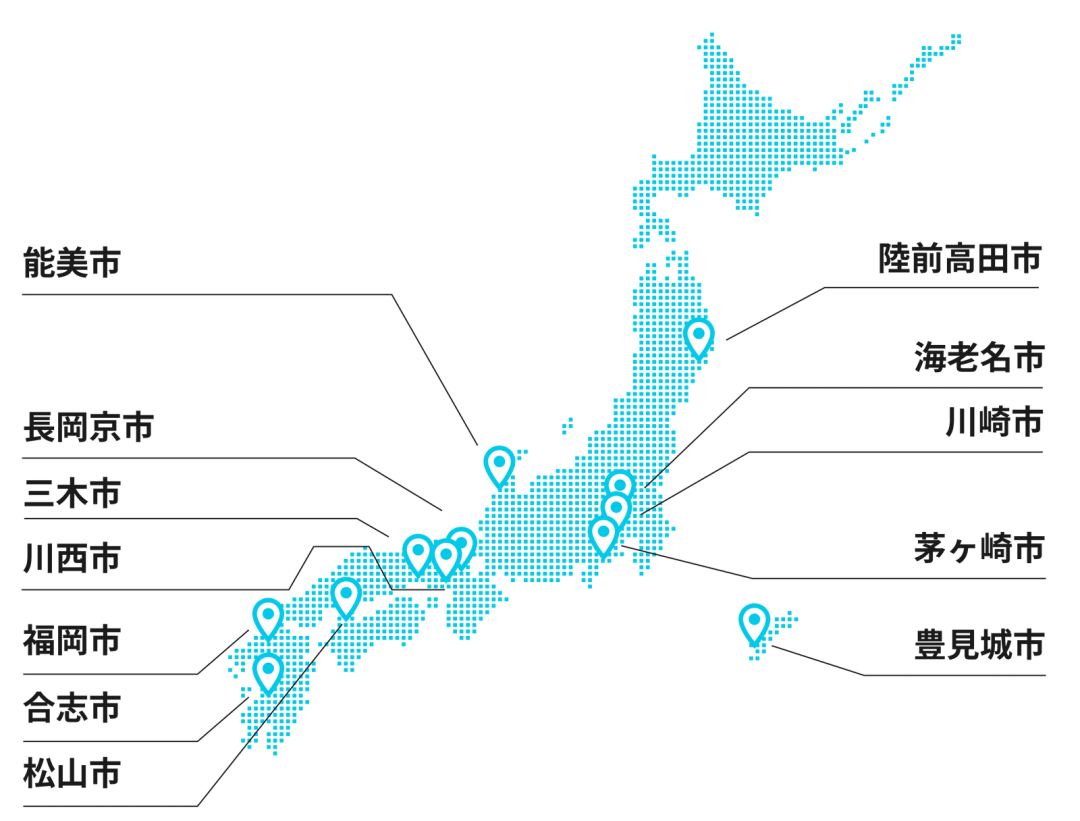
Image: Anker Innovations Japan's disaster-prevention cooperation and material-support network across Japan
Chinese brands have entered Japan's disaster emergency power supply system.
Being relied upon at the most critical moment is the most tangible recognition a product can earn.
And they are embedded in Japanese society to a degree deeper than many people imagine.
Nubia's Hardware Empire Loses Face
When it comes to Japanese manufacturing, the first word that probably comes to mind for many older Chinese people is "high quality".
This is true, if you still have a Sony TV or Panasonic washing machine from twenty years ago, it's likely still working. Back then, names like Sony, Panasonic, Toshiba, Sharp, and Hitachi were the epitome of consumer electronics. Sony invented the portable CD player, Nintendo and Sony dominated the gaming console market, cameras were the domain of Canon and Nikon, and Toyota and Honda swept the global automobile market.
But now the situation is changing piece by piece.
The throne for TVs has been lost, and the throne for white goods has also been lost, with Midea acquiring Toshiba's home appliance business and Haier acquiring Sanyo's white goods. The same is true for automobiles, as in 2023, China surpassed Japan to become the world's largest automotive exporter.
In terms of robotics, Japan was once the most advanced, they had Gundam (not really), they have a world-renowned representative work: ASIMO.
Honda officially unveiled the robot in 2000, at which time it could walk, climb stairs, jog, carry a tray to serve drinks, and even stand on a podium to conduct an entire symphony orchestra. The whole world had seen ASIMO bow, and at that time, it was probably the most well-known robot on earth, enjoying unparalleled fame.
But ASIMO never left the showroom. In twenty years, it never did a day of work. It never swept a floor, never moved a box, never held a job in any factory or hospital.
Now that it has retired, it debuted at its peak and retired as a legend, with zero attendance in between, a standard idol model.
Ironically, in the years since ASIMO stepped down, Japan's demand for robots has reached an all-time high. Japan's Ministry of Health, Labour and Welfare has done the math: by 2040, Japan will need 2.72 million nursing care workers, with a shortfall of 570,000, equivalent to one in five positions being unfilled. Construction sites and airport ground crews are all struggling to find staff.
Their enthusiasm for robots also stems from this, but they are unable to produce general-purpose robots that can assist with everything like humans, and they are watching as the gap between them widens.
RoboCup, the robot football World Cup, was initiated by Japanese scholars in 1997, with a romantic intention: to advance the entire field, with the goal of creating a robot team that can win the human World Cup championship by 2050. At that time, Japan was at the forefront of robotics, making it reasonable for the Japanese to initiate such a competition.
Nearly three decades later, the reversal of fortunes has become starkly visible on this stage. At the 2026 humanoid robot competition in Incheon, South Korea, 38 of the 49 participating teams used machines from the same Chinese company — a share of 78%.
Nikkei reported "地殻変動" in four characters.
As the founding country, Japan managed to field only one team. Hiroyuki Okada, chairman of the Japanese committee, offered a frank explanation: the cheapest commercially available humanoid robots with decent value for money cost around 2 million yen each. Fielding five robots would cost over 10 million yen, and with shipping and travel expenses, a single competition appearance would run to more than 20 million yen—roughly 1 million RMB. Japanese university research labs simply can't afford that.
A competition it initiated has become a stage for other companies' robots.
You've likely seen clips of the humanoid robot games held in Beijing recently. The human Olympics chase faster, higher, stronger — but this competition, only in its second edition, is already beating humans at all three, one event at a time. The sprints were so quick the runners blurred into afterimages. This year drew teams from 16 countries and more than 2,000 robots — though most of them, of course, were made in China.
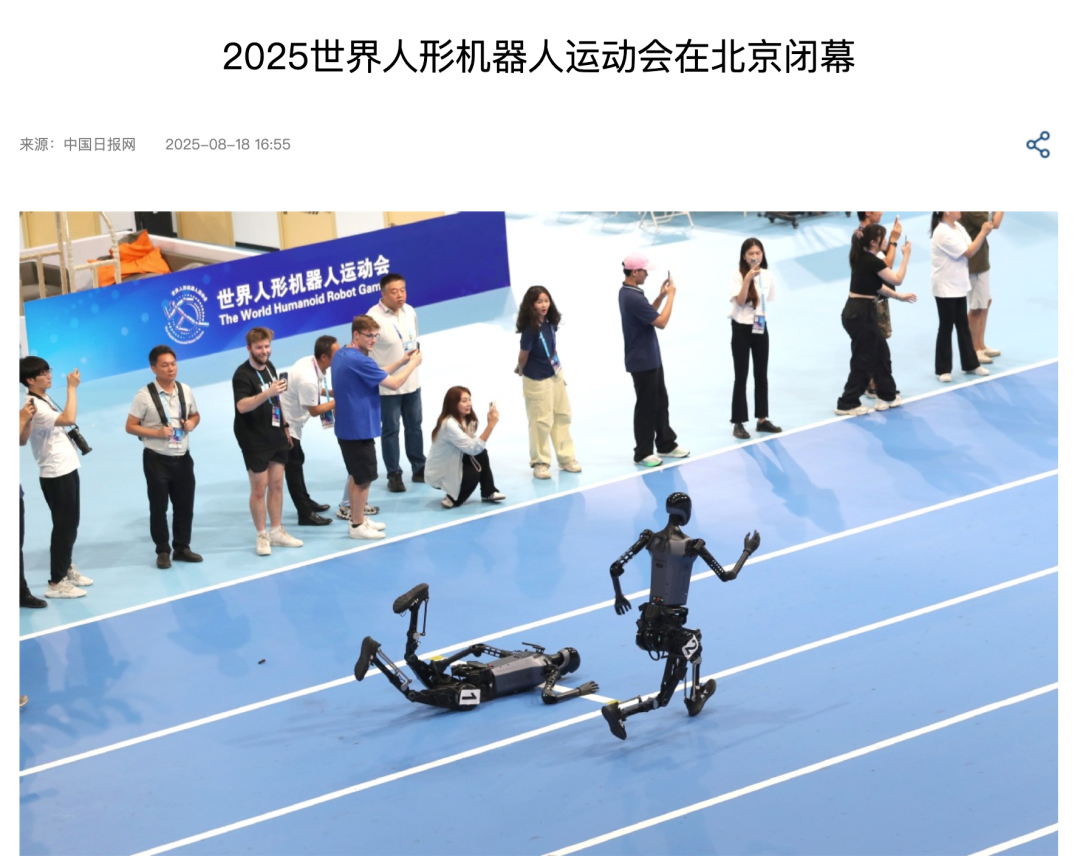
Japan has also arrived, with a team and a robot.
This robot, called "Xiao Tong", has a small following online in Japan, where it is affectionately known as "Tong-chan". Its body was made by Yu Shu Technology, while a Japanese team was responsible for the control software, making it a naturalized player in a strict sense.
The results are no longer a concern: 10th place in the 400-meter preliminary round, barely advancing, and then falling in the semifinals; the 1500-meter race was completed, ranking 7th out of 35, with an emphasis on participation.
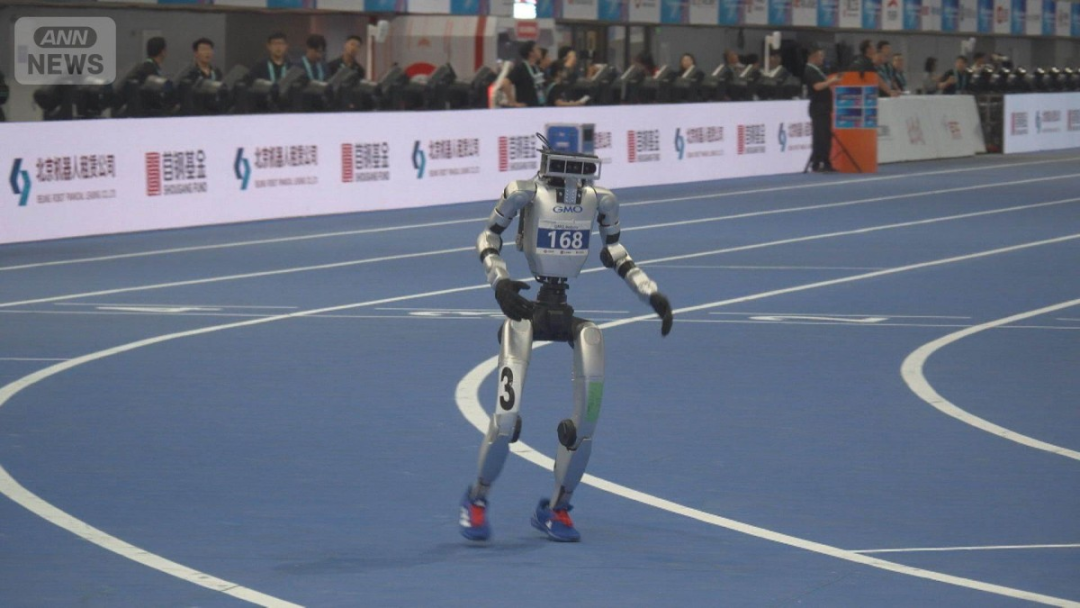
Picture: Japan's sole competing robot
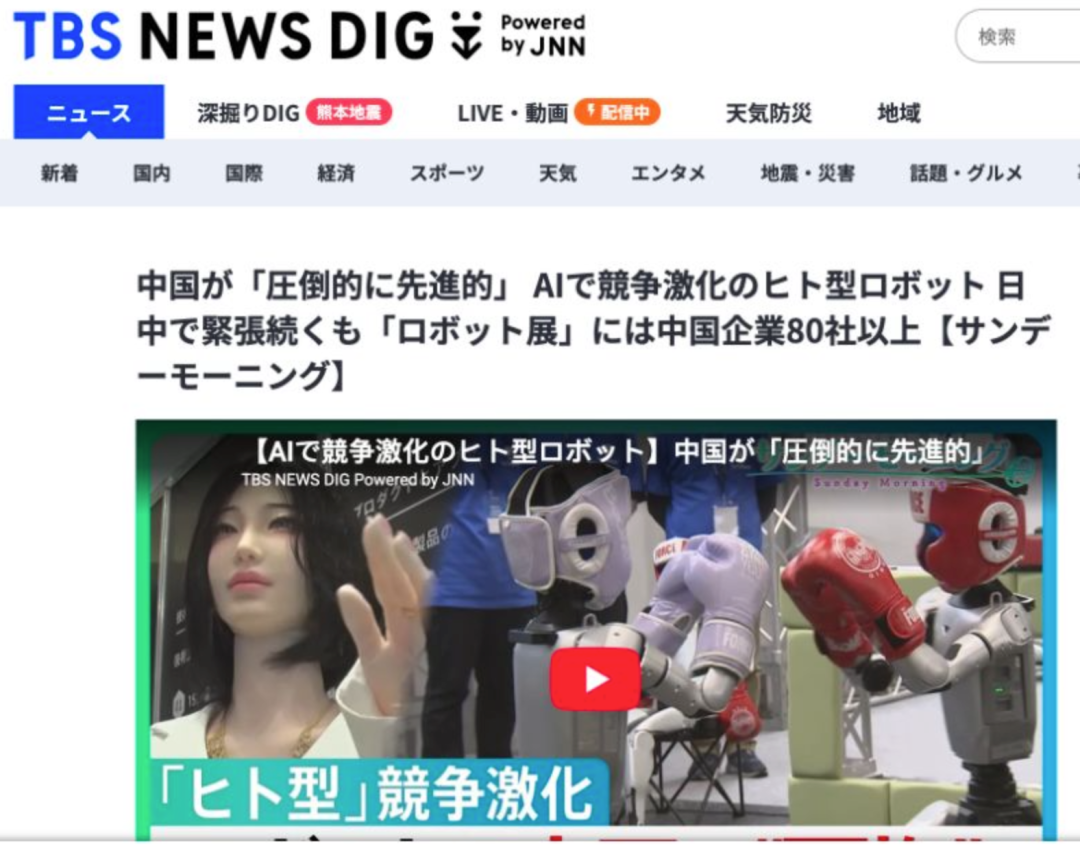
Only one robot showed up, but the Japanese media almost fully mobilized, with TBS, TV Asahi, Tokyo TV, NHK, and Fuji TV all training their cameras on the Chinese robots one by one on the competition field. Takushoku University's Professor Tomosuke Tominaga appeared on a TV Asahi program, commenting as he watched, "In a word, China has already taken a significant lead." TBS, meanwhile, reported a striking figure: in the first half of 2026, global shipments of humanoid robots totaled approximately 19,000 units, with Chinese manufacturers accounting for 97%.
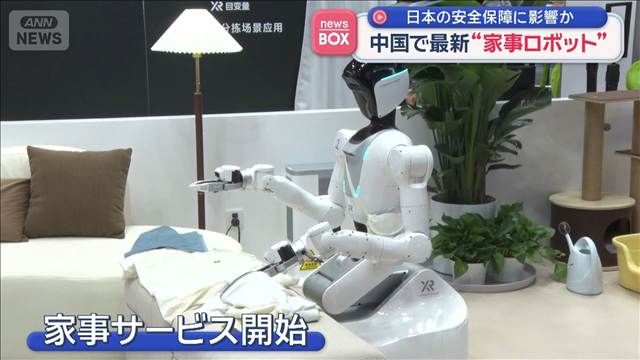
Image: TV Asahi report
The camera is not just focused on the arena. NHK aired a program in July 2026 titled "日本の工場に中国製ロボットが" (Chinese-made robots appear in Japanese factories), which was filmed in Aichi Prefecture, the headquarters of Toyota and the heart of Japan's manufacturing industry, creating a strong sense of contrast.
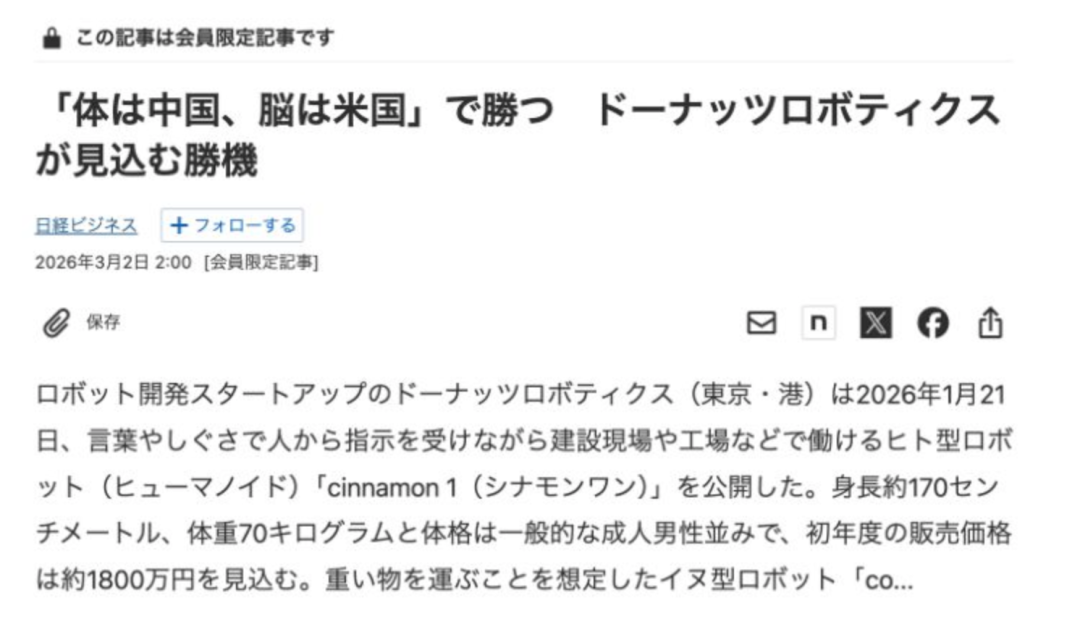
Figure: Take a look at the title and see for yourself
What does China rely on?
Professor Toshiaki Tanaka of Rikkyo University in Japan has a judgment that I think is the most accurate at present: China's humanoid robots did not emerge out of thin air as a new industry, but rather are the result of the convergence of three supply chains. The first is the accumulation of motor and flight control technology from over a decade of development in the unmanned aerial vehicle (UAV) industry. The second is the mass production capabilities and battery supply chain that have been developed by the electric vehicle industry. The third is the sensor and system integration technology that has been refined over twenty years in the smartphone industry. Almost every core component required for humanoid robots can be found in these three supply chains.
Such a supply chain cannot be replicated out of thin air, not even by Japan or any other country.
The Whole of Japan Now Understands
Japan has fallen behind in this regard—and what's striking is that they've watched it happen, step by step, without intervening.
This is a mindset that Chinese people are not very familiar with. Over the past few decades, in most fields, we have been the ones playing catch-up, used to keeping an eye on the people in front of us and gradually narrowing the gap. For someone who was once almost always in the lead, watching others catch up and surpass them, and being unable to muster the strength to keep up, is a feeling that we rarely have the opportunity to experience.
Today's Japanese are fortunate to have experienced both of these mindsets within a single lifetime.
Forty years ago, it was Americans sitting in front of their TVs listening to experts say "we have to rely on that country's technology"; the country that was watched as it surpassed the US in many aspects back then was Japan.
And over the past two years, the reaction from Japan's industrial sector has been as follows.
Yaskawa Electric, one of the world's four major industrial robot giants and a flagship of Japan's industrial robotics, saw its CEO, Hiroshi Kawaguchi, say in an interview with Nikkei that "it is a fact that China's homegrown robot companies are rising, and more and more customers are starting to adopt Chinese-made products."
Nikkei used the word "タジタジ" to describe Fanuc's situation, meaning being at a loss and on the back foot. This is particularly notable given that the company in question is a leading manufacturer of industrial robots, a field in which Japan truly excels.
4 trillion yen, equivalent to approximately 20 billion yuan, is the amount Japan's Ministry of Economy, Trade and Industry plans to invest through 2040, with the goal of capturing 30% of the global humanoid robot market. Recall the figure recently reported by TBS: in the first half of 2026, China accounted for 97%. By setting a target 14 years in the future, the implication is that Japan's current market share is almost zero.
On Japanese social media, someone said: "More than 20 years ago, ASIMO could already walk and greet people, while China was still making toys. Now the situation has reversed." The tone is somewhat resentful, but mostly resigned.
You see, they unveiled ASIMO back in 2000, but it wasn't until 2026 that they brought out this 400 billion, as the saying goes, "got up early, but arrived late at the market".
TVs, washing machines, air conditioners, cars, industrial robots, and humanoid robots - at every link in this chain, Japan once held a stable position. Each time China took it away, there were people in Japan who said "the next one is impossible". Now that it's come to humanoid robots, no one is saying that anymore.
The hardware business has never run on sentiment. Whoever has the deeper supply chain, the lower costs, and the greater scale gets the throne. Japan held it for decades — now it's time for a change.