The mid-year report disclosure window has come to a close, and under the current environment of power supply shortages, domestic AI chips have finally entered their best period of revenue growth. Multiple manufacturers have achieved year-over-year growth of more than double or even several times, and from the first quarter to the second quarter, this growth has also accelerated.
This corresponds to the rapid growth of domestic computing power construction. According to the Ministry of Industry and Information Technology, as of the first half of the year, China's intelligent computing power scale reached 2185 EFLOPS (FP16), a year-on-year increase of 177%, and according to previously disclosed data, the national intelligent computing power scale increased by approximately 303 EFLOPS in the second quarter alone.
Such good days will continue for the industry, determined by the contradiction between supply and demand. The US is still restricting Chinese model vendors from obtaining NVIDIA's most advanced AI chips, and even plans to extend control from "controlling physical goods" to "controlling the right to use computing power". Meanwhile, the production capacity of domestic chips is still ramping up, and adaptation and maintenance with model and cloud vendors also require further refinement. According to data from the China Academy of Information and Communications Technology, the growth rate of China's AI computing power demand is roughly three times the growth rate of supply.
Cloud service providers and model providers are rushing to secure funding. In the face of a shortage of AI chips, what's happening even faster than fundraising is the rapid spending of money. Alibaba and Tencent spent over 120 billion yuan in the most recent quarter, while DeepSeek has invested over 10 billion yuan in AI computing power this year. Liang Wenfeng believes that domestic AI chips are facing a historic opportunity, as the previous weakness in the CUDA ecosystem can be solved through AI coding, and the core bottleneck over the next two years will still be production capacity. Wu Yongming, on the other hand, thinks that the shortage will last at least until 2030.
If demand and production capacity continue to grow at the current pace, leading AI chip companies are expected to cross the break-even point around 2027. Cambrian, which had been posting significant losses, turned a profit last year and has set a revenue target of 47.6 billion yuan to 59.5 billion yuan in its equity incentive plan for 2028. Companies expected by the market to be the "next Cambrian", including Montage Technology, Sino IC and Moore Thread, have all released guidance indicating they will turn a profit as early as the end of 2026 or the beginning of 2027.
For chip companies, however, profitability may not be the metric most worth watching. Profits can grow alongside revenue recognition, but cash must actually return to the company's books. Judging from the half-year reports, domestic AI chip companies generally face capital being tied up at both ends: upstream suppliers require cash upfront to secure capacity, while downstream customers' payments have yet to fully flow back. The funding gap in between is absorbed by the chip companies themselves.
Muxi's figure was -13 billion yuan, while Moore Threads was approximately -21 billion yuan, with both experiencing a significant expansion in net outflows. Although Huawei did not disclose details about Ascend, the company's overall operating cash flow turned from a net inflow of 311.8 billion yuan in the same period last year to a net outflow of 398.9 billion yuan in the first half of this year. Meanwhile, inventory reached 2775 billion yuan, up 45% from the end of last year.
This means that the real competition among domestic AI chips will quietly intensify during a boom that could last for years. On one hand, being the first to enter the application ecosystems of top-tier customers, building customer stickiness, and even forming a closed loop of collaborative optimization is especially critical. On the other hand, over the long term, the contest will still hinge on supply chain capabilities—particularly as networking and memory become key bottlenecks in AI infrastructure, with related vendors vying with logic chip makers for the right to define next-generation AI computing infrastructure.
In this sense, China's domestic AI chip manufacturers will gradually see differentiation in their camps and rankings.
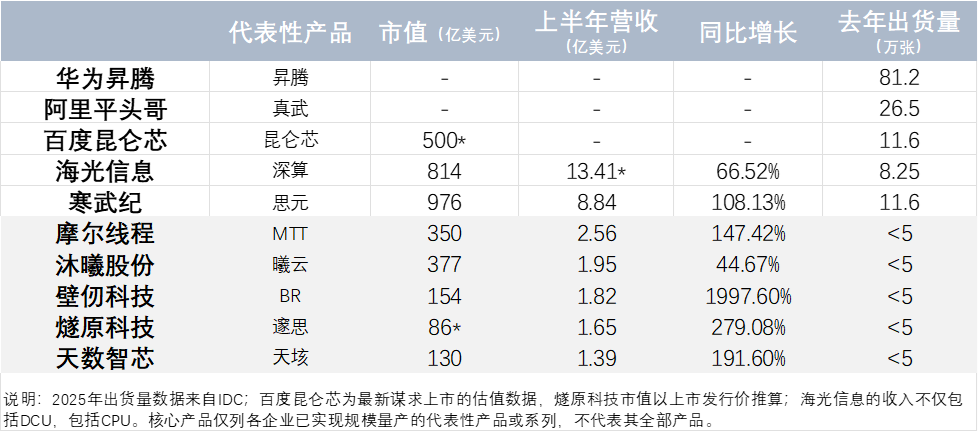
If comprehensive shipments and commercialization stages are considered, China's domestic AI chips can be roughly divided into three major camps as of 2026.
The first tier consists of Huawei Ascend, Alibaba's Pingtouge, Baidu's Kunlun Chip, as well as Cambricon and Hygon Information, which have already achieved large-scale shipments. They reached a shipment threshold of 100,000 cards last year, and except for Huawei and Alibaba's chips lacking a publicly available valuation, the market value of the other three companies exceeds $50 billion.
The second tier includes Moore Thread, Maxscend Microelectronics, Bitmain Technologies, Tsingtech Micro and Primarius Technologies, most of which had shipment volumes of less than 50,000 units last year. They have all gone public in the past year, providing ample emotional value for their stocks, but their market capitalization is generally below $50 billion.
The third camp consists of companies like Xiwang and Dongfang Chixun, which are unicorns with valuations of over $1 billion in the primary market but have yet to achieve large-scale shipments. They are more likely to choose a differentiated route with targeted optimization for inference workloads, attempting to avoid direct competition with the first two major camps.
Alibaba's Pingtouge will be the biggest variable in the future. As the country's largest cloud giant and the model vendor with the most extensive open-source model coverage and the most downloads, Alibaba naturally forms a full-stack synergy with its self-researched AI chips. Previously, there were rumors in the market about Pingtouge's potential spin-off and listing, but there has been no update since then. Nevertheless, during the latest earnings conference call, Alibaba's executives intentionally "highlighted" Pingtouge's business, which was previously rarely mentioned, and some statements were quite "open", sparking considerable speculation in the market:
Thanks to this generation of chips, we are one of only two companies in the Chinese market that can massively deploy super nodes, and possibly the only one in China with large-scale training and inference commercialization capabilities.
The next-generation chip will start to be taped out and produced in the second half of the year, and will have extremely strong computing power and extremely strong interconnect bandwidth, which we believe can completely replace large-scale model training.
I don't think that a so-called government-led computing power supply can produce a highly competitive chip...
The only two, the market easily associates with Huawei's Ascend 950 series. Last week, China Mobile announced the winning bid for the expansion project of the Hohhot Intelligent Computing Center, purchasing 3,840 cards and 480 sets of AI super node devices based on the Huawei Ascend CANN ecosystem, with a total bid price of approximately 1.296 billion yuan; in April, China Mobile had already completed the first-phase procurement of 6,208 cards and 776 sets of the same type of equipment, with a total price of approximately 2.06 billion yuan. Reuters previously stated that Huawei plans to ship around 750,000 950PR chips in 2026.
Huawei still has the largest domestic AI computing power capacity and is "tied" to telecom operators, local intelligent computing centers, and AI native model manufacturers, making it an unshakeable member of the first camp in the foreseeable future. Moreover, according to the Ascend 950 NPU Architecture White Paper, its Ascend 950DT is also specifically designed for the full lifecycle of large models, covering pre-training, post-training, and inference (including Decode and Prefill) throughout the entire process, making it particularly suitable for the training and inference tasks of generative large models. It is expected to enter the shipping phase in the second half of the year, slightly ahead of Pingheduo's next-generation chip. Whether it can handle large-scale training tasks has always been one of the core indicators that determines the strategic value of a chip.
The affiliation of a chip is not necessarily determined by its own identity, but by the entity it is tied to. In the current top camp, Baidu Cloud, which backs Baidu Kunlun Chip, is still not comparable in scale to Alibaba and other telecom operators. Its Wenxin large model also lacks market appeal. From the perspective of cloud or model vendors, however, the ecological position of Cambricon is undergoing changes, with frequent market rumors about its cooperation with ByteDance; nonetheless, ByteDance is also developing its own chips.
The most challenging but also the most resilient is probably Suoyi Yuan. Currently, its financial performance is not outstanding, even among second-tier companies. However, it is essentially a "direct lineage" AI chip in the Tencent ecosystem, as Tencent is not only its largest shareholder with over 20% of its shares, but also its largest customer, accounting for over 80% of its revenue. If Tencent's Hy model continues to catch up, and its B-end intelligent platform WorkBuddy and C-end intelligent platform WeChat Mini Program continue to gain market share, Suoyi Yuan, which is deeply tied to Tencent, may also gain a more advantageous position.
However, the third camp should not be underestimated. Demand for inference is becoming more refined, shifting from "having enough to eat" to "eating well," and new opportunities are emerging. At this year's WAIC, Qiming Venture Partners' managing partner, Zhou Zhifeng, pointed out that centered on inference demand, combining memory, interconnect, and AI-driven EDA and automated compilation, new technical routes and chip architectures are rapidly emerging in China. A batch of AI chip companies, founded just one or two years ago, have already achieved valuations of over 10 billion yuan.
So, what is likely to happen in 2027 is not that the domestic AI chip industry will suddenly start to reshuffle, but rather that the prosperity will begin to have a filtering effect. Demand is still growing, and production capacity is still in short supply, but as profit expectations gradually spread from a few leading manufacturers to more companies, the intrinsic value of each AI chip company will quietly diverge. Ultimately, it will be when the industry's growth rate starts to slow down that the survival of the fittest will truly come into play.