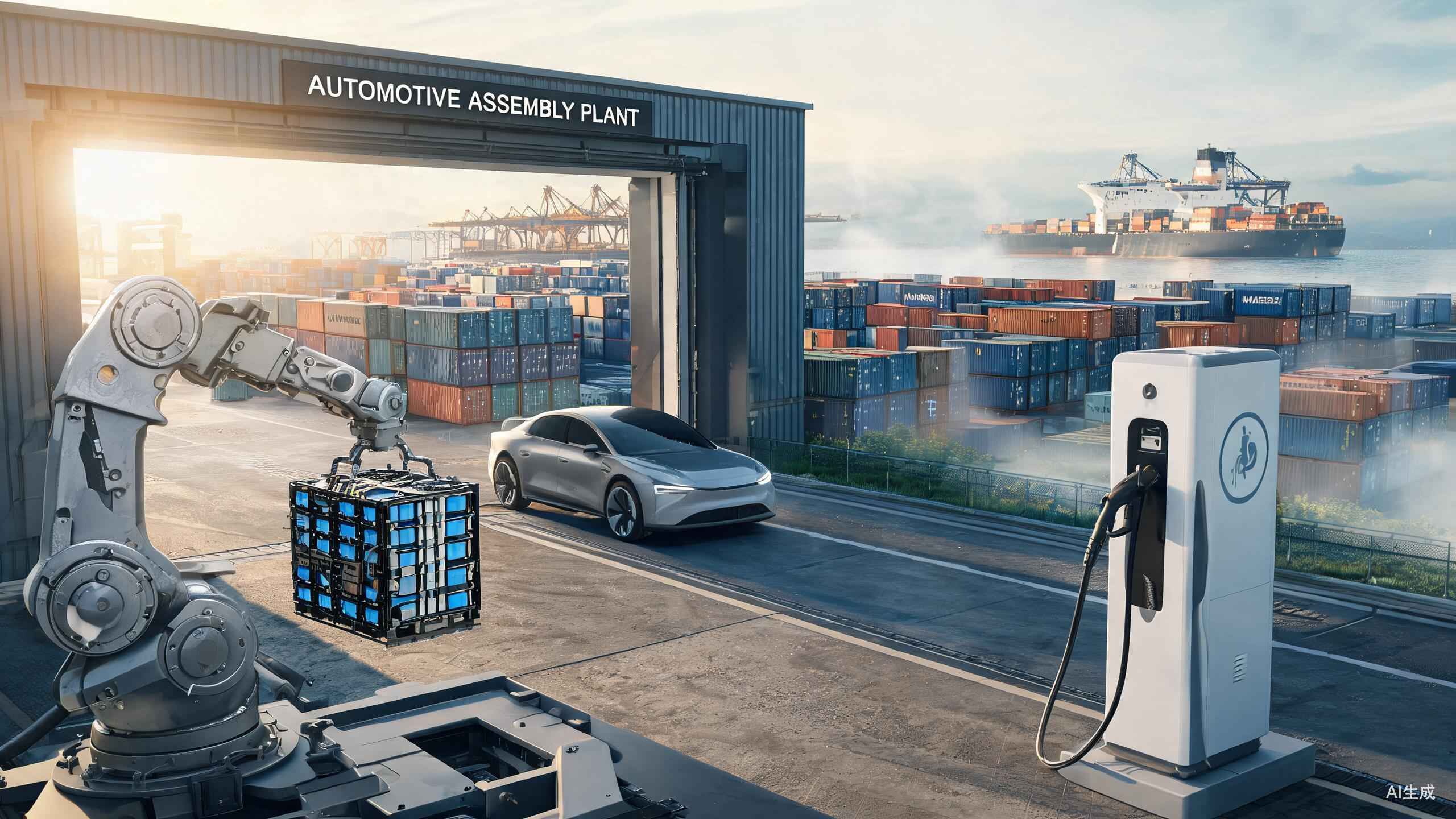
Currently, China's new energy vehicles are accelerating their overseas expansion, with overseas sales reaching a historic high and the globalization strategy achieving phased progress, yielding abundant export results. At the same time, issues such as increasing international trade barriers, stringent overseas access certification requirements, difficulties in global supply chain layout, and insufficient local operation construction are becoming increasingly prominent, posing real challenges to the overseas expansion of new energy vehicles. Therefore, steadily promoting the high-quality overseas expansion of new energy vehicles has become an essential path for China to transition from a major automobile country to a strong automobile country.
China's New Energy Vehicles Make New Breakthroughs Overseas
Firstly, the export volume and price of new energy vehicles have both risen. According to statistics from the China Association of Automobile Manufacturers, from January to June 2026, China's new energy vehicle exports achieved super-expected growth, with a cumulative export volume of 2.355 million units, a significant year-on-year increase of 1.2 times. In June, 523,000 new energy vehicles were exported, a year-on-year increase of 1.6 times. For the first time, the monthly export scale exceeded that of traditional fuel vehicles, becoming the largest export category of automobiles. Corresponding to the significant growth in export volume, the export structure of China's new energy vehicles is also undergoing profound changes: the past low-price competition strategy of "trading price for quantity" is being reversed, and high-quality Chinese brands that prioritize "quality over price" are gradually gaining favor with international consumers.
According to industry research data, the average export price of new energy vehicles in China has reached $29,800, and has even exceeded $40,000 in the high-end markets of Europe and the US, indicating that China's new energy vehicles are steadily gaining pricing power in the international market. Chinese new energy vehicles are gradually shedding the label of "cheap goods" and are truly upgrading to products with global competitiveness.
Second, the economic benefits of leading enterprises have improved significantly. According to the companies' publicly disclosed 2025 financial data, Chery's overseas revenue surpassed its domestic market for the first time, reaching 157.4 billion yuan, accounting for 52.4% of total revenue; BYD's overseas revenue exceeded 310 billion yuan, accounting for approximately 38% of total revenue; Geely's overseas revenue in the first quarter of 2026 increased by 126% year-over-year.
In terms of brand performance, Chery has consistently held the top position in exports, with cumulative exports of 393,300 vehicles in the first quarter, up 53.9% year-over-year, accounting for 65.4% of its total sales. Geely exported 203,000 vehicles in the first quarter, with a year-over-year growth of 126%, and the proportion of new energy vehicles in its exports continues to rise.
Third, the overseas market landscape continues to expand. From the distribution of export markets, regions such as Southeast Asia, the Middle East, and Latin America are becoming new blue oceans. According to publicly available information, in countries such as Thailand and Brazil, Chinese brands represented by BYD account for more than 70% of the local pure electric vehicle market share, and local taxis and official vehicles have achieved comprehensive "greening". Especially under the backdrop of high oil prices, new energy vehicles are reshaping the global automotive industry landscape with unstoppable momentum. China's new energy vehicles going overseas are no longer just a competition of "quantity", but a profound transformation of growth logic, competitive essence, and market pattern.
Currently, Belgium has become the largest overseas market for Chinese new energy vehicles, meaning Chinese new energy vehicles have successfully entered the market of developed European countries and are no longer limited to large sales volumes in emerging markets. At the same time, relying on the "Belt and Road" initiative's landing cooperation and trade facilitation arrangements in countries along the route, market demand in Central Asia, Africa, and other regions continues to be released.
China's New Energy Vehicle Exports Face New Challenges
Firstly, the technical shortcomings need to be addressed urgently. The battery degradation issue is a common problem faced by the entire industry. Although China's power battery industry is at the global forefront in terms of scale and technological level, issues such as abnormal discharge in winter and long-term parking discharge have yet to be completely resolved. The fast-charging performance and battery lifespan are also difficult to balance, and the high cost and insufficient stability of mass-produced solid-state batteries are current technical bottlenecks that need to be broken through.
Secondly, the supply capacity for high-end automotive-grade chips and independent research and development capabilities are relatively weak. Automotive-grade chips have strict requirements for high-temperature resistance and anti-interference, and domestic products have significant gaps with international advanced levels in terms of yield rate, reliability, and certification cycle, with insufficient production capacity and supply chain stability, making them more prone to supply shortage risks.
Finally, the weakness in developing high-performance chips for autonomous driving is prominent. High-level autonomous driving requires vehicle-mounted computing chips with high computing power and low power consumption, and domestic high-performance chips lag behind international leading products in terms of peak computing power, computing power utilization, and algorithm adaptability. Domestic car companies are generally faced with insufficient supply of computing power, and the standard system for environmental reliability, information security, and other aspects of chips still needs to be further improved.
In addition, issues such as the low integration of vehicle electronic control systems, the insufficient reliability of high-voltage components, and the low domestic production rate of high-precision onboard sensors also need to be continuously addressed in order to further enhance the industry's core competitiveness.
Secondly, in the context of international competition, there is multiple squeezing and an escalation of trade barriers. Western industrial powers are accelerating the relocation of their manufacturing industries, while emerging economies are competing to undertake the transfer of the automotive industry, resulting in homogeneous competition in the new energy sector, which puts multiple pressures on China's new energy vehicles going overseas and drives the escalation of trade barriers.
Third, the difficulty of setting up overseas factories remains high. To begin with, there is insufficient adaptation to local regulations, climates, and consumer preferences. Different markets define "good products" differently, and inadequate product localization directly affects customer satisfaction and after-sales experience. For example, Norway is an important market for Chinese electric vehicles in extreme cold regions, where the frigid environment places extremely high demands on EV quality and after-sales systems—this is a core challenge for Chinese EVs entering Norway. During the thawing phase in cold weather, charging ports freezing after car washes, leaving vehicles unable to charge, is a common problem. Such issues have become a significant test of Chinese automakers' after-sales service capabilities.
Secondly, they face the dual complexity of integrating into local society and coping with geopolitics. Building factories overseas is not just a business move, but is also deeply affected by local politics, environmental requirements, and community communication. For example, during the development of BYD's vehicle factory in Szeged, Hungary, the project underwent a comprehensive review after a change in the local government, resulting in repeated delays in production. At the same time, multiple problems such as labor, environmental, and local supply chain issues have become prominent, highlighting the decisive role of localization governance and community communication in overseas projects.
Finally, there is the risk of labor compliance in the context of cross-cultural management. Building factories overseas requires exporting domestic lean management models to local areas, but this often encounters difficulties due to language barriers, cultural differences, and differences in industrial foundations. In particular, the stringent labor laws and trade union systems in host countries have caused Chinese automakers, who are accustomed to the efficient operational pace at home, to frequently encounter obstacles, and have even triggered serious compliance crises.
Fourth, Chinese technical standards urgently need to be aligned with the world. As Chinese new energy vehicles are selling well overseas, technological leadership also needs to keep pace. Although China has already taken the lead in participating in the formulation of international standards for new energy vehicles such as ISO, the rule-making power in key core technology fields is still controlled by European and American countries, and China is still in the stage of "following" and "participating".
On the one hand, the stringent testing and certification standards of host countries such as the European Union have become a major pain point and bottleneck hindering the overseas expansion of Chinese new energy vehicle companies. In particular, the series of related bills introduced by the EU in recent years have posed a severe challenge to Chinese automakers going abroad from multiple dimensions. For example, according to the EU Battery and Waste Battery Regulation, the EU plans to implement a mandatory "battery passport" system for electric vehicle batteries starting from February 2027, requiring the disclosure of information such as carbon footprint and chemical composition, and making public the carbon footprint of the entire battery life cycle. Under this requirement, Chinese lithium battery companies not only need to set up factories in Europe but also must rebuild their upstream material supply chain, persuading and assisting domestic material suppliers to establish a carbon data accounting system that meets EU standards, resulting in a huge amount of work and compliance costs. This not only tests the data governance capabilities of automakers but also increases the risk of core business secrets being leaked.
On the other hand, China's high-level safety and energy efficiency standard system is still underdeveloped, which has become a bottleneck restricting the high-quality development of new energy vehicles. To support the iteration of high-level intelligent driving technology, Chinese automakers need to build data centers and other computing infrastructure overseas, but most companies are unable to bear the huge investment of hundreds of millions of yuan required for overseas data centers, which not only weakens their ability to make large-scale layouts, but also restricts the in-depth overseas expansion of intelligent driving technology.
China's New Energy Vehicle Industry Sees New Trends
Firstly, the "three transformations" on the production end are reshaping China's new energy vehicle industry. The national "13th Five-Year" planning outline has listed intelligent connected new energy vehicles as a strategic emerging industry, representing a transformation and upgrade of China's manufacturing sector, indicating that the current industrial manufacturing paradigm is shifting towards intelligent manufacturing, green manufacturing, and service-oriented manufacturing.
First, smart manufacturing has equipped automotive factories with an intelligent "brain" and "eyes," enabling machines not only to operate autonomously but also to make optimal decisions based on real-time working conditions. In automotive manufacturing, the smart manufacturing model has endowed production systems with the ability to deeply self-perceive information, intelligently optimize self-directed decisions, and precisely control self-execution. Since 2015, the scale of robot applications in China's automotive industry has grown sevenfold. Smart manufacturing has significantly improved production efficiency and product quality: at the JAC Zunjie S800 super factory in Hefei, Anhui, the fully automated welding line monitors 5,714 connection points in real time, the paint shop uses AI technology to reconstruct paint surface processes, and dual-tone automatic color-separating robots control the color separation line precision to within 0.3 millimeters; at Geely Automobile's Changxing production base in Huzhou, Zhejiang, nearly 1,000 industrial robots operate in an orderly manner across stamping, welding, painting, and final assembly lines, achieving 100% production automation and rolling out one vehicle in under a minute.
Secondly, in the field of green manufacturing, the application results of greenization in automobile production are significant. Green factories are accelerating their popularity, with continuous deepening of carbon emission management throughout the process, a power battery recycling utilization rate of over 90%, and prominent effects of lightweighting and energy-saving technologies. This has also driven green synergy in the supply chain, reducing the energy consumption of automobiles while enhancing their environmental performance.
Ultimately, service-oriented manufacturing achieved a deep integration of "selling products" and "selling services". Carmakers no longer provide single products, but instead offer a suite of services bundled with their products. For example, intelligent connected new energy vehicles, in addition to being equipped with autonomous driving and intelligent cockpit hardware, also come with corresponding music, gaming, and office content ecosystems, driving the transformation of cars from simple transportation tools to multifunctional intelligent carriers that can better meet users' diverse and personalized needs.
Second, lean and digital-intelligent practices are boosting management soft power. As Chinese products reach global markets, the spillover of management models, business philosophies, and corporate culture has accelerated at an unprecedented pace. Building on their hard-power strengths, automakers are now making increasingly notable progress in enhancing and exporting management soft power defined by lean and digital-intelligent practices. China FAW, for example, has developed the EOA (Enterprise Operations Intelligence) concept and embedded it throughout its operations, providing a benchmark for digital and intelligent transformation at large manufacturers and activating new growth drivers through technological innovation. As of May 2026, China FAW has deployed 20 digital employees and automated 23 key decision-making processes. Digital Employee No. 001, for instance, serves as a production planning administrator, with seven business processes—customer order placement, resource confirmation, production scheduling, and delivery-date feedback—now executed automatically by AI. The staff who previously handled these tasks have pivoted to roles as data miners, model builders, and business optimizers. From the EOA concept to the deployment of OpenMind, an enterprise-level intelligent agent, China FAW is using AI to restructure its entire operations workflow, charting a distinctive transformation path.
Additionally, SAIC-GM-Wuling has been recognized as a national innovation exemplar for its "345" model of electric-intelligent quality management. Selected by the Quality Development Bureau of the State Administration for Market Regulation, the company stands as an industry benchmark for comprehensively enhancing quality management through digital tools, serving as a classic case of applying digital technology to improve management efficiency and effectiveness.
Third, the trend of systematic and collaborative overseas expansion has become inevitable. Against the backdrop of driving the global automotive industry towards electrification, the importance of systematic and collaborative overseas expansion will become increasingly prominent. Systematic and collaborative overseas expansion is the inevitable choice for enterprises to achieve global value chain upgrading and release dynamic comparative advantages through deepening division of labor, internalizing transaction costs, and building overseas ecosystems on a global scale. Firstly, the production capacity and knowledge reserves accumulated by the new energy vehicle industry itself are the foundation for supporting Chinese new energy vehicle companies to advance overseas.
Secondly, when upstream and downstream enterprises "band together to go overseas", they can form a complete division of labor network in the host country, which can not only amplify scale effects and improve specialized efficiency, but also reduce cross-border transaction costs and optimize the price competitiveness of Chinese brands.
Once again, after Chinese companies invest in and set up factories overseas, they can achieve a transformation from simply exporting production capacity to deeply embedding themselves in local manufacturing and even the service industry, integrating into the local ecosystem, and ultimately deeply participating in global industrial division of labor and cooperation, integrating into the global value chain.
Ultimately, its highest form is the export of standards and rules, where Chinese automakers, by promoting their own technological routes, become widely accepted technologies or industry rules in the international market, establishing them as industry benchmarks. This not only enhances the collaborative efficiency of participating entities based on common rules, but also grants leading enterprises the power to define the industry's "rules of the game", helping them obtain sustained rule-based benefits.
In recent years, Chinese new energy vehicle makers have been shifting from simply "going global" to "embedding locally." Thailand offers a clear example of the clustering effect taking shape: automakers such as BYD and Great Wall Motor built local plants first, drawing in battery giants including Gotion High-tech and CALB, plus component leaders like Ningbo Tuopu Group, which have followed with factories of their own. In Europe, Hungary has become Chinese manufacturers' bridgehead: after BYD invested in a European headquarters plant there, CATL and EVE Energy quickly moved in, followed by Senior International and Huayou Cobalt. This model—one vehicle brand's overseas expansion pulling the entire supply chain along—vividly illustrates the industrial cluster effect of coordinated, systematic internationalization. The geographic concentration of upstream and downstream players sharply reduces logistics losses and transaction costs while strengthening technological collaboration. It also helps sidestep trade barriers and get closer to customers, ultimately maximizing supply-chain efficiency and enabling cross-border value creation. The shift marks Chinese automakers' evolution from pure exporters into system integrators.
China's New Energy Vehicles Advance on the Global Stage
First, accelerate the realization of high-level technological self-reliance and self-strengthening, and focus on breaking through the "bottleneck" weaknesses. To consolidate the advantageous position of core technologies in electrification, the industry should continue to increase its efforts to tackle cutting-edge technologies such as solid-state batteries and high-efficiency electric drive systems, further optimizing the safety and range performance of new energy vehicles. At the same time, in line with the development trends of intelligentization and connectedization, efforts should be made to enhance the autonomous research and development level and large-scale application capabilities of automotive-grade chips and underlying operating systems. Additionally, the industry should actively promote the deep integration of the new energy vehicle industry with artificial intelligence and new materials, with a focus on strengthening resource circular utilization and comprehensively consolidating the comprehensive competitiveness of the industry chain.
Second, we must forge a path from product exports to ecological co-construction. In response to the trade barriers set by European and American countries against Chinese electric vehicle exports, on the one hand, we must proactively adapt to these barrier-like rules. For example, in response to the EU's requirements for carbon footprint disclosure and provision of "battery passports," China must conduct advance research and drive the industry and enterprises to make advance layouts and develop contingency plans. On the other hand, we must build a collaborative system between industry and ecology. In addition to exporting complete vehicles, we must also drive the upstream and downstream of the industrial chain and supply chain to go overseas together, jointly creating a new industrial ecology that adapts to the host country. Furthermore, we can leverage export credit insurance and official or private negotiation and coordination mechanisms to respond to sudden situations such as overseas anti-dumping and countervailing investigations.
Third, strengthen the mechanism for identifying and defending against cross-border investment risks. Currently, with high global trade barriers and a rise in protectionism, Chinese automakers' overseas expansion is no longer simply a pursuit of profit, nor are they in a passive "contractor" position; instead, they are transitioning into rule-makers who grasp the core of global supply chains. When the host country undergoes significant geopolitical changes, or when local governments or partners breach business integrity, unilaterally change business terms, or encounter force majeure risks, overseas automakers must maintain a clear strategic direction and have the courage to cut losses in a timely manner, enhancing their risk identification capabilities. Even in the face of "market blackmail," they must be prepared to suspend negotiations at any time. China's new energy vehicle companies' experience of going overseas has repeatedly proven that cross-border investment is not international charity, and cooperation must be based on mutual respect for sovereignty. Once partners cross the red line of controlling rights, intellectual property rights, and ownership, cutting off loss-making sources and adopting defensive strategies is a sober decision that aligns with modern business logic.
Fourth, as China's new energy vehicles expand overseas, the country must also fully showcase the soft power of Chinese industrial civilization. The process of going global is itself one of cultural enrichment, brand appreciation, and the cultivation and export of managerial soft power. With NEVs now selling strongly in markets around the world, how to shape Chinese automotive culture, how to carry Chinese industrial civilization to the world, and how to help the world understand China more broadly, deeply, and accurately are questions worth serious reflection. As products go global, companies must develop a deep understanding of user habits and aesthetic preferences in different markets, strengthen the cultivation and export of management expertise and brand-building capabilities, and fully demonstrate the soft power of China's new energy vehicle industry.