Recently, Huawei, Xiaomi, and Honor have collectively raised the prices of multiple smartphone models, with some models seeing a single increase of up to 1,000 yuan, and related topics quickly topping the trending search charts.
In recent days, a reporter from the Sci-Tech Innovation Board Daily found that related models have completed price adjustments after visiting physical stores. Due to the sudden price increase, some physical stores did not have time to replace the price tags and could only inform consumers of the new prices verbally. Online price comparison data also confirms the fact of multiple price adjustments, with high online discussion heat, but the customer flow in physical stores has not shown significant fluctuations.
Behind the recent collective price hike of mobile phones is the surge in prices of upstream components such as storage chips. The fluctuation in chip prices has also affected the second-hand recycling market, giving rise to a profitable business of "dismantling phones for chips," with many practitioners being caught off guard by market fluctuations.
Due to cost pressures, the thousand-yuan phone market is rapidly shrinking, and the industry is presenting a new landscape of declining shipments and rising average product prices, as the domestic mobile phone industry is ushering in a brand new development cycle.
Sudden Price Hikes Hit Phone Stores
On September 1, price tags in the mobile phone industry collectively jumped upwards. Huawei, Xiaomi, and Honor, the three major domestic mobile phone brands, simultaneously raised the prices of multiple models on sale, covering products across all price ranges, from the thousand-yuan tier to the ten-thousand-yuan flagship.
Recently, a reporter from the Sci-Tech Innovation Board Daily visited the Huawei authorized experience stores at Shanghai's Wujiaochang Hualian Mall and Bailian Youyicheng, and found that the price increase came suddenly and sharply.
Sales staff told reporters that the price increase notice was recently distributed to experience stores through a WeChat group, with price hikes for both the Huawei Mate 80 series and the Huawei Enjoy 90 series. The prices of all configurations of the Huawei Mate 80 have been increased by 800 yuan, with the 12GB+256GB version rising from 4,699 yuan to 5,499 yuan. The Mate 80 Pro and Pro Max saw price increases of 1,000 yuan across all versions, with the top-of-the-line 16GB+1TB Pro Max now priced at 9,999 yuan, officially crossing the "10,000 yuan smartphone" threshold.
Reporters noticed that in some experience stores, new price tags for the models that had increased in price had not been printed yet, and employees could only inform customers verbally that "the price has already gone up today" when they inquired about the price.
Although it is currently possible to receive a subsidy of 15% of the sales price for electronic and digital products purchased offline in Shanghai, with a maximum subsidy of 500 yuan, "now 5,000 yuan can't even buy a 512GB Mate 80," the salesperson lamented.
When asked about the reason for the price increase, the salesperson said that due to the current rise in prices of storage and other chips, almost all models of the brand have increased in price, "Occasional buyers may not be aware, but we often notice the price changes here."
Compared to Huawei, Xiaomi's price tags are updated more quickly, and the Xiaomi Home store at Shanghai's Wujiaochang shopping mall, visited by a reporter from the Sci-Tech Innovation Board Daily, has already completed the price tag update.
Specifically, the Xiaomi 17 saw a price increase from 4,799 yuan to 5,099 yuan, a single-model hike of 300 yuan. The Xiaomi 17 Pro was raised from 5,399 yuan to 5,699 yuan, also a 300 yuan increase. The Xiaomi 17 Pro Max was adjusted from 6,499 yuan to 6,999 yuan, a price hike of 500 yuan. This marks the second time in a month that Xiaomi has raised the prices of its main models, following a price adjustment on August 2.
The Xiaomi 17 was released last September, and we thought it would be discounted during the 618 shopping festival, but it didn't really drop in price, said a salesperson. Previously, the old model was discounted because of excessive inventory, but now we basically only have a month's worth of stock, and the price increase was very sudden, so it's unlikely to be discounted afterwards.
In some Honor stores, the original price tags were still retained, but the prices had changed. According to an official Honor announcement, the Honor Power 2 12GB+256GB and 12GB+512GB versions were raised by 500 yuan and 600 yuan, respectively, while different versions of the Honor Magic 8 were increased by 300 yuan to 500 yuan.
A reporter from the Sci-Tech Innovation Board Daily noticed that some sales staff looked displeased when customers wanted to buy the Magic series, saying "The current price is not right, if you need to buy it, I can help you take a look."
"This Magic 8 has not had a price increase from its launch until now, it's the first time it's going up in price. In the past, when other brands raised their prices, it didn't," a salesperson revealed to a reporter from Sci-Tech Innovation Board Daily. Currently, only the Honor Magic 8 Pro Air in the Honor Magic series has not had a price increase.
In addition to visiting stores, a reporter from the Sci-Tech Innovation Board Daily tracked the price trajectory of Tmall's official flagship store through a price comparison app. The data shows that models from Huawei, Xiaomi, and Honor with similar prices simultaneously increased in price on September 1, while some models of the Xiaomi 17 and Honor Magic 8 had already undergone two rounds of significant price adjustments in August.
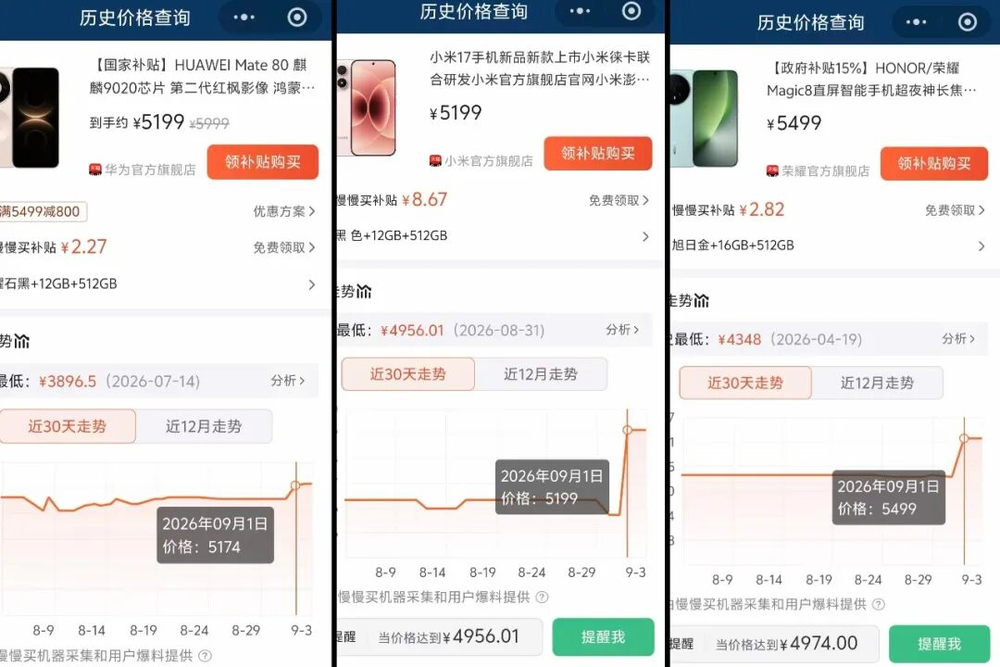
In the past month, the price trends of the three major brands have been as follows:
Specifically, the Xiaomi 17 12GB+256GB version has maintained a price of around 4,999 yuan since its first price increase on August 2, with a brief adjustment on August 30-31, followed by a sharp increase to 5,199 yuan on September 1. The Huawei Mate 80 12GB+256GB version remained between 4,799 yuan and 4,999 yuan from July 31 to August 31, and rose to 5,174 yuan on September 1. The Honor Magic 8 16GB+512GB version was priced at 4,699 yuan on August 1, jumped to 4,999 yuan on August 2, and has since fluctuated slightly around 4,999 yuan, with another sharp increase to 5,499 yuan on September 1, representing a cumulative increase of 800 yuan within a month.
It's worth noting that on September 1, "multiple mobile phone models officially increased in price" also instantly topped the Weibo hot search list.
During a visit, a reporter from the Sci-Tech Innovation Board Daily observed that despite the heated online discussions, the foot traffic in physical stores did not show significant changes compared to other working days. "I'm hesitant to buy, it's not that necessary," a consumer told the reporter, indicating they can wait for the year-end promotions.
Huaqiangbei Phone Market Sees Rise of 'Chip Salvaging' Amid Soaring Chip Prices
Apart from the price hike of new devices, the undercurrents in the second-hand recycling market are also worth attention. Recently, a reporter from the Sci-Tech Innovation Board Daily visited several mobile phone recycling shops in Shenzhen's Huaqiang North and found that what is really driving the recycling market is not the brand price adjustments on September 1, but rather the continuous surge in storage chip prices over the past year.
A stall owner told a reporter from the Sci-Tech Innovation Board Daily that the price increase of new branded machines will also lead to a corresponding increase in the recycling price of relevant models, but the overall change will not be significant, as the previous surge in storage chip prices had driven up recycling prices and second-hand sales prices.
A recycler told reporters that although price hikes for new branded devices will lead to slight increases in the recycling prices of corresponding models, overall fluctuations will be limited, with "high-quality" second-hand devices rising in price by around 100 to 200 yuan. According to their quotes, the second-hand Huawei Mate 80 with 256GB was priced at around 3,300 yuan, while the 512GB version was approximately 3,800 yuan.
When a reporter from the Sci-Tech Innovation Board Daily inquired about the recycling price with the reason "there is a one-year-old Xiaomi 17 to be sold", the stall owner said that the actual item needs to be seen in order to estimate the price, "the appearance and other aspects will also affect the recycling price, and the Xiaomi 17 can be sold for around 2,000 yuan at most if it is collected now."
What's more unsettling for Huaqiangbei recyclers than the price hike of new branded machines is the fundamental transformation brought about by the rising cost of chips.
The AI boom has squeezed global storage chip production capacity, causing a significant increase in the prices of mobile general memory and advanced process chips, resulting in a passive price hike for new machines. According to Chen Shenyu, a manager at CIC Qizhi Consulting, "The popularity of recycling in Huaqiangbei is driven by a logic of dismantling and arbitrage, where scrapped or water-damaged phones are recycled, and the large-capacity memory particles are removed from the main board, then re-washed and re-balled, and downgraded to supply automotive accessories, IoT hardware, or refurbished machines overseas."
However, it is not a lucrative business.
According to a reporter from the Sci-Tech Innovation Board Daily, the scrap machine recycling market in Huaqiangbei has just experienced a rollercoaster-like fluctuation. At the peak of the price surge, the recycling price of a scrap machine rose from less than 100 yuan to over 200 yuan. However, in late March this year, the market trend suddenly shifted, with mainstream memory prices plummeting over 40% within a month, and many recycling stores stopped accepting scrap mobile phones.
Chen Shenyu also pointed out to the reporter of the Sci-Tech Innovation Board Daily that this is a speculative arbitrage behavior caused by a short-term mismatch between supply and demand in the industry chain. "Dismantling chips involves yield loss and compatibility risks, and the downstream low-end market has limited digestibility; once the upstream semiconductor original factory's production capacity dynamically adjusts, this recycling premium will be quickly relinquished."
"The market won't always be that good, many people previously bought in bulk and now have their entire inventory in hand," said the owner of a store, also telling the Sci-Tech Innovation Board Daily reporter that when a trend emerges, it's good for business, but when it stops, all that's left is inventory.
Storage Chip Shortage Disrupts Supply Chain, Ending Era of Smartphones Under $100
On one hand, new brand models are seeing price increases, yet sales remain stagnant; on the other hand, the used phone recycling business is experiencing a rollercoaster ride, together forming the two sides of this round of price adjustments in the mobile phone market. Their common driving force points to the same place: storage chips. And the price surge of storage chips is also thoroughly rewriting the cost ledger of the mobile phone industry.
According to Counterpoint Research, the price of smartphone memory surged over 80% quarter-on-quarter in the second quarter of 2026. Additionally, the proportion of storage chips in the total bill of materials (BOM) cost of mobile phones has skyrocketed from the previous 10% to 15% to over 20%, and even approached 30% for mid-to-low-end models.
Among the major components of mobile phones, except for screens, which have not seen a price increase, almost all other components, including storage, SoCs, PCBs, and MLCCs, are rising in price. According to IDC China Research Manager Guo Tianxiang, "Qualcomm has already notified its clients that it will raise prices starting in September. The price increase of storage will slow down compared to the first half of the year, but prices will still continue to rise."
"Mobile phone prices have undergone multiple rounds of increases since March, and it's expected that the prices of new models from various brands starting this month will continue to rise," Guo Tianxiang predicted.
Counterpoint Research senior analyst Shenghao Bai also believes that the price increase is mainly driven by the rise in upstream key component prices. "Among them, the price of storage chips is still at a high level and is expected to continue to rise in the second half of 2026, but the increase will slow down. SoC chip prices have also been adjusted upward recently. For now, this trend is expected to continue in the short term."
Under cost pressures, smartphone makers' pricing logic is undergoing a fundamental shift. Chen Shenyu, a manager at CIC Consulting, said that with chips and memory at a cyclical peak, the hardware costs of the four major components—processor, memory, display, and battery—are already extremely high. Add in tooling costs and channel margins, and producing budget phones priced around 1,000 yuan is highly likely to incur losses, forcing manufacturers to cut their low-end lineups.
According to IDC data, in 2023, models priced below 1,000 yuan still accounted for 22% of the market share, but by the first quarter of 2026, this had plummeted to 2.7%. Mainstream brands such as OPPO, vivo, Xiaomi, and Honor have all stopped selling models priced below 1,000 yuan.
Counterpoint Research senior analyst Ivan Lam warned that the impact of rising memory costs in the second half of the year will be more pronounced, with all manufacturers affected. "Traditional mid-to-low-end smartphones, especially models priced below 2,000 yuan, will face even more severe sales challenges, but the actual impact will not be limited to the mid-to-low-end market, as mid-to-high-end models will also be hard to avoid."
Notably, IDC released a report estimating that global smartphone shipments will decline by 16.7% year-over-year in 2026, marking the largest drop in history, while the average selling price will reach $581, up 27.6% year-over-year.
Selling fewer units at higher prices - the mobile phone market is entering a whole new cycle. However, for China's mobile phone industry, whether this round of price hikes is a springboard for moving towards "technological premiumization" or a forced measure remains to be seen.