
After doing housework for several decades, Gao Bo, a full-time mother in her 50s, discovered for the first time that her movements could also be monetized.
She lives in Shandong and normally has to take care of her teenage son, making it difficult for her to work outside the home. Now, Gao Bo records herself with her mobile phone while doing chores like cooking, laundry, and cleaning. She told the media that she can earn 120 yuan for six hours of work every day.
These first-person videos, after processing, will become training materials for robots to learn household chores.
Gao Bo is not an isolated case. On social media, similar scenes are increasingly common: in a McDonald's, a girl wears a collecting device to clean a table; in a large restaurant, a chef stir-fries while recording the angle and trajectory of his wrist movements...
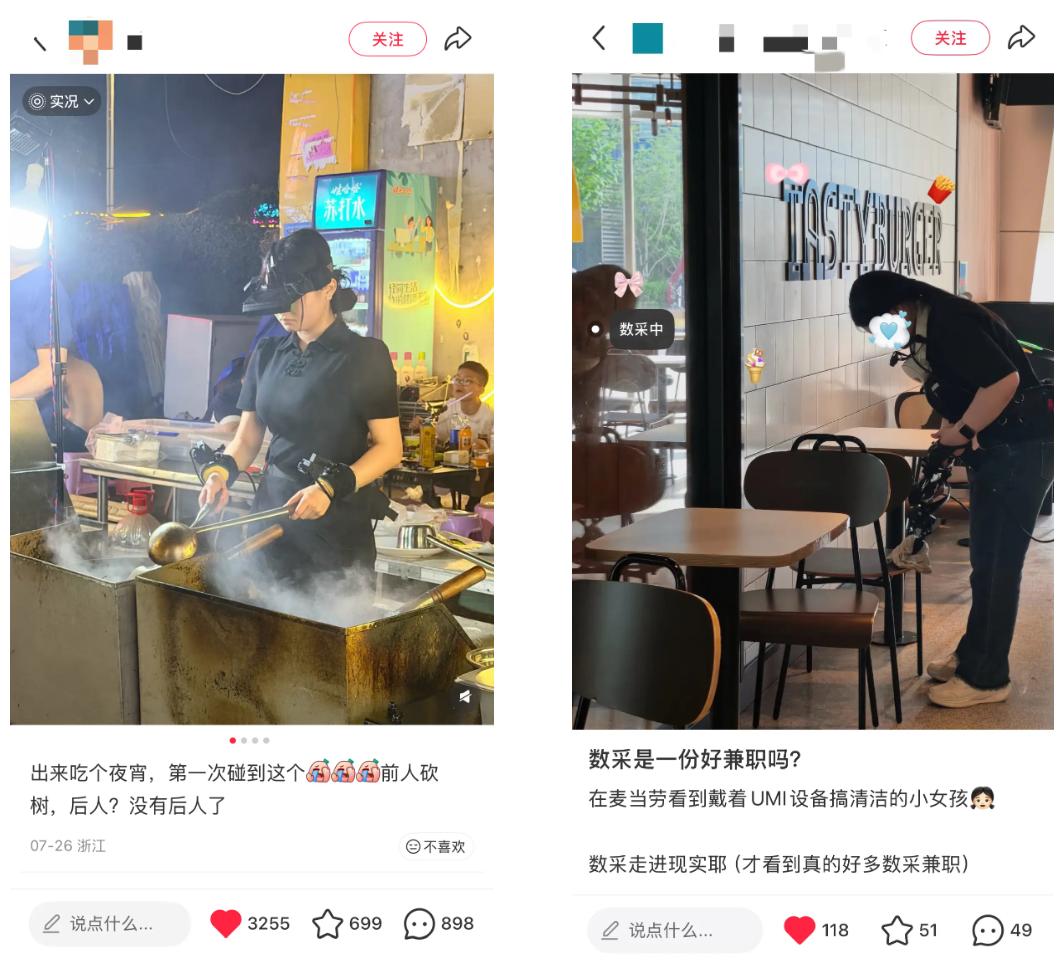
Embodied data is entering the era of "crowdsourcing". In the past, robot data was mainly collected by collectors in training centers who remotely controlled real machines. Today, with the popularity of first-person perspective cameras and other non-entity collection devices, data collection workstations are no longer limited to training centers, and anywhere people work can become a classroom for robots.
This wave of crowdfunding fervor is driven by a massive data gap in the robotics industry. For robots to work in the physical world, they must first be "given a brain", but the current situation is that there is a severe lack of data for understanding the physical world.
A surrounding industry chain for robot data collection and training has rapidly emerged, with enthusiasm from the primary market also pouring in.
But behind the excitement, the math is not easy to do. Who in this industry chain will make money first? How much of the continuously expanding data capacity can actually be converted into a robot's capabilities and customer orders?
The entire industry is competing to provide robots with "education"
According to Interact Analysis data, as of the end of April 2026, 64 data collection and training centers had been put into operation nationwide, with at least 90 more including those under construction and planned. At least 13 of these centers have deployed over 100 robots each.
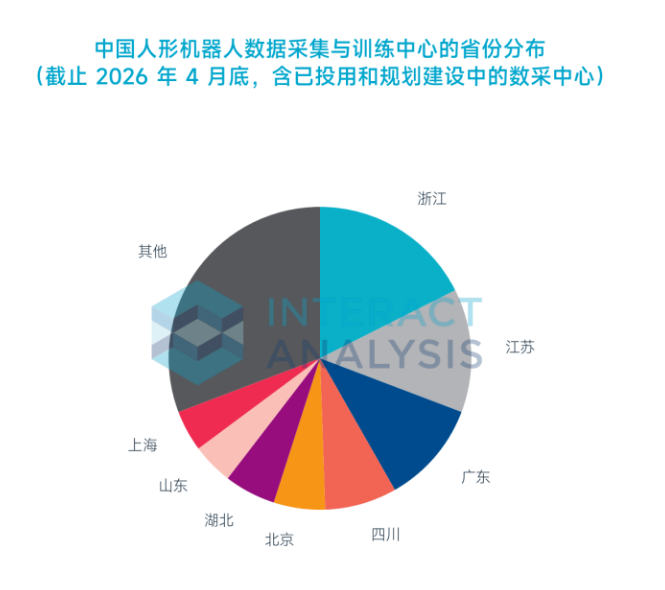
Interact Analysis has compiled a list of over 90 domestic humanoid robot data collection centers.
In an area of several thousand square meters, homes, supermarkets, warehouses, and factories have been replicated on a 1:1 scale. Dozens or even hundreds of robots line up for "classes," where pickers wear VR headsets and manipulate mechanical arms to repeatedly move boxes, sort goods, and operate tools.
Embodied intelligent data collectors have also started to emerge in large numbers on recruitment websites, with some positions not requiring work experience.
A data collection service provider, which previously served internet clients such as Baidu Maps, added a new team of over 20 people at the beginning of this year to focus on binocular data collection for general-purpose applications. According to a person in charge, two leading robot manufacturers and one elderly care real estate company have proactively approached them for cooperation, "The demand is still relatively large, and it can be said that we have caught the trend."
This wave of enthusiasm stems from a shift in the development focus of the robotics industry. As advancements in torso, joint, and overall motion control continue, robots are now capable of running, dancing, and boxing, prompting the industry to devote more energy to models and practical tasks.
New bottlenecks have also emerged: robots can repeatedly complete an action in a training environment, but their success rate may drop sharply when the object is changed, the placement angle is adjusted, or they enter a room with different lighting and environmental conditions, which means the robot's generalization ability is relatively weak.
The robotics industry is therefore attempting to replicate the scaling law of large AI models: when the model architecture and training methods are relatively stable, it exchanges increased data, parameters, and computing power for enhanced capabilities.
This law is still in the verification stage on robots, but it has already changed the industry's expectations for data scale.
According to industry estimates, the entire industry has currently accumulated around 500,000 hours of high-quality training data, while to achieve intelligent emergence, even 100 million hours of training data may not be sufficient. By this scale, the two differ by at least approximately 200 times.
After demand increases, the industry still needs to solve the problem of where the data comes from. Traditional real-machine collection is difficult to fill this gap. Insiders revealed that a trainer can usually only remotely control one robot, and one robot often requires two people to cooperate, completing only a few dozen real-machine collections per day, because the robot's "work" speed is much slower than that of humans.
The concentrated warming up of entity-free collection in 2026 has lowered the threshold for expanding data production capacity.
This route emerged around 2024 and has begun transitioning from papers and prototypes to complete products this year. For example, the EGO device worn on the head records body movements, while the handheld UMI records hand movements, rotations, and openings and closings; wrist cameras and tactile devices supplement close-up images and contact information.
Technology is opening up supply, and policies are further expanding construction demand. In June 2026, the Ministry of Industry and Information Technology and the State-owned Assets Supervision and Administration Commission of the State Council launched a special campaign for immersive simulation training, requiring 10 provinces and cities to each select no fewer than 20 key scenarios, with a plan to form more than 100 high-value application scenarios by the end of the year, driving the landing of capabilities on a scale of tens of thousands of units.
Multiple factors have combined to cause the data acquisition industry to rapidly fill up with companies from different backgrounds.
Companies like OBI Light and Tu Jian Technology are similar to "shovel sellers". OBI Light started with 3D vision, extending its 3D camera, calibration, and large-scale manufacturing capabilities to EGO, UMI, and wrist cameras. Tu Jian, on the other hand, entered the market with flexible electronic skin, using tactile gloves to record contact forces and changes in force that are difficult to capture on video.
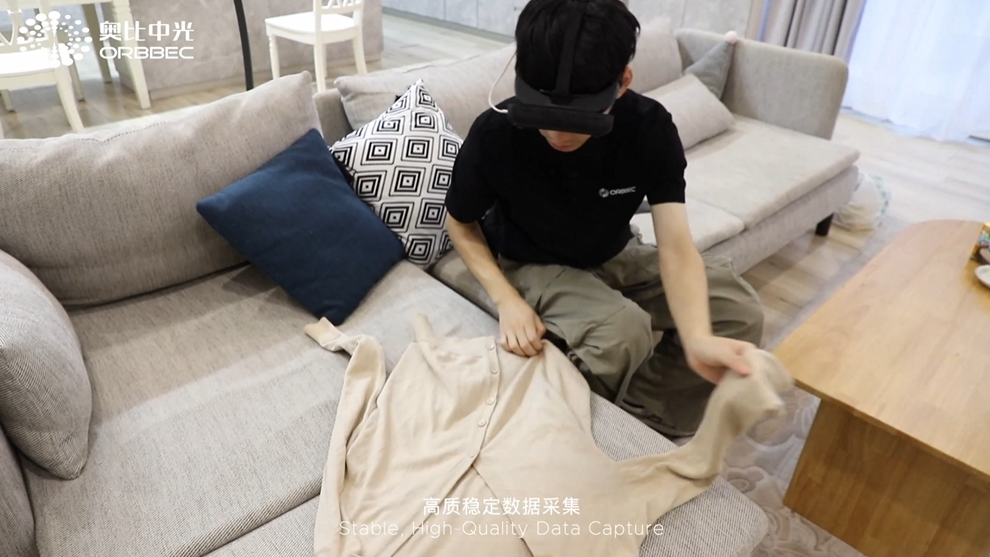
On the official website of OriCiro Genomics, a video demonstrates a person wearing the EGO device to collect data.
Companies like Ubitus and Zhihuang have entered the data acquisition phase to secure device orders and training data. When building data acquisition centers, local governments often bundle procurement of robots, remote operation equipment, and training systems. Ubitus has won two projects in Huizhou and Hohhot, with a total amount exceeding 130 million yuan. Zhihuang is simultaneously developing models, ontologies, and data acquisition tools, which can determine what data to collect next based on model performance, shortening the cycle of data collection, training, and testing.
Zhiyuan's incubated company, Mifeng Technology, is attempting to transform its data capabilities, originally designed for its own robots, into an independent platform, offering external services such as data collection, governance, training, and evaluation, and acting as an organizer for the entire data production chain.
Jingdong and Xian Intelligence have the advantage of existing scenarios. Jingdong has logistics, retail scenarios, and organizational capabilities, allowing it to extend its reach into warehouses, shopping malls, factories, and ordinary households. Xian Intelligence already has a large number of robots operating in warehouses and factories, and hopes to generate data while these devices work. The company disclosed that its robot brain installation exceeds 50,000 units, accumulating over 500,000 hours of multi-format real-machine data.
The entire industry is accelerating the process of "teaching materials" to robots, but having more "teaching materials" does not necessarily mean students can learn.
What kind of "textbooks" do robots need?
In June this year, robot company XDOF shared an experiment.
The team was training a robot to fold T-shirts using a standard imitation learning method, and after the initial training, the robot succeeded in all 20 tests. However, when the team added more demonstrations of completed tasks, expecting the increased data to improve the model's performance, the success rate first dropped to 2 times and eventually resulted in 20 consecutive failures.
The issue lies in those videos that appear to be qualified, where the clothes are ultimately folded correctly, but the process is interspersed with pauses, hesitations, re-grasping, and ineffective adjustments. Humans can watch it once and think it's just normal operation; robots, however, will learn the entire process, including the hesitations, as the standard answer.
This is similar to the experience of domestic practitioners. An industry insider told NoNoise that starting this year, the demand for data collection has expanded rapidly, but many of the collected data turned out to be useless after being brought back.
What the industry truly lacks is the ability to determine what robots should learn from.
To transform a human action into a robotic capability, the first step is to determine what to capture. Picking up boxes prioritizes stability and rhythm, screwing requires precision and force control, while folding clothes involves handling deformation, occlusion, and multi-step operations. As task definitions differ, the requirements for collecting camera images, motion trajectories, tactile sensations, and joint states also change.
These items can all be converted into hours on the "capacity table", but once they enter the model, they play completely different roles.
Once collection is complete, the data goes through a first round of quality checks: whether the task was completed, whether the camera view was obstructed, whether any sensors dropped offline, whether images and control commands are synchronized, and whether any faces, phone screens, or trade secrets were captured.
Some data service providers claim that they can currently achieve at least one valid piece of data out of every three or four collected, which is relatively efficient in the industry.
After being cleaned and labeled, the data still has to go through an even more troublesome hurdle: the same batch of data may yield completely different verification results when handled by different companies.
Embodiment data is deeply tied to the robot's body and model architecture. Six-axis robotic arms and seven-axis robotic arms have different degrees of freedom, two-finger grippers and five-finger dexterous hands have different action spaces, and camera positions, sensor configurations, coordinate systems, and control frequencies also vary. The same trajectory can be trained directly at one company, but switching to a different robot or model may require remapping, or even be completely unusable.
Therefore, embodied data have at least three layers of effective standards.
The first layer involves verifying the effectiveness of data collection, confirming task completion, and ensuring file availability. The second layer involves verifying the validity of the dataset, confirming that the data has been cleaned, annotated, and aligned, and can be fed into the client's training pipeline. The third layer is where the model's effectiveness is verified, determining whether the addition of this batch of data actually improves the robot's success rate, generalization capabilities, and failure recovery.
Currently, these three layers of "effective" are easily confused. A supplier delivering 1000 hours of effective data may have only completed the first two layers, but the client's expectation is that the robot's capabilities will increase accordingly.
This also means that embodied data is difficult to trade like ordinary commodities for the time being. It is hard for clients to simply place an order for 1,000 hours of data; more common demands are: a certain robot has a success rate of only 60% when performing specific tasks, and the supplier needs to determine which scenarios and actions are missing, and then design a plan for data collection, cleaning, training, and supplemental collection.
Effectiveness is thus hard to become a fixed attribute of the data itself, as it depends on whether the data can match a certain model, a certain embodiment, and a certain task.
USTree founder Wang Xingxing has pointed out that for robots, every input and output operation may produce deviations and losses, which is an important reason why the generalization ability of current robot models and task success rates are still insufficient.
This means that from shooting a video of an action to a robot actually learning, there is a data loss chain in between.
This has resulted in a mismatch in the industry chain: the costs have already been incurred upfront, while the effectiveness of the final training remains uncertain, as there is no formula for machines to automatically become intelligent after being fed for a certain number of hours.
When the output of data cannot be directly converted into gains in capability, a dilemma arises in the data acquisition business: suppliers calculate costs based on equipment, labor, and collection time, but customers are only willing to pay for model effectiveness. Who bears the intermediate losses has become a necessary calculation for the data acquisition industry.
Survival Issues in the Data Acquisition Industry
Looking along the industry chain, the first payments to be received are still for the construction of basic infrastructure, with settlements made on a per-unit or per-set basis for items such as cameras, gloves, grippers, remote operation systems, and robot bodies, while training venues can be accepted based on area, number of equipment, and construction period.
Once it comes to the data transaction link, uncertainty increases sharply.
Several professionals in the field of embodied intelligence revealed to NoNoise that some local governments are willing to spend money on robots and build training facilities, but during project negotiations, they require robot companies to buy back data.
The "Embodied Intelligence Training Ground Research Report (2026)" jointly released by the China Academy of Information and Communications Technology's Institute of Artificial Intelligence notes that training grounds require heavy asset investment, and while selling data products can generate revenue quickly, relying solely on data sales is difficult to offset the heavy asset investment, resulting in a long payback period.
Based on publicly available estimates, a professional remote operator working 8 hours can only produce an average of 2 to 3 hours of effective data. The price of domestic real-machine data is approximately 500 yuan to 1,000 yuan per hour, while some data collectors who require a technical background or on-site presence can earn a monthly salary of 8,000 yuan to 15,000 yuan.
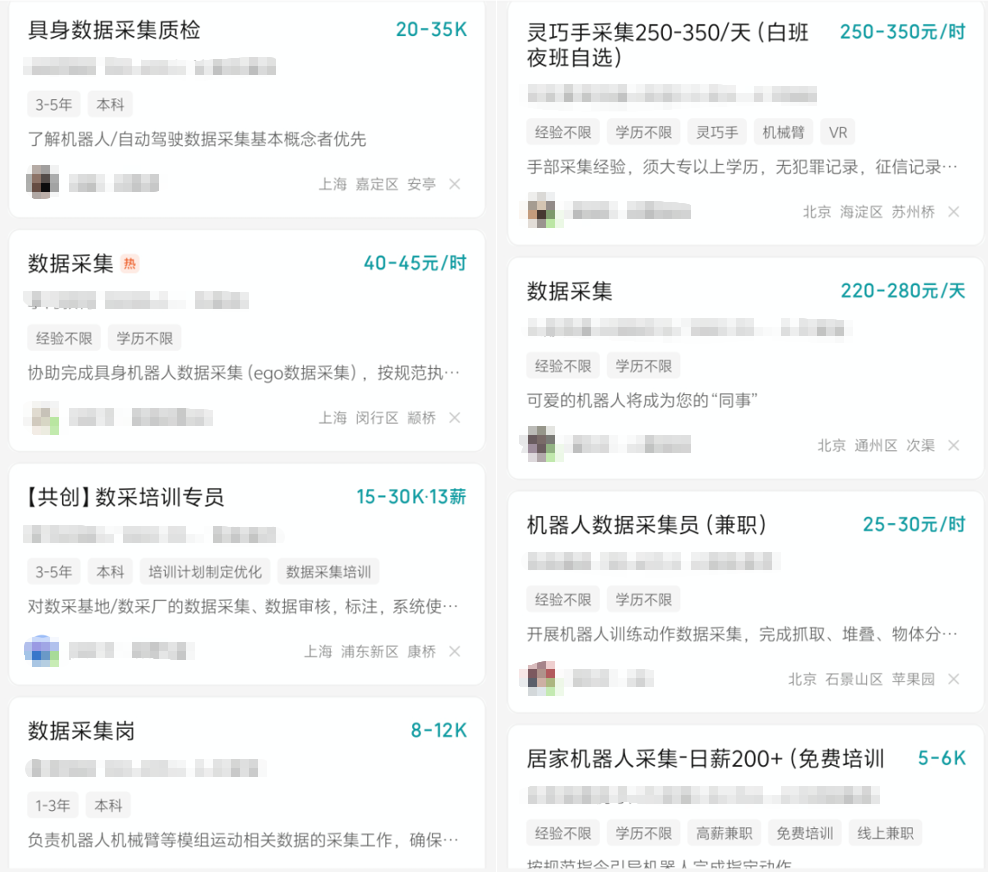
▲Data collection roles on recruitment platforms
Requiring data buyback is equivalent to adding an "insurance policy" for high upfront investment costs.
However, manufacturers of robot bodies and modeling companies also have their own struggles —
The cost of Ego and dual-lens devices has been decreasing, and general tasks such as cleaning, storage, and sorting are the easiest to mass-produce and also the most prone to repetition. Different collectors wiping tables in different rooms do indeed increase the duration; however, if the objects, actions, and environments are limited in variation, the new capabilities added to the model may not be as numerous as the new dataset appears to be.
US humanoid robot unicorn Figure once attempted to procure data from external suppliers, but found it difficult for the data to meet the company's model requirements for scale, diversity, and quality simultaneously. As a result, Figure shifted to building its own data collection system - the Index platform - which uses crowdsourcing to collect daily chore or work videos from ordinary users worldwide. To date, Figure has paid creators $15 million.
Real-world data is also hard to sell. It is more closely tied to specific tasks and robotic bodies, with slower production speeds and higher costs, resulting in fewer potential customers. An industry insider told NoNoise that when model companies reach the procurement stage, they often opt for lower-cost simulated data first. Only when tasks are close to actual delivery, such as moving boxes or assembly, will clients supplement with targeted real-world data.
These issues are forcing the industry to change its approach to production. What the industry needs to reduce is not just the cost of collection per hour, but the total cost of a robot learning a skill.
One approach is to reserve expensive real-world machines for where they are needed most, such as using simulator-based data collection to expand the scale of human demonstrations, simulating bulk manufacturing environment changes and failure scenarios, and then having real-world machine data complete task adaptation and final calibration. Nvidia once used a small amount of human demonstrations to generate 780,000 synthetic trajectories, equivalent to 6,500 hours of manual demonstration data, with the entire generation process taking only 11 hours.
Another approach is to reduce the cost of repeated adaptation between different clients. Google has partnered with 33 laboratories to launch the Open X-Embodiment dataset, which brings together 22 types of robots, over 500 skills, and more than 1 million task trajectories, in an attempt to unify action representation and data formats.
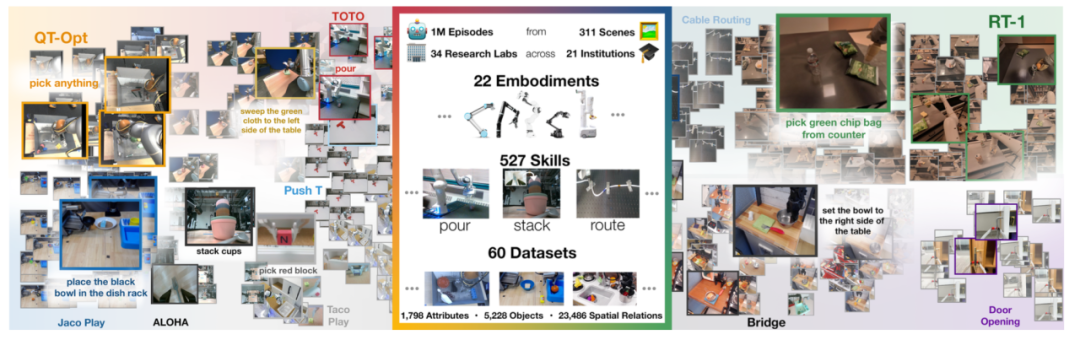
The Open X-Embodiment dataset
These attempts cannot eliminate the physical differences between robots, but they can unify the way data is recorded and read, reducing the workload of service providers in defining formats from scratch, and making it easier for customers to determine whether a batch of data can be fed into their own training pipeline.
Domestic standard development has also been initiated, with multiple somatic intelligent data and training standards being released or launched since March 2026.
From an industry perspective, the data collection industry, as part of the data infrastructure that serves as the "brain" for robots, is on the cusp of a breakthrough. In the future, once the technical direction of foundational models converges and the industry reaches a consensus on data standards, the value of high-quality data may be revalued.
Reference materials:
In a small factory in China's eastern province of Jiangsu, a robotic arm is being trained to perform a task that has long been the exclusive domain of human workers: folding shirts. The robot, developed by a local tech firm, is part of a broader effort by the Chinese government to automate the country's manufacturing sector, one mundane task at a time. With the help of artificial intelligence and machine learning algorithms, the robot is able to learn from its mistakes and improve its folding technique with each passing day. The goal is to create a robot that can fold shirts with the same speed and accuracy as a human worker, a feat that could revolutionize the textile industry and free up human workers to focus on more complex tasks.
Lowering the Noise Floor on Robot Data, XDOF, June 2026
Inside the Data Acquisition Factory: In-Depth Discussion of the Robot Data Desert, the Four-Layer Pyramid, and the Tree Planter, Silicon Valley 101, May 2026
Embodied Data Collection Industry Chain Survey: Humans Collected by Machines, Yazhi Guangnian, June 2026