
Produced by | Huxiu Auto Team
Author | Xing Shubo
Illustration | AI-generated image designed by the author
Starting from September 1, 2026, the State Taxation Administration and other departments jointly announced that the consumption tax on lithium-ion batteries will be levied at a rate of 2%, which will be increased to 4% from September 1, 2027. Meanwhile, sodium-ion batteries, solid-state batteries, and fuel cells will continue to be exempt from tax until December 31, 2028.
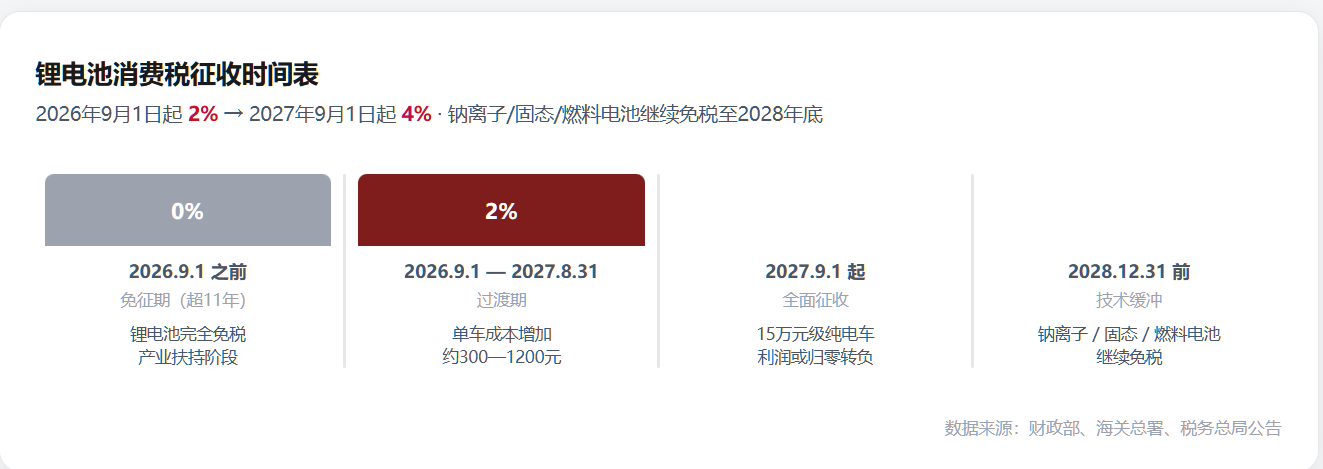
Battery Consumption Tax Schedule
This is not an isolated tax adjustment.
Huang Ya'na, deputy researcher at the Institute of Industrial Economics of the Chinese Academy of Social Sciences, noted: "In 2015, when tax exemptions were implemented, the industry was still in its infancy; now China's photovoltaic and lithium battery industry chains dominate globally. The inclusive tax exemption policy has completed its historical mission of 'helping the industry get started'."
After 11 years of protection, the lithium battery industry is entering a period of transformation.
Battery Makers: Some Rush Ahead, Others Wait and See, Industry Leaders Bide Their Time
On the eve of the policy's implementation, the tension in the industry chain has become palpable.
According to Huxiu, some energy storage battery manufacturers started concentrated shipments at the end of August, hoping to complete factory deliveries and issue invoices before the policy takes effect on September 1.
The reason is simple: orders that complete delivery and invoicing before September 1 will not incur the 2% consumption tax. For example, for a 500 million yuan contract, the company can save around 10 million yuan in costs.
Guangda Securities noted in a report that prior to the September 1 tax implementation, battery manufacturers may experience a "rush to install" effect due to concentrated shipments and advance inventory preparation, which could lead to a short-term surge in August production data.
However, the reactions from various parties are not consistent.
According to Xinhua Finance, CATL did not adopt a "one-size-fits-all" price increase model, but instead implemented a layered and flexible negotiation strategy. During its 2026 semi-annual earnings call, CATL stated that "related policy adjustments have a minimal impact on the company's operations," and customers have generally expressed a willingness to share the burden.
Several battery manufacturers have expressed support for the policy in their respective announcements and media interviews, and their shipment plans are currently unaffected.
Guoxuan High-Tech stated that its August shipment pace was "at a normal level". Xinwangda said "the specific price increase plan has not been finalized, but the direction of cost transmission is clear". BYD Lithium said its battery production capacity and market demand have long been in a state of tight balance, and the shipment pace itself has already been at a relatively high level, with no additional disruption during the policy window period.
But BYD is also the first to "take action".
According to the China Business News, BYD Lithium announced the "Notice on Price Adjustment for Conducting Consumption Tax Costs" ahead of others, explicitly stating that from September 1, domestic sales products will be subject to an additional 2% consumption tax on the original tax-exclusive price. Upstream lithium-electric core materials company Hunan Yuenergy acted even earlier, raising the price of its entire series of lithium iron phosphate products by 2,000 yuan per ton from August 1, firing the "first shot" in the industry chain's cost adaptation to the new policy.
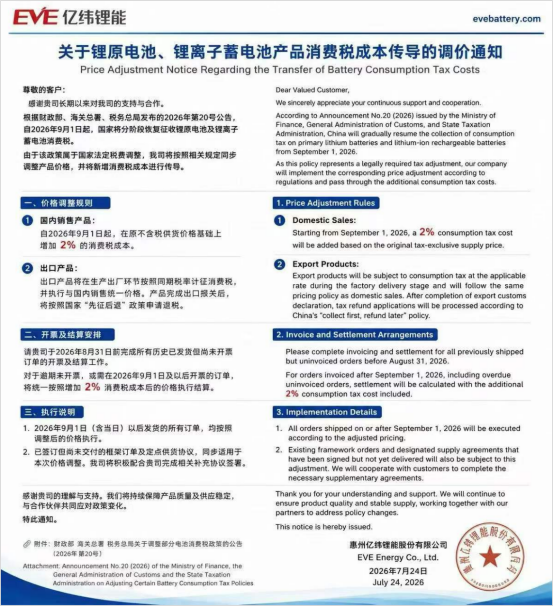
Circulating online, unconfirmed by the manufacturer
According to Hu Song, a senior expert at China Automotive Data Co., Ltd., in the short term, battery companies will mainly bear the increased tax burden, as the supply agreements between battery companies and automakers are generally long-term and stable, and will not be adjusted immediately with market changes. However, in subsequent price negotiations, the costs will be gradually passed on, and may eventually be partially transmitted to consumers, although the impact will not be very noticeable.
In other words, the first wave of pain is borne by the battery factories themselves, but the pain won't disappear - it will just be passed down the industry chain.
The divergence among battery manufacturers was destined from this moment on. Industry leaders rely on their scale to dilute tax burdens and use their bargaining power to share costs with customers. Second-tier companies seize the window of opportunity, issue price adjustment notices, and pass the pressure on to upstream material suppliers. The most struggling ones are the third- and fourth-tier battery cell manufacturers that have neither scale nor the ability to renegotiate prices, as they are bound by low-priced long-term agreements - their gross profit margins are already only in the single digits, and a 2% tax is enough to erode half of their profits.
Can Automakers Endure with a 1.5% Profit Margin?
Battery makers have issued price hike notices, and automakers are the ones absorbing the increase.
The problem is that automakers themselves are struggling to stay afloat. Data shows that from January to May 2026, the profit margin of automobile manufacturers was only 1.5%. Many car companies' per-vehicle profits were only a few dozen yuan, and some were still in a state of loss.
The battery consumption tax incurs a cost of
According to data from GG-Li, in August 2026, the average price of domestic 314Ah lithium iron phosphate energy storage cells was approximately 0.365 yuan/Wh. Taking a new energy vehicle equipped with a 60kWh battery as an example, under a 2% tax rate, the battery cost per vehicle increases by about 438 yuan; under a 4% tax rate, the increase reaches 876 yuan.
Based on the mainstream 150,000-yuan-level household pure electric vehicles equipped with 80kWh ternary lithium batteries, the additional tax burden in the 2% stage is approximately 1,200 yuan, and in the 4% stage it reaches 2,400 yuan. If calculated according to the market mainstream, the cost increase per pure electric vehicle is between 300 yuan and 1,000 yuan. (Note: The industry profit margin is not the net profit margin of a specific vehicle, and the 150,000-yuan retail price also involves value-added tax, channels, sales expenses, after-sales, and vehicle structure differences, for reference only)
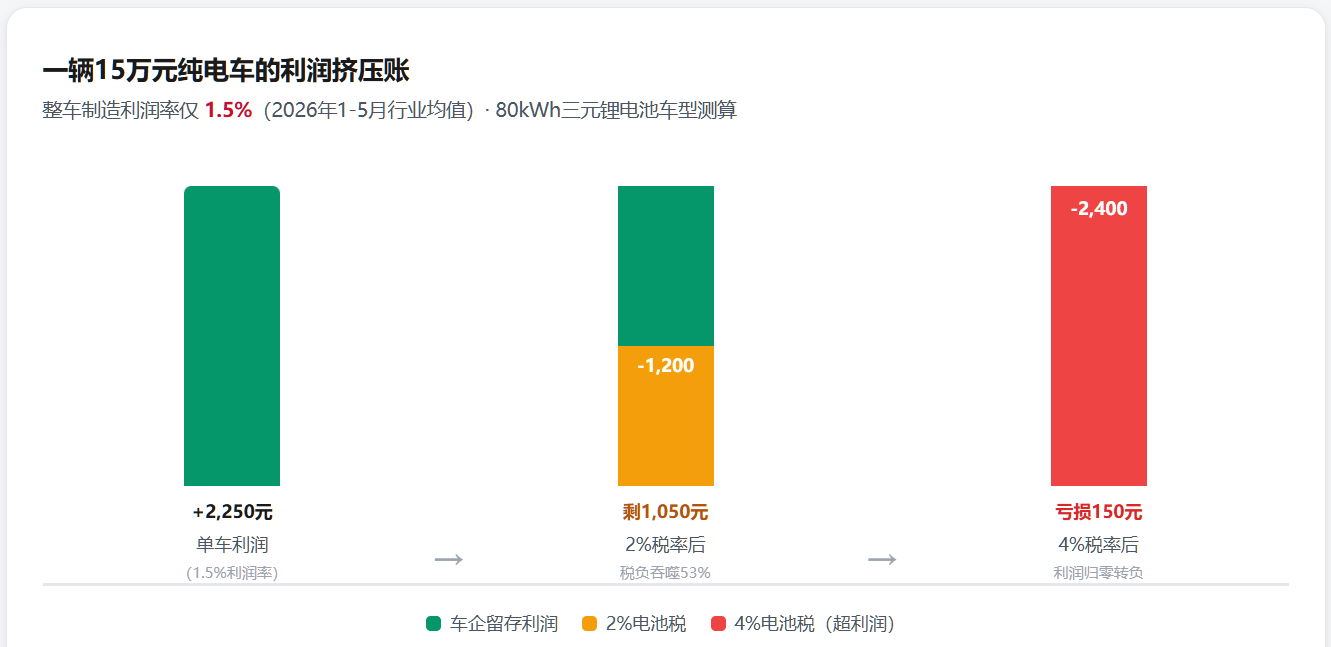
Husheng Graphics: Estimated Losses of Electric Bicycles Due to Battery Consumption Tax
Let's do a simple arithmetic problem: a 150,000 yuan pure electric vehicle, with a 1.5% whole-vehicle manufacturing profit margin, has a single-vehicle profit of approximately 2,250 yuan. If it is equipped with an 80kWh ternary lithium battery, the 2% battery consumption tax brings new costs of around 1,200 yuan, which is equivalent to swallowing up more than half of the profit. By 2027, when the tax rate rises to 4%, the new cost will be 2,400 yuan, and the theoretical profit will directly drop to zero or even turn negative.
In other words, automakers are not earning a little less, but are struggling at the threshold of whether they can earn a profit at all.
Li Yanwei, a member of the expert committee at the China Automobile Dealers Association, believes that in the face of intense market competition, car companies will likely absorb the increased cost of the battery consumption tax themselves and will be unable to pass it on to consumers, "unless everyone raises prices together, but price hikes are difficult to implement."
A marketing department head at a domestic automaker told China Consumer News that the new energy vehicle industry is currently experiencing intense price competition, and if battery manufacturers pass on their tax burden to automakers, the automakers will be unable to further pass on the price increase to consumers, and can only squeeze their own profit margins.
Industrial Securities' macro chief analyst Duan Chao views this policy adjustment as one of the mild measures against "internal volume." China Photovoltaic Industry Association consultant expert Lü Jinbiao also pointed out that the adjustment is "mainly to guide new energy manufacturing not to engage in low-price competition, but rather to prioritize quality and price accordingly." The implication is that when the entire industry is selling at a loss, adding a bit of tax to force everyone to recalculate may not be entirely bad.
Carmakers Show Different Abilities to Withstand Pressure Under Consumption Tax
The announcement clearly states in Article 6 that taxpayers who produce and use taxable battery products for continuous production of taxable battery products are exempt from paying consumption tax. Some media comments suggest that companies like BYD, Great Wall (Honeycomb Energy), and Geely, which have already achieved self-production of batteries, can legally avoid taxes.
This is inconsistent with the facts.
According to documents from the State Taxation Administration, it is explicitly stated that self-produced batteries used to assemble automotive products are considered "used for continuous production of taxable products other than batteries" and should be declared and pay consumption tax when transferred for use. This means that companies such as BYD, Great Wall (Honeycomb Energy), and Geely, which produce their own batteries, cannot "legally avoid" this tax, but instead incur tax obligations when the batteries are transferred to the final assembly stage. Their true advantage lies in internal settlement, supply chain efficiency, and flexibility in profit adjustment, rather than tax exemption.
However, from a side perspective, self-produced batteries do have a comparative advantage in terms of battery pricing power.
BYD's vertical integration spans from lithium mines and cathode materials to battery cells and packs, allowing the company to self-produce and self-use batteries without going through sales channels, thereby reducing industry risks through internal synergy. Great Wall has also achieved a closed-loop of self-supplied batteries through its Hive Energy platform. Geely's Quzhou Jikang and Yaoneng Battery are also rapidly scaling up production. Although Tesla does not produce battery cells in China, its deep binding with CATL and scale effect give it sufficient flexibility in pricing negotiations.
The ones truly feeling the pressure are those automakers "swimming naked": they have no battery production capacity, thin profit margins per vehicle, and annual sales volumes that are too small to dilute costs in procurement negotiations. They face two transmission chains - battery manufacturers passing on tax burdens, while market competition does not allow them to raise prices, further compressing the profit margin in between.
Of course, the tax burden will not be evenly distributed across each link and will not be automatically passed on downstream. Where it stops depends first and foremost on the contract structure.
The first category is the annual long-term agreement between battery manufacturers and car companies. According to Hu Song, a senior expert at China Automotive Data Co., Ltd., the supply between battery companies and car companies is generally based on long-term stable prices, which will not be adjusted immediately with the market. This means that after September 1, the long-term agreements that continue to be implemented will likely have the 2% tax absorbed by the battery manufacturers themselves until the next pricing cycle.
The second category consists of spot and short orders from small and medium-sized battery factories. The pricing negotiation cycle for this type of order is short, and battery factories can directly add taxes to new quotes. However, the issue lies in whether they dare to add taxes and how much to add, which depends on market supply and demand. Against the backdrop of overall excess battery production capacity, small and medium-sized factories that lack customer loyalty often have to absorb the costs themselves.
The third category: fixed-price contracts for energy storage projects. Energy storage EPC and system integrators lock in the total price when bidding for projects, and if tax burden changes cannot be adjusted through contractual terms, the integrators themselves become the primary bearers. A staff member from the energy storage battery division told Blue Whale News that "completing delivery and invoicing before September 1" is essentially about securing the last tax exemption window for such contracts.
Category 4: Fixed-point pricing for new models. This is the true entry point for tax burdens to be passed on to automakers. New projects are not burdened by historical pricing, and battery manufacturers can directly factor taxes into their costs when quoting prices. The issue is that, given the razor-thin profit margins of automakers currently, adding two percentage points to prices may directly result in losing fixed-point qualification.
In other words, the 2% tax will not be "passed on" but rather "borne" by the party with the least flexible contract terms and weakest bargaining power. Who holds the long-term agreement, who bears the spot market risk, who signed the fixed total price contract, and who is competing for new designated projects will determine who feels the pain first.
In the history of business, almost every industry policy exit has been accompanied by a round of brutal reshuffling. After the photovoltaic "531 New Policy", enterprises without cost advantages were eliminated in batches, and the surviving leading companies became even stronger. The lithium battery industry will likely reenact this scenario.
For automakers, the paths of differentiation are clear: the first tier consists of companies like BYD with high self-produced battery ratios, which are least affected by tax burdens; the second tier comprises core customers of CATL, which rely on procurement scale and strategic cooperation to share the burden; the third tier includes tail-end new energy brands that lack battery factories and scale advantages, and they will be the first to feel the chill of the 2% tax, facing a survival test before the 4% tax rate takes effect in April 2027.
Compact EV Models Gain Marginal Advantage
It is worth noting that the true structural role of policies may not lie in the distinction between fuel-powered vehicles and pure electric vehicles, but rather in the technological routes within the new energy sector.
In the first half of 2026, the sales growth of extended-range models slowed down significantly, with some models experiencing a decline. The high fuel consumption in charging mode and the decrease in power under high-speed conditions have made the transitional nature of extended-range technology more apparent. More efficient plug-in hybrid technology is filling this gap.
The battery tax puts consistent cost pressure on pure electric and extended-range electric vehicles, but has a relatively smaller impact on plug-in hybrids. The battery capacity of plug-in hybrid and mild hybrid models is usually only one-fifth to one-third of that of pure electric vehicles. For a 150,000-yuan plug-in hybrid model equipped with a 20-30kWh battery, the additional tax burden under a 2% tax rate would be only 150-350 yuan, far lower than the thousands of yuan of pressure on pure electric models in the same price range. As the "tax exemption bonus" for pure electric and extended-range electric vehicles is weakened, the relative economic competitiveness of plug-in hybrids is highlighted.
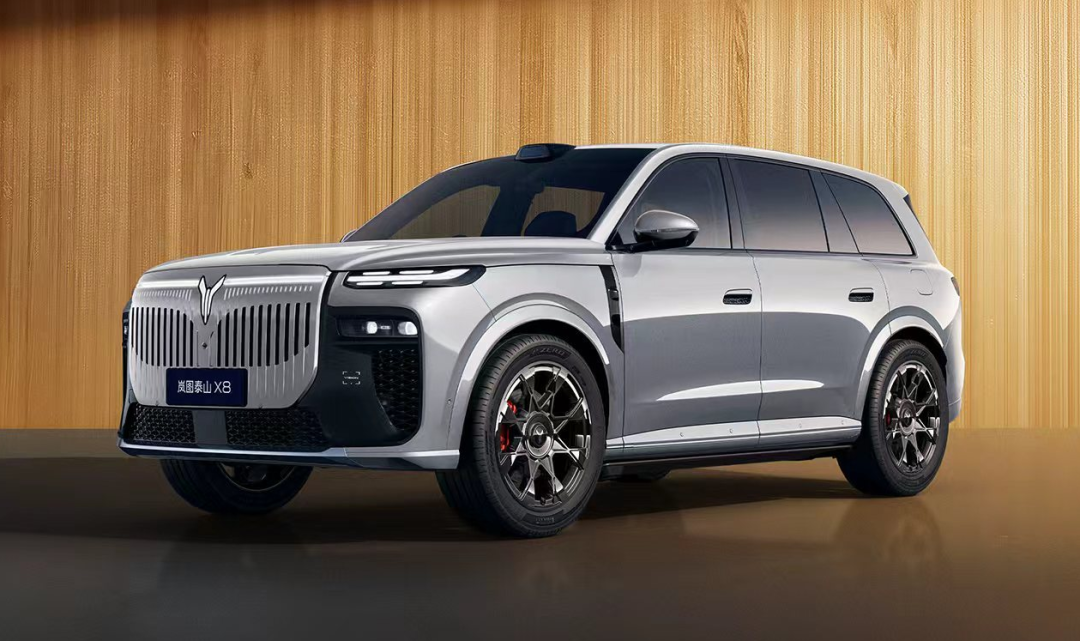
Lantrn Tai Shan Plug-in Hybrid Edition
The tax leverage has inadvertently accelerated the rational return of the technology route. Shen Yinghua, Ernst & Young's Greater China Tax Policy Leader, pointed out that the differentiated arrangement of "one tax and one exemption" in the policy - lithium batteries are taxed, while sodium solid-state batteries are exempt - helps to regulate the tax order of mature industries and provides a policy buffer period for the research and development of cutting-edge battery technologies. Sodium-ion batteries, solid-state batteries, and fuel cells will continue to be exempt from tax until the end of 2028, meaning that the policy is using real resources to leave a window open for next-generation technologies.
This is also beneficial for BYD. The DM-i hybrid system has a much smaller battery capacity compared to pure electric models, which naturally alleviates the pressure from battery taxes.
In summary, after the 1994 tax reform, automobiles and refined oil products were subject to consumption tax, resulting in gasoline-powered vehicles shouldering multiple taxes, including purchase tax, vehicle and vessel tax, and fuel consumption tax, for an extended period. The 2009 reform of road maintenance fees into a fuel tax further solidified the "more use, more pay" logic. Meanwhile, new energy vehicles have been exempt from vehicle purchase tax since 2014, and lithium batteries have been exempt from consumption tax since 2015, effectively creating a "tax haven".
This valley is not unreasonable. In the initial stages of an industry, tax incentives are the most direct means of support. However, all support has a cycle. When China's lithium battery production capacity accounts for more than 80% of the global total, and when annual electric vehicle sales exceed 10 million units, continuing to exempt lithium batteries from taxes is no longer "support," but rather "subsidizing a mature industry."
Finally, we must be aware that even if battery costs increase by thousands of yuan, the economic advantages of pure electric vehicles over their entire lifecycle still exist. The consumption tax will slightly widen the cost gap between large-battery pure electric vehicles and small-battery hybrid models, but it is not enough to single-handedly change the outcome of the technological route. Pure electric vehicle manufacturers should not give up because of this, but instead proactively embrace the policies and strive for innovation and change.
China's automotive industry has taken 40 years to transition from "market-for-technology" to "overtaking on a curve". Throughout these 40 years, tax policies have consistently played a crucial role behind the scenes. Today, the reinstatement of taxes on batteries does not signify a rejection of the new energy route, but rather marks the end of a phase: growth driven by tax exemptions, subsidies, and policy favors has reached its limit.