
What is the public's awareness of this year's summer movie season?
This forecast is more optimistic than in previous years.
This summer's box office, marked by frequent surprises that ultimately led to a phenomenal breakthrough, has come to a close with a total box office of 12.498 billion yuan and 340 million viewers, and behind the data lies a deeper reflection on the entire industry.
This is a summer season that is unpredictable and somewhat hard to understand.
This year, few industry insiders would dare claim to have fully decoded the market's logic. After all, the film market has long since entered the "middle zone."
With the lack of fresh blood and the solidification of creative methodologies, how can they fully understand the content consumption needs of the younger generation?
This disparity has been further highlighted during this year's summer season, with young people's quirky ideas and intense emotions often leaving others bewildered.
It is undeniable that this summer's slate has seen a high degree of collision between "old concepts" and "new awareness".
It can also be seen from the results of this summer's box office that some previous steadfast positions are also beginning to loosen.
Something to be grateful for
Schedule for "Screen Marketing"
Some still cling to what the old era treasured, while others have embraced the unruliness of the new.
"Screen capture" is one such typical topic of discussion.
While the 2024 market was still abuzz with the Xue Zhiqian incident that ushered in the "Year of Screen Recording", by the 2026 summer season, the success of three films could not be separated from the efforts of "screen recording marketing".
First, there is "Kung Fu Soccer".
From a marketing perspective, the operation of "Kung Fu Girls" can be seen as a "gray-scale test".
It is an industry-wide practice that even if the law does not clearly define screen recording, film producers will proactively restrict platform distribution for copyright protection. However, during the film's initial release, a large amount of screen-recorded content spread almost unchecked on social media, with marketing accounts even directly using screen-recorded materials as promotional content. This unusual "silence" was not broken until the 13th, when a belated "refusal of theft recording" statement was issued, which naturally lacked persuasive power.
When these actions are linked together, a clear logical chain emerges: the so-called "screening and release" is actually using controversial visual presentations as a draw, creating social topics through polarized word-of-mouth, and relying on Stephen Chow's nostalgic appeal, ultimately converting it into the audience's "desire for verification" to enter the cinema.
Of course, most of the audience walking into the cinema, especially those in lower-tier markets and family-friendly crowds, can also find laughter in the 106-minute film's over-the-top performances, kung fu action, and lively scenes.
Immediately following is Spider-Man: New Day
If you were to ask everyone what their most impressive image is from this version of "Spider-Man", it would undoubtedly be Peter Parker sitting alone on a pillar, basking in the warm glow of sunset as he gazes out over the entire city, exuding a sense of loneliness.
This scene was captured by numerous bloggers and became a popular post on social media, sparking analysis of the self-redemption required for one's growth and the sense of loneliness that adults should possess.
The emotionally charged moment instantly went viral across the internet, and that same "screen-capture" image spread through every comment section asking, "Is Spider-Man 4 any good?"
In addition, more than one scene has become a classic spread, and the "screenshot" of a person leaning against the bus window with a calm expression, namely Meredith Grey, has also become a favorite of many.

Image source: Internet
It can be said that the 1.5 billion yuan earned by Spider-Man 4 in the domestic summer box office created a new historical high, winning over not just the Hollywood blockbuster effect or the masses' nostalgia for this IP, but more so the emotional identification with growing up, which also relied on the help of "screening marketing".
Last but not least, the annual most absurd phenomenon - "Niu Lai".
From the first wave of audiences filming the screen and posting "skip this flop" warnings, to the next batch finding an abstract kind of amusement in those screen recordings, to more people flooding into theaters just to capture a piece of social currency—then came the wave of nationwide meme-making around "Niu Lai," which instantly became a cultural phenomenon.
The craze over "Niú Lái" has turned movie theaters into temporary playgrounds and brought the discussion of the word "movie" to a long-unseen peak, while also prompting the public to re-examine the film market and industry professionals to re-evaluate their approach to filmmaking.
Three films coincidentally point to the same fact: "screen capture" is evolving from an industry grievance into a special marketing lever.
For many practitioners, this is no different from an ideal country being eroded by reality - the Eden where the quality of works is the only passport, is being re-encoded by new consumer logic.
Rethinking "Popularity"
This also reveals a break from a certain fixed paradigm for this summer's releases, which is, just because a film has a strong word-of-mouth and takes a good first step, does it necessarily mean it will be successful?
There are two losers worth breaking down.
The 8-episode "Fight Breaks Out in Luoyang" - why doesn't the general public accept it, is it because it's not good to watch?
The key is that it's not a universally acknowledged "good-looking" design, nor does it have "discussable value".
Judging from the marketing approach of "Zheng Luoyang", two things are at its core - the improvement of domestic animation production standards and the benchmarking against "Chang'an 30,000 Miles", which sold 1.8 billion yuan three years ago, with the intention of restoring public confidence.
However, from the perspective of narrative selection and storytelling, "The Battle of Lugou Bridge" still overestimates the idea that "good creation can conquer the audience." It hasn't thought through why audiences would go to the cinema to watch a story about Cao Cao, a historical figure who isn't as popular with the masses.
Perhaps in terms of character selection, it has chosen to take the route of igniting the masses through niche circles, but the risk index has also increased sharply.
To many viewers, "Chang'an Thirty Thousand Miles" is a work that can be called a family-friendly show, with a story pace and imagination that is endearing, and features such as being able to recite poetry, count poetry, and see familiar historical figures, all of which are likable and worthy of discussion, making it something the masses are willing to pay for.
In "A Battle of Wits," if the narrative doesn't explore the appeal of Yuan Shao and Cao Cao to the masses, how can the "historical account" style of storytelling move the audience? Not to mention that the positive reviews and anticipation from viewers are all about Lü Bu and the scene of the three heroes fighting Lü Bu, while the movie as a whole is just Cao Cao and Yuan Shao carrying the show with a lukewarm reception from the masses.
History buffs are satisfied, and then what?
"Struggle in Luoyang" is a good circle-layer movie work, it is entertaining, but it is not a good movie product. The "value of being discussed" in the setup was ignored, which is the key to why this entertaining movie is not satisfactory.
The same situation also occurred in *When Stars Shine*.
Similar to "The Battle of Liao Yang", the high word-of-mouth and explosive popularity from various preview screenings and advance screenings have filled audiences with anticipation, with many sci-fi fans giving it a "thumbs up", but what exactly is stimulating the masses?
It appears to be more passive than "The Battle of Lugou Bridge", and ultimately the 73.73 million yuan box office chose to withdraw.
And who are the winners?
Among these, the case of Stephen Chow deserves special mention. His previous film, "The New King of Comedy", had already discounted the nostalgic effect of his work, so why was Stephen Chow able to make a comeback this time?
One reason worth affirming is that his active engagement in short video creation has helped him regain popularity, from continuously reinvigorating his classic old works on short videos, to entering the short drama theater business, and even opening up AI secondary creation authorization, Chow Sing Chi is not living in the past, but rather using the past to connect with the present, thus giving birth to "Chow Sing Chi 2.0".
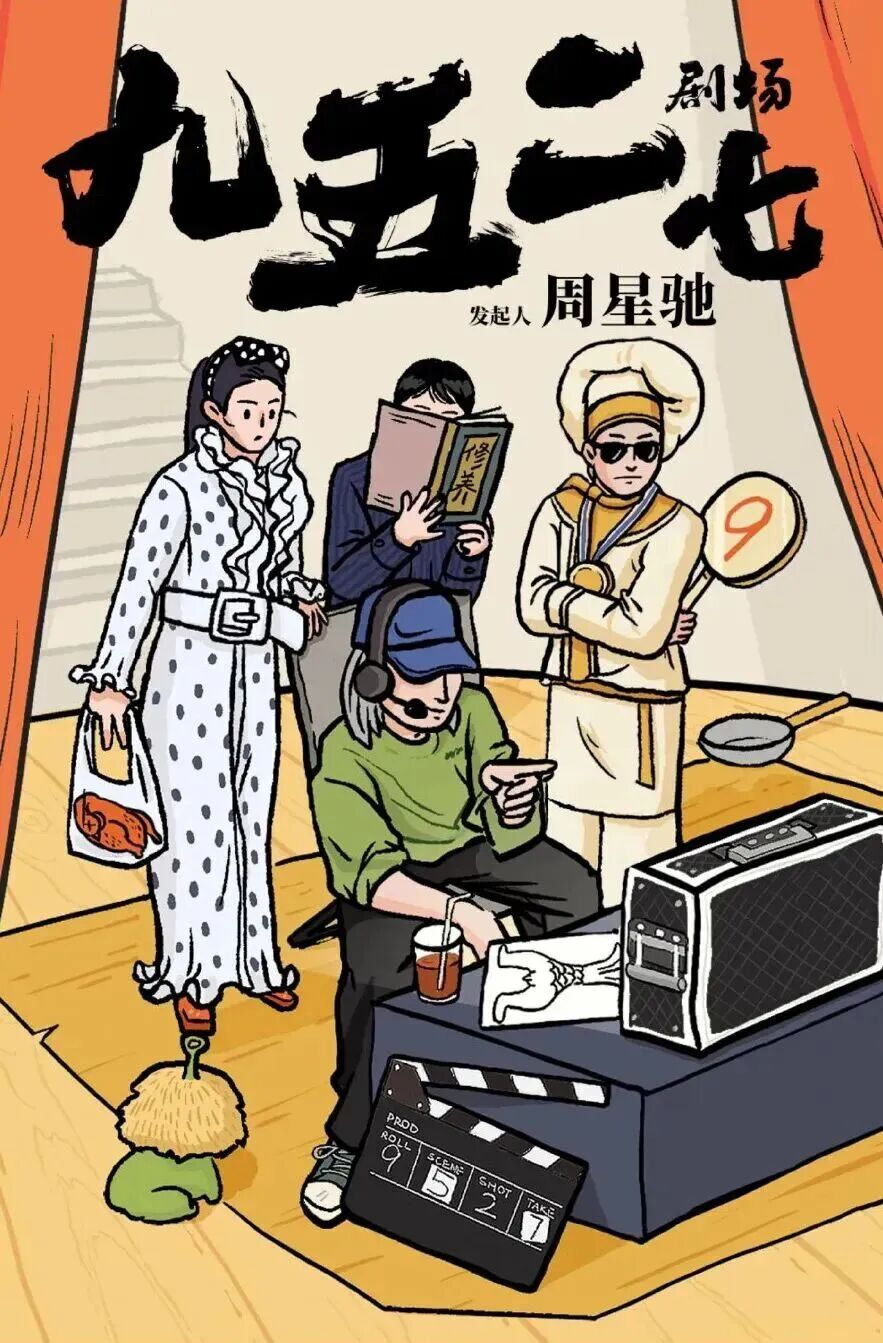
Chow Sing Chi has partnered with Douyin to establish the "9527 Theater"
What is meant by "being liked by everyone" is not about being liked by the most people, but rather about not feeling like a stranger to the majority. Short videos maintain a sense of familiarity with Stephen Chow through a low-concentration, high-frequency approach.
Chow Sing Chi's approach to rebuilding the common ground, the way Black Horse Film overturns market rules, and even the "divine stroke" of "The Coming of the Cows", all point to a structural dilemma: the internal innovation engine of film as a medium is losing momentum, and practitioners need to hold onto popular ideas to draw energy from external ecosystems.
It can be short videos, subcultures, games, communities, and AI, or even two-dimensional attributes, abstract logic, totems, and faith, to agilely capture new grammar systems, new collective emotions, and new creation mechanisms, and then replenish them to popular explosion points.
Of course, the mainstream narrative has never been permanently possessed by anyone, and as this summer's releases have shown, it is also punishing those who mistook "having once understood" for "always understanding".
Returning to the narrative of the masses' fondness for films: it's not about educating the audience on what makes a good movie, but rather acknowledging that the audience has redefined the standard of what is "good" - a standard that includes social value, emotional outlets, and a sense of participation, but not necessarily "film quality".