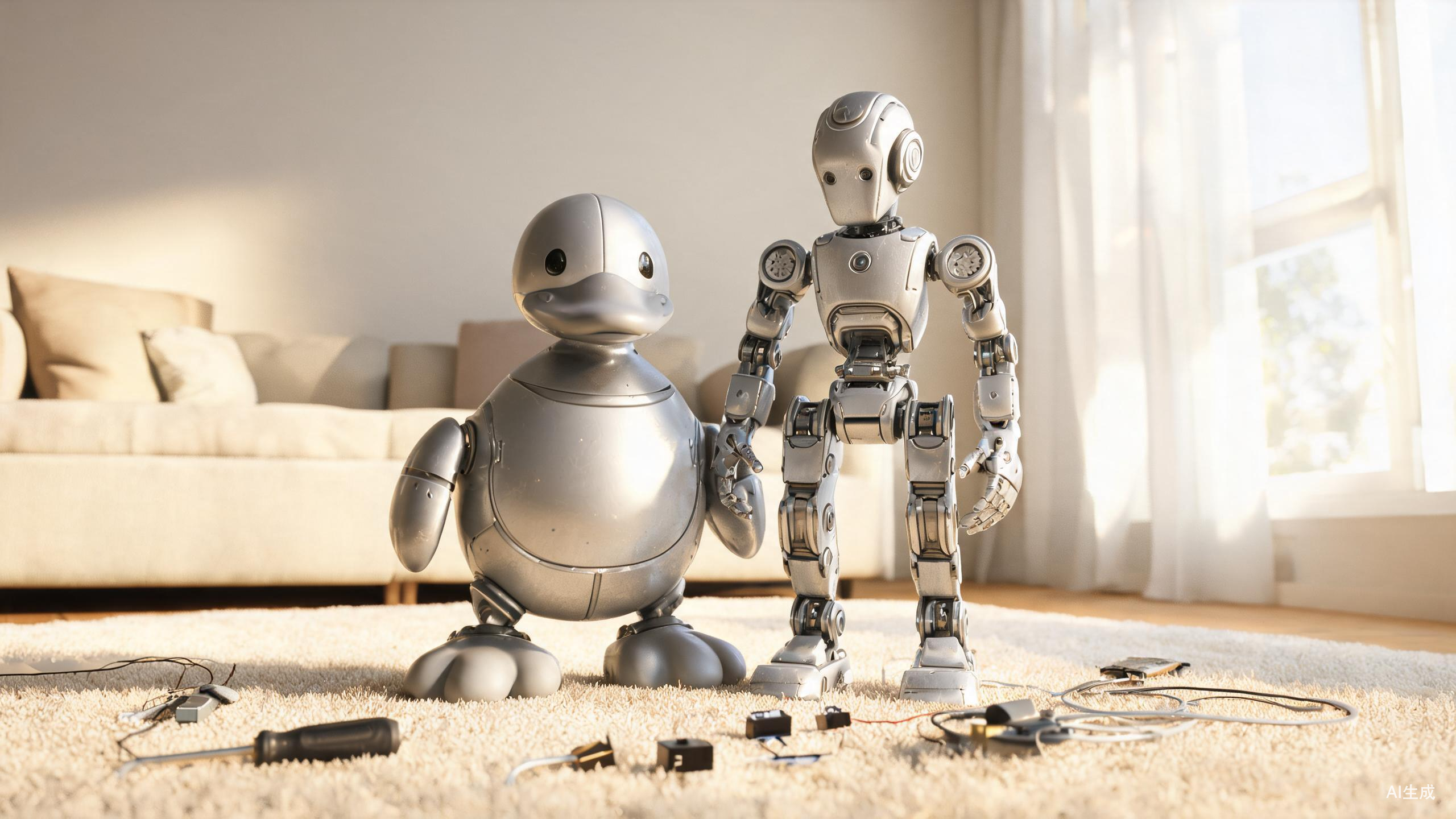
The robotics sector has recently been in a tough spot.
Meanwhile, Unitree Robotics, which just went public, saw its stock quickly pull back, at one point nearly halving from its intraday peak on listing day. Mocked by the market as a "giant remote-controlled toy," some joked that its valuation should be benchmarked not against other tech stocks but against Pop Mart—both sell "toys," just one big and one small.
Let's put aside whether this joke makes sense or not. However, it raises a more interesting question: if humanoid robots are to be valued like toys sold to ordinary people, who is the real contender that has ordinary people's wallets in its sights?
The answer may not be Yuzhu.
This change can already be felt at this year's WRC. In addition to engineers, suppliers, and investors, there are also ordinary spectators who are more like those attending a consumer electronics exhibition: watching robot performances, inquiring about prices, and considering spending a few hundred yuan to buy a "gadget" to take home for their children.
It wasn't until a few days later that this probing truly landed on the sales side.
On August 23, Shangwei New Material's subsidiaries, Qiyuan Q1 and T1, started accepting pre-orders. As of press time, the Taobao page showed a pre-sale period of 30 days, with sales exceeding 1,000 units in just three days after the product's launch.
Four days after its launch, Hugging Face's Pollen Robotics opened pre-orders for Microduck, with over 10,000 pre-orders received within five days of sales. According to the company, the estimated delivery period for new orders has been extended to 4-6 months, and it cannot guarantee that products will be delivered before Christmas.
This is a 25cm-tall, less-than-800g robotic duck equipped with 15 motors, as well as a camera, LiDAR, and two IMUs, with a launch price of $399. Pollen has pre-installed 7 actions on it, while also opening up the SDK, MuJoCo simulation environment, and complete reinforcement learning training stack, allowing users to train new behaviors in the simulation environment and then deploy them back to the physical device.
Two products were opened for booking almost simultaneously, both of which appear to belong to the emerging category of "personal robots".
But Microduck is closer to a Physical AI development terminal that can run, train and share robot strategies, while the latter attempts to stand between a development platform and consumer electronics.
Before discussing who has stronger "general intelligence", personal robots may first need to answer a more fundamental question: why do people need to own a robot?
Not All Personal Robots Are Created Equal, First Batch of Users May Vary
Microduck looks very much like a robotic pet.
But what Pollen truly wants to sell is not just a duck that can walk, fall down, get back up and kick a ball.
Pollen has opened up its SDK, MuJoCo simulation environment, and reinforcement learning training tools to Microduck, allowing users to access a complete robot learning workflow from simulation training and strategy deployment to running on actual machines.
Even its $119 developer suite includes three spare motors, motor wires, two batteries, an NFC tag, a screwdriver, and spare screws.
This combination of accessories reveals the product's imagination for its early users: you're not just using the robot, but also taking it apart, modifying it, and retraining it in various ways.
This is in line with Hugging Face's robotics layout over the past two years.
In 2024, Hugging Face launched LeRobot; in April 2025, it acquired Pollen Robotics, which has long been engaged in robot research and development. At the time, Hugging Face's vision was straightforward: it hoped that robots could be open, affordable, and private, allowing more participants, from hobbyists to enterprises, to enter robot development.
Microduck is certainly not a bare development board, as it supports controller operation, comes with pre-installed actions, and has a design more akin to consumer electronics, but based on the currently publicly available software stack, accessories, and usage process, developers, makers, and robotics enthusiasts still make up a very important layer of its user base.
The robotics industry is certainly not short on development platforms. UBTech's humanoid robot also has an open development interface, but there is a completely different purchasing decision between tens of thousands of yuan and $399. This also gives robot development the opportunity to shift from professional equipment procurement to personal interest consumption.
Keyuan's Q1 has a broader scope. The PrimeBOT official website currently introduces Q1 as an embodied intelligent creation platform, clearly catering to developers, educators, and technology enthusiasts.
However, in the semi-annual report of the listed company, Shangwei New Materials' definition of its products has clearly shifted to the other side. The company has clearly positioned its consumer-level robot business in the "personal and family scenario", hoping that robots will play the role of "little companions, little assistants, and little butlers"; Q1 is defined as a consumer-level, humanoid intelligent robot for individuals and families, while T1 adds features such as outdoor mobility, intelligent following, image capture, foreign language teaching, and life reminders.
Long-term memory, proactive interaction, personality setting, character development, and emotional interaction have also been incorporated into the company's technical planning.
This difference is also reflected in the sales system.
The Q1 and T1 from Qi Yuan have simultaneously entered channels such as WeChat Mini Program, Tmall, Douyin, and Bilibili; Shang Wei also revealed that it has set up offline experience stores in Shanghai, Shenzhen, Guangzhou, Hangzhou, Wuhan, Xi'an, and Xiamen, and is building an after-sales and service system.
This is no longer a typical sales logic for robot developers.
However, personal robots have yet to become a clear product category like smartphones or PCs. They can be Physical AI hardware repeatedly trained, disassembled, and crashed by developers, or consumer electronics that aim to enter living rooms, providing companionship, interaction, and even some tool-like functions.
Microduck and Q1 thus provide a rare cross-sectional view, as robots start being sold to individuals, what kind of product answers are different industry systems giving?
The answer does not lie solely in the models and parameters. The greater difference comes from their differing understanding of the value of the "body" itself.
Cheap Bodies and Complete Bodies
Hugging Face is first and foremost an AI platform company.
Its accumulated core assets are mainly models, datasets, development tools, and open-source communities. Upon entering robotics, this AI infrastructure will ultimately encounter a problem different from large language models: robots need a physical body.
A language model can complete training, evaluation, and deployment on a server, but a robot policy ultimately must control a physical entity.
Hugging Face's LeRobot paper, published in February this year, argues that the acceleration of robot learning in recent years is due to several key factors, including increasingly affordable remote operation systems, larger-scale open data, and learning methods that can scale with data and computing power. LeRobot aims to address the issue of connecting everything from low-level motor communication, data collection and storage, to model training, inference, and real-world robot deployment, with a focus on supporting "accessible hardware platforms".
It can be seen that in Hugging Face's system, low-cost hardware also has the opportunity to reduce another even scarcer cost: the cost of real robot experiments and data production.
The LeRobot Humanoid, released in May this year, has already embodied similar ideas. This humanoid robot project utilizes 3D printed structures, off-the-shelf components, and relatively inexpensive electronic devices, with the official estimated cost of current components at around $2,500. It emphasizes not high-end hardware performance, but rather enabling users to build, modify, and conduct learning experiments around the robot themselves.
Microduck has further lowered the threshold to $399.
On the other hand, Hugging Face's previously released SmolVLA also demonstrates what kind of relationship can exist between low-cost hardware and community data.
SmolVLA has only around 450 million parameters, can run on a CPU, and can be trained on a single consumer-grade GPU. More importantly, its pre-training data is entirely sourced from the LeRobot community's publicly shared robot data, including real data collected in various environments such as laboratories and homes.
When robot hardware becomes cheap enough and training tools are standardized, the producers of real robot data will not be limited to just a few large laboratories.
However, SmolVLA is currently mainly verifying mechanical arm operation tasks, while Microduck's most prominent feature at this stage is its strong reinforcement learning capabilities, such as bipedal movement and posture recovery.
What one duck learns, can another robot use? There is no answer yet, which is also the cross-ontology problem that robot learning has long faced.
How much of the data, policies, and training experience generated by Microduck can be transferred out of the specific Microduck body and migrated to the broader LeRobot ecosystem remains to be verified.
Perhaps Hugging Face is continually lowering the threshold for real robots to fall into developers' hands, and waiting for a larger closed loop to take shape: more affordable bodies - more real robot experiments and data - better strategies - and then back to more robots.
What Shangwei needs to address is another matter altogether.
In 2025, after a change in control, Shangyi New Materials made robots one of its largest new business investments.
In the first half of 2026, Shangwei New Materials' research and development investment reached 1.80 billion yuan, with approximately 1.64 billion yuan invested in the research and development of consumer-grade humanoid intelligent robots. During the same period, the company's net profit attributable to the parent company was a loss of approximately 1.67 billion yuan. As of the disclosure of the semi-annual report, the robot business had already received prepayments of 2.1 billion yuan, but as of the end of June, it was still in the research and development stage and the verification of application scenarios, and had not yet generated operating revenue and profit.
Compared to Microduck, Q1 Choice retained more of its "body".
According to WeRide, the Q1 is approximately 88 cm tall and can be folded to fit into a standard backpack. The entire machine utilizes a self-developed miniaturized QDD direct-drive joint, while retaining full-body force control and high dynamic response capabilities. WeRide said the company has independently developed the motor, reducer, and drive control scheme, and through structural and material optimization, has reduced the overall weight of the joint by 30% while maintaining the same joint performance.
In other words, both companies are working on miniaturizing robots, but they are shrinking different things.
Hugging Face's priority is ensuring that a real robot learning pipeline can still run.
Q1 aims to minimize size while preserving the motion, force control, interaction, and consumer attributes of a full-body robot as much as possible.
The former faces a development cost issue, while the latter faces a more typical product engineering problem: how to get a more complete product through costs, manufacturing, supply chains, channels, and after-sales service, and ultimately into households?
As for the interaction and motion data generated by Q1 and T1 when they enter consumer households, it is unclear whether this data will be fed back into the training system and in what form it will create a closed loop, as Upward has not provided sufficient clear public information.
This is another unverified blank.
What Does it Take to Succeed in the C-End Market?
And as robots move towards individual users, the body may become one of the most expensive variables.
More joints mean more actuators, gearboxes, encoders, and drivers; higher dynamic performance means increased requirements for structure, materials, batteries, and thermal management; entering the home also raises issues of safety, reliability, falling, maintenance, and after-sales service.
This is also why robots that have already entered the C-end market are diverging into completely different physical forms.
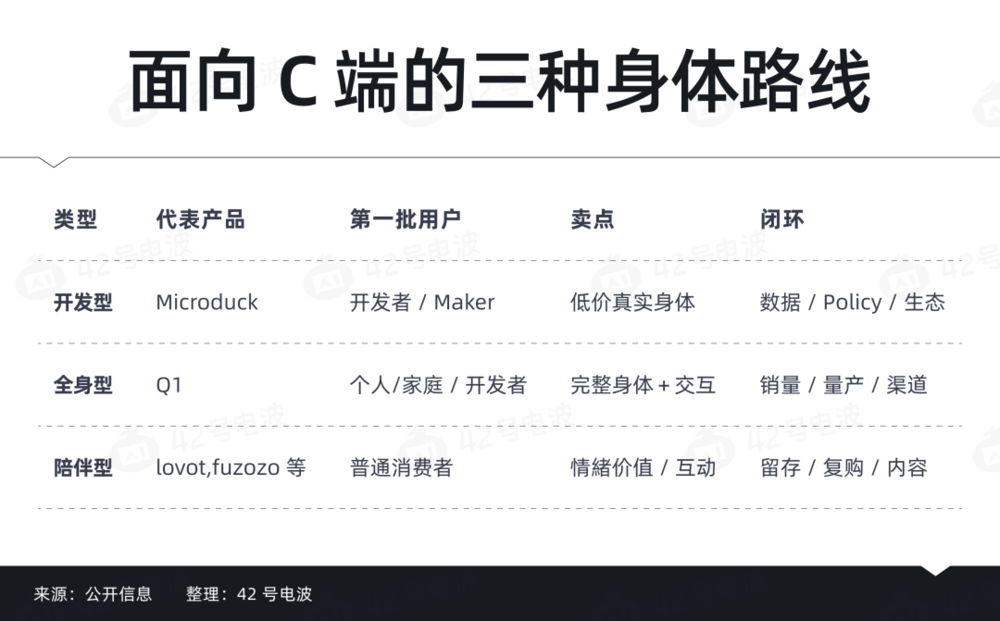
Microduck has opted for the smallest possible entity.
A third-party open-source project, Microduck Replica, has conducted a reverse analysis of Microduck's hardware based on the MJCF simulation model, STL files, and runtime code publicly released by Pollen.
Although not an official BOM, this teardown still provides an interesting cost breakdown.
The project utilizes Microduck, which is equipped with 15 Dynamixel XL330 actuators, a Radxa Zero 3W main control unit, an IMX219 camera, a ToF sensor, and an IMU, among other hardware components.
Let's do the math. Currently, the single-unit retail price of the XL330-M288-T on the ROBOTIS US official website is $27.49, and 15 units would total approximately $412, which already exceeds Microduck's $399 launch price for the entire machine.
Of course, the retail price is not equal to Pollen's bulk procurement cost, but obviously $399 is not a price that an individual maker can replicate based on the retail bill of materials.
Compact body size, mature standard components, scale procurement, and highly standardized hardware design have collectively lowered the threshold for developing a genuine bipedal robot to a level that developers can afford.
What's even more interesting is that this change has already begun to have a reverse impact on the component market. On August 31, Usree released a rather interesting poster, directly referring to its S288 brushless digital servo as the "high-performance alternative to Microduck servos".
To some extent, when a robot starts to have alternative servos, replica schemes, printed structural parts, and community policies surrounding it, it also starts to have a bit of a "developer toy" feel to it.
Q1 refers to another cost curve.
It didn't continue to cut down on overall mobility, but instead tried to rely on miniaturized joints, self-developed core components, material optimization, and supply chain coordination to fit a much more complete robot into an 88-centimeter body.
According to the semi-annual report of Shangwei, the company is developing its self-researched QDD while promoting production line cooperation, whole machine assembly, and mass production process optimization with external partners, and establishing an e-commerce, offline experience, and after-sales system.
Two routes have shown obvious differences, with Microduck being more like: small form factor + mature standard components + lightweight perceptual configuration + open software stack + developer community.
In Q1, the disclosed route is closer to a small-sized full-body robot with self-developed core joints, external supply chain collaboration, and a consumer-level channel and service system.
T1 has taken a different approach, capable of autonomously switching between a bipedal humanoid form and a quadrupedal form, adapting to different scenarios with the same body, which in itself is an answer to the question of how many bodies are needed, perhaps not more bodies, but a body that can change.
But they are not the entire answer for C-end robots.
Prior to these, companion robots such as Lovot and Fuzozo had already explored the third path, which involves reducing the complexity of the physical body if a complete one is too expensive, and instead focusing limited hardware costs and computational resources on voice, vision, proactive interaction, personality, and emotional value.
It's clear that consumers don't necessarily have to wait until robots can perform tasks to be willing to buy them. For some products, companionship, interaction, personality, and entertainment can be selling points in themselves.
The three different trade-offs for C-end robots ultimately all answer the same question: how much "body" does the first truly mass-market robot for personal use really need?
Microduck is still working to become more fun and user-friendly, while Q1 continues to emphasize developers and secondary creation, neither of which has yet reached the end of being purely consumer products.
In the end, factories will calculate how many workers robots can replace, how much efficiency they can improve, and how long it takes to recoup their investment. However, most people do not create an ROI table every time they buy trendy toys, game consoles, cameras, or even a new mobile phone.
This is also why the comparison between Yushu and Pop Mart, which may seem frivolous at first glance, is worth reconsidering.
Many of Yushu's former humanoid robot developers entered the field for research, algorithm verification, or secondary development purposes. Products like Microduck have further lowered the price of a real robot body to a range that individual developers may be willing to buy out of interest.
Development itself is also starting to have the opportunity to become part of consumer value.
If enough people ultimately prove willing to pay for that value, the market personal robots truly open up may be far more than a scaled-down version of the industrial robotics sector.
Instead, it is a consumer demand that the robotics industry has rarely taken seriously in the past: buying it simply because someone really wants to own a robot.