
When Tim Cook last walks into the office as Apple's CEO, it will likely be without much fanfare.
In 15 years, he rarely created dramatic moments like Jobs, no black turtleneck, no long pauses, and few sentences that would be repeatedly quoted in tech history.
Even at Apple's most important product launches, he typically emerges from the side of the stage, says "Good morning", and then cedes most of the time to the people in charge of the products.
On September 1, John Ternus officially took over as Apple CEO, replacing Cook, who at 65, transitioned to the role of Executive Chairman, marking the end of a 15-year tenure as CEO.
When Cook took over Apple from Jobs in 2011, many people did not have faith in him.
Steve Jobs is too easily written into a narrative. Ousted from the company he founded when he was young, only to return over a decade later; creating the Mac, iPod, iPhone, and iPad; and despite being gaunt from cancer, still standing on stage telling everyone what the next product should be.
Cook doesn't have such a story.
He was born in a small town in Alabama, where his father worked at a shipyard and his mother at a pharmacy. After joining Apple in 1998, his most important task was to clear inventory, close warehouses, and reorganize the supply chain.
Jobs focused on discussing products, while Cook was concerned about when hundreds of thousands of devices could be shipped from Asian factories to the US and Europe.
A product genius handed Apple over to a supply chain manager.
Later, for 15 years, Cook lived with this contrast.

He is not Jobs
Cook knew about it very early on.
After Jobs' death, he would sometimes ask himself how Steve would handle the problems he was facing.
Before he passed away, Jobs had discussed Disney with him, and after Walt Disney's death, the company's managers would often ask themselves when faced with a decision: "What would Walt do?"
Jobs did not want Apple to become like this, meaning don't imitate me, do what you think is right.
That statement may have saved Tim Cook. The world wanted him to be Steve Jobs, but Cook lacked both the ability and the temperament for it.
Cook doesn't erupt like Jobs did. His control freak tendencies are hidden in a different place: numbers.
At internal Apple meetings, Cook would repeatedly ask a question, and if a leader couldn't answer, he wouldn't usually blow up, he would just keep asking, and often this silence was more unsettling than anger.
This is how industrial engineers make sense of the world: take apart a complex system, then find the number that doesn't add up.
Later, Apple also became more like Cook - more stable, more precise, and less prone to mistakes.
Of course, it also gives the world fewer and fewer surprises. That, precisely, has become the biggest controversy of Cook's 15 years.
People have been waiting for the next iPhone from Cook, but it has yet to arrive. With the emergence of ChatGPT, Apple has rarely found itself as a follower, as Siri has failed to deliver the upgrades the outside world has been expecting, and Apple Intelligence has experienced delays and adjustments.
A question has followed Cook for 15 years: Has Apple stopped innovating? Later, this question was often simplified into another one: What would happen if Jobs were still alive?
This is not fair to Cook, but sitting in that position was never about being fair.
A person without myths
Cook has always known he's not the central figure in the story.
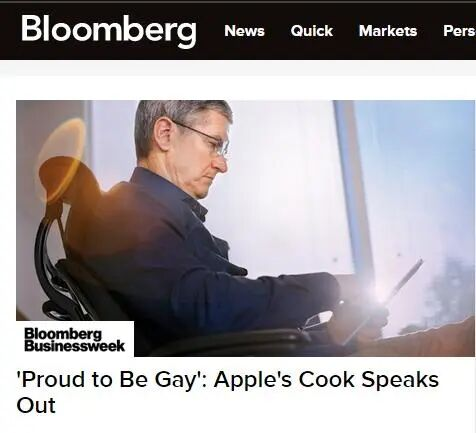
In 2014, he publicly announced that he is gay in an article published in Bloomberg Businessweek.
It's not easy for the CEO of one of the world's largest tech companies. Cook has explained that he has always valued his privacy and never thought his sexual orientation should be a subject of public discussion.
However, he has received letters from some young people, including those who have been rejected by their families due to their sexual orientation, bullied, or are unsure of how to face life.
Cook ultimately decided to go public, writing the words: "I'm proud to be gay."
This won't help sell one more iPhone, and may even bring additional risks to a CEO who needs to face different cultures, governments and consumers around the world.
But Cook did so anyway, saying that if his openness could help a child, then sacrificing some privacy was worth it.
This incident provides another entry point to understanding Cook, who, unlike Jobs, does not believe that personal will can distort reality, but rather believes in responsibility.
Perhaps this has something to do with his upbringing environment.
As a child, Cook rode his bike past a location where people were burning a cross, a symbol of the American racist organization Ku Klux Klan, and yelled at them to stop.
Years later, Cook would still bring up that image. Under Cook's leadership, Apple also spoke more frequently about privacy, the environment, equality, and supply chain responsibility than it did during the Jobs era.
Of course, Cook is not a saint. Apple is still a company that has to face profits, regulations, supply chains, and global markets. But Cook seems to have been trying to prove a point: once a company becomes big enough, it can't just be about how much money it makes.
This is very different from Jobs. Jobs left behind a kind of quasi-religious productism, while Cook has slowly added another layer to Apple: responsibility.
It may not necessarily make Apple cooler, but it makes Apple more like a truly global company.
Cook's best product
Judged solely on business performance, Cook's results are even somewhat exaggerated.
When he took over in 2011, Apple's market value was approximately $350 billion. Fifteen years later, that number has risen to around $4.5 trillion.
When Jobs left Apple, the most important thing he left behind was the iPhone, with the company's fate highly concentrated on a single product.
Over 15 years, Cook transformed the iPhone from a great product into the center of a business system. The Apple Watch, AirPods, Mac, and iPad continually expanded the hardware boundaries, while the App Store, Apple Pay, and iCloud kept apps, payments, and data within the Apple ecosystem, and Apple Music, Apple TV, and AppleCare further extended the relationship between users and Apple.
By early 2026, Apple had more than 2.5 billion active devices worldwide. Cook turned a one-time hardware purchase into a years-long relationship between Apple and its users.
If you had to name Tim Cook's most important product of 2015, the answer might not be the Apple Watch or the AirPods.
Rather, it is Apple itself.
He took the series of great products left behind by Jobs and assembled them into a highly efficient machine in the history of business.
This played to Cook's strengths, namely industrial engineering, supply chain management, and systems management, making complex things stable.
In this sense, Cook has not betrayed himself.
The person who took charge of Apple's supply chain in 1998 and the CEO who later managed a trillion-dollar company were essentially doing the same thing: making the system run better.
The issue is that the tech industry has never only rewarded systems that work.

Apple is increasingly like Cook
This may be the most difficult aspect of evaluating Cook.
He was so successful that the problems Apple later exposed were also increasingly like his personality, being cautious, stable, profit-oriented, and avoiding uncontrollable risks, while continuously optimizing products that had already been proven successful.
A company that is increasingly unwilling to fail.
Jobs was willing to push immature new things to the world and bet that they would eventually change the industry.
Under Cook's leadership, Apple is more accustomed to waiting until technology is mature before entering the market, a strategy that is effective most of the time.
AI may be different, as when ChatGPT emerged, Apple did not define this wave. The subsequent exposure of problems with Siri and Apple Intelligence also made Apple seem slow for the first time.
The most dangerous thing is not even that the model parameters are outdated.
Instead, it's the business model that Apple has built up over the past 15 years that Agent may want to change.
In the past, the entire mobile internet was built around apps, and the entrance to these apps was controlled by the operating system, giving Apple enormous power.
The real issue Agent wants to change is: why do users still need to open the app themselves?
If AI can understand tasks and then call upon different services, the primary entry point for users in the digital world may shift from apps to AI.
Then the question becomes: who owns the AI? If it's Siri, Apple still controls the gateway.
If not, Apple may still have the best screens, chips, and devices, but the most important step between it and users may no longer naturally belong to Apple.
This may be the most ironic challenge left for Apple by Cook.
He spent 15 years taking Apple's old world to the extreme. The next CEO may first need to do just the opposite, and question parts of it.
In recent years, Cook has been repeatedly asked about his successor.
His answers are usually restrained, Apple has a very detailed succession plan, there are many excellent people within the company, and he hopes the next CEO comes from within.
The answer has now emerged: John Ternus, a fellow veteran hardware engineer who has also worked at Apple for many years.
Cook didn't leave like Jobs did due to illness, but rather handed over the CEO position when Apple was still extremely profitable and its market value was still among the highest in the world.
This could also be the most ideal way for an operator to leave, with nothing stopping suddenly because of their departure.
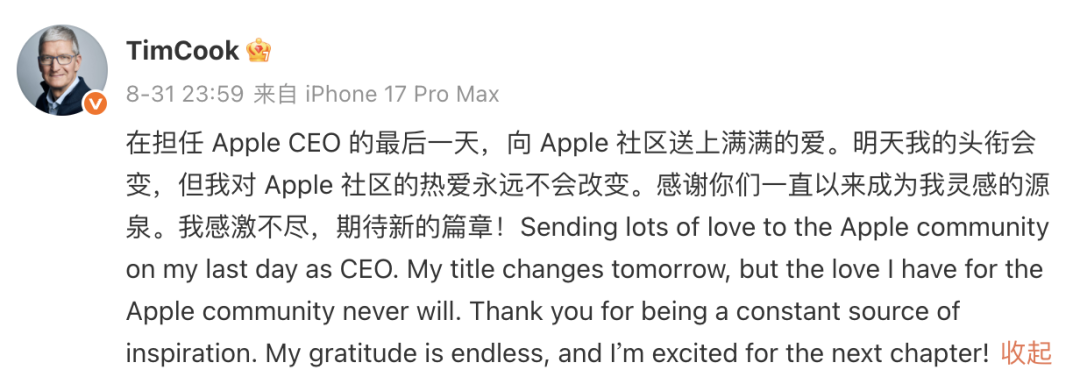
For someone who spent 15 years reducing system uncertainty, this could be a fitting conclusion.
But there was one problem he couldn't solve for his successor: in 2011, everyone was worried about what would happen to Apple without Jobs.
"I "I top of a top of a top of a top of a "I "I top of top of a top of a "I " "I " "I " "I " "I " "I " " only minors top of only minors top of only only minor " " " " " " " " " " " " " " " " " " " " " " " " " " " " " " " " only " " " " " " " " only " " " " " " " " " " " " " " " " " " " " " of " " " " " " " " " " " " " " " " " " " " " " " " " " " " " " " " " " " " " " " " of " " " " this " " " " " " " " " " " " " " "." " " " " " " " " " " " " "." " " " " " " "." " " " " " " " " " " " " " " " " " " " " " " " " " " " " " " " " " " " " " " " " " " " " the " " "
By 2026, the question has been turned on its head: what would Apple be like if it were no longer run the way Cook has been running it?
Because the greatest legacy left by Cook is no longer just the supply chain, 2.5 billion devices, or a $4.5 trillion market value.
He left behind a way of running Apple: taking what's already right and pushing it to the extreme. This approach helped Apple navigate the 15 most perilous years after Jobs' passing and brought the company to where it is today.
The challenges that the next CEO will face are already different from those of 15 years ago.
What Jobs left for Cook was an iPhone era that had yet to be fully developed, while what Cook will leave for Ternus is a machine that has been fine-tuned to near perfection.
When a company's old methods no longer work, change is not difficult. What's difficult is changing when they still do.
Cook spent 15 years proving that Apple can thrive without Jobs, but starting tomorrow, Apple may need someone who is not so much like Cook.