Produced by Huxiu Tech Team
Author | Liang Kaer
Editor | Miao Zhengqing
Photo | Visual China Group
The completion of Apple's power transition was hidden in a subtle yet ritualistic move.
After John Ternus took over as CEO, Apple's official X account unfollowed Tim Cook, leaving only Ternus on its follow list. Without a lengthy inaugural speech or a rush to announce strategic shifts, Apple has begun to complete the transition between old and new leaders, from social media accounts to the management team list on its official website.
However, Tenus doesn't have much time to adapt to his new role. In just one week, he will face his first major public milestone since taking over as CEO. More subtly, the most anticipated product at the upcoming launch event seems to have already been thoroughly exposed online.
A folding screen device that has been thoroughly leaked across the entire network
The closer Apple's September 9 launch event gets, the less its first foldable phone looks like a secret.
Various media outlets, analysts, and KOLs have obtained CAD drawings, third-party accessory diagrams, and machine models, and even vendors at Huaqiangbei have been seen handling prototype units in short videos. Through these fragments, the outside world has pieced together the basic outline of this product from different angles. However, the credibility of this information is not entirely consistent, and Apple has yet to confirm the product's name and specific configuration.
According to a widely circulated version, the device, possibly named iPhone Fold or iPhone Ultra, will feature a horizontal inward-folding design. When closed, it has an external screen of around 5.5 inches in width, and when opened, it becomes an internal screen of around 7.8 inches, close to a 4:3 ratio, resembling a smaller, foldable iPad.
Its most intuitive selling point is likely its thinness, with rumors suggesting its unfolded thickness is approximately 4.5mm and around 9 to 9.5mm when closed, equivalent to stacking two ultra-thin iPhones on top of each other. For Ternus, who has long been responsible for Apple's hardware engineering, this also continues the product line represented by the M4 iPad Pro, using structural and material innovations to constantly push the physical limits of consumer electronics.
What will truly determine whether Apple can differentiate itself from existing foldable screens, however, is the hinge, crease and durability. According to supply chain sources, Apple may adopt customized panels and new hinge materials to reduce the inner screen crease and achieve seamless closure. If the information is accurate, the folding technology is already in place, and what Apple needs to solve is the long-standing issue of visual fragmentation and reliability in foldable screens.
Being extremely thin also means making sacrifices. Leaked renderings and internal diagrams show that the new device may cancel the periscope telephoto lens and Face ID, and instead use a dual-camera setup on the back and a side-mounted Touch ID. The internal body may use a split dual-battery design to accommodate the internal space separated by the hinge. As for whether MagSafe will be retained, there is still disagreement among different sources.
the a top of a "(s,"(s,"(s "(s,"( "(s "(s "( "(s " "(s " "(s " "(ering a only " " also " " "(s " " only " " "(s " " only " " "(ations " " "(s " " only " " "(s " " "s " " "(s " " only " " "(s " " "(s " a " " "(s " " "(s " " "(s " " "(s " " "(s " " " " " " " " " " " " " " that " " " " " " " " " " " " " " " " " " " " that " " " " " " " " " " " " " " " " " " " " of " " " " " " " " " " " " " " " " " " " " " " " " " " " " " " " " " " " " " " "ing " " also " " " " " " " " " " " " ". " " " " " " "." " " " "
Apple is not the first time to encounter product leaks. In 2010, an iPhone 4 prototype was left in a bar, nearly exposing the entire machine design before its release; now, the leak channels have expanded from accidental prototype incidents to a supply chain network spanning panels, hinges, motherboards, accessories, and repair diagrams.
Apple may still be able to keep the final product name and stage presentation under wraps, but it's becoming increasingly difficult to keep an entire hardware product a secret. A digital blogger once told Huxiu that due to the increasing homogenization of products, the marketing rhythm of mobile phone manufacturers has undergone a fundamental change, shifting from creating surprises to guiding the direction of discussions.
This strategy has been repeatedly verified by Chinese mobile phone manufacturers, who use social media for pre-launch hype, KOLs to guide hot topic discussions, and emphasize differentiation at the launch event before finally announcing the pricing.
For this foldable screen, the real suspense is no longer just about what it looks like, but whether Apple can reorganize these repeatedly leaked specs into a product story that makes consumers willing to pay nearly 20,000 yuan.
The product may no longer hold many secrets, but the person responsible for explaining it is still in the process of introducing themselves.
Two "hellos", two temperatures
On September 1 US time, Tim Cook posted "hello" on his newly opened X account. Within 12 hours, his followers exceeded 620,000. The account shows he is following the official Apple account, Apple's Senior Vice President of Worldwide Marketing Greg Joswiak, and himself, now Chairman of the Board.
Around the same time, Tenus also made its debut on Sina Weibo, with the first post reading "你好hello." Page information showed the post was published from an iPhone 17 Pro Max, with the IP location listed as Shanghai. Because the account is managed by a team, the initial profile photo was flagged by netizens for being too low-resolution, and it was quickly replaced.
On Weibo, Tenus is following Apple Greater China Managing Director Isabel Ge Mahe, as well as Cook, who has already updated his certification information.
There is a significant difference in popularity between the two platforms. At around the same time, Tim Cook had approximately 35,000 followers on Weibo, which is less than 6% of X's. This is partly due to the platform and recommendation mechanism, and also indicates that, compared to Cook, who frequently visits China and already has a high level of public recognition, domestic consumers' understanding of this "new leader" of Apple is still limited.
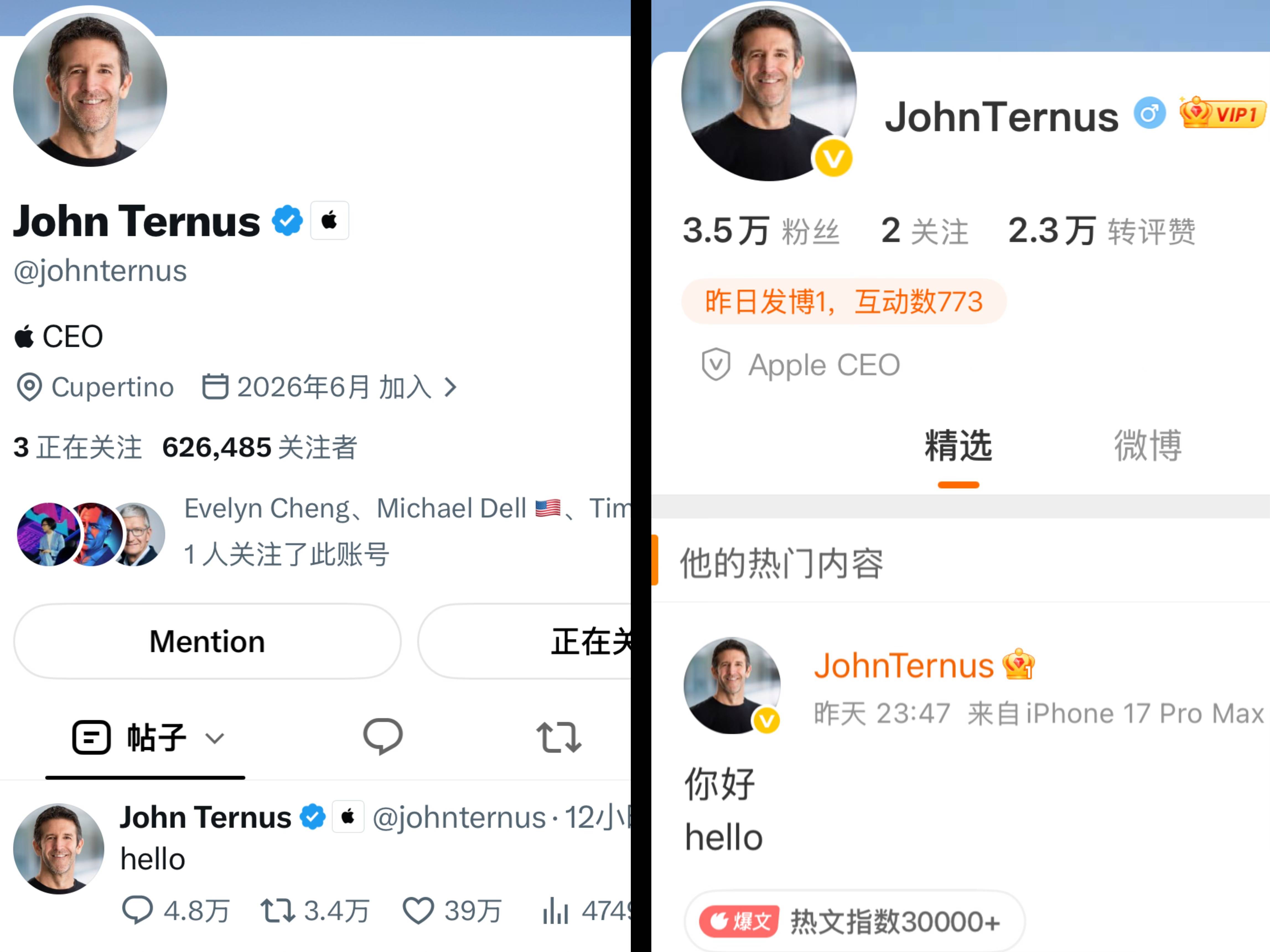
Image source: webpage screenshot
Having a Weibo account, of course, is not enough to prove any change in Apple's strategy for the Chinese market, but entering Chinese social media on the first day in office at least sends a clear signal that China remains a core market that the new CEO must directly face.
More important than saying "Hello" on social media is the first all-hands letter Tim Cook sent to Apple employees.
He expressed gratitude in the letter for Cook's sharing of experience during the transition, and also praised Cook for leading Apple with values, integrity, and humanity over the years, stating that Apple is fortunate to continue having Cook serve as Chairman of the Board.
The tone of the letter is one of continuity, rather than a cut-off. The new CEO's first task is to ensure a smooth transition for the nearly $500 billion company.
However, what truly caught the attention of outsiders was a clear hint in the letter, "Next week we will have a major release, and it will be very exciting."
Tenuis is stabilizing internal morale with a tribute to Cook while swiftly shifting external attention to September 9, which marks the countdown to the new CEO's first public appearance.
Stock prices started the year on a strong note, but the capital market has not shaken off its concerns.
The capital market gave Tenus a decent welcome gift.
On September 1, against the backdrop of overall downward pressure on the Nasdaq index and the S&P 500 index, Apple's stock price rose 2.61% against the trend, with a single-day increase of $8.28, closing at $325.13, and its market value reaching approximately $4.75 trillion.
Some market analysis suggests that in an environment where US bond yields are rising and the tech sector is experiencing rotation, Apple, with its abundant cash flow and smooth management transition, has become a "super safe-haven" in the eyes of investors.
At least on the first trading day, Tim Cook's takeover did not trigger market concerns about Apple's management being out of control. However, the rise on this day does not mean that the capital market has recognized the new CEO's abilities.
Tenuis inherited an almost perfect start, but he also got a extremely expensive ticket.
The first pressure comes from valuation. When Cook passes the baton to Tenuous, Apple's price-to-earnings ratio has reached 36-37 times. The 12-month average target price given by Wall Street is around $324.45, which is almost equivalent to Apple's latest closing price.
This means that the smooth handover and the optimism brought by the press conference may have already been partially reflected in the stock price, suggesting that the room for further sharp gains in the short term is limited. Tenus has taken over a high-valued company that can hardly afford to make mistakes.
Another pressure comes from AI. Ternus must demonstrate that Apple's AI future is not just a ordinary app on the iPhone, nor just a patch for Siri. Especially when facing competitors like OpenAI and Google, Apple is already seen as a latecomer in the generative AI race.
The outside world expects it to come up with a set of software and hardware experiences that can serve as a reason to upgrade, or even be groundbreaking.
Changes have emerged in the list of senior executives, and the "hot potato" has been put on the table
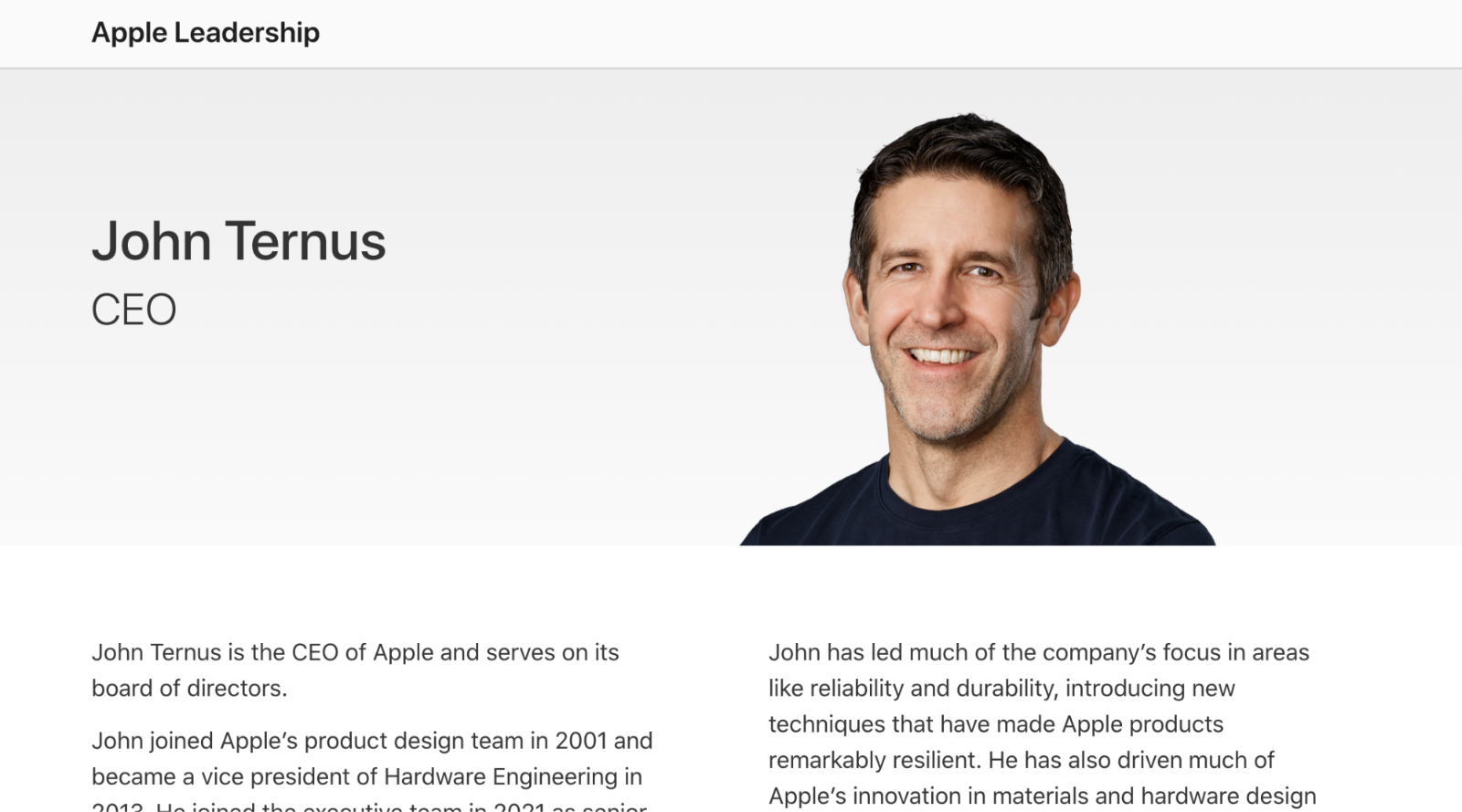
Image source: Screenshot from Apple's official website
The management team list on Apple's official website has also changed after the shuffle, with signs of adjustments to the high-level lineup beginning to emerge.
Senior Vice Presidents Katherine Adams, Luca Maestri, who oversees corporate services, and Adrian Perica, who is in charge of corporate development, are no longer listed or have adjusted roles, with Eddy Cue, the head of services business, moving up the list accordingly.
A simple website hierarchy does not fully represent a company's actual power structure, but when combined with changes in management, it still serves as a public signal of the transition of old and new guard at Apple. Media reports have stated that Ternus is evaluating the management teams of Apple's core departments, including hardware, chips, and retail, and is considering ways to create a closer collaboration between AI and the hardware and chip systems.
If the relevant adjustments are ultimately implemented, Apple will face more than just the issue of how to arrange seating for its executives.
In addition to high expectations from the capital markets, Tennus has also inherited several "hot potatoes".
Firstly, with regards to AI, Apple's smart offerings must transition from conceptual conference announcements to stable, usable, and hardware-sales-driving product capabilities. The issues Tenuis needs to address are not limited to model problems, but also include organizational coordination between the AI team and the teams responsible for chips, operating systems, and terminal hardware.
Secondly, in the Chinese market, faced with the continuous offensive of manufacturers such as Huawei, Xiaomi, OPPO, and vivo in high-end and foldable screen devices, Apple needs to re-interpret the premium of the iPhone and also deal with the practical issues of deploying generative AI services in the Chinese market.
Tenus taking over and immediately opening a Weibo account can be seen as a gesture, but sales ultimately rely on the product, not appearances on social media.
Additionally, there are regulatory and supply chain pressures. The anti-monopoly reviews surrounding the App Store and the Apple ecosystem by the US Department of Justice and the EU are impacting Apple's rule-making power over its services business, while the company also needs to rebalance production capacity, costs, and geopolitical risks between China, India, and Southeast Asia.
The outside world will first speculate based on Ternus' engineer identity background that he will start with the easiest hardware. He may further expand the ultra-thin and light route represented by the M4 iPad Pro to Mac, Apple Watch, and even foldable screen devices. Apple may also continue to accelerate the development of self-researched 5G baseband, Wi-Fi chips, and display technology, and bring more key capabilities in-house.
Tenu's engineering background can explain why Apple chose him, but it doesn't automatically prove he can solve AI problems. Apple's real challenge now is how to turn its chip and hardware advantages into model capabilities, software experiences, and service ecosystems. The upcoming launch event will be the first window for the outside world to observe this transformation capability.
From "Technology Explainer" to Press Conference Star
For those who have been watching Apple's launch events for a long time, Tenor is not unfamiliar.
After joining Apple in 2001, he initially participated in the development of display products such as Cinema Display, and then gradually moved into core hardware projects such as Mac and iPad. One of the representative projects he was involved in was to completely migrate Mac from Intel's X86 architecture to Apple's self-developed M series chips, achieving full autonomy in core underlying technology.
At WWDC in June 2017, he first took the stage to preview the iMac Pro product to global developers and users. Since then, he has appeared at numerous Apple events, responsible for introducing hardware products such as Mac and iPad. In May 2024, he was tasked with introducing the thinnest product in Apple's history, the iPad Pro.
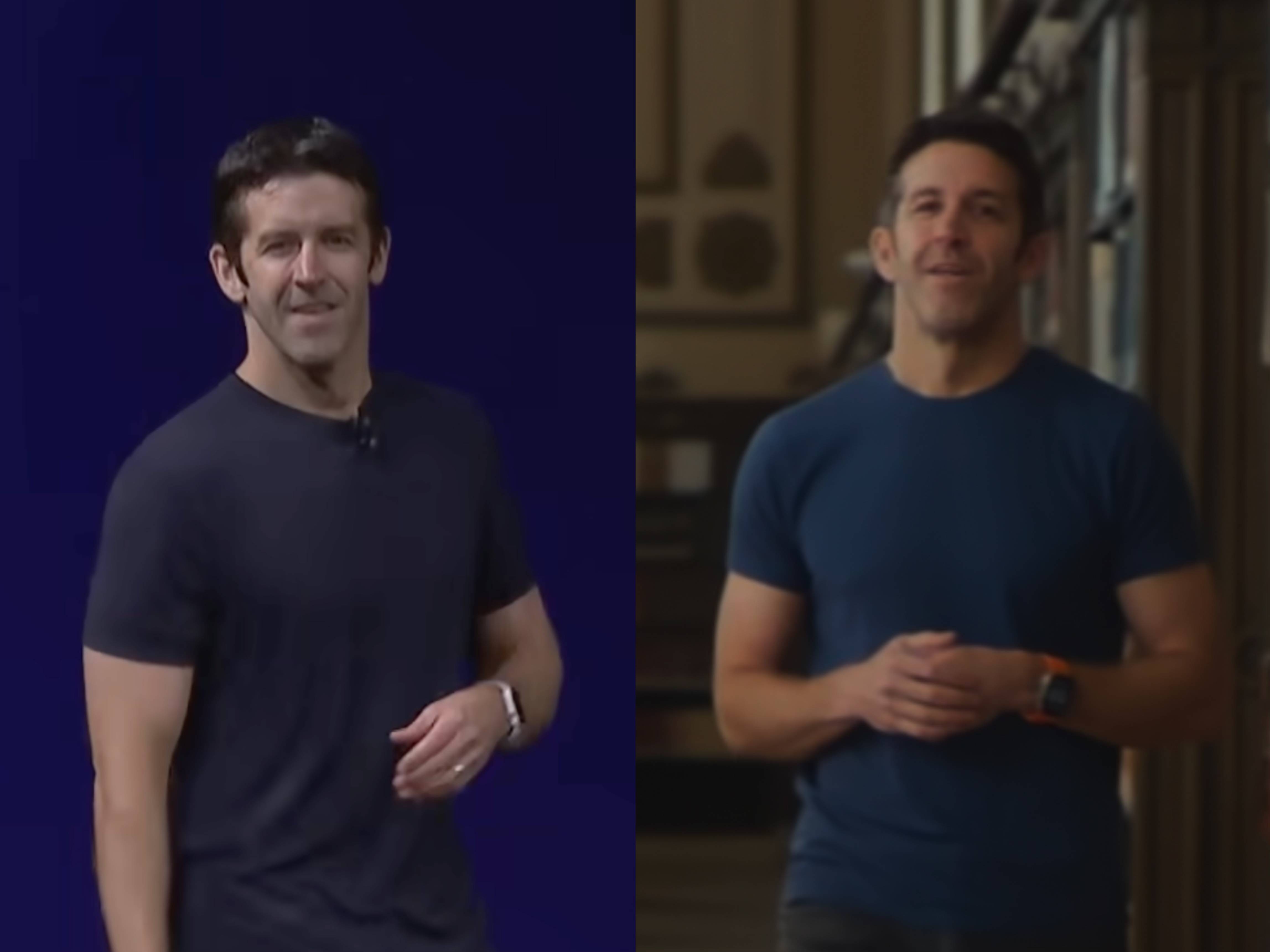
Image source: Video screenshots from launch events in 2017 and 2025
Looking back at Tenor's past press conferences, his role has been relatively stable. He rarely undertakes grand expressions of values, instead spending a few minutes explaining chips, performance, heat dissipation, power efficiency, and body design. He is a typical "technology explainer", responsible for telling users how Apple creates a faster, thinner device.
On September 9, the situation will be completely different, as Tim Cook will no longer just be responsible for a particular piece of hardware, but for the first time as CEO, will have to answer what kind of company Apple will become next.
In addition to the foldable screen iPhone, the market is also waiting to see if the iPhone 18 series will adjust its release schedule, as well as new Apple Watch, AirPods, the screen-equipped smart home hub HomePad, and the next-generation Apple TV. A common question for these devices is whether they can access the large model version of Siri and achieve cross-device collaboration. However, what the outside world expects is not just the addition of an AI entry point, but also hopes that Apple's chips and hardware can form a stable closed loop.
The autumn launch event on September 9 is more like Tencent's first comprehensive exam.
Most of the products on stage have been in development for many years and cannot be simply seen as the new CEO's personal report card. However, how he arranges the main event of the launch, how he explains the relationship between AI and hardware, and whether he plays the ultimate trump card of foldable screens will determine the outside world's first impression of the "Tenuos era".
Cook left behind a business empire supported by a supply chain, services, and massive cash flow. Next, Tenus needs to prove that Apple still has the ability to define the next type of device.
Foldable screens are almost a given, but the real suspense for Apple has only just begun to unfold.