
A company with annual net profit of just 300,000 yuan hit three 30% limit-up moves in four days.
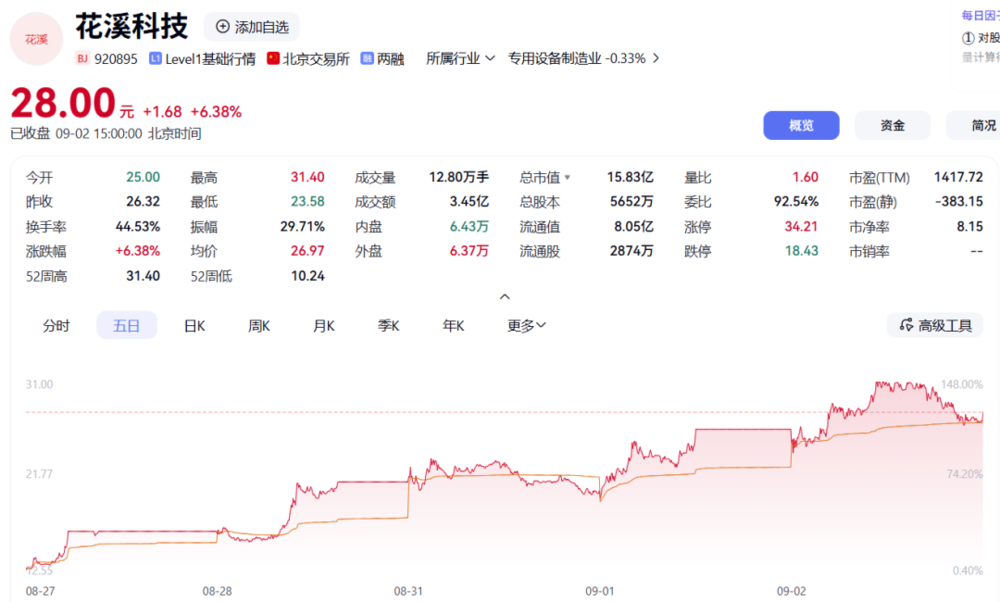
On September 2, Huaxi Technology (920895.BJ), a agricultural machinery stock on the Beijing Stock Exchange, surged to 31.40 yuan at one point during trading, and finally closed at 28.00 yuan, with a daily fluctuation of 29.71% and a turnover rate of 44.53%, and a total transaction value of 345 million yuan. From the closing price of 12.5 yuan on August 26 to the closing price of 28.00 yuan on September 2, the stock accumulated a gain of 124% over the past 5 trading days; if calculated based on the intraday high of 31.40 yuan, the maximum gain once reached 151%.
It was Huaxi Technology's 124% surge over five days that completely ignited the momentum on the Beijing Stock Exchange. On September 2, the three major A-share indexes all fell, with the Beijing Stock Exchange being the only bright spot in the A-share market. The Beixun 50 Index opened low and closed high, with a maximum increase of nearly 5% at one point, and still rose 2.5% by the close of trading. Among the 344 stocks listed on the Beijing Stock Exchange, only 43 fell. Weiqi Technology, Shengnan Technology, and Zhixin Electronics saw their shares rise by the daily limit of 30%, while nearly nine individual stocks rose by more than 10%. The market welcomed a Beijing Stock Exchange gala on the fifth anniversary of its establishment.
Huaxi Technology's revenue for the first half of the year was nearly 30 million yuan, but it only earned a profit of 300,000 yuan, with a net profit margin of just over 1%. However, this 1% profit margin has supported a market capitalization of nearly 1.6 billion yuan.
Loss-narrowing semi-annual report
It all started on August 24.
On the evening, Huaxi Technology disclosed its 2026 semi-annual report: revenue was 29.5145 million yuan, up 102.49% year-over-year; net profit attributable to the parent company was 3.031 million yuan, turning a profit from a loss, compared to a loss of 4.944 million yuan in the same period last year.
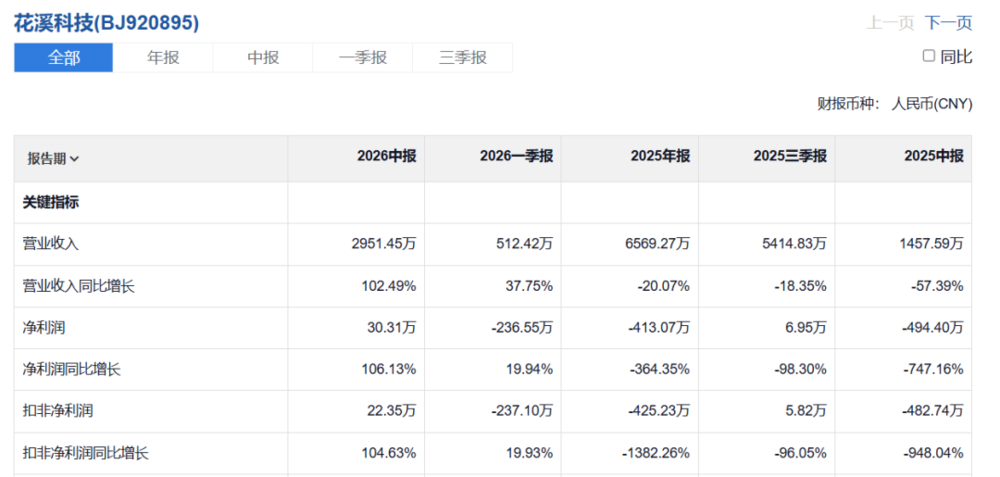
Revenue has doubled, turning losses into gains. On the A-share market, many companies have achieved such a "reversal from adversity" and deserve a limit-up day.
However, Huaxi Technology did not immediately surge to the daily limit. On August 25 and 26, the stock price remained stable. It wasn't until August 27 that Huaxi Technology's stock suddenly soared, hitting the "30CM" daily limit. This was followed by a second "30CM" daily limit on August 28. After a one-day correction on August 31, the stock surged to the daily limit again on September 1, with three daily limits in four days, and the stock price doubling.
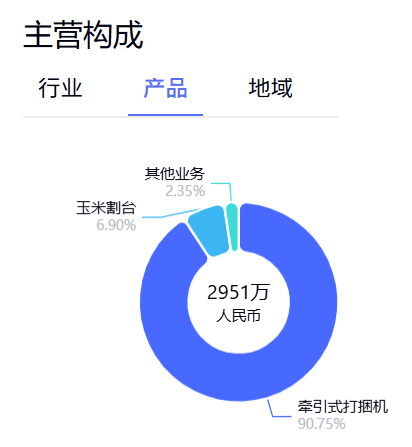
A closer examination of the half-year report reveals the answer. Huaxi Technology's flagship product is a bundling machine, used for collecting and bundling crops such as straw after harvesting, and is a key device in the straw recycling industry chain, accounting for 90.75% of the company's main business revenue in the first half of 2026. The company's revenue growth is almost entirely due to the significant increase in sales of this product through foreign trade channels. In the first half of the year, the company achieved revenue of 12.4418 million yuan from sales of bundling machines to foreign countries through cooperation with foreign trade companies, compared to only 0.1648 million yuan in the same period last year, representing a year-over-year increase of more than 74 times. Direct export revenue also increased by 171.72% year-over-year.
Jilin Tianlang, a Beijing Stock Exchange-listed company that ranks higher in the bundling machine industry, saw its revenue decline 32.06% year-over-year in the first half, with a net loss of 10.6309 million yuan. The domestic agricultural machinery market as a whole is sluggish, with severe internal price competition. The only variable that enabled Huaxi Technology to achieve a doubling of revenue in such an industry downturn is foreign trade.
Huaxi Technology's R&D department engineer said bluntly in an interview, "It's mainly due to the contribution from overseas markets."
However, one detail is noteworthy: overseas direct revenue was only 668,800 yuan, while the remaining 12,441,800 yuan was achieved through foreign trade companies. The company did not establish its own overseas sales network, instead relying on intermediaries to go abroad, which is a low-asset, low-risk approach, but also means that part of the profit margin is being shared with others. The gross margin fell from 28.77% in the same period last year to 24.89%, and despite doubling revenue, the profit margin actually became thinner.
This is the cost of being driven by foreign trade.
What is different about this round of surge compared to the past?
Huaxi Technology is not experiencing a large surge for the first time.
On February 1, 2024, amidst a 3.16% plunge in the CSI 300 Index and a decline in over 4,100 individual stocks across the market, Huaxi Technology bucked the trend with a 15.48% surge, at one point soaring 23% intraday. The company subsequently released a statement on the unusual fluctuation in its stock trading, citing a cumulative rise of 41.51% in its closing price over the past three trading days. However, the statement also explicitly stated that the movement was "not related to popular concept stocks" and that "there have been no significant changes in the company's recent business operations or internal and external business environment." In other words, the surge lacked fundamental support and was more a result of capital maneuvering in a weak market, with the benchmark index falling while the stock rose, purely a result of short-term funds seeking refuge or speculating.
In November 2024, Huaxi Technology experienced another unusual fluctuation. On November 26, the stock price surged 21.60% to 19.70 yuan, reaching a historic high. Two days later, on November 28, the stock price rose again by 10.12%, with a daily fluctuation of 33.40% and a turnover rate of 24.99%. However, data from the dragon and tiger list showed that the total net sales of brokerage seats reached 6.3672 million yuan, with funds selling out at high levels. Just a short time before this surge, on November 4, the company had received a regulatory warning letter due to inaccurate disclosure of multiple pieces of information. Despite the lack of improvement in performance and the receipt of a penalty, the stock price reached a new high, indicating another round of short-term speculation lacking fundamental support.
In June 2025, Huaxi Technology experienced another sharp surge. On June 10, the stock price soared 29.99%, with the agricultural planting sector fluctuating in the afternoon; on June 20, it again hit the daily limit, with a gain of 30.00%, and the total net buying amount of brokerage seats reached 49.6827 million yuan. The logic behind this round of speculation was slightly clearer, as the agricultural sector as a whole was active, and Huaxi Technology, as an agricultural machinery stock, was tapped by funds, with the concept of "agricultural machinery + welding robots + overseas expansion" being labeled. However, at that time, the company did not have substantial performance to back it up, and it was more of a conceptual speculation driven by sector rotation.
In comparison to the three previous major rallies, the differences with the current trend are stark.
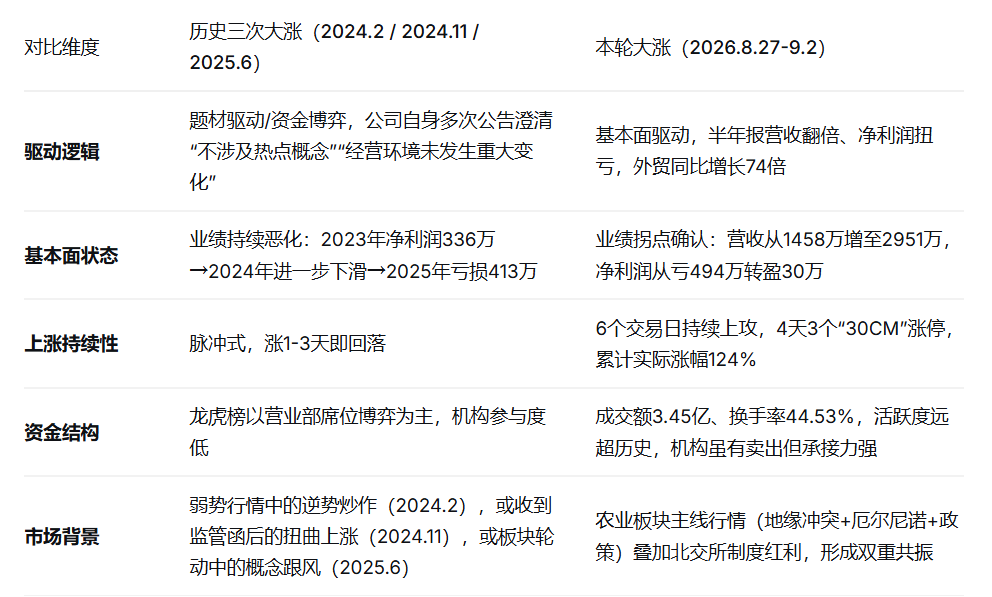
Firstly, the difference lies in the driving force. The previous three major rallies were either baseless increases where companies acknowledged they were "not involved in hot concepts" and "there were no significant changes in the operating environment", or they were following the trend in sector rotation, or they were distorted market trends where they rose after receiving a penalty. In contrast, this round of increase has a real inflection point in performance, with revenue doubling and net profit turning losses into gains; it is supported by data showing a 74-fold growth in foreign trade; and it has a clear direction in industrial layout with the smart laser weeding robot.
Secondly, the difference is sustained. Previous rallies were often pulse-like, with the increase on February 1, 2024, stopping immediately, the rally from November 26 to 28, 2024, retreating after three days, and the two waves from June 10 to 20, 2025, returning to calm. In contrast, this round has seen a sustained surge from August 27 to September 2, with five consecutive trading days of gains, including three "30CM" limit-ups in four days, with both the intensity and sustainability far exceeding previous instances.
The difference in funding structure is another factor. In the previous surge, the dragon and tiger list was dominated by brokerage firm seat trading, with low institutional participation. However, in this round, although institutions are also selling, the turnover and turnover rate have both reached new highs, with a turnover of 242 million yuan and a turnover rate of 31.72% on September 2, with activity far surpassing any previous instance.
Ultimately, the difference lies in the fundamentals, which is the most critical distinction. In the three previous major rallies, Huaxi Technology's performance continued to decline, with a net profit of 3.3628 million yuan in 2023, further deteriorating in 2024, and directly incurring a loss of 4.1307 million yuan in 2025. The rise in stock price was divergent from the deterioration in fundamentals. In contrast, this round has seen revenue more than double from 14.5791 million yuan in the same period of 2025 to 29.5145 million yuan, with net profit turning from a loss of 4.944 million yuan to a gain of 0.3031 million yuan, although the absolute value is not large, the direction has undergone a fundamental change.
In other words, the previous rally was a capital-driven game, while this round of gains is driven by expectations of a revaluation due to improving fundamentals. The former came and went quickly, while the sustainability of the latter depends on whether foreign trade can continue to increase in volume and whether smart agricultural machinery can truly be implemented.
The agricultural sector is active, with the Beijing Stock Exchange becoming the main battleground
The surge in Huaxi Technology cannot be viewed in isolation from the overall trend in the agricultural sector.
On September 1, the A-share agricultural sector reached a new high. Wanxiang Denong rose by the daily limit for six consecutive days, accumulating eight daily limits over 11 days, while Xinsai Shares rose by the daily limit for four consecutive days. Popular stock Jinkenmi Industry rose by the daily limit seven times over 12 days, with over 20 individual stocks in the sector rising by more than 9%. The agriculture, forestry, animal husbandry, and fishery sector saw a net inflow of main force funds of 2.731 billion yuan, ranking first among Shenwan's primary industries. Sub-sectors such as seed industry, grain concepts, aquatic products, and glyphosate all rose.
More noteworthy is the divergence between the indices. On September 1, the Shanghai Composite Index fell 0.16%, the Shenzhen Composite Index dropped 1.02%, and the ChiNext Index plummeted 1.32%, while the BEIJING50 Index bucked the trend with a 1.34% gain. Over 290 BEIJING stocks rose, accounting for nearly 90% of the total.
On September 2, the Beijing Stock Exchange celebrated its fifth anniversary since its establishment. The number of listed companies has increased from 81 to 339, with total market capitalization rising from approximately 300 billion yuan to around 840 billion yuan, and average daily trading volume surging from less than 10 billion yuan to over 200 billion yuan. On the fifth anniversary, the Beixun 50 Index soared 4.55% again, responding to policy expectations with a "birthday market trend". When the main logic of the agricultural sector coincided with the institutional premium of the Beijing Stock Exchange within the same time frame, the 30% daily limit became the largest emotional amplifier. Main board agricultural stocks can rise by up to 10% at most, while the Beijing Stock Exchange allows for a 30% increase. Under the same sector logic, funds naturally flow towards the direction with the greatest elasticity. Huaxi Technology became the sharpest spear in the agricultural sector trend amidst this dual resonance.
The explosion in the agricultural sector has led to a highly consistent judgment from institutions: "geopolitical conflict + extreme weather + policy regulation" forming a triple logic resonance.
Looking at the geopolitical conflict, Russia and Ukraine, as two giants that together account for more than a quarter of global wheat exports, have recently significantly escalated their attacks on ports and grain terminals, bringing exports to a near standstill. Shipments via the Black Sea route have plummeted, with the region responsible for nearly a third of global wheat exports. Chicago wheat futures prices have soared to their highest level in three years.
Looking again at extreme weather, US National Oceanic and Atmospheric Administration monitoring shows that the globe entered an El Nino state in May 2026, with a 95% probability of reaching a super-strong level by the fourth quarter, and a nearly 70% probability that the peak intensity will break a new high since 1950. The main corn-producing areas in the US and Europe are experiencing continuous heatwaves, while economic crops in Southeast Asia are threatened by drought. In August, the Bloomberg Commodity Index for agricultural products, which tracks 10 major agricultural products, surged over 13% in a single month, marking the most intense monthly rally since July 2012.
The combined result is that the US Department of Agriculture predicts global grain production in 2026/27 will fall below consumption for the first time since 2020/21, marking the largest supply deficit since 2006/07. HSBC and JPMorgan have issued successive warnings of a "global food crisis".
Policy support has also been strengthened. On August 28, the revised Agricultural Law was passed, elevating the food security strategy to a higher level, with provisions for autonomous and controllable seed sources and the industrialization of biological breeding written into the law. The 2026 Central Document No. 1 clearly states that "grain output will remain stable at around 140 billion catties" and emphasizes "strengthening the construction of agricultural disaster prevention and mitigation systems". In 2026, the national general public budget for agriculture, forestry, and water affairs is 243 billion yuan, with the central government allocating 263 billion yuan to stabilize the implementation of agricultural subsidy policies. The agricultural machinery purchase subsidy focuses on supporting high-performance seeders, large intelligent high-end combine harvesters, and other areas.
The collective rise of the agricultural sector has provided fertile ground for Huaxi Technology. The trend has spread along the industry chain from seed and grain and oil to supporting sub-sectors such as fertilizers and agricultural machinery. As an elastic target in the agricultural machinery sector, Huaxi Technology is at the end of this expansion chain. When the industry leaders continue to push the market to new heights and funds start to look for supplementary targets along the industry chain, Huaxi Technology, a small agricultural machinery stock on the North Exchange, becomes the easiest to ignite.
Huaxi Technology's recent surge is essentially a trade based on a "gap in expectations." When a semi-annual report that was expected to show a loss suddenly appeared, combined with a story of 74-fold growth in foreign trade, the imagination of intelligent laser robots, and the macro narrative of El Nino, all positive factors were concentrated and priced in at the same time. Whether the fundamentals can truly support a market value of nearly 1.6 billion and a price-to-earnings ratio of over 5,000 is another question.