
DRG/DIP 3.0 is not just about being more detailed, it redefines how hospitals make money, how doctors get paid, and how innovative technologies are incorporated into payment standards.
On September 2, the National Healthcare Security Administration's official website released Medical Insurance Document [2026] No. 22. This document simultaneously implements three measures: one targets township health centers, one affects doctors' performance-based salaries, and one leaves room for surgical robots and new drug consumption.
The implementation timeline has been set, with preparations for the switch to be completed by December 31, 2026, and the application to be launched by the end of March 2027.
The grouping structures have also changed: ADRG expanded from 409 groups in version 2.0 to 492, while DRG subgroups grew from 634 to 825. The DIP core disease library, meanwhile, contracted from 9,520 groups in version 2.0 to 5,125 in version 3.0, yet case coverage rose from 92% to 95%.
Fewer groups, more accurate, and closer to clinical practice are the underlying themes of this adjustment.

Going downstream, 158 types of grassroots diseases will have the same payment for the same disease
For the first time, the national level has explicitly defined "primary-level disease categories" under Version 3.0: an initial batch of 158, comprising 31 under DRG and 127 under DIP, for local reference. Within a pooling region, different tiers of medical institutions are to be reimbursed at the same rate for the same primary-level disease category—same disease, same payment.
Vice Director Chen Kai of the Primary Healthcare Department of the National Health Commission directly stated the intention at the press conference, using the same disease, same payment approach to guide patients with common and frequently occurring diseases to receive initial treatment at the county and grassroots levels, and promote tiered diagnosis and treatment.

But there are two tensions here.
The document serves as a reference for local areas and is not a mandatory list, with each locality determining its own approach based on its medical resource allocation, primary service capabilities, and resident needs, leaving room for flexibility.
The "same disease, same payment" policy strips large hospitals of their reimbursement advantage for mild cases, theoretically pressuring them to cede basic disease groups to primary-care facilities.
Can grassroots healthcare facilities handle it? With the same amount of money, if grassroots facilities lack the necessary technical capabilities, have more complications, and longer hospital stays, the costs may not be lower than those of large hospitals.
For the industry side, this serves as the payment infrastructure for county-level medical communities, health communities, and AI-based follow-up care at the grassroots level. With the same disease priced identically at community clinics and top-tier hospitals, managing and standardizing common illnesses at the community level now has, for the first time, a Medicare payment anchor on par with major hospitals.
Inward integration, disease species standards have been incorporated into departmental performance metrics
The DRG/DIP payment reform has been promoted for many years, with most discussions focusing on the hospital level, including total budget, surplus retention, and fund security. Version 3.0 is the first to take the conversation to the departmental allocation level.
Article 8 clearly states: Medical institutions are not allowed to use disease payment standards as a quota to assess departments or medical personnel, or link them to performance distribution indicators. Surplus funds can be used as business income for medical institutions.
Together, these two measures form a "block and retain" approach. The block targets arbitrage opportunities where providers could game the system by grouping cases to earn tens of thousands of extra yuan; the retain preserves genuine incentives for cost control, allowing surplus funds to be channeled into academic development and staff performance.
Huang Xinyu, Director of the Medical Administration Bureau of the Medical Insurance Bureau, explained at the press conference that the disease payment standard is the average cost formed by the medical insurance department based on objective historical costs and patient group data. The reform of the payment method is not a means or purpose of controlling costs, and it is not possible to require that every case does not exceed the payment standard. Simply and crudely letting doctors bear the part that exceeds the payment standard will affect normal diagnosis and treatment, and damage the interests of insured persons.

This is an old problem. Treating averages as quotas and penalizing doctors for overruns is a common practice of lax management in some hospitals.
This anxiety is real. After the release of the 3.0 document, Dxy.com user @医策老徐 posted a sentence: "For the same disease, the same payment, grassroots healthcare will welcome good news, but will top-tier hospitals suffer greater losses the more they treat?" The comment with the most likes sparked considerable controversy.
In a previous survey of multiple hospitals by Deep Blue, a doctor of oncology at a tertiary hospital in Zhejiang, surnamed Fang Hua, calculated that after the implementation of DRG, his and his colleagues' salaries decreased by about 30% overall, with the limits on hospitalization days and total costs being adjusted downward year by year.
Shifting the average cost to a quota and passing it on to doctors is one of the sources of this kind of conflict.
So for now, it can't be interpreted as "good news for doctors," as the medical insurance provides a boundary, not a salary increase.
Guide external support to provide innovative technologies with clear payment expectations
Version 3.0's support for innovative technologies has been incorporated into the group's structure.
Robotic-assisted surgery is now a subdivision in the DRG 3.0 grouping scheme attachment. DRG groups are broken down by whether robotic-assisted surgery was used, yielding multiple robotic-assisted surgery groups.
Stricter and more binding than the signal of grouping, is the institutionalization of explicit exceptions for single-case negotiations. In principle, the number of DRG exceptions for single-case negotiations should not exceed 5% of the total number of DRG discharged cases. For DIP payment areas, starting from 2027, it can be no more than 1% of the total number of DIP discharged cases.
The target is clear, namely cases with long hospital stays, high medical expenses, the use of new drugs and new technologies, complex and critical illnesses, or multidisciplinary joint diagnosis and treatment that are not suitable for standard payment. The medical insurance administration institutions organize expert review and evaluation on a quarterly or monthly basis.
These two moves together will provide reassurance for surgical robots, new consumables, and new technologies. However, from an industry perspective, do not overestimate this space, as 5% and 1% are the ceiling. Special cases will only be considered for severe and complex diseases and new technologies, and will not be relied upon for widespread benefits.
In addition, the 3.0 version also made a distinction for the elderly and young. Cases involving children under 6 years old and people aged 70 and above are grouped separately, accounting for about one-tenth of all DRG groups. Pain-free childbirth is classified into three separate payment groups. This is part of the refinement of the grouping, and is consistent with the separate listing of robots, making payments more closely aligned with actual resource consumption.
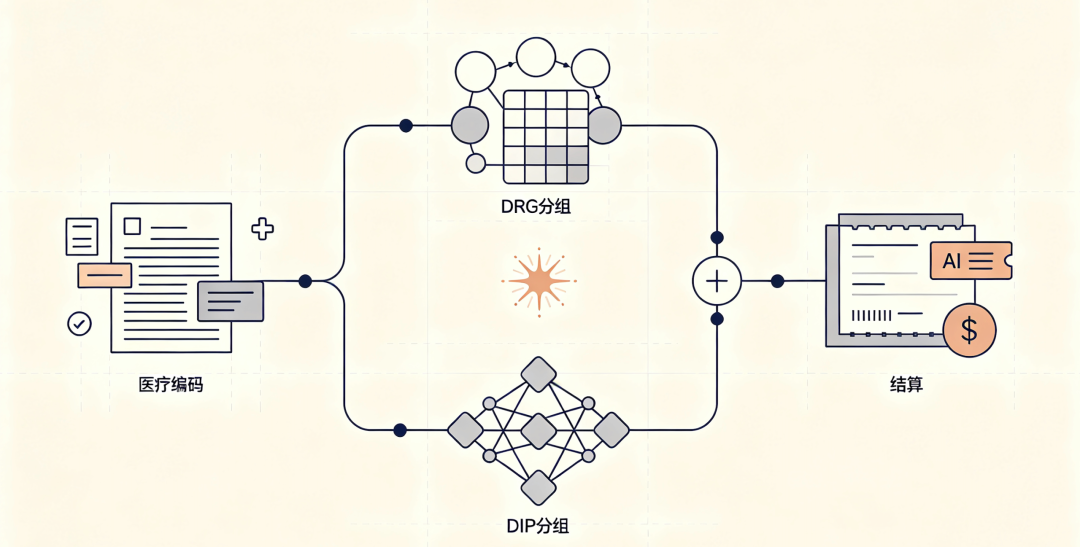
Three forces are converging to rewrite the hospital's accounting logic
Looking back at this version of the plan, the ADRG core group increased from 409 to 492, a gain of only 83. The numbers are not large, but the impact is significant.
It has grasped the logic of controlling costs, from "how much a hospital spends in a year" to "the value of a disease group, how to calculate the allocation of each treatment, and whether a village clinic can afford to provide it." The medical insurance payment reform has reached 3.0, and its focus has long gone beyond just saving money.
After implementation, it's immediately clear who needs to relearn their accounting.
Large tertiary hospitals need to shift their focus from project-driven and quantity-based approaches to cost management and overcoming technical difficulties. County hospitals must clearly identify their advantageous disease categories after the base disease group is flattened by the same disease and same payment standards. Primary institutions have finally obtained payment benchmarks equivalent to those of tertiary hospitals, but their capacity to undertake tasks is a hard constraint.
The most certain opportunity in the industry is to get the calculations right. Whoever helps hospitals accurately calculate costs, coding, and grouping, whether through tools like groupers, Hospital Information Systems (HIS), or medical insurance big data platforms, will grasp the most stable demand in payment reform.
This is no longer a story that can be summed up by a single notice benefiting the people, it is rewriting how hospitals make money, how doctors get paid, and how innovative technologies are incorporated into payment standards.
When the rules are implemented, the beneficiaries and those who need to relearn and recalculate will not be the same group of people.