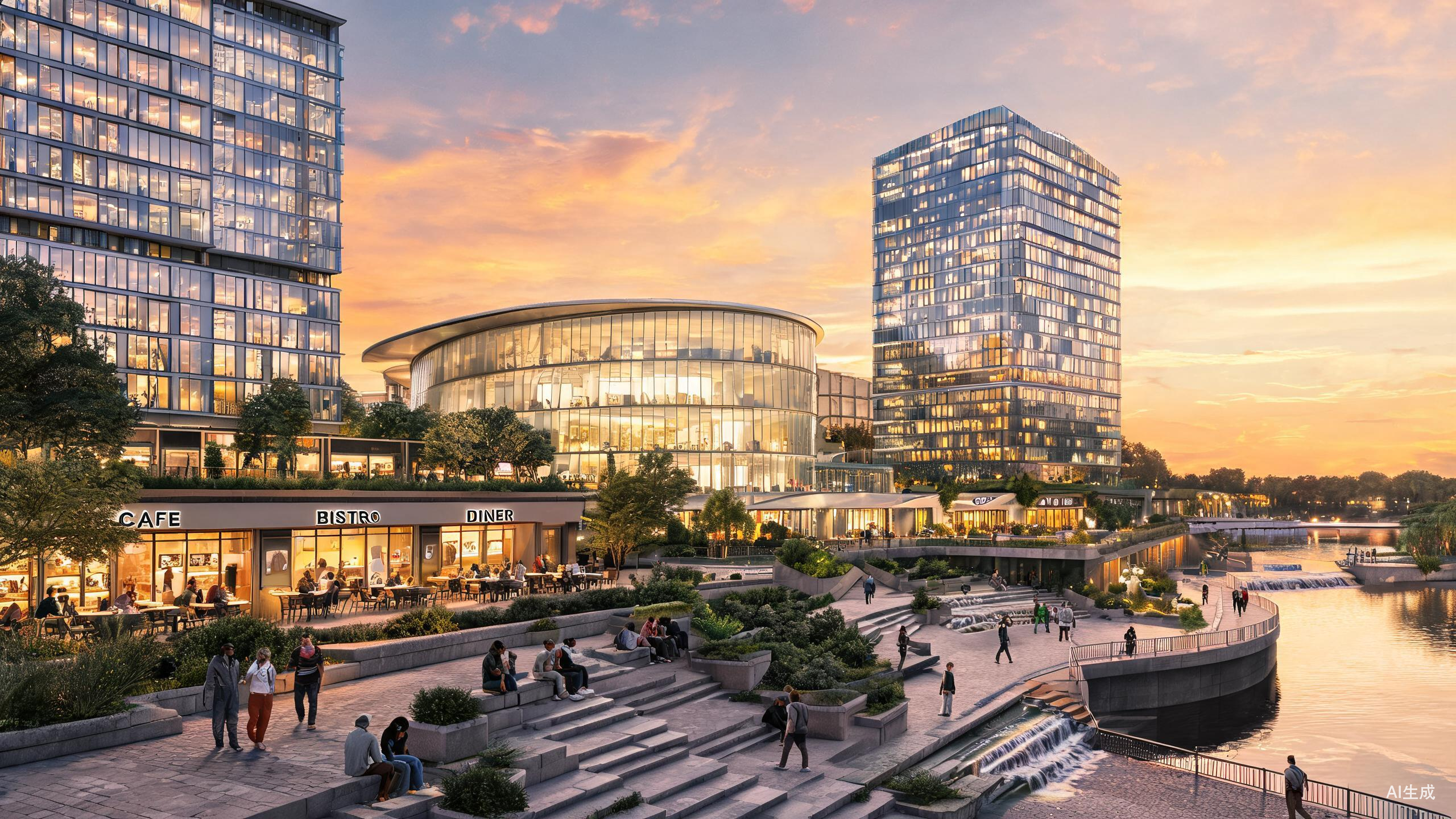
From Shenzhen to Shanghai, internet companies are embarking on an offline experiment, transitioning from online platforms to real cities.
In 2026, the new headquarters of several internet technology companies are entering the countdown to completion in both Shenzhen and Shanghai.
In Shenzhen's Houhai area, the M80 project, developed by Tencent's ecosystem, is expected to be completed by the end of the year. In addition to office buildings, the project will also include an art center, a hotel, and open-style commercial spaces, with the commercial portion to be operated by the Tianmu Li team.
Three headquarters projects from ByteDance, Meituan, and Bilibili in Shanghai's Yangpu Riverside area are also expected to be completed this year. Notably, all three companies have set aside a significant amount of space for commercial, cultural, and public use beyond their offices.
In the past, large factory districts had supporting businesses that mainly served to meet the work and life needs of employees. However, in this batch of projects, we see a clear change - they are moving beyond the boundaries of the districts, placing dining, retail, exhibitions, performances, and public spaces on the side facing the city.
The commercial spaces under the headquarters building have started to take on the functions of attracting the public, expressing corporate culture, and connecting surrounding urban areas.
When tech companies that excel at managing traffic, users, and platform ecosystems start to engage in commerce, we also wonder how their projects will differ from those created by traditional businesspeople.
Leave Business to Tianmu
Tencent's offline exploration efforts first landed in Shenzhen's Nanshan district, specifically in the Houhai area.
M80, located next to the Shenzhen Bay Culture Plaza, is owned by Tencent's self-held asset platform, Tencent Future. The project has a total building area of approximately 228,000 square meters, including office buildings, the Fusion Art Museum, a hotel under the Swire Hotels brand, and about 18,000 square meters of open commercial space.
In terms of planned spatial form, the corridors between the four towers, central public spaces, and commercial districts connect the offices, art center, and hotel. The office area is approximately 39,000 square meters, accounting for about 17% of the total building area, while the art gallery and hotel account for about 8% and 11%, respectively, with a large amount of space allocated to retail and public areas. According to current plans, M80's commercial areas are mainly distributed from the basement to the fourth floor, with the open commercial space resembling a connecting space embedded between the offices, art, and hotel.
Tencent did not personally undertake this part of the business operations, instead opting to bring in the Hangzhou Tianmu team.
The influence of Tianmu Pavilion in Hangzhou is largely not based on relying on a single super IP to attract people, but rather through its brand, exhibitions, art, design, public events, and continuous daily operations, allowing the building to gradually form its own content.
It's still too early to call it the "Shenzhen version of Tianyue Village". After all, the formation of Tianyue Village is closely related to Hangzhou's urban environment, architectural conditions, merchant recruitment process, and long-term operations, and it's not a brand list that can be directly replicated. In terms of location, M80 is adjacent to Shenzhen Bay MixC, and building another shopping center with similar content may struggle to create new attractions.
The Tianmu team needs to answer how to understand the highly mature commercial environment of Houhai and what new reasons M80 can provide to stay.
But when the focus shifts to Shanghai's Yangpu Riverside, the issues become different:
What's lacking here isn't urban space, but rather the commercial and content offerings that are part of daily city life. The arrival of several tech company headquarters is becoming a new experiment.
With the public waterfront now connected, Yangpu Riverside has become an open space for residents to stroll, run, and view industrial heritage, though daily commerce and urban amenities remain limited. Eastward along Yangshupu Road, the ByteDance, Meituan, and Bilibili projects sit within close proximity of one another, with a combined gross floor area exceeding one million square meters. As office workers and commercial tenants gradually move in, Yangpu Riverside is poised for its largest population and functional influx in recent years.
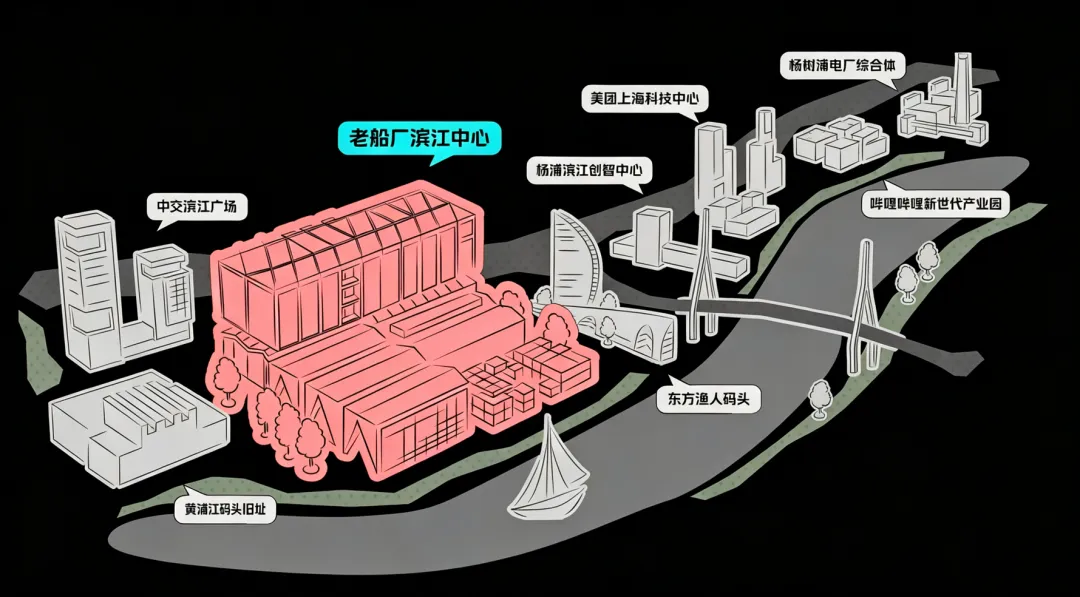
ByteDance: Making MEET an Interface Between Human Traffic and Space
Among the three projects, ByteDance's offline commercial path is relatively clear.
Douyin Group's Shanghai Bund Center, located near the intersection of Yangshupu Road and Dalian Road, has a total building area of approximately 115,000 square meters. The project retains four historic buildings from the original Shanghai Shipyard and integrates offices, corporate showcases, performance events, and commercial facilities into the same waterfront area.
The commercial section is named Laochuan Factory MEET178, which is expected to start trial operations in October this year and officially open at the end of the year.
This is not the first time the MEET series has appeared in Shanghai. At the end of 2023, MEET678 in Jiangwanli, Xinchuang International Community, had already opened, serving a relatively mature office park and residential community, with about 60% of its business configuration dedicated to catering, and through coffee, flagship stores, and social taverns, extending the stay time of office workers after leaving their workstations.
MEET178 faces more fluid urban conditions.
The entire MEET178 has a commercial leasing area of approximately 5,000 square meters, spread across the basement level and two above-ground levels, making it a relatively small-scale project. The north side of the project faces the city road and subway station, bringing in commuter traffic, while the south side opens directly onto the Yangpu Riverside public space, attracting pedestrians, cyclists, and citizens and tourists visiting the riverside.
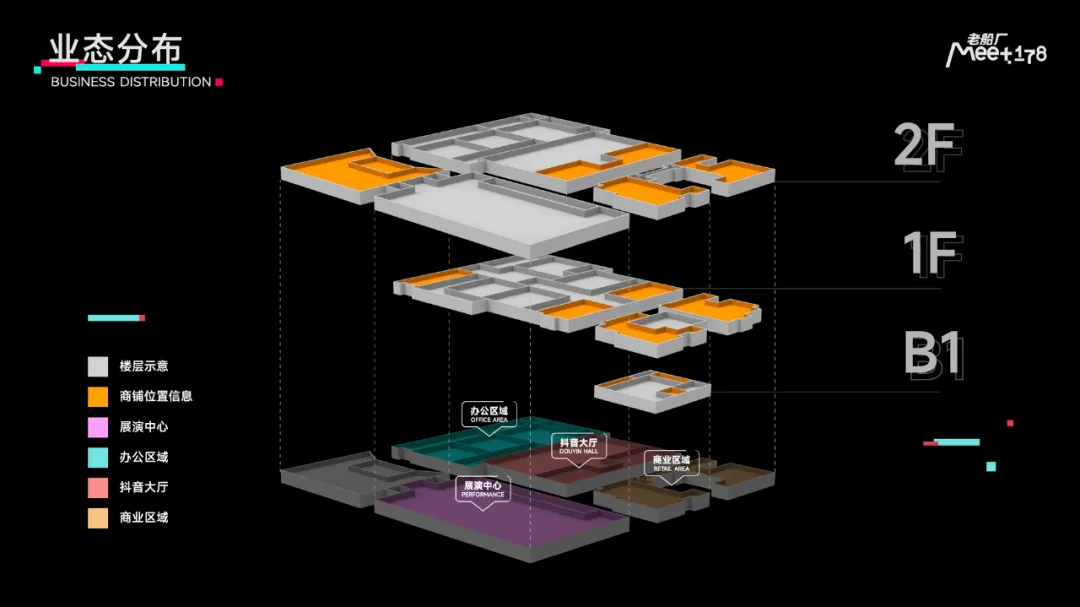
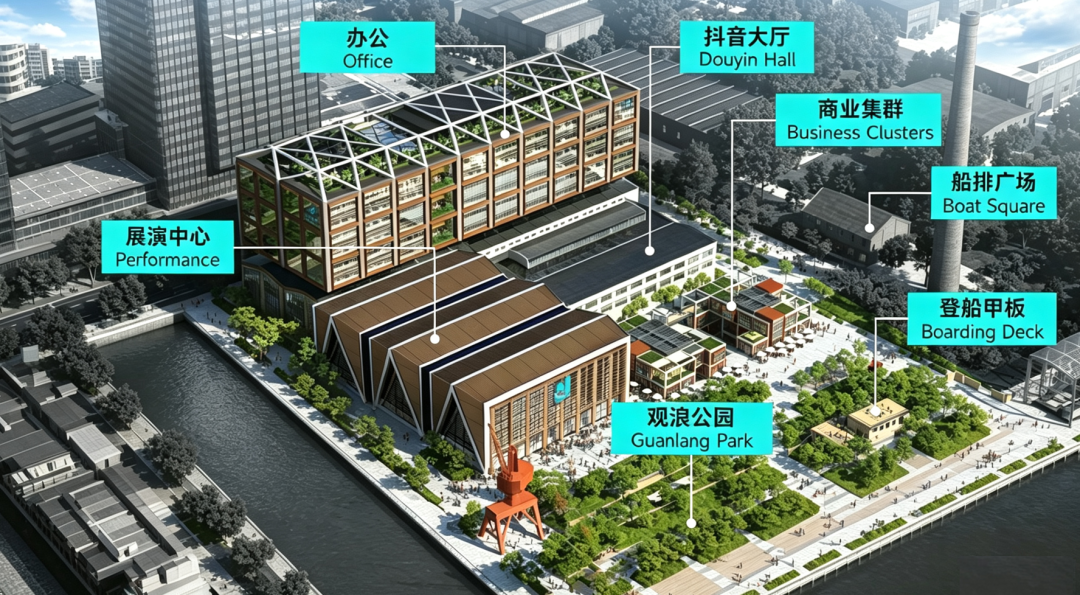
The preservation of four old shipyard buildings around the area, as well as the presence of public spaces such as the Performance Center, Douyin Hall, Ship Formation Square, Boarding Deck, and Wave-Watching Park, in addition to commercial areas, gives this project a richer "content entrance" than a typical industrial park.
One noteworthy aspect is the exhibition center adjacent to the business cluster.
The exhibition center is not just an auxiliary facility outside of the office, but rather an integration with Douyin's content production and dissemination capabilities, becoming a public interface for enterprises to connect with the city.
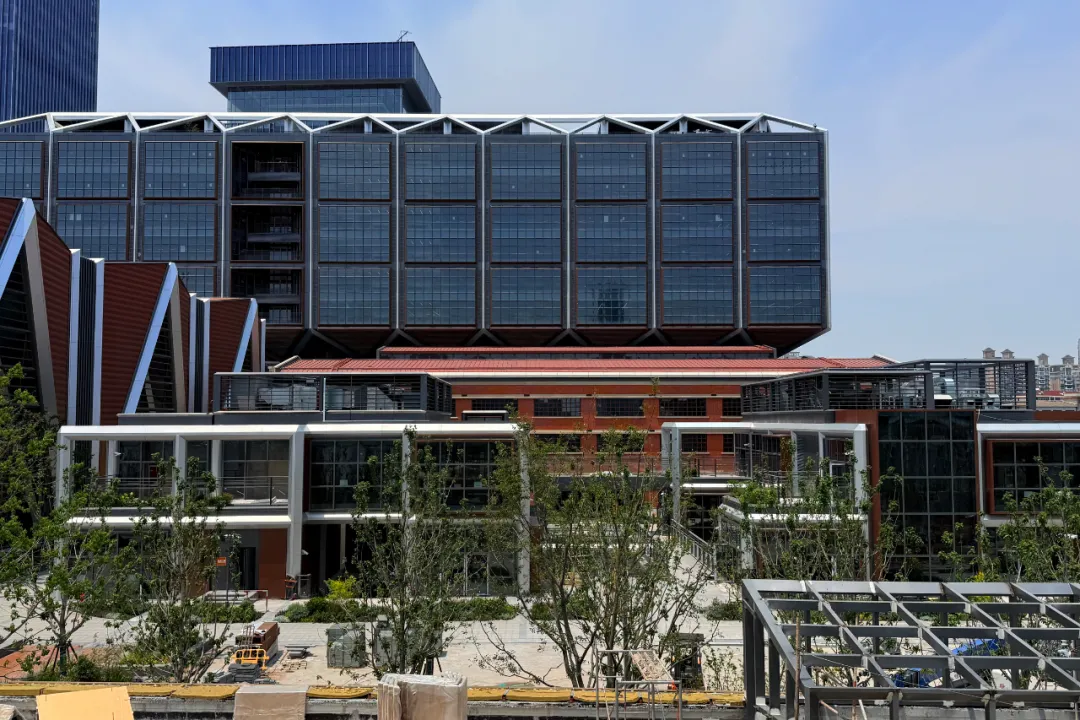
On-site photos confirm the project is complete and awaiting its unveiling.
For MEET178, what's crucial is not just "what brands can be brought in," but whether the originally independent foot traffic can be converted here. Business is just one aspect of these spaces.
If Jiangwanli's MEET678 has created a new consumption scenario between mature parks and communities, then MEET178 faces a more complex task: it needs to establish a new usage relationship between tech headquarters, industrial heritage, and waterfront public spaces.
If a cycle of "passing through—entering—staying—returning" can be established across different groups, the 5,000-square-meter commercial space would serve far more than a shopping center's function. It would function more like an interface along the Yangpu Riverside—connecting headquarters with the city, commuting with leisure, and industrial heritage with contemporary public life.
Bilibili to Bring Online Community into the Real World
The B Station New Generation Industrial Park is also located on the Yangpu waterfront, and its scale is the largest among the four projects. The total building area is approximately 785,000 square meters, including a headquarters tower, over a dozen standalone office buildings, supporting cultural and commercial spaces, rental housing, historic buildings, and cultural heritage sites. According to the latest progress, the project is expected to be completed in October this year, with personnel moving in by the end of the year, and commercial supporting facilities will also gradually enter the trial operation phase.
The project was designed by the chief designer of the Shanghai Planetarium, with an overall design that is full of science fiction elements, and the most eye-catching space is a huge spherical performance space that appears to be suspended in the park - "Bilibili Ball". According to the project plan, the exterior of the "Bilibili Ball" will also be equipped with a huge 3D curved screen to display visual content.
Spherical screens themselves are not new, but what Bilibili has planned for this screen and what will be inside the sphere is still worth looking forward to.
After all, this is a platform with a large amount of UGC, interest communities, and content production capabilities. When its headquarters is transformed into an open urban space, will the content on the platform enter reality here?
The publicly available plans offer some direction: the park will attract content creators, MCN agencies, and digital entertainment businesses, while also featuring cultural, commercial, and integrated performance spaces. Yangpu District's commercial plan likewise proposes leveraging Bilibili's content ecosystem to encourage KOLs and merchants to collaborate on offline space activations and content creation, while bringing livestreaming and interactive art installations into the riverside public realm.
The commercial space under Bilibili's headquarters is not short on imagination, capable of accommodating 2D retail formats, offline exhibitions, performance releases, creator events, and serving as a venue for UP masters to meet with users.
For Bilibili, the cultural language shared among users is its greatest advantage, but the commercial scale of Bilibili's projects far exceeds that of ByteDance and Tencent's M80, meaning it cannot rely solely on fan pilgrimages and themed events to sustain itself.
The commercial space in the new park will be operated by the Hopson Development team, which will meet the daily needs of headquarters employees, surrounding residents, and ordinary consumers, while introducing secondary theme commerce with Bilibili cultural characteristics, and forming a staggered operation with Binjiang Hopson Development.
This has also given Bilibili's offline layout a more concrete imagination: it's not just about bringing Bilibili's cultural symbols into business, but also attempting to leverage professional commercial operations to transform a set of cultural languages that originally emerged in online communities into a offline consumption and social scene that is open to the city.
Meituan to Operate Its Own District, Leveraging Insights into Offline Consumption
Compared with ByteDance and Bilibili, Meituan's growth potential is less immediately apparent, though that partly reflects the early-stage nature of the project.
Meituan's Shanghai technology center is located between the headquarters of Bilibili and Bytedance, with a total building area of approximately 450,000 square meters, comprising four plots of land. The four plots are separated by municipal roads such as Yangpu Road and Anpu Road, but are interconnected through aerial walkways, underground tunnels, and other means, forming streets, plazas, and courtyards between buildings, with the first floor also required to form an open urban interface.
The planned commercial area in this spatial structure is approximately 57,000 square meters, which, together with the 170,000 square meters of commercial space in the Bilibili project, will form the new commercial increment in Yangpu Riverside.
The proposed direction is to "strengthen the introduction of Meituan's Hei Zhen Zhu and Bi Chi Bang brand genes, creating a new landmark for lifestyle aesthetics." It also mentions launching community activity operations through "Meituan Life Calendar" and promoting KOL and merchant online and offline space collaboration.
This is actually not a completely unfamiliar capability, as Meituan has been trying to move the content on its platform offline over the past few years.
In 2023, the Must-Eat List held its first nationwide offline market in Shanghai's Meiro City, gathering nearly 20 listed restaurants, transforming the original list used for "finding restaurants" into an event where people can consume, shop, and participate on site. Hei Zhen Zhu has also taken its restaurant recommendations offline through activities like Star-Picking, making the list a part of the city's consumer scene.
However, while the platform can determine where people dine, it doesn't necessarily understand why a particular street makes people want to slow down; it can use data to identify popular restaurants, but it's difficult to decide solely based on orders whether a cluster of shops will form a unique neighborhood atmosphere.
The 57,000-square-meter commercial space may be an experiment for Meituan to bring its online local life capabilities offline, and whether it can ultimately create a unique district will also be a test of the boundaries of this platform's capabilities.

Can Tech Companies' Capabilities Develop into a New Business Model?
Putting the four projects side by side, the differences stem first and foremost from the companies themselves.
Tencent is bringing in Tianmuli to hand its long-held assets to professional operators; ByteDance is connecting content, exhibitions and performances with waterfront public spaces; Bilibili is seeking to give creators, interest communities and platform culture a physical gathering place; and Meituan may bring its rankings, merchant resources and local consumption data into a real neighborhood.
They are all starting from their own businesses, rethinking what can happen under the headquarters building.
For internet companies, bringing platform capabilities into physical spaces is just the beginning. Douyin can create content-driven events, Bilibili can gather interest-based communities, and Meituan can mobilize merchant and consumer data. Online platforms excel at enabling people to quickly discover, access, and consume, whereas offline businesses need to foster a desire to linger, become familiar, and return. The latter relies on time and an understanding of local areas, neighborhoods, and daily life by enterprises.
The gates of headquarters are opening.
They may eventually become part of the city, bringing more offline people to offline venues for a more authentic display, and possibly evolving into more open and enterprise-oriented headquarters, or even giving rise to new types of commercial spaces that have not existed before.
If these can be truly achieved, offline business may usher in new growth points for innovation.