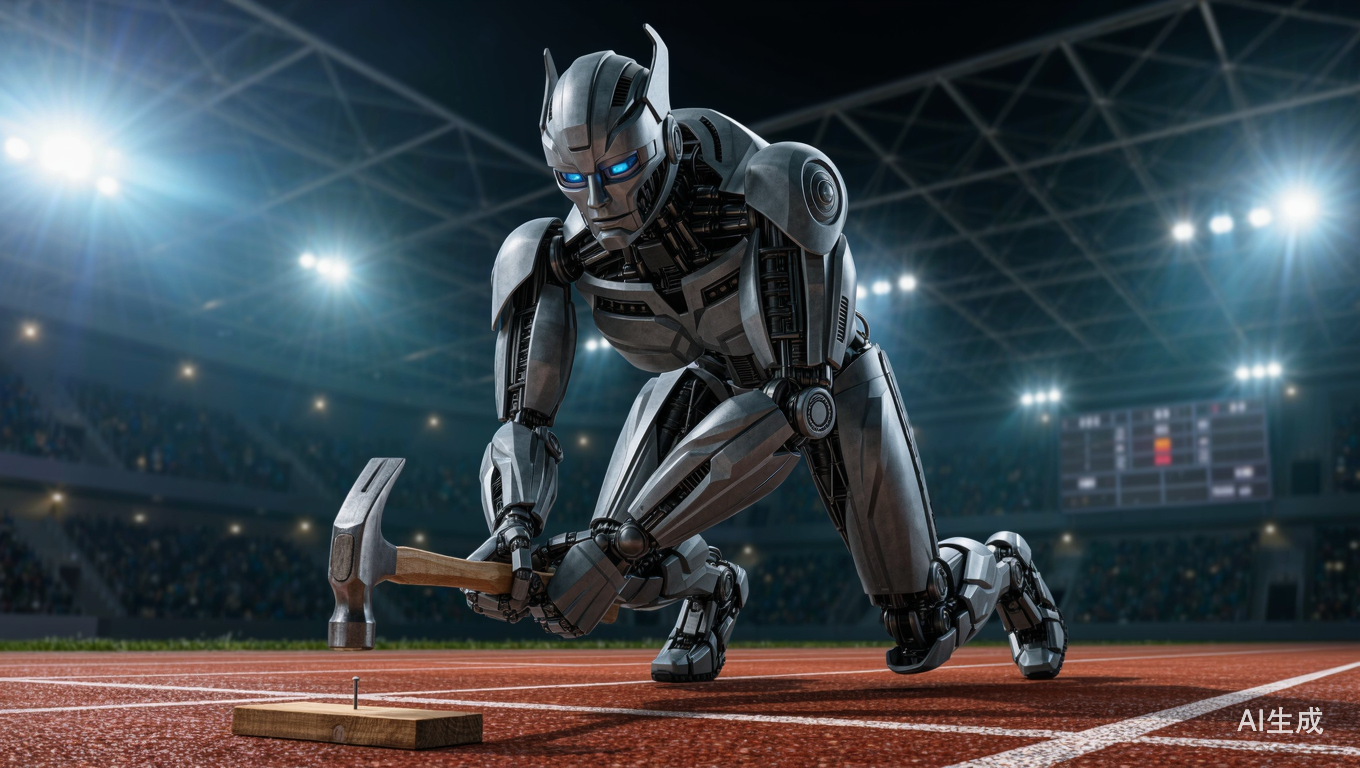
Humanoid robots have broken records in sprinting and other athletic events, but they struggle to perform tasks like hammering nails.
The first humanoid robot ran faster than a human. The second jumped over 3 meters high, breaking a record. The third competed against a human Olympic champion in a ping-pong exhibition match. These were some of the impressive performances at the 2nd World Humanoid Robot Sports Games recently held in Beijing, a competition designed to push the physical limits of robots.
The robotics competition intuitively showcased the rapid iteration of humanoid robots - humanoid robots using AI to learn, plan, and execute real-world movements. But we also saw that these robots still have a long way to go in helping humans cope with actual tasks.
"If I ask you which action is more difficult - folding clothes or doing a backflip, most people would definitely say folding clothes is simpler," said Karen Liu, a computer scientist at Stanford University in California, "but for humanoid robots, the tasks we do every day are much more difficult than a backflip."
This year's competition, which took place from August 22 to August 26, featured more than 600 teams from Chinese universities, research institutes, and robotics companies, with events expanding from track and field to real-world challenges such as sorting bookshelves and making beds. The scene contests preceded the athletic contests, in which robots that could complete tasks independently scored higher than those controlled remotely by humans in these "scenario-based tasks".
This competition is not just a game, but an important field test for embodied intelligence, said Cheng Hao, CEO of Beijing Accelerate Evolution Technology, which sent nearly 300 robots to participate.
The Associated Press' video captures the on-site performance at the 2nd World Robot Games in Beijing and interviews some of the participating R&D teams. Source: Associated Press
The emphasis on practical tasks in competitions is crucial for developing practical robots, Aya Durbin said. Durbin, who led the development of the Atlas humanoid robot at Boston Dynamics in the US, did not send a robot to compete. "If humanoid robots are just 'toys', they will never be able to participate in our daily lives," she said. "They must be able to solve real-life 'pain points' and make the world a better place."
Pros and Cons
During the competition, a robot from Beijing-based X-Humanoid won the gold medal in the 100-meter dash with a time of 8.64 seconds - nearly a second faster than Usain Bolt's world record in 2009. The robot won the 100-meter dash last year with a time of 21.5 seconds, demonstrating the rapid development of the technology. Another robot from X-Humanoid broke the human record set in 1993 by jumping 3.4 meters vertically in place during this year's competition, the Global Times reported.
Humanoid robots shine on the track because they convert energy into acceleration with exceptional efficiency, Liu said. Backflips and sprints are simply a matter of following a preset trajectory, she added: "Down to every thousandth of a second, the robot knows what to do and how much torque to generate. It doesn't need to 'think' at all."
In a video released by Chinese state media CCTV+, a competition tests robots' ability to hammer nails into a wooden board, with varying degrees of success. Source: CCTV+
What puzzles humanoid robots are those highly dexterous tasks, Liu said, and developing "dexterous hands" or grippers that can simulate human hand strength and coordination is the challenge, with using tools being particularly difficult for these robots because the contact surface of the dexterous hand holding the tool is too small and hard to exert force on.
Indeed, the robots on the field had a tough time hammering nails into the wooden board, even with team members wearing gloves to manipulate the robots' every move, and they were not always successful.
"Physical AI models" that can translate input data into real-world actions are accelerating the optimization and iteration of humanoid robots, according to Durbin. Researchers train these models in several ways, including having humans wear virtual reality headsets and sensors to collect task-based data for robots to mimic, or having robots train in simulated scenarios before performing real-world tasks.
Task-Oriented Robots
Enhancing the ability of humanoid robots to perform actual "work" is crucial, as this is where they can be utilized, researchers told Nature. "The tasks you think 'I don't want to do' are what we want Atlas to do," Durbin said. These tasks can range from folding clothes to operating in high-risk environments, such as high-radiation environments, which are harmful to humans but not to robots. Cheng Hao said Beijing Acceleration Evolution Technology is also attempting to have humanoid robots handle repetitive, physically demanding, or flexible tasks.
However, to deeply integrate into the real world, humanoid robots are still too prone to errors, according to Durbin. Additionally, because they are heavy, if the system fails or they fall, they can easily cause harm, making them a danger when unmonitored, said Chris Atkeson, a robotics researcher at Carnegie Mellon University. Atkeson has long dreamed of designing lightweight, soft robots that can care for humans without causing harm. (His idea was the inspiration for Baymax, the assistive robot in the Disney movie Big Hero 6.) Durbin said that leaving robots at home is a dangerous scenario unless rules and standards are established, and robots should be designed to "touch down in the safest, most controlled way" rather than falling due to a malfunction.
These robots are currently pricey, so they won't be helping with household chores anytime soon. The most affordable humanoid robots on the market include a basic model sold by Hangzhou-based robotics company Unitree, priced at just under $5,000. More advanced models can cost over $100,000.
Of course, the competition wasn't all smooth sailing: some robots crashed into walls and shattered, others tripped over themselves, and a few even caught fire at the finish line. However, the competition entertained the masses and helped them gradually accept a concept: that through continuous optimization, robots can slowly become a part of their daily lives. Durbin said, "Robots are supposed to be fun."
The "Robot Olympics" revealed humanoids' rapid progress—and flaws, published in the news section of Nature on August 27, 2026
Nature