After Moutai's price increase, another "old stock" - Pai Huang Gong, also faced the same soul-searching.
In the first half of 2026, Pianzaihuang's revenue declined by nearly 15% year-over-year, and its net profit attributable to the parent company dropped by almost a quarter; in 2025, both indicators had already seen double-digit declines. After two consecutive years of pressure on its performance, the market naturally thought of Pianzaihuang's most familiar card again.
For Yunnan Baiyao, the approach has often been "when in doubt, raise prices." With the scarcity of natural bezoar and natural musk, and the formula being a national secret, Yunnan Baiyao has raised its prices nearly 20 times over the past 20 years. Each price increase not only lifts the selling price but also reinforces its scarcity and value retention expectations.
It last raised prices in 2023. With three years having passed, if looking solely at performance pressure, it seems it's indeed time again to give the market another "surprise".
The problem is that this price hike may not be as effective as it was in the past.
Just five months ago, The Beijing News reported that a recycler was only willing to pay 460 yuan for a single-piece Yipinhong plaster produced in 2024, a difference of 300 yuan from the official guided price of 760 yuan. Meanwhile, Yipinhong's advertising and promotional spending increased significantly in the first half of this year, but its revenue continued to decline.
But from another perspective, perhaps Weiwei (the company that owns the brand "片仔癀") now needs to raise its prices.
For a product that truly has high-end pricing power, a price increase is not just about making a bit more money, but also a direct "test of goods": whether consumers are still willing to pay after the price is raised even higher will reveal just how strong the "Maotai" brand really is.
More notably, the company does not seem to be pinning all its hopes on the next price hike. Recently, Pianzaihuang spent over 80 million yuan on a land purchase in Beijing, with plans for a total investment of 754 million yuan, as it ventures into high-end medical aesthetic equipment.
On one hand, there's the price-increase card that has been used for decades, and on the other hand, there's the medical beauty card that has just been bet on. Perhaps before determining which card will drive the next round of growth for Piece Home (also known as Pianzaihuang), it's necessary to get a clear view of things.
Can Yunnan Baiyao's pill still hold on?
Even if costs are reduced, it won't be effective
Weiwei's performance has been under pressure for some time now.
In 2025, the company achieved revenue of 9.001 billion yuan and net profit attributable to the parent of 2.159 billion yuan, down 16.56% and 27.49% year-over-year, respectively. In the first half of 2026, revenue and net profit attributable to the parent were 4.573 billion yuan and 1.093 billion yuan, respectively, down 14.98% and 24.22% year-over-year.
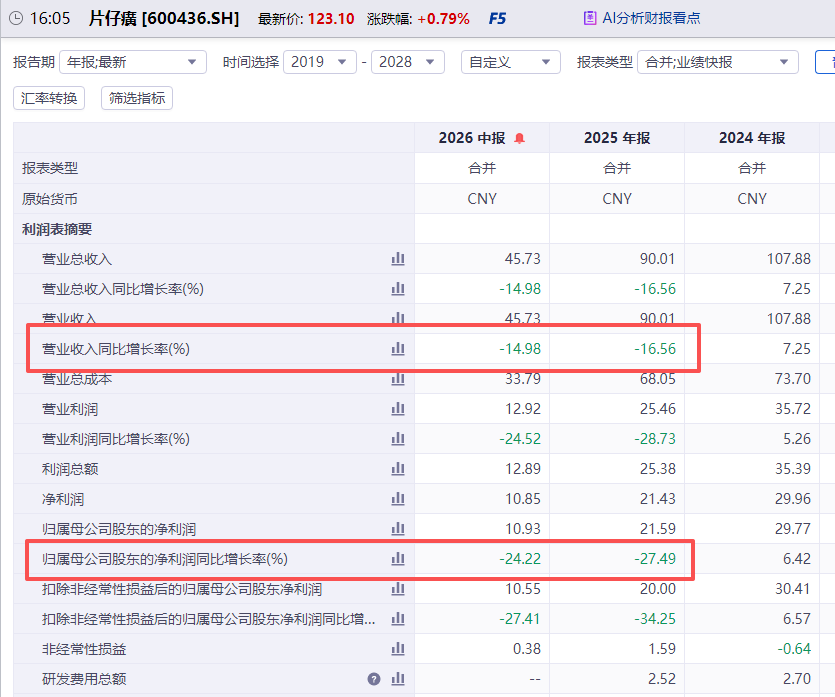
With the 2025 performance already laid out, the market should not have been overly surprised by this semi-annual report. However, on the first trading day after the report's release, the share price of Xiuzheng Pharmaceutical, also known as Piecewise, still fell 4.06% to close at 122.13 yuan.
Compared with the historical peak of 467.66 yuan in 2021, the current level is only about a quarter of that; even versus the August 2025 high of 214.55 yuan, it has dropped more than 40% in roughly a year.
To some extent, this shows that the market is no longer just worried about the continued decline in performance, but about a problem that seemed easy to solve in the past and now appears more difficult to resolve.
In recent years, Pianzaihuang has been heavily impacted by fluctuations in raw material prices, particularly natural bezoar, which saw its market price surge to around 1.65 million yuan per kilogram in 2025, compared to approximately 350,000 yuan per kilogram in 2019. While the scarcity of raw materials can support Pianzaihuang's high prices and growth story, it also directly erodes profit margins.
So, from the supply side, the first half of 2026 should have been a breather for Pianzaihuang.
In March, Uruguayan natural bezoar was approved for import, and by June, the country's first batch of imported natural bezoar from Argentina for pharmaceutical production arrived at Tongrentang, further opening up overseas procurement channels. Meanwhile, the price of natural bezoar on the open market also dropped significantly from its highs.
The decline in costs is gradually being reflected in the financial reports.
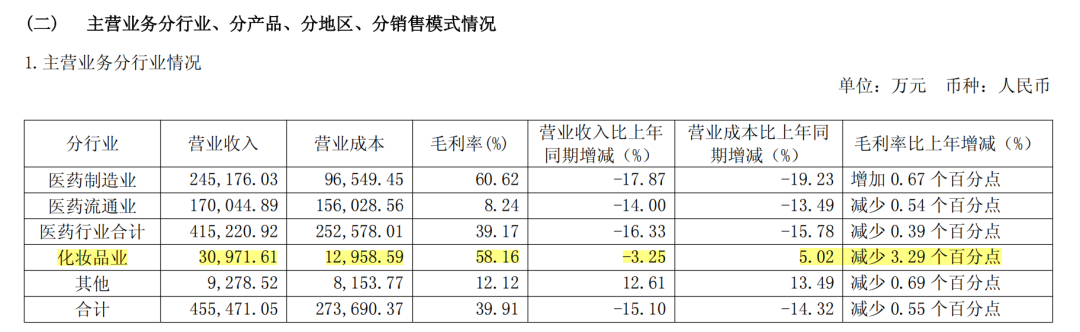
In the first half of 2026, the gross margin of Pianzaihuang's liver disease drugs reached 62.77%, up 1.27 percentage points year-over-year; the gross margin of its pharmaceutical manufacturing business also increased by 0.67 percentage points to 60.62%.
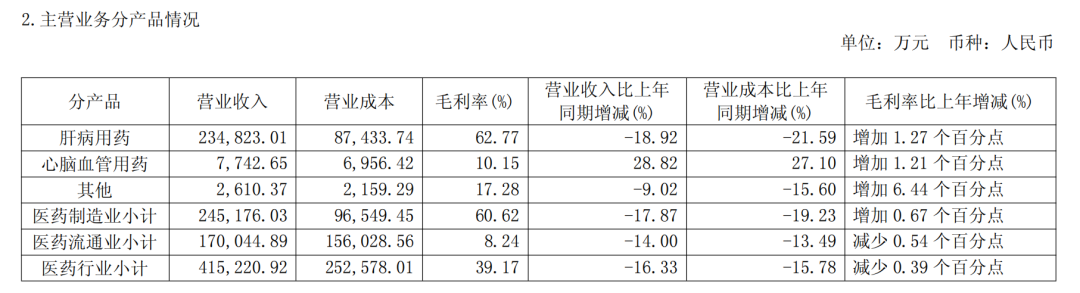
Although the price of raw materials has dropped and the gross margin has recovered, the revenue and profit of Tongrentang still plummeted by double digits.
This means the main challenge facing Pian Zai Huang may have shifted. Cost used to be its biggest headache; now the truly stubborn problem increasingly looks like it lies on the demand side.
The change in selling expenses is particularly telling.
In the first half of 2026, Pai Huang Ya's sales expenses reached 279 million yuan, a year-on-year increase of 27.5%. Among them, "promotional, business promotion and advertising expenses" reached 138 million yuan, while in the same period of 2025 it was only 81 million yuan, equivalent to a growth of about 70% in one year.
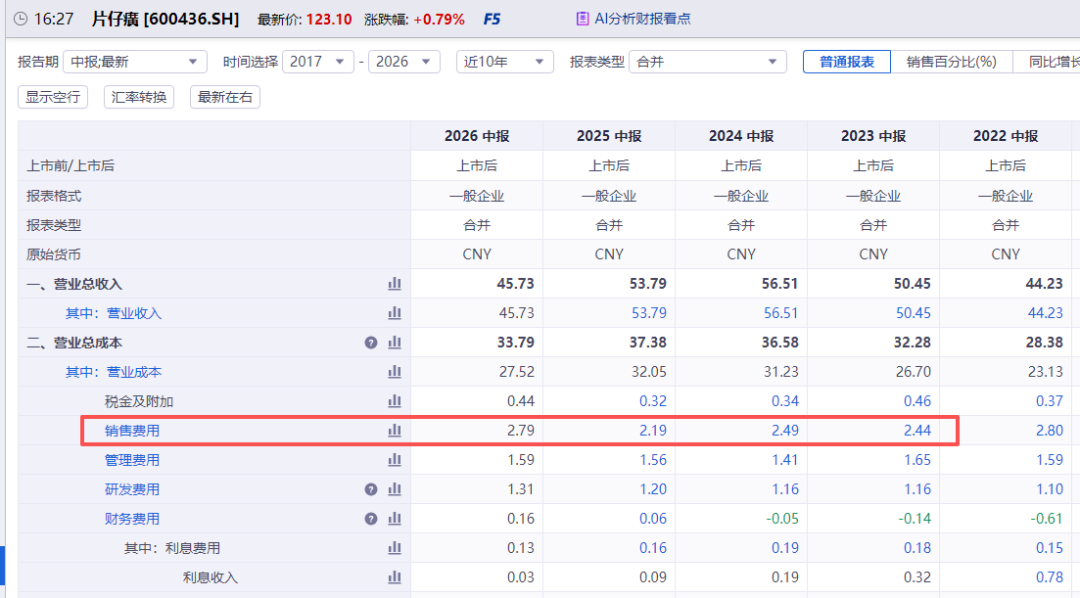
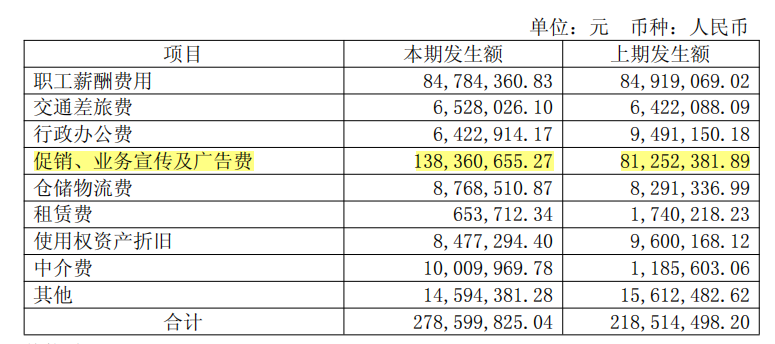
But during the same period, Pien Tze Huang's revenue actually declined by nearly 15%, which is somewhat awkward.
One of the most valuable aspects of Yunnan Baiyao in the past was that it didn't need to advertise aggressively like ordinary consumer goods. The scarce raw materials, secret formula, and the prestige of being a well-established brand itself formed a strong marketing system, and the continuous price increases created expectations, making distributors willing to stock up, with some people willing to give it as a gift and others willing to hoard it in anticipation of the next price hike.
Now, this logic seems to be reversing: companies are spending more on promotions and advertising, but the sales end still hasn't shown significant improvement.
Of course, the semi-annual report of Wanglaoji is not without its highlights.
In the first half of 2026, Pien Tze Huang's net cash flow from operating activities reached 1.625 billion yuan, versus 376 million yuan in the same period last year, up more than 300% year-on-year.
But a closer look reveals it's not that simple.
Cash received from the sale of goods and provision of services decreased from 5.382 billion yuan to 4.477 billion yuan, while cash paid for the purchase of goods and receipt of services plummeted from 3.967 billion yuan to 1.886 billion yuan.
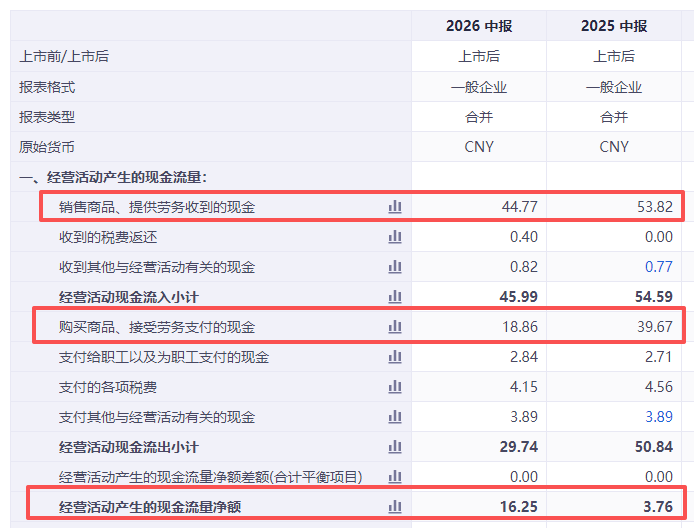
In simple terms, the money received from selling goods was less, but the money spent on buying goods was reduced even more.
For Fei Yan, there may be a more bitter reason behind it: de-stocking.
As of the end of June 2026, the carrying value of Yunnan Baiyao's inventory still stood at 5.954 billion yuan, down from 6.679 billion yuan at the beginning of the year, but still accounting for 32.16% of total assets. Meanwhile, the inventory turnover days have reached 413.22 days, exceeding one year.

In terms of structure, the book value of raw materials decreased from 4.807 billion yuan at the beginning of the year to 4.121 billion yuan, while the inventory of finished goods only dropped from 1.448 billion yuan to 1.328 billion yuan.
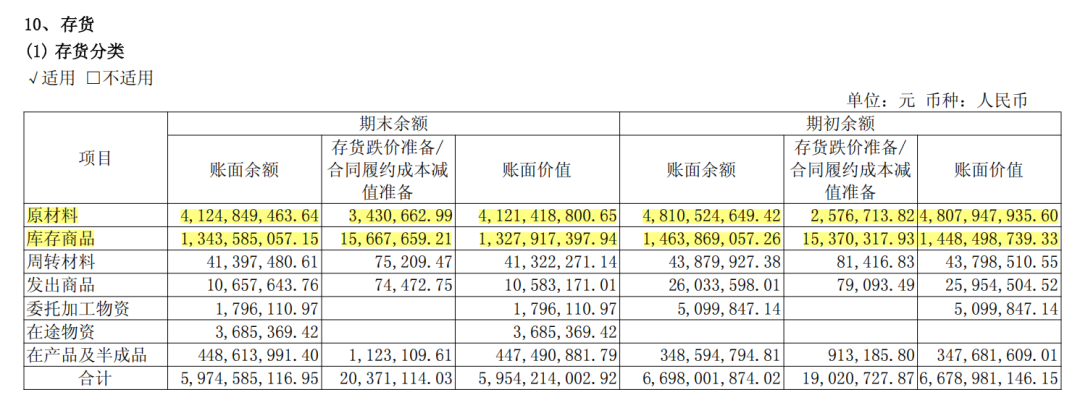
In other words, it's already very clear that they're buying fewer raw materials, but the products aren't selling off the shelves at the same pace.
This could be more troublesome for Tongrentang than the price increase of natural cow bezoar.
When raw materials become more expensive, it's still possible to raise prices; but if the real problem becomes that products are selling slowly, the next price increase will either solve the problem or thoroughly expose it.
The guided price is 760 yuan.
The recycling price is 460 yuan
Relying on scarce raw materials, a secret formula, and its time-honored brand status, Pianzaihuang has raised prices nearly 20 times over the past two decades. The most recent increase came in 2023, when the company lifted the domestic retail price of its Pianzaihuang tablets from 590 yuan to 760 yuan apiece—a jump of almost 30%.
In the past, this was almost a foolproof tactic, but it has not been as effective in recent years.
In September 2024, a Pengpai News reporter, posing as a seller, contacted multiple "scalpers" to inquire about the resale price of Pianzaihuang pills, with some quoting as low as 400 yuan per pill. By April 2026, a New Beijing News investigation found a recycler willing to pay only 460 yuan for a single-pill pack of Pianzaihuang pills produced in 2024.
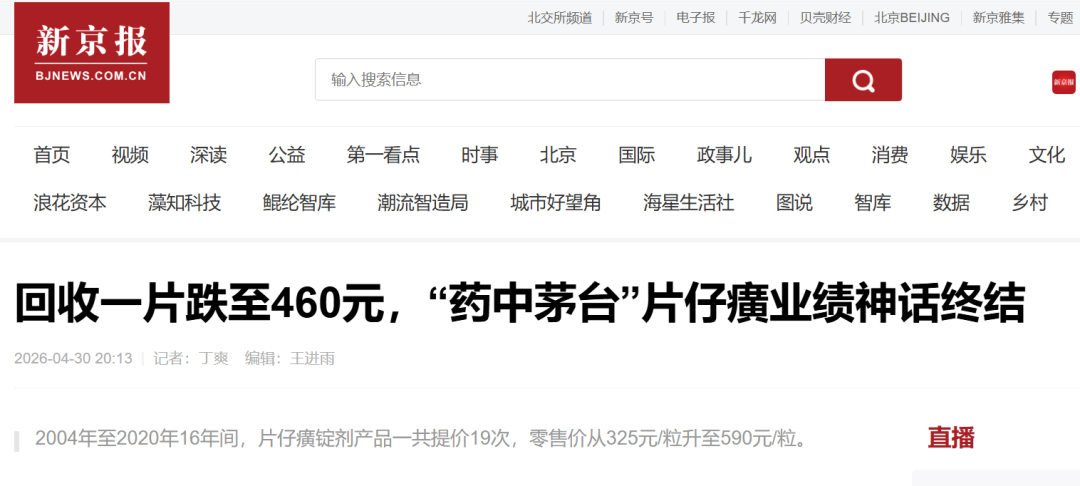
The official guided price is 760 yuan, and the recycling price is 460 yuan, a difference of 300 yuan.
Of course, the buyback price doesn't directly reflect the normal retail market. But Pien Tze Huang is, after all, more than just an ordinary medicine. Beyond genuine medicinal demand, its high price has historically been supported by demand for gifting and stockpiling — and the buyback market happens to be a good gauge of how those two are faring.
" top of a a top of a top of a " " " " " " " " " " " " " " " " " " " " " only " " " " " " "ori " " " " " " " " " " " " " that " " " " " " " " " " " " " " " " " " " " " " " " " " that " " " " " " " "." " " " " " " " " " " " " " " " " " " " " " a " " " " " " " " " " " " " " " " " " " " " " " " " " " only " " " " " " " " " " " " "." " " " " " " "." " " " " " " " " " " " " " " " " " " "ering," " " " " " " " " " " " " " " " " " " " " " " " " " " " " " " " " " " " " " " " " a " " " " " " " " " " " " " " " " " " " " " " " " " " " " " " "
Once demand for gifting and stockpiling recedes, Pien Tze Huang's bid to maintain or even raise prices ultimately comes down to answering one fundamental question:
So how many people are still willing to shell out 760 yuan or more for the pill itself?
But consumers are changing too.
Tmall Health data for 2023 shows that consumers born in the 1990s purchased 45% of liver-protection tablets. JD Health data from the same period also indicates that people aged 26 to 35 have become the largest consumer group for liver-protection nutritional supplements.
These figures do not directly equate to the demand for Wang Lao Ji's pharmaceutical products, but they do indicate that the consumption of liver-protecting products is becoming noticeably younger. The way young people shop is also quite different from the previous generation.
One of the most compelling stories behind Pian Zai Huang has long been its state-secret formula. For those who trust time-honored brands, precious medicinal ingredients, and traditional expertise, this represents scarcity and authority. But today's young consumers have been trained by skincare and supplement marketing to become "ingredient checkers"—they habitually ask what's inside, why it works, whether there's evidence, and what justifies such a high price.
Thus, the "secret formula" began to take on a subtle dual nature: those who believe in it see it as a moat that no one else can replicate, but for those accustomed to tearing products apart to study them, being told only "it's a secret" may no longer command the same premium it once did.
The recent promotional controversy has made this matter even more sensitive. According to media reports, stores affiliated with Pien Tze Huang's controlling entities were reported by consumers for allegedly making false claims in certain promotional materials. The Beijing Dongcheng District Market Supervision Administration has opened a case for investigation, though no final conclusion has been reached.
By this logic, Pien Tze Huang seems even less justified in raising prices.
But from another angle, now is actually the best time for a price increase.
This is how Moutai does it.
After the price increase for Feitian Moutai, core demand has remained resilient. While the series liquor segment has weighed on overall results, at least one thing has been reaffirmed: the bottle that truly props up Moutai possesses pricing power approaching that of luxury goods.
What Pien Tze Huang lacks now is precisely such an "inspection."
If prices continue to climb while core sales hold steady, that would signal a sufficiently strong brand with room to push its main business further upmarket.
If a price hike immediately causes sales to drop, the answer may not be pretty, but it's still better than being left hanging. At the very least, it lets you see sooner whether what supported the high premium was genuine demand, or merely gifting, stockpiling, and expectations of appreciation.
Only by actually playing this card can the company see whether its next move should be to keep doubling down on this drug or to shift more chips elsewhere.
Betting on Medical Aesthetics
If price increases are a test of its core business, Pien Tze Huang has already prepared another path: medical aesthetics.
It may sound completely unrelated, but it isn't entirely unexpected.
Pien Tze Huang's cosmetics business dates back to 1980, when its predecessor incorporated traditional Chinese medicine ingredients into skincare products, launching Queen-brand Pien Tze Huang Pearl Cream and Pearl Facial Cream. In 2020, the company began preparing to spin off and list the cosmetics unit. After completing a shareholding system reform in 2024, the entity was renamed Fujian Pien Tze Huang Cosmetics Co., Ltd.
Pien Tze Huang has spent years expanding from liver-protection drugs into skincare, yet that business line has never truly carried the company.
In the first half of 2026, Pian Zai Huang's cosmetics business posted a 3.25% year-on-year decline in revenue, while gross margin contracted by 3.29 percentage points. With the core business under pressure, cosmetics not only failed to pick up the slack — it is now showing signs of strain itself.
Pien Tze Huang's move is to continue doubling down.
The company recently acquired land in Daxing, Beijing for 80.13 million yuan, with a planned total investment of 754 million yuan to build a northern health-tech manufacturing base focused on high-end medical aesthetics device R&D and industrialization. Construction is scheduled to begin in October 2026 and complete in April 2028, with projected annual output value of 1.18 billion yuan once fully operational.
This is no small move.
The entity behind the land acquisition, Pien Tze Huang Big Health, is wholly owned by Pien Tze Huang Cosmetics. In other words, the company's ambition extends beyond simply selling more jars of face cream. By building out its "big health" line, it is positioning itself to move further into the medical aesthetics market, where profit margins are considerably higher.
Medical aesthetics certainly has its appeal. According to Frost & Sullivan data, China's medical aesthetics market is projected to reach 638.2 billion yuan by 2030. Over the past few years, companies ranging from traditional pharmaceutical firms to medical device makers have all been crowding into this sector.
So Pian Zai Huang's choice is quite shrewd, but the real challenge lies in whether the playbook that worked for liver protection can be replicated in its skincare ambitions.
For skincare products, brand, distribution, and marketing are what matter most. But high-end medical aesthetics devices compete first and foremost on R&D, regulatory approval, clinical evidence, physician networks, and product iteration. Some of these devices are even Class III medical devices, where the barriers to entry and development cycles are on an entirely different scale from selling skincare.
More realistically, the medical aesthetics play won't yield results quickly.
The Beijing project alone won't be completed until 2028, and that's before product registration, production ramp-up, and channel development even begin. By the time this business line actually starts contributing profits, it could be several years down the road.
The medical aesthetics market is no longer an untapped blue ocean. Professional device manufacturers, traditional pharmaceutical companies, and a range of cross-industry players have already taken their seats at the table—by the time Pianzaihuang actually brings its products to market, competition will only be fiercer.
But before that, how should Pien Tze Huang stabilize its core business?
Given little prospect of a near-term recovery in consumer demand, raising prices is the pragmatic move — at least to preserve the prestige of being the "Moutai of medicines."
Would Pien Tze Huang dare to raise prices the way Moutai does?
I notice you've provided translation instructions but no source text to translate. Please share the Chinese content you'd like me to translate into Bloomberg-style English.
New Express: Pien Tze Huang, priced at 760 yuan per pill, faces investigation for alleged false advertising; shares down over 40% in past year
Pien Tze Huang's Fall: Can 760-Yuan Pills No Longer Sell? Liver-Protection Market Faces Major Shakeup
Business Elixir: 754 Million Yuan Goes North — Pien Tze Huang's Anxiety and Bold Gamble
Star Island Research: Pien Tze Huang's Moat Crumbles, Cosmetics Fade — Heritage Brand Sets Sights on Medical Aesthetics