TCL has sued Samsung, alleging that the Mini LED televisions Samsung sells aren't actually Mini LED.
On August 31, TCL North America sued Samsung Electronics America in US federal court, alleging that Samsung repackaged ordinary LED TVs as Mini LED, misleading consumers and stealing TCL's market share through low pricing.
The products in question are Samsung's M70H, M80H, and M90H, launched in 2026. TCL is asking the court to prohibit Samsung from continuing to promote these products as "Mini LED", and is also demanding that Samsung correct its advertising, return related profits, and compensate for losses.
Samsung responded that it will actively defend against the litigation, insisting that its product descriptions are accurate and reliable.
So the core of the current debate between the two parties is: what constitutes a Mini LED?
Is it still considered Mini LED without local dimming control?
This debate sounds professional, but the principle is not complicated.
Most so-called LED TVs are, strictly speaking, still LCD liquid crystal TVs. The "LED" refers to the backlight system that provides the light source for the liquid crystal panel. The liquid crystal screen itself does not emit light, so a set of lamps must be installed behind the screen, similar to shining a flashlight from behind a transparent painting.
Standard LED TVs generally fall into two categories: edge-lit and direct-lit. Many entry-level models can only adjust the backlight as a whole; some products with local dimming have relatively few and large dimming zones, making it difficult to precisely match fine brightness variations within the picture.
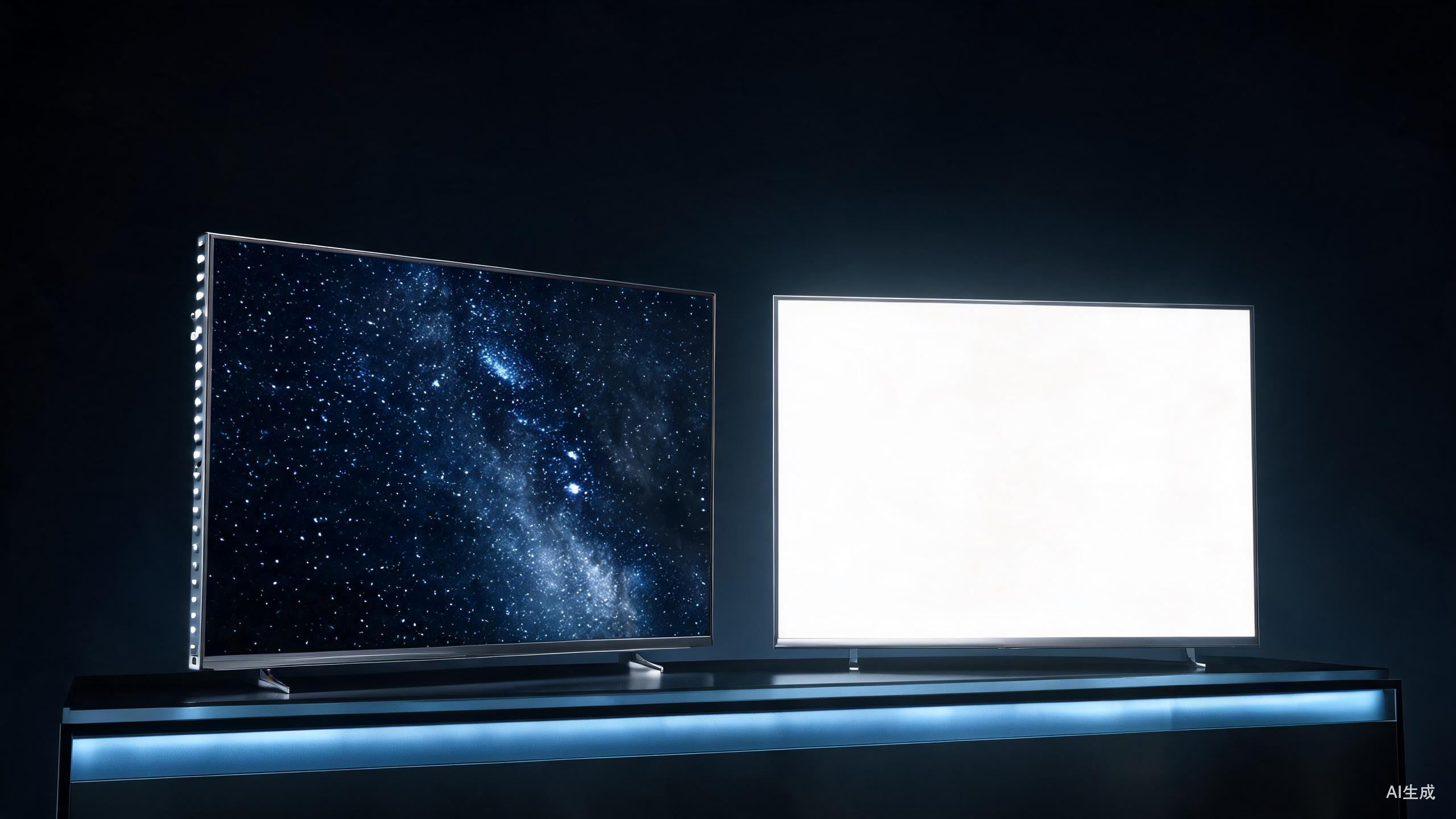
For instance, when a TV is displaying a pitch-black night sky with only a few bright stars, ordinary LED TVs have difficulty illuminating only the stars without also illuminating the surrounding night sky, resulting in the black color appearing gray and a halo of light around the bright spots.
Mini LED addresses this issue by making the backlight LEDs smaller and increasing their number, allowing more LEDs to be packed into the same area and dividing them into more and finer dimming zones. The brightness of the backlight is increased in bright areas of the image and decreased or even turned off in dark areas.
When these light-emitting units are arranged in a matrix behind the entire LCD panel and adjust brightness by zone according to image content, this technology is called "Full Array Local Dimming", abbreviated as FALD.
TCL is now accusing Samsung of removing the crucial "zone control" feature, while still using the Mini LED name.
Standards for ambiguity have been turned into a business by Samsung
In a lawsuit filed with the court, TCL disassembled and compared Samsung's M70H with its own ordinary Crystal UHD TV, the U800F.
According to TCL, the standard U800F contains 54 LEDs internally, while the M70H has only 52—two fewer. These LED chips are arranged on two light bars and measure roughly 0.5 millimeters, also larger than what the industry typically considers Mini LED.
More importantly, TCL claims that the M70H lacks an independent LED control chip and hardware partition control circuit. All the LEDs can only be turned on or off simultaneously, and the backlight, reflective membrane, power board, control board, processor, and light bar structure are almost identical to those of ordinary Crystal UHD TVs.
In straightforward terms, TCL believes Samsung takes a basic LED-backlit LCD TV, changes its name and packaging, and sells it as a higher-end Mini LED TV.
It is worth noting that this accusation is not entirely one-sided, coming from TCL alone.
RTINGS, a TV review agency, purchased and tested the 65-inch Samsung M80H and found that the TV indeed lacks local dimming, which means it cannot independently control the backlight in different areas of the screen. RTINGS directly commented that Samsung's promotion of this product with Mini LED is "highly misleading", and its contrast and HDR performance are even inferior to the lower-priced TCL QM6K.
Over the past few months, questions have also been mounting in Samsung communities, on Reddit, and across TV forums about whether the M70H and M80H are truly Mini LED televisions — including why they lack local dimming, and whether a set relying only on software-based dimming can still be called Mini LED.
More subtly, Samsung's own product documentation also states: "Supreme Mini LED Dimming is a software-based technology, not a full-array hardware-based technology."
In other words, Samsung did not entirely conceal the lack of a hardware partition for optical control, it just placed the statement in the footnote of the product page and specifications table.
Samsung is capable of producing full-array local dimming, and its higher-priced Neo QLED series has already adopted this feature. However, true full-array local dimming comes at a higher cost, and what Samsung needs now is a more affordable product to counter TCL. Taking US market prices as an example, the smallest 45-inch M70H is priced at just $349.99, while the 65-inch QN80H with full-array Mini LED costs around $1,599, a price difference of nearly five times.
Samsung's logic has been reciprocated by TCL in kind.
Why does Samsung still insist its marketing is above reproach? Because Mini LED still lacks a globally unified, mandatory definition.
It's not like 4K, where you can clearly count the number of pixels. Currently, there is no globally unified mandatory standard that stipulates: the size of the lamp beads must be less than a certain size, the quantity must reach a certain number, and it's absolutely not allowed to be called Mini LED without FALD.
RTINGS criticized Samsung's marketing while also acknowledging that Mini LED itself is closer to an industry marketing term. Market research firm Omdia has also included Samsung's M series in its Mini LED TV category, stating that Samsung uses white light Mini LED packaging, but reduces costs and prices by removing configurations such as quantum dot films.
So the real point of contention between the two parties is that TCL believes Mini LED has formed a clear consumer perception - it must have a large number of small LEDs and hardware zone control for dimming. Samsung cannot take advantage of the lack of mandatory standards to put a TV without local dimming into a Mini LED box.
Samsung may argue that Mini LED describes the type of backlighting, which does not necessarily mean it must come with FALD, and that the company has already clarified in the footnotes that the related dimming is a software technology.
Notably, the timing of the lawsuit reflects a very real market battle behind the scenes.
According to Omdia data, in the first quarter of 2026, TCL still held the top spot in global Mini LED TV shipments with a 30.2% share. In March, Samsung launched its more affordable M series, and by the second quarter, Samsung had risen from third to first, with a 28.2% share, while TCL fell to 23.3%.
According to TCL's statement in the lawsuit, after the M series was launched, Samsung's sales of Mini LED TVs increased several times, with about 60% coming from the M series.
Samsung has won back market share with lower prices, but TCL believes these lower prices come from cuts to the core Mini LED hardware.
What makes it more intriguing is that TCL is now deploying against Samsung the very same legal strategy Samsung used against TCL earlier this year.
In March, Samsung won a false advertising lawsuit against TCL in Germany.
QLED is not an entirely new type of screen like OLED, it is essentially still a liquid crystal TV, but with quantum dot material added between the backlight and the liquid crystal screen, which "purifies" the light, making reds more red and greens more green, allowing the TV to display more vivid colors even at high brightness.
Samsung had accused TCL of marketing some televisions as QLED despite not delivering the quantum dot display performance consumers typically expect. A German court ruled in Samsung's favor, prohibiting TCL from continuing to advertise and sell the relevant products as QLED TVs. As of now, there is no public information indicating that the ruling has become final and binding.
QLED is primarily about solving color accuracy, while Mini LED focuses on backlighting and contrast. Although the two lawsuits involve different technologies, the legal reasoning is nearly identical: you cannot use the full name of a technology simply because your product contains a few related components; and if the core effect consumers expect is not delivered, it may constitute misleading marketing.
This time, TCL essentially gave Samsung's logic back to them unchanged.