
On the evening of August 31, Saint Bella Group (02508.HK) released its 2026 interim results. The report shows first-half revenue of RMB 611 million, up 36.0% year-over-year; adjusted net profit of RMB 60.584 million, up 56.2%; and book net profit of RMB 53.971 million, down 83.5%.
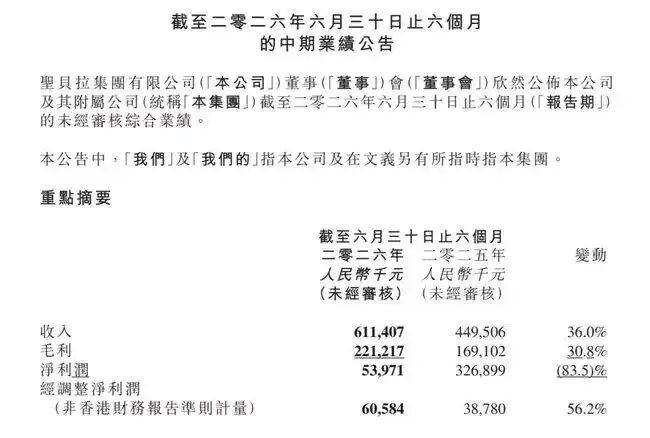
The same report showed that profits plummeted 80% and surged 50% at the same time. The explanation for the plummet is not complicated: the base figure was boosted by a one-time gain of approximately 318 million yuan from the change in fair value of financial instruments in the same period in 2025, prompting the company to guide the market to look at the adjusted figures.
From the prospectus to the annual report and then to the semi-annual report, the company's external communication almost only uses adjusted figures, with statutory profits and adjusted profits diverging for years. The most worth looking at in this semi-annual report is not growth, but the accounting treatment. After flipping through the accounting books page by page, you will find that financial techniques may be the most refined product of this company.
Looking at the profits themselves, the 2025 annual report showed a net profit of 411 million yuan on the books, of which approximately 318 million yuan was a one-time gain from the change in the fair value of financial instruments prior to listing. After adjustment, the net profit was only 125 million yuan. In other words, about 70% of the net profit of 411 million yuan in the annual report was not earned through operations. By the 2026 mid-year report, the net profit on the books was 53.971 million yuan, and 60.584 million yuan after adjustment, with the two sets of numbers continuing to diverge. Readers need to ask themselves: which year's reported profit is clean.
There are several algorithms for calculating profit for the same company
What's even more interesting is that the same accounting item has played a completely opposite role for this company. From 2021 to 2024, the company's net losses were 119 million yuan, 412 million yuan, 239 million yuan, and 543 million yuan, respectively, totaling approximately 1.3 billion yuan. The company explained that this was mainly due to the change in the fair value of financial instruments issued to investors, which is a non-cash item. Before listing, this item generated huge losses; on the eve of listing, the same item generated huge profits. When the company was losing money, it told investors that this was a non-cash item and not to worry; when it was making a profit, it was also a non-cash item - should investors be equally skeptical?
Looking at the average transaction value, during the IPO period, the company disclosed the "average contract value of postpartum recovery customers for the Saint Bella brand", which was 472,000 yuan, 458,000 yuan, and 419,000 yuan in 2022, 2023, and 2024, respectively, declining for three consecutive years. After listing, this indicator was no longer disclosed, replaced by the ASP metric: the 2025 annual report showed that the average transaction value of the Saint Bella brand was 267,000 yuan, and the average transaction value of all brands in the first half of 2026 was 171,000 yuan, up 15.9% year-on-year, with the narrative changing to "quantity and price rising together". The statistical scope of the two metrics is completely different, with the former only covering postpartum recovery customers and the latter covering all customers and all brands. The company has never explained the reason for switching between the two metrics. The old metric declined for three consecutive years, while the new metric has been hitting new highs, which is not a data contradiction, but a choice of disclosure.
The "global first" is also a product of rhetoric. According to Frost & Sullivan data, based on 2025 revenue, Saint Bella ranks first in the global postpartum care center industry with a market share of around 0.5%, while the top five companies combined account for only 1.3% of the market. The first place has a share of only 0.5%, which suggests that the industry is highly fragmented and lacks scale barriers, rather than the company having established a strong dominance. The title of "global leader in family quality care" is based on a set of customized rhetoric.
Operational metrics also raise questions. The mid-year report showed a second-time consumption conversion rate of 96.3%, with 94% of postpartum care customers purchasing STB's Yu Kang service. The conversion rate of 96.3%, which is close to a perfect score, did not disclose its statistical caliber. According to Qidian Bai, most postpartum care services are given away as gifts, and independent purchases are relatively rare. AI-powered physical examination contributed 6.9 million yuan in revenue, accounting for about one-thousandth of the total revenue of 611 million yuan, yet occupies a prominent position in the report. Additionally, the proportion of diversified revenue: the mid-year report claimed that the proportion of diversified business revenue had reached 31.5%, but postpartum care revenue was 508 million yuan, accounting for 83% of total revenue. The gap between 31.5% and 17% depends on what is included in "diversified revenue", and the company has not disclosed this information.
The quality of growth also needs to be examined. Revenue increased by 36.0% year-over-year, but the number of stores grew from 96 at the time of listing to 140 by the end of 2025 and 148 in the first half of 2026, with the store network expanding by more than 50% compared to the same period last year. In June 2026, the company acquired Wuhan Freya, adding 3 standalone stores, 160 beds, and nearly 10,000 high-net-worth members. The total revenue generated by new store openings and acquisitions does not necessarily mean that individual stores have become stronger. According to calculations by NetEase Finance based on the prospectus, the company's average monthly revenue per store decreased from 2.59 million yuan in 2021 to 1.99 million yuan in the first half of 2024, indicating that growth at the individual store level is not as impressive as the overall revenue growth.
The improvement in profit margin does not hold up to scrutiny. The adjusted net profit margin of 9.9% represents a year-over-year increase of 1.3 percentage points, appearing to indicate enhanced profitability. However, the gross margin for the same period was 36.2%, a year-over-year decline of 1.4 percentage points. The true source of the improvement in profit margin is cost compression: the marketing expense ratio was 11.3%, down 0.7 percentage points year-over-year, and the management expense ratio was 16.7%, down 5.4 percentage points year-over-year. The core business's ability to generate profits is weakening, and the profit statement is being propped up by cost-cutting, which is not sustainable in the long term.
Another reference point is cash flow. In the first half of 2026, the company's net operating cash flow was approximately 12.82 million yuan, while its net profit was 53.97 million yuan during the same period, with operating cash flow significantly weaker than net profit. The company's cash reserves are also relatively thin compared to its revenue.
Lastly, there's the share buyback. The company approved a HK$1 billion buyback plan in June 2026, with a maximum purchase price of HK$6.85 per share, whereas the current price is only around HK$3.1, with the upper limit more than double the market price; the HK$1 billion accounts for about 0.5% of the company's HK$19 billion market capitalization, indicating a symbolic gesture of supporting the stock price rather than a substantial one. Another set of numbers worth noting is that the net proceeds from the IPO were approximately HK$630 million, while the company's current market capitalization is around HK$19 billion, meaning the funds raised from the market back then are equivalent to about one-third of the company's current valuation.
Beyond the official narrative, the underlying business remains thin.
Strip away the rhetoric, and the fundamentals of this business are plain to see.
Shengbella has 148 global stores, many of which are located in high-end hotels such as the Ritz-Carlton, Peninsula, and Mandarin Oriental. The pricing system includes the entry-level Xiaobella starting at 68,000 yuan, Aiyu starting at 98,800 yuan, and the main Shengbella brand's 28-day package starting at 168,800 yuan. According to a report by the Southern Daily, the Queen's package starts at 388,800 yuan for 28 days, with the 56-day version having a nationwide highest quote of 768,800 yuan to 1,168,800 yuan. The list of publicly reported clients includes celebrities such as Qi Wei, Gina, and Tang Yixin. This is a business that has turned postpartum care into a luxury product.
However, the luxury goods market also has its cycles. According to data from the National Bureau of Statistics, the number of births was 9.02 million in 2023, 9.54 million in 2024, and 7.92 million in 2025, falling below 8 million for the first time.
At the other end of the industry is a wave of closures: reportedly, about 90% of maternity centers are losing money; in January 2025, Ai Jia Maternity Center went bankrupt, affecting 67 stores in 22 cities across eight provinces; Hangzhou Maternity Center's collective closure became a trending topic; Ai Di Gong, once the "first listed maternity center stock," has been suspended from trading since February 2025. This industry's model has three inherent vulnerabilities: a prepayment system, where customers pay first and consume later; high rent, with leasing costs accounting for 35% to 40% of sales costs, and high-end hotel rents not being discounted due to declining birth rates; and low frequency, as maternity consumption has almost no repeat business, requiring continuous investment in customer acquisition.
The company's compliance record is not clean, with most cases on file. The company's subsidiary was penalized twice for practicing medicine without a license and once for false advertising, involving content such as the ACI maternal and infant care certificate and the claim of being the "only one to collaborate with MIT," which could not be verified. In 2022, it was ordered to pay 500,000 yuan in compensation to its peer, Weige, for commercial defamation. Its subsidiary, Guanghe Hall, was fined twice for violating advertising regulations. The prospectus revealed that the company had lent money to a third party. In the 2024 Yuege incident, a settlement plan that involved 40% cash compensation and required the plaintiff to abandon their rights and delete negative content was criticized by some parties as a "gag order." According to Xiaohongshu, customer complaints are mainly focused on several aspects, but it is now difficult to find relevant posts, and it is understood that customer service will communicate with users one-on-one based on their posts.
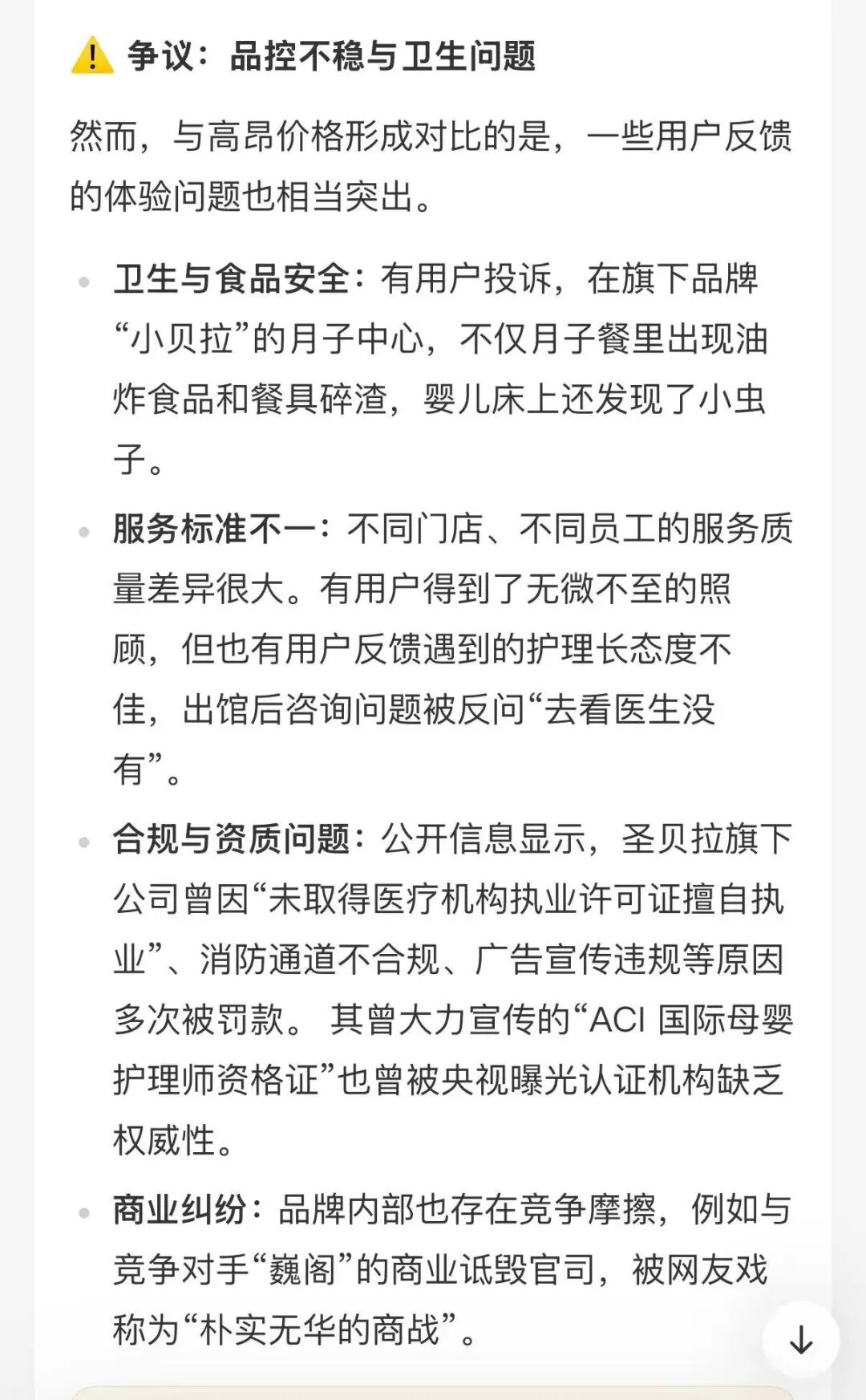
These penalty amounts are generally not large, but in an industry where trust is an asset, they point to the same issue: whether the brand owners' management scope can keep up with their expansion speed.
Voting in the capital market has already begun. Listed on June 26, 2025, with an issue price of HK$6.58, the stock closed at HK$8.80 on the first day, with a market capitalization of HK$5.366 billion, but plummeted 25.45% to below the issue price the next day. As of September 1, 2026, the stock price is around HK$3.0 to HK$3.2, with a market capitalization of around HK$1.9 billion, down about 52% from the issue price, while the average target price of analysts is HK$6.32. Despite strong interim growth, the stock price remains stagnant, and the object of the market's "voting with its feet" may not be the performance itself, but rather the quality of that performance.
The company also has some notable highlights, including an adjusted net profit growth rate of 56.2%, which is indeed high; its position as the industry leader is genuine; its cost control measures have been effective; and its revenue from family care increased by 59.1% year-over-year, Guanghe Hall grew by 44.4%, and overseas revenue surged by 244%, all of which are real advancements, albeit on a small scale.
The maternity care center business is high-end but fragile: low-frequency, service-intensive, prepaid, and heavily reliant on trust, and the industry is still in the midst of consolidation. It is a fact that Saint Bella's Black Cat has zero complaints, high adjusted profit growth, and the largest market share. It is also true that: approximately 70% of its annual net profit comes from one-time items, the definition of average transaction price was changed after listing, operating cash flow is weaker than net profit, and the buyback limit is more than twice the current price, but the amount only accounts for 0.5% of its market value.
The contrast between the accounting-driven plunge in book value and the surge in adjusted earnings is easy to explain. But the divergence between the stock price and underlying performance is a matter of trust—and that is far harder to resolve. The market is still waiting for an answer: when a 28-day package priced at 168,800 yuan collides with an era of births falling below 8 million, will the next 36% growth come from operations—or from methodology?