
With the freedom to drink milk tea and the freedom to use mobile data, will there be more freedoms like these in the future?
Many people are asking.
Starting in August, major operators suspended online agency card sales, and suddenly, many platforms no longer offered monthly rentals of over a dozen yuan and super-large traffic cards with hundreds of gigabytes.
Even earlier, last year, the 10-yuan and 20-yuan small-amount mobile phone top-ups bound to third-party platforms like WeChat were already gone.
"Free phone top-ups and data" seems to be becoming a thing of the past.
The increasing disappearance of small-denomination and low-priced services, what does it really mean?

There were already signs that small-denomination recharges were not very convenient.
Since last year, most payment platforms that support mobile top-ups—such as WeChat, Alipay, and UnionPay's Cloud QuickPass—have discontinued low-denomination options of 10 or 20 yuan. Pages now start at 50 yuan, with some platforms requiring a minimum recharge of 100 yuan.
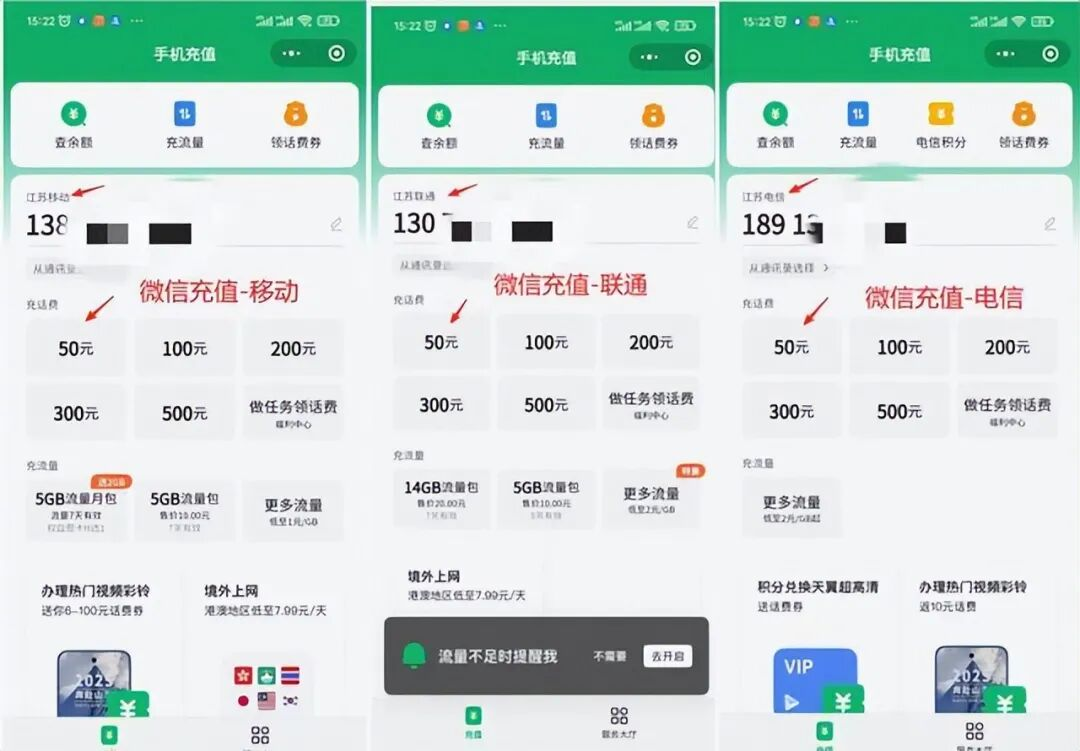
Denomination changes on top-up service platforms
For instance, if your monthly phone bill is 80 yuan, previously you could get it done on WeChat with a 50 yuan plan plus a 30 yuan add-on, but after the bundles disappeared, you would have to pay 100 yuan, resulting in an additional 20 yuan.
Similarly, the suspension of third-party card sales services by operators in August this year is essentially the same.
Compared to before, the most obvious change brought about by the implementation of this new regulation is that the scenarios for ordinary people to apply for and recharge cards will be reshaped.
It's worth noting that prior to this, third-party platforms such as Taobao, Pinduoduo, and short video live streaming rooms were the core hubs for low-priced traffic cards. Various 19 yuan and 29 yuan ultra-large traffic packages emerged one after another, far lower than the official packages sold by operators, with a wide range of choices and extremely low thresholds, also being the main way for the public to access the internet at a low cost.
If these low-priced traffic cards were to truly disappear from the internet, it would seem that many people would be losing a hidden benefit.
The reason is not hard to understand. The official pricing for packages on sale is uniform and has a higher threshold, compared to the low-priced, high-traffic packages that were once available on third-party platforms. Although we have a wide range of package options, the price advantage is no longer there.
For example, a data card with an original monthly fee of 59 yuan and 235G of monthly traffic can have its monthly fee reduced to 19 yuan after using coupons and other discounts. In contrast, similar 19 yuan and 29 yuan monthly plans offered on some carriers' official websites may only provide 2G to 35G of traffic, with 30GB being exclusive traffic.
Additionally, if more traffic is added in the future, it will not be very cheap.
A friend said they've been using the lowest-tier package for over a decade, which now starts at 69 yuan, but only includes 10G of data. Given the current 5G speeds, they use it up in just two or three days when out and about. If they want to purchase additional data, 10 yuan or 20 yuan only buys a few more gigabytes, and it's only available for a limited time.
The disappearance of small-denomination third-party recharge channels and low-priced traffic cards has sparked heated discussion, which is not hard to understand.
Some people claim their interests have been affected, while others downplay the issue, pointing out that there are other convenient channels for replenishment.
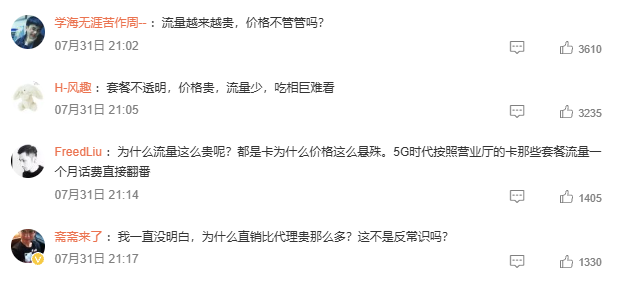
But behind these controversies, why has the public reaction been so strong, with even netizens raising questions?
For a long time, the communications services market has had a unique phenomenon, "cheaper doesn't necessarily mean inferior quality".
This contradicts the consumer logic in our daily lives that "good service comes with a good price".
Third-party data cards and small-denomination top-up services are not inherently low-quality offerings—they precisely match the needs of a vast pool of niche users with essential demand.
Many people only have a small balance left on their phones and don't want to recharge with large denominations, so small-amount quick recharges fit perfectly with fragmented demands. For students, elderly users, those using backup cards out of town, or other low-tariff groups, third-party services solved the pain points of official packages being overpriced, having high thresholds, and lacking flexibility. Gradually, these became one of the few low-cost digital benefits for the masses. Now that low prices are gone for good, isn't it painful?
This is enough to show that third-party low-cost communication services are not dispensable auxiliary functions, but rather a pressing need that aligns with the daily lives of ordinary people, which is also the inevitable reason why the public's perception has fallen short after the new regulations took effect.
That being the case, we need to dig one level deeper: has the freedom over phone bills and mobile data truly disappeared?
In fact, there isn't.
but was hidden instead.
In reality, after examining the operators' recharge interfaces, we found that what has disappeared is the freedom to recharge any amount on unofficial platform channels. However, the minimum denomination can still be recharged through the operators' apps, and even custom amounts are allowed, so the freedom of phone bills and traffic is not actually gone.
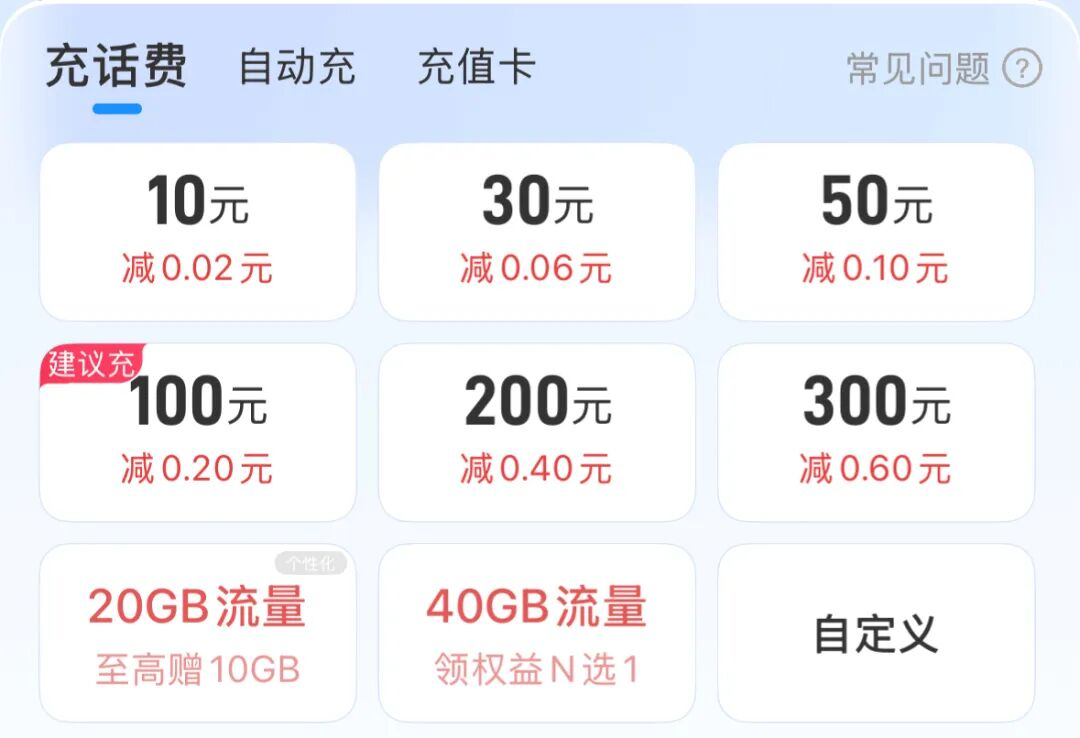
A certain operator's app recharge interface
It is still possible to customize the amount.
As for low-cost data plans, after the new regulations took effect on August 1, theoretically, all online phone card businesses will be consolidated under official channels. Does this mean that users' data discounts are really gone?
Not entirely.
Currently, users who want to apply for a new mobile phone card or select a data package can only do so through official China Mobile, China Unicom, or China Telecom channels, but there are still rewards such as point redemption, which I have used to exchange for talktime and data in the past.
Additionally, operators have introduced data packages on their official platforms tailored to different time periods and benefit structures, offering greater flexibility in both format and choice.
In conclusion, while the minimum recharge and low-cost data plans are indeed disappearing from some platforms, freedom is not completely gone. Some self-media and reports claiming that "all phone bill freedom is exiting history" are not true.
Another issue that has arisen is what the real reason is for the disappearance of third-party minimum talktime recharge and low-cost data cards.

Currently, there are two possible explanations for the disappearance of third-party minimum recharge amounts and third-party traffic card sales services. One is the various official responses provided, but the second explanation is more worthy of consideration, as it involves multiple aspects such as industry development and market operations, which will be discussed in more detail later.
What is referred to as an official explanation is, of course, a response to everyone's questions and criticisms.
Operators have responded that the closure of third-party small-value top-up channels is primarily to safeguard account security, and they recommend users recharge through the official app instead.
Operators also stated that the closure of third-party platform recharge services for 10 yuan and 20 yuan is mainly because the small-amount recharge cooperation agreements with some third-party platforms expired last year and have not been renewed, resulting in the minimum recharge amount being raised to 50 yuan.
However, multiple third-party recharge platforms claim that the recharge denominations are set by the three major operators.
The reasons each company gave were not entirely the same, and there was even a sense of passing the buck.
Similarly, telecom operators have their own justification for halting SIM card sales through third-party internet channels. Misconduct on these third-party sales channels has become rampant: some unscrupulous merchants falsely claim operator authorization to sell cards, illegally collect personal information such as ID numbers and facial data, and breed risks including telecom fraud, information leakage, and the circulation of black-market SIM cards.
The chaotic situation does exist, but is regulating low-cost services simply a response to these issues?
It's worth noting that these third-party services have existed for some time, and the various problems they pose are unlikely to have been discovered only now. In reality, the withdrawal of low-cost third-party traffic services is driven by surface-level regulatory standards and, at a deeper level, by the synchronized adjustment of multiple interests and development logic, rather than a single factor.
On one hand, from a business logic perspective, aside from compliance factors, relying on small-fee voice services and data cards has become increasingly difficult to attract incremental customers, and the withdrawal of low-priced, fragmented services is a necessary choice for enterprises.
During the early phase of internet adoption, telecom operators relied on third-party channels to rapidly acquire customers, reach users in lower-tier markets, and capture market share. As a result, they tacitly permitted various low-cost plans and agency distribution models.
However, with the total number of mobile phone users in China now exceeding 1.8 billion and the mobile phone user penetration rate approaching saturation, continuing to rely on low-priced, fragmented packages from third parties to acquire new users has extremely low cost-effectiveness. For operators, providing scattered small orders and ultra-low-priced services occupies system resources and human resources, yet is unable to contribute effective profits, and no longer meets the needs of large-scale development.
On the other hand, operators' traditional businesses have been under pressure in recent years, with their focus shifting to new businesses such as computing power.
Statistics show that in the first half of 2026, China's telecommunications business revenue totaled 887.3 billion yuan, down 2.1% year-on-year. Given that the revenue growth of the three major operators slowed to around 1% in 2025, with traditional businesses experiencing "increased volume but not increased revenue." In the first quarter of 2026, due to the combined effects of policy factors and the peaking of traditional businesses, the profits of the three companies also declined collectively, so operations require higher-quality development.
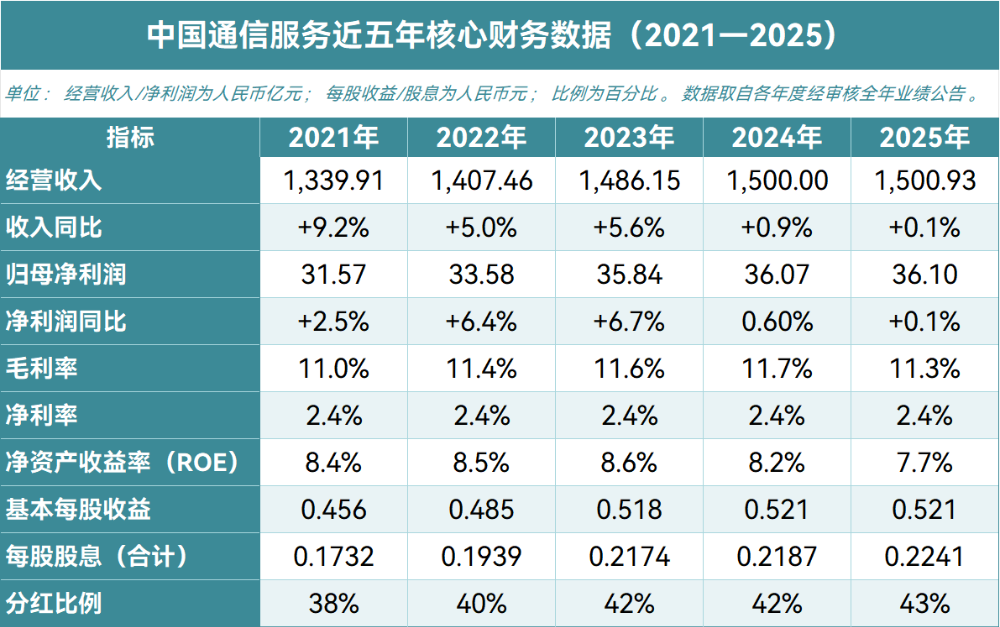
So while regulatory emphasis is a key reason for adjusting low-price service models, there's another factor at play: a shift in growth gears.
The three major carriers' total capital expenditures for the first half of the year exceeded 100 billion yuan, and they are shifting their focus from communication traffic to computing power services, a trend also seen in third-party platforms.
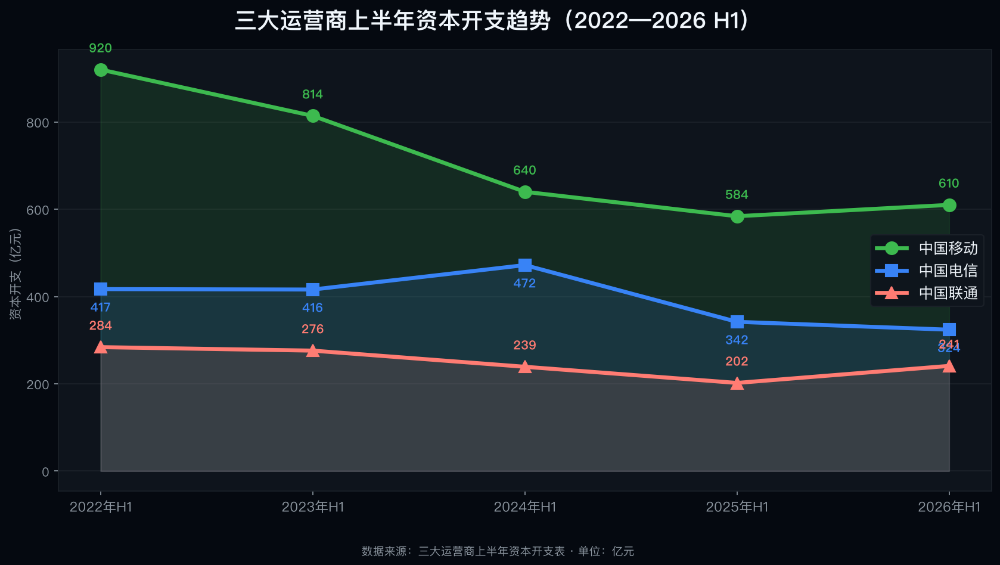
The capital expenditure of operators
Take China Mobile as an example: in the first half of the year, computing power-related revenue accounted for 22.58% of total main business revenue. Computing power service revenue alone reached 52.9 billion yuan, up 14.0% year over year. Against this backdrop, the token economy has become a hot topic—and at the operator level, everyone is pursuing this approach. China Telecom, for instance, previously launched three token plan tiers—Light, Standard, and Premium—with monthly fees of 9.9 yuan, 29.9 yuan, and 49.9 yuan, corresponding to 10 million, 40 million, and 80 million tokens per month, respectively.
Focusing on computing power and tokens is essentially a new business, but does it necessarily follow that it is logically connected to the disappearance of low-cost third-party services we mentioned earlier?
Operators have indeed adjusted their business strategies, focusing on new resources and cutting unnecessary maintenance costs. One operator once mentioned, "Consolidating and enhancing user value has become the key to increasing revenue and profit."
This explains a question mentioned earlier, why the common 10-yuan and 20-yuan top-ups can now only be done through the carrier's app.
Because compared to top apps with monthly active users of 700-800 million, although carriers have more than 1 billion and more than 400 million users, their app's monthly active scale does not rank in the top 10 in the application software field.
It's clear that operators prefer high-quality user stickiness, as these users will also become the foundation for operators to provide more value-added services to users in the AI era.
As for external third-party platforms, their thinking is that they are also unwilling to maintain low-yield businesses. For them, low-fee calls and low-priced cards are typical low-margin, high-after-sales, and low-yield businesses. These businesses have large order volumes, numerous customer complaints, and meager profits, which may consume a large amount of operational manpower. Under the trend of platform refinement, operational improvement, and efficiency enhancement, such low-profit convenience services are naturally being gradually marginalized.
Looking at it this way, it's not possible to simply view the withdrawal of third-party low-priced services from the surface. However, for us users, the company's reasoning is based on business logic, but what consumers care about is that tightening sales channels and stopping third-party minimum recharge services have already affected me, and will future services be upgraded?

To be frank, it's plain for everyone to see that the low-price dividends across industries have been fading in recent years, while costs for storage, computing resources, and the like continue to climb.
Many people subconsciously think that the disappearance of low-priced services and official unified control means that industry services are more standardized and the experience is better. However, from the perspective of ordinary consumers' real experiences, with low prices gone, they naturally expect an upgrade in services.
Taking some low-cost traffic cards as an example, it is undeniable that official channels have unified card issuance and controlled packages, eliminating problems such as black cards, fake packages, and information leaks. The after-sales system is more complete, and rights and interests are more stable. For the vast majority of ordinary users, security and standardization have indeed been improved. This is the positive value of industry standardization and an important significance of reform.
However, the issue is that the price disparity experienced by consumers is very real, and ordinary people have fewer affordable options and choices.
For user benefits, with the disappearance of third-party minimum recharge services, there will be expectations for operators to offer more diverse types of benefits. The same applies to recharge cards. Operators' customer service has also provided a clear response, stating that halting the sale of cards on third-party platforms does not affect user benefits.
Today's elderly, young people, students, delivery riders, and livestreamers will continue to rely on convenient, simple, low-denomination top-up options, and their demand for high data allowances at low prices is not going away.
For budget, long-cycle and scenario-based plans, carriers should fully disclose all terms to the public—including promotional validity periods, renewal standards and data throttling constraints—and lay out pricing rules clearly enough for users to grasp at a glance.
After all, in the eyes of some users, adjustments and regulation may be necessary, but it's also important to eliminate non-compliant marketing and sales tactics, rather than canceling products that genuinely meet users' actual needs.
It is crucial for the industry to strike a balance between high prices and services, allowing ordinary users to have more cost-effective and flexible communication options while ensuring safety and compliance.
The era of third-party low prices in communication services has come to an end, but the public's demand for affordable, convenient, and free consumption will not disappear.
Moreover, this is a real and ever-present need.