
It can serve, volley, and return, and humanoid robots are now capable of fully autonomous rallies.
At the opening ceremony of the 2nd World Humanoid Robot Games, the tennis and table tennis performances drew significant attention. Facing off against tennis star Zheng Jie and Olympic table tennis champion Ding Ning, the tennis robot from Galaxy Universal and the table tennis robot from the University of Hong Kong's SMASH team responded with ease, autonomously serving, adjusting their steps, and smoothly hitting forehand and backhand shots, while also completing technical movements such as lobs and smashes, with abilities now approaching those of human beginners.
Outside of the exhibition match, table tennis was also included for the first time as an official event at the World Robot Conference, with the competition adopting an 11-point system, where two humanoid robots completed a full match entirely autonomously. A total of 12 teams from universities and companies, including Peking University, Tsinghua University, the University of Hong Kong, Shanghai Jiao Tong University, and UC Berkeley, competed against each other. In the end, the Peking University Intelligent Science and Technology Institute joint team won the championship, the University of Hong Kong SMASH Hyperdimensional Team took second place, and the Shanghai Jiao Tong University/Shanghai Innovation Institute joint team took third place.
Recently, at the 2026 World Robot Contest in Yizhuang, table tennis has become an important window for manufacturers to showcase their technology - Chao Wei Dynamics, Dongyi Technology, Ji Jia View, and Yu Shu Technology have all set up human-machine interaction areas for table tennis at their booths, attracting a large number of audience members to interact.
Table tennis is becoming a new technological arena in the field of humanoid robots, attracting an increasing number of university research teams and robot manufacturers to participate and lay out their plans.

It is a swing motion.
According to China News Service, Qingteng Vision founder Zhang Haiwei categorizes robot-achievable movements into three types: routine movements, such as dance, individual competitive sports, like tennis, table tennis, and badminton, and team competitive sports, including soccer and basketball.
Zhang Haiwei further pointed out that currently, routine movements can be achieved through pre-programming, with relatively mature technology; swing movements, such as those in one-on-one confrontational sports, require robots to have real-time perception and decision-making capabilities, which have made initial progress; team confrontational sports involve complex collaboration and game mechanisms, and are still in the exploration stage.
This World Humanoid Robot Athletics Championships features 11 events, including track and field, gymnastics, table tennis, martial arts, and free fighting. In events such as gymnastics, martial arts, and sports dancing, humanoid robots have been able to complete high-difficulty movements like front and back flips, and can also perform smooth dance routines to music. In events like running and jumping that test underlying control capabilities, humanoid robots have repeatedly surpassed world records previously set by humans.
Table tennis is the next hurdle for humanoid robots to overcome. It requires them to achieve visual capture, trajectory prediction, and reaction decision-making of high-speed moving balls in a very short time, while also coordinating full-body movements and maintaining balance. As Zhai Shanghang, a researcher at the School of Computer Science at Peking University, said in an interview with the Beijing News, "When robots play table tennis, it's a test of the collaboration between the eyes, brain, and body. The 'eyes' capture the movement trajectory, the 'brain' makes quick predictions and decisions, and then the whole body is mobilized to execute precisely."
This capability is highly consistent with real-world demands, as the "perception-decision-execution" loop trained by humanoid robots in milliseconds through movements like swinging a racket shares a common underlying logic with real-world scenarios such as industrial sorting and home services – first perceiving the environment, then making a judgment, and finally executing.
"The perception, decision-making, motor generalization, and motion control capabilities that humanoid robots develop through playing table tennis have very strong transferability," said Li Yinghui, captain of the University of Hong Kong's SMASH super-dimensional team, in an interview with Lazy Bear Sports. Humanoid robots performing tasks in real-life scenarios, such as picking up trash, also require locating the target object, planning the action path, and then executing it precisely.

Where does the difficulty lie?

For humans, returning a serve is almost an instinct, but for humanoid robots, it involves a tremendous amount of engineering and numerous technical hurdles to overcome.
Racket sports are high-dynamic movements that require extremely high perception. A ping-pong ball takes less than 0.15 seconds to travel from serve to crossing the net, with a speed of over 15 meters per second; tennis balls can reach speeds of over 100 kilometers per hour. The ball is small, fast, and spinning, making traditional visual systems prone to image blur or perception delays during high-speed movements.
The main solution currently is to install external visual perception systems. At this humanoid robot sports competition, multiple motion capture cameras were installed at both the ping pong and tennis venues, capable of locking onto the coordinates and movement trajectories of the ball and robots within milliseconds, providing real-time data for subsequent decision-making.
In daily training, the SpikePingpong algorithm developed by the Peking University team combines high-frequency pulse vision of up to 20kHz with imitation learning strategies, enabling the robot to capture the precise trajectory of the ball in real-time and compensate for interference such as air resistance, achieving millimeter-level prediction of the ball-racket contact point.
On the ping-pong table, the "brain" must complete trajectory prediction, landing point judgment, and stroke strategy generation in milliseconds, while the "cerebellum" synchronously converts it into precise full-body movement control. This ping-pong tournament uniformly adopts Zhiyuan robots as the entity, and the core competition is the algorithmic capability of each team.
In terms of the collaborative approach of "brain + small brain", each team has chosen different technical paths. In a special report on humanoid robots released by Industrial Securities in April this year, the mainstream frameworks are divided into two categories: hierarchical and end-to-end. The hierarchical architecture adopts a division of labor of "brain - small brain - limbs"; the end-to-end architecture directly maps human instructions to robot actions, with a higher degree of integration.
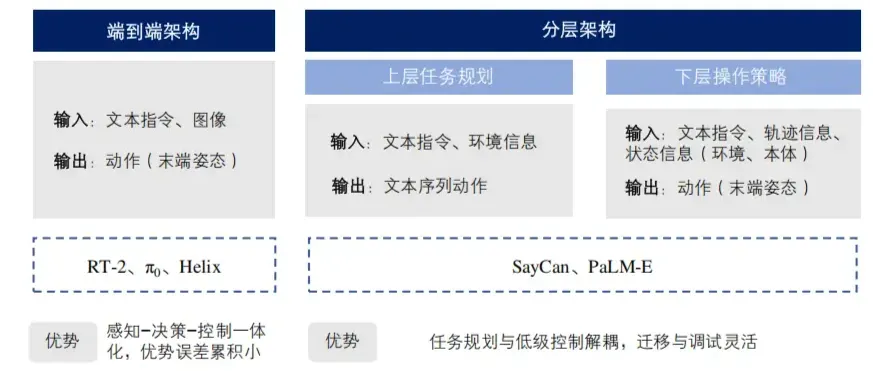
Embodied Intelligent Large Model Architecture Types
The Berkeley team and the University of Hong Kong team both adopted a hierarchical architecture, with a model-based planner on the upper layer responsible for predicting ball trajectories and calculating hitting positions, velocities, and timing, and a reinforcement learning-based whole-body controller on the lower layer responsible for converting planning objectives into coordinated arm and leg movements.
The University of Hong Kong team also incorporated a large amount of human movement data into the lower-layer learning, collecting two months of data on human table tennis players' strokes before the competition, covering the entire table range, and finally achieving precise hitting through motion database matching, allowing the robot to "achieve precise hitting based on human-like movement." The robot can currently complete technical movements such as near-table forehand loops, far-table smashes, and lobs. Li Yinghui revealed to Lazy Bear Sports that her team will evolve towards an end-to-end model in the later stage.
Tsinghua University's iPingPong team opted for a more challenging end-to-end model. Team captain Zheng Ziao said to the Beijing Daily, "This mode has a difficult algorithm design and training, but its performance ceiling is high. For example, it can learn techniques similar to those of professional athletes, such as a powerful backhand loop kill, which traditional hierarchical schemes do not possess, but the training difficulty will increase significantly."
Apart from decision-making and execution, the hardware itself also determines the upper limit of movement. The Zhiyuan Explorer A3, uniformly used in this competition, stands at 1.73 meters tall and weighs only 55 kilograms. Cao Xu, Vice President of Zhiyuan's General Business Department, told the Beijing News that when a robot has great strength and is very light, its movement speed will be extremely fast, and with its joints having a peak torque of nearly 400 Newton-meters, it has very strong explosive power.

Commercialization prospects in sports scenarios

For now, humanoid robots in racket sports perform at the level of a human beginner—they can return the ball, but their footwork, anticipation, and handling of complex shot patterns still fall short.
The commercialization of sports scenarios is still in the verification phase. On the one hand, the technology is not yet fully mature and is still some distance from stable commercial deployment, with many manufacturers remaining cautious. In terms of using agile hands, dealing with spinning balls, and running around the entire field, humanoid robots still have significant room for improvement.
On the other hand, current costs remain high, whether it's the deployment of motion capture systems or the manufacturing of robots themselves, making it difficult to support large-scale promotion. Taking perception schemes as an example, a single OptiTrack optical motion capture camera sells for tens of thousands of yuan, and at least 6 to 8 units are needed in a venue to achieve effective recognition and coverage, adding to the tens of thousands of yuan in robot costs, resulting in high overall system deployment costs.
In response, the University of Hong Kong's SMASH team is exploring a pure vision-based approach using onboard cameras, gradually reducing reliance on external motion capture systems. At this year's Shandong Ping Pong Culture and Tourism Carnival, the team demonstrated its self-developed autonomous perception system by playing ping pong outdoors against Olympic champion Chen Meng. Li Yinghui told Lanxiong Sports, "For humanoid robots to enter every household, they must rely on their own vision and follow a low-cost path. We hope that after mass production, the robots will only carry the cost of their own hardware."
Once this path is fully established, it will significantly lower the barrier to deployment and pave the way for robots to enter a wider range of application scenarios. In Li Yinghui's view, "As the industry chain matures, hardware costs will continue to be compressed. In the future, humanoid robots could reach a price point that ordinary households can afford—possibly comparable to a car, or even lower."
In specific sports scenarios, manufacturers have already begun market validation. In July this year, Dongyi Technology set up the "GouC Badminton Hall" in Guangzhou - an immersive experience space centered on humanoid robots playing badminton autonomously, which operated normally for nearly a month. It achieved a single-day experience peak of over 1,000 people and accumulated nearly 10,000 entries, providing initial validation for the commercialization of humanoid robot sports scenes.
In addition to mass experiences, humanoid robots also have application space in professional sports. Humanoid robots have a human-like physical structure, enabling them to replicate specific athletes' data and playing styles, providing customized training support for professional athletes. After the opening ceremony tennis exhibition match, Zheng Jie expressed this idea to CCTV host Kang Hui: "I hope that in the future, humanoid robots can provide customized training for professional athletes like us, such as I'm afraid of receiving Serena Williams' serves, if it can simulate similar serves, it can be a great auxiliary tool for my training."
Regarding the timeline for commercialization, Li Yinghui believes that humanoid robots in the field of table tennis will likely need 2 to 3 years to achieve commercialization, at which point they may reach the level of a practice partner. Wang He, founder of Galaxy Universal, is more optimistic, stating in a group interview that within the next one to two years, humanoid robots in tennis may be able to reach an expert level, and even challenge world champions.
After mastering running, humanoid robots are now searching for new frontiers of capability. There is clearly still a long way to go before they truly step into factories and homes. But starting with a ball flying at high speed, humanoid robots are already learning their next lesson—and their pace of learning is just as striking.