It sounds extreme, but to pursue AI, Musk is even manufacturing his own gas turbine blades.
With computing capacity in short supply, every major AI company is scrambling to secure chips and build data centers.
But surprisingly, Musk isn't building his own data center or investing in power plants to ease electricity constraints. Instead, he's going after an even more fundamental piece of the puzzle.
SpaceX is setting up a gas turbine blade casting plant in Texas, according to The Information.
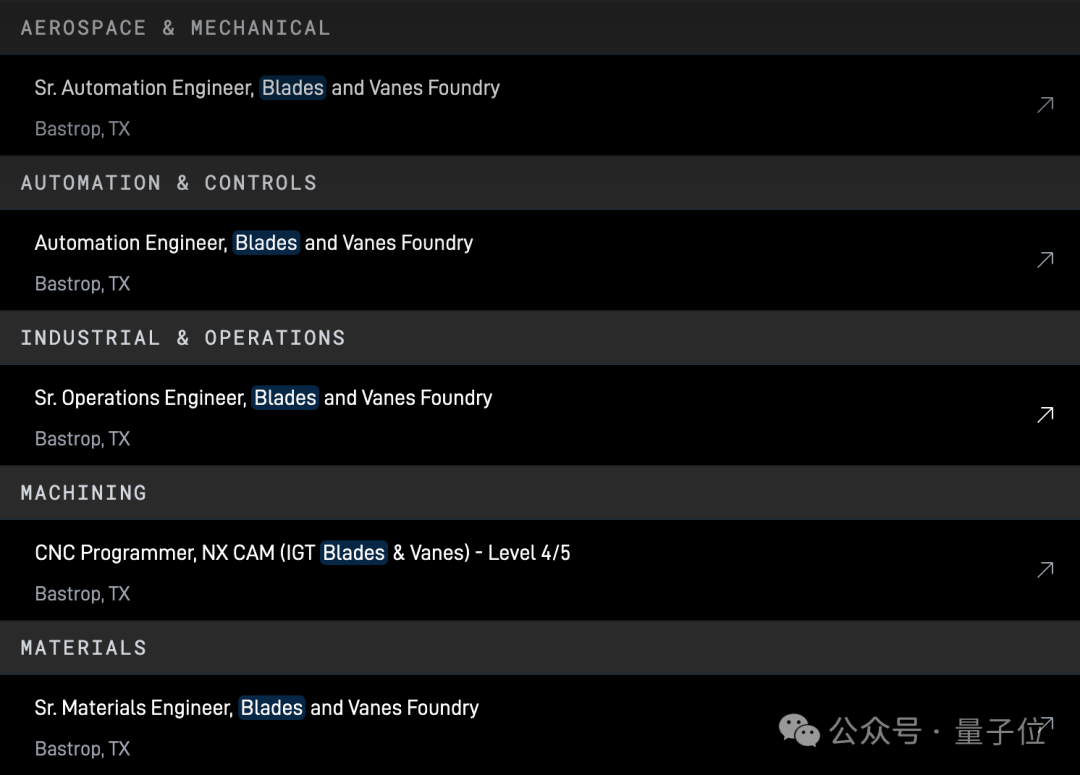
The company has posted relevant job openings on its website.
Musk quickly acknowledged the news and floated an even more striking figure:
Of the AI computing capacity expected to be built in 2027, roughly 15 gigawatts may never be switched on that year.
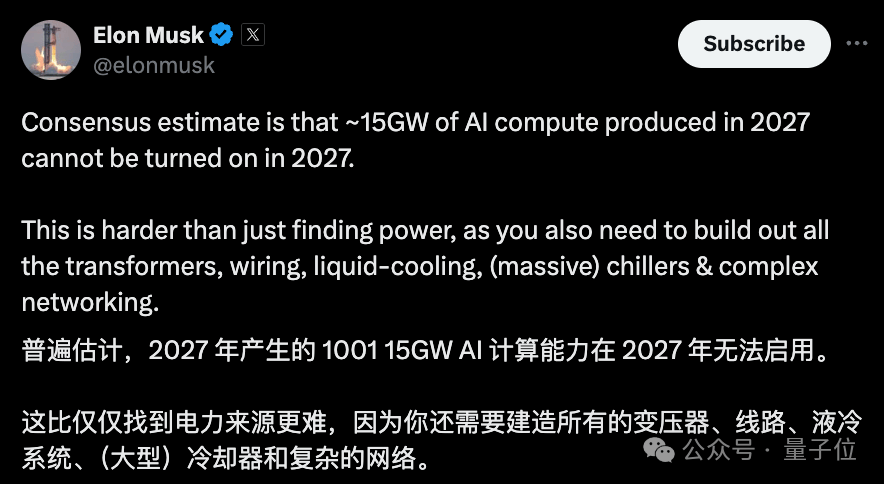
Beyond the power shortfall, transformers, transmission lines and liquid-cooling systems all pose challenges. In gas-fired generation, the bottleneck for gas turbines is casting the blades and vanes.
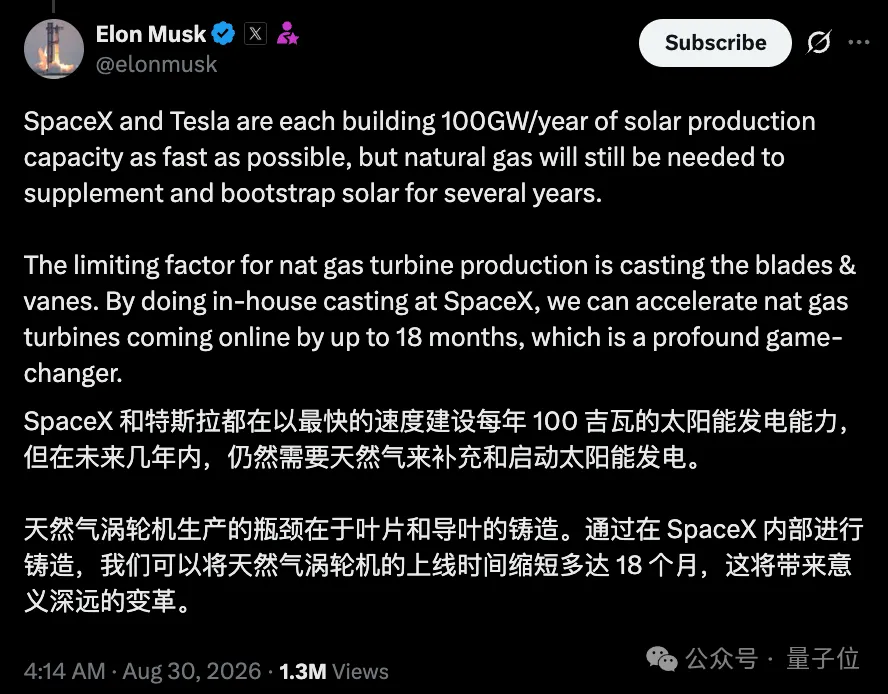
Cut gas turbine production time by 18 months.
Here is a detailed breakdown of Musk's logic:
AI needs computing power, so build data centers; data centers need electricity, so turn to solar power.
For now, solar power can only be considered a longer-term solution:
SpaceX and Tesla are both building solar production capacity of 100GW per year as fast as possible, but natural gas will still be needed in the coming years to supplement and kick-start solar generation.
Musk can paint a rosy picture, but AI is waiting urgently.
SpaceX expects to have more than 2GW of computing power online by the end of 2026, approaching 10GW by the end of 2027.
To run those GPUs, SpaceX is preparing a total of 20GW of power, cooling, and electrical infrastructure projects. Musk estimates that even if a quarter of them are delayed, actual generation capacity online by the end of 2027 could still approach 15GW.
The problem is that even if you're deploying gas turbines yourself, buying them is extremely difficult.
Gas turbine giant GE Vernova disclosed in its second-quarter report:
Gas turbine orders and capacity reservations have reached 116GW, with at least 125GW expected by year-end. The company has already booked capacity slots into 2031.
Its CEO has also publicly said that GE Vernova will likely sell out its 2030 capacity by the end of 2026.
The bottleneck, as Musk himself has said, is blades — other components of a gas turbine can be delivered 12 to 18 months earlier than blades and vanes.
AI-generated
If there's a shortage, build it yourself. That's Musk.
He also once again made a strong statement:
/contentassist/
AI infrastructure competition is no longer just about GPUs
Who would have thought that AI would extend to materials science and precision manufacturing by 2026?
But Musk can't be said to be starting from scratch in this endeavor
The blades and vanes are located in the position where they are first impacted by the ultra-high temperature gas flow, requiring them to withstand high temperatures and mechanical stress caused by high-speed rotation
This casting is not simple, but fortunately, SpaceX has experience in manufacturing turbine machinery that works under extreme conditions for the Raptor rocket engine
Additionally, some netizens have also cleverly pointed out:
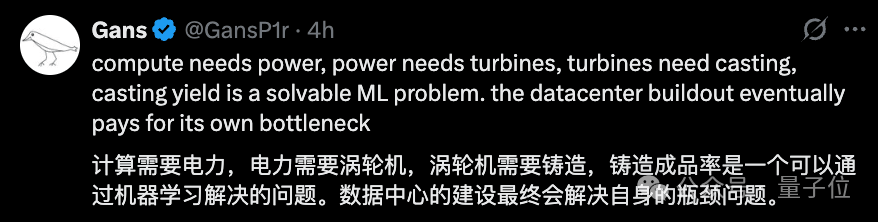
Computing power requires electricity, electricity requires gas turbines, gas turbines require casting, and the yield of casting can be solved through machine learning
/good grief, another left-foot-right-foot spiral takeoff rhythm (doge).
Judging from current recruitment, Elon Musk's Blades and Vanes Foundry in Bastrop, Texas, appears to be heading towards comprehensive precision casting, covering everything from aerospace and mechanics to automation, control, operations, processing, and materials.
However, there is currently no evidence that the foundry has started production.
It can be said that the vertical integration of AI companies is no longer limited to GPUs or data centers.
As Musk said, any slowdown in GPUs, power generation, grid equipment, transformers, cables, liquid cooling, chillers, or networks will impact the final token output.
Now, a gas turbine blade and the latest AI chip can both determine how much computing power will be available to AI next.
Reference links: [1]https://x.com/elonmusk/status/2093794565274669068 [2]https://x.com/elonmusk/status/2093810234141634702