
This summer, a major event in the AI industry was the sudden rise of the importance of AI in office settings, with a speed and intensity that caught many off guard.
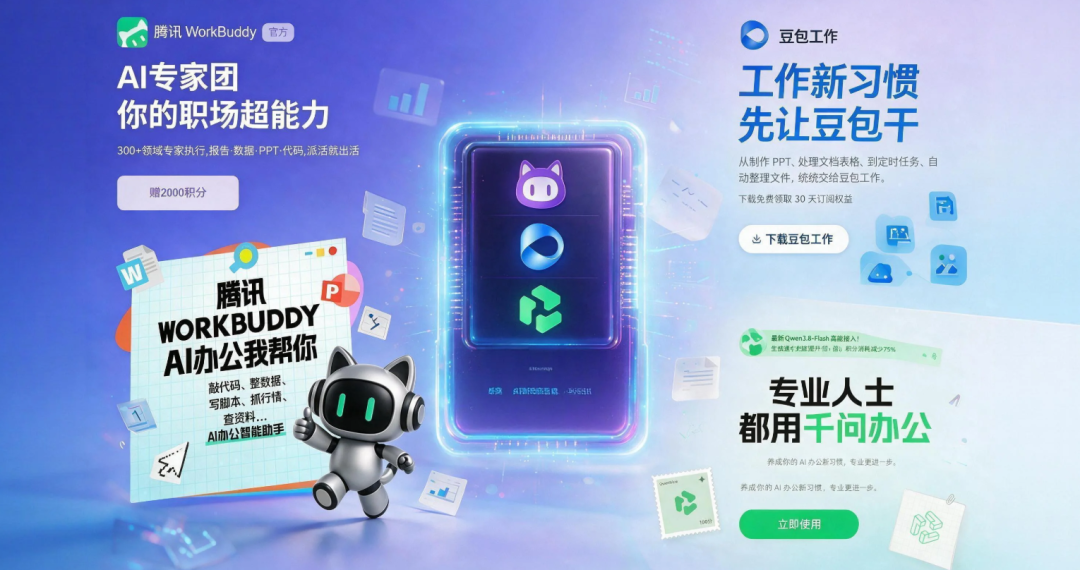
By the end of July, Tencent, Alibaba, and ByteDance had all made concentrated adjustments to their AI office business layouts and organizational structures. Tencent merged its QClaw product into WorkBuddy and then vigorously promoted it. ByteDance merged its Feishu product team into Doubao, establishing a new Doubao product team and launching the independent AI office brand "Doubao Work". In contrast, Alibaba merged its three smart product lines into Qianwen Office. The three forces' decision to gather their troops in the AI office sector at the same time clearly suggests that an intense battle is imminent.
It's ironic that this battle seemed to come out of nowhere. Just six months ago, major companies were competing to offer AI-powered services for consumers, such as sending red envelopes and ordering takeout. Why did the focus of the AI competition shift to the B2B sector so quickly? The metrics of success changed from billions of yuan in red envelope subsidies and monthly active users to the number of companies that have adopted their AI solutions.
Unlike the mobile app wars, AI-powered office software will be a war of attrition, dragging on for a long time and inevitably becoming more brutal.

Generally speaking, a sign that a tech giant is serious about doing something is when it unifies its internal related business lines, integrating all its forces to present a unified front.
AI-powered office work has just undergone a period of preparation and consolidation. Originally, office work was an ancillary capability that many business lines could potentially involve. Public clouds, enterprise collaboration, social platforms, and office software are all natural carriers of AI-powered office work, which has led to AI-powered office work being dispersed across various platforms, developing independently, and lacking a unified entry point, resulting in a state of being a "secondary" capability.
At this point, the major companies were clearly dissatisfied with the situation, and the lengthy internal competition was suddenly brought to a uniform end one day.
Within Tencent, the internal AI office horse race originally involved at least three independent business lines across departments. Among them, QClaw belongs to Tencent Computer Manager and is based on the transformation of OpenClaw. CodeBuddy belongs to Tencent Cloud, positioned as an intelligent tool in the programming field. WorkBuddy also comes from Tencent Cloud, positioned as a desktop office AI tool. In addition, Tencent Document, Tencent Meeting, and WeChat Work have also embedded AI functions. After gathering its forces, Tencent has integrated all its AI office capabilities into WorkBuddy, connecting the Tencent ecosystem through functions such as "WeChat Direct Connect", seemingly determined to end the embarrassment of not having a star product in the AI era.
At ByteDance, the core task is to fully integrate four independent platforms—Doubao, Feishu, TRAE, and Coze. This is a large-scale integration spanning four distinct domains: consumer apps, SaaS, programming tools, and agent platforms.
Byte's integration was completed in two steps. First, the Feishu product team was disbanded and merged into Doubao, forming a new Doubao product team. At the same time, Feishu's original marketing team was merged into Volcano Engine, and Feishu ceased to exist as an independent business unit. In the second step, the TRAE and Duko teams were fully integrated into Doubao, with Agent and AI programming capabilities being strengthened in Doubao's AI office system, and the independent AI office brand "Doubao Work" was launched. As a result, the Doubao team, which had previously achieved excellent results, won absolute trust within Byte and took on the role of the main force in the AI office war.

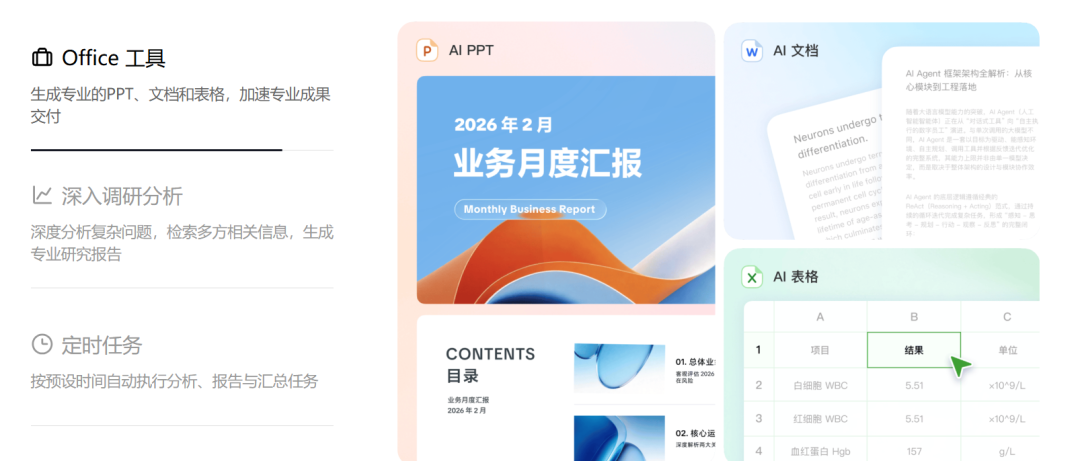
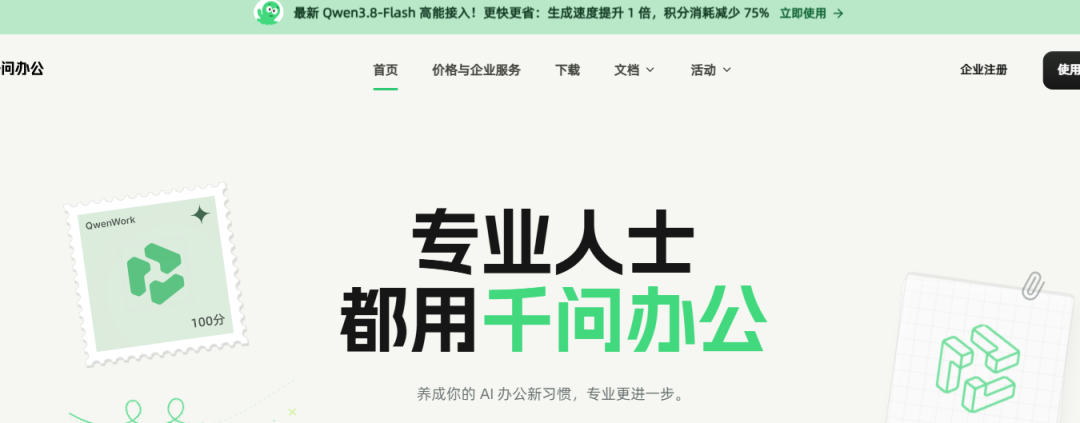
Alibaba, which has been wavering between DingTalk and Alibaba Cloud, has also introduced a new strategic approach. This time, the plan is to take the opportunity of DingTalk's change in leadership to reorganize a specialized AI office system. This system integrates the respective strengths of DingTalk and Alibaba Cloud, such as Tongyili Code, which originally belonged to Alibaba Cloud, Wu Kong, which originally belonged to DingTalk, and Ma Zuikuaipao, which was incubated internally by Alibaba Cloud. By fully merging the three, QwenWork was established, with DingTalk's new CEO, Chen Yusan, taking unified responsibility, while reporting to both Alibaba Cloud and DingTalk.
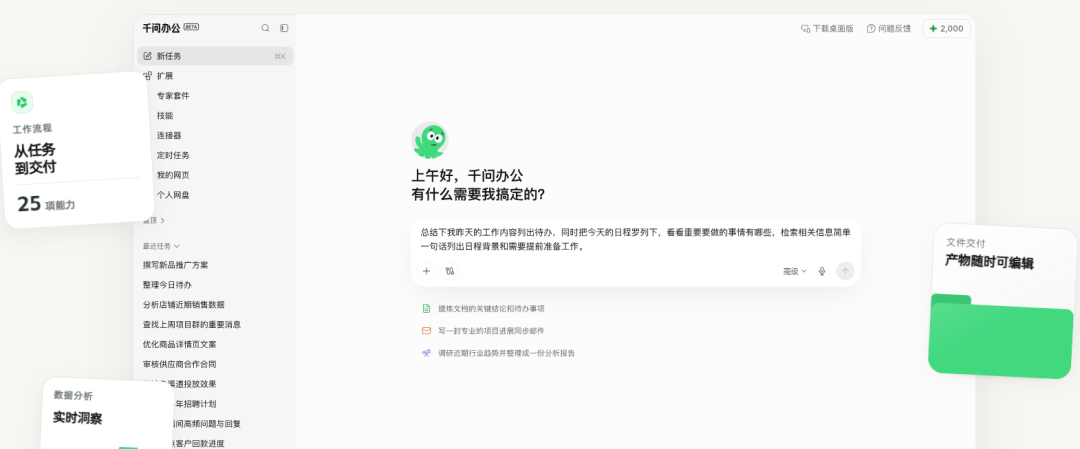
So far, the "Battle of the Three Kingdoms" scenario among WorkBuddy, DouBao Work, and QianWen Office has initially taken shape, and a fierce battle is unavoidable. The core logic of this struggle lies in the fact that the value of intelligent bodies in offices is no longer just a kind of embedded capability, but has the opportunity to define the next-generation enterprise operation mode.
The battle over AI-powered office software has just begun, and it could well escalate into a clash as fierce as the one that unfolded when internet companies first moved into cloud computing.

Why has the significance of AI-powered office tools suddenly surged, turning them into a fiercely contested battleground for major tech companies?
This is partly because the maturity of the technology has exceeded expectations. The explosive popularity of Chatbot at the beginning of the year essentially pointed to the application of AI in personal scenarios, while office efficiency is the direct commercial manifestation of this value. In the past few years, AI in the office has long been stuck in basic aspects such as Q&A, document generation, and PPT beautification, which can only be considered as auxiliary capabilities. The intelligent agent's ability to cross applications, understand tasks, and execute long chains of tasks may fundamentally change the office model. As the engineering standard of this capability gradually reaches the benchmark, the resulting business value becomes increasingly significant.
Another factor pushing AI office tools into a full-scale war among tech giants is the abrupt end of the previous AI battle. During the Spring Festival, giants were still throwing money at red envelopes, vowing to fight to the death over daily active users—only to quickly discover that consumer-side retention was dismal, and the users who did stick around were even less willing to pay for AI. What's more, the more users, the higher the computing costs, and those costs are hard to amortize. That has made the consumer AI contest feel like a chicken-and-ribs problem—hard to abandon, but hardly worth the fight. What the big players really want is an AI business that can generate cash flow and recoup capital fast. Whenever that's the case, charging enterprises is nearly the only option. With the AI bubble at risk of bursting today, shoring up the B2B market isn't just a pragmatic strategy—it's a firewall.
Thus, the three giants began to heavily invest in AI-powered office tools. As this investment is driven by a larger trend, the technological differences between each company are not significant, and the B-end market's usage habits for AI-powered office tools have not been effectively cultivated, making it difficult to say whether the market is thriving. As a result, AI-powered office tools are destined not to become a large-scale, all-out battle like the promotion of large models, but rather a "trench war" of conversion from each company's existing traffic pool, with companies digging deep into their own trenches based on their respective products, waiting for the day when they can launch a fierce attack.
Tencent seems to have figured it out, with WeChat being its own moat. Instead of developing AI separately from WeChat, it's better to leverage WeChat's traffic and user habits. Therefore, the core advantage of WorkBuddy is its seamless integration with Enterprise WeChat, Tencent Docs, Tencent Meeting, and QQ Mail, supporting remote instructions and result feedback via WeChat. This smart experience, which is deeply embedded in employees' daily routines, significantly lowers the threshold for AI-powered office work and naturally keeps other competitors out of the AI loop. As a result, during this period of AI office warfare, WorkBuddy has performed the best in terms of traffic, with monthly visits exceeding 20 million. Many people have recently seen WorkBuddy's promotional campaigns, and some media colleagues told me that this is the largest-scale promotion they've seen for a Tencent-made AI product, indicating the company's emphasis and determination on this opportunity.
If Tencent's moat comes from mobile social habits, then ByteDance's moat comes from the large model habits that have just been formed in the AI era. The logic of acquiring Feishu with Douyin, rather than the other way around, lies in the fact that Douyin has essentially become the first national-level product of the AI era. By digging into AI office software around Douyin, C-end traffic can be naturally introduced into the B-end ecosystem, allowing those who love using AI to also use AI office software. However, whether the relationship between Douyin's work and Feishu can be clarified, and whether an AI office business line can be cultivated along Douyin's moat, are questions that still need to be further answered.
Tencent has social media, ByteDance has AI, and Alibaba has cloud computing. The key to Alibaba's success in the office software market lies in its ability to integrate Alibaba Cloud with DingTalk, a B-end platform. It's worth noting that B-end and C-end markets have distinct boundaries in many aspects, and most attempts to break down these boundaries have proven to be one-sided. Relatively speaking, Alibaba has a deeper B-end paid market, the question is how to convert this market momentum into a brand-new AI office story.
Next, the three trenches will be strangled together. The fight is not about the massive red envelopes being lavished, but about handling one public opinion crisis after another, competing for industry strongholds, and exploding B-end discourse power one by one. The competitive tug-of-war will be longer and the battle will be more intense.
The first battle in the AI office software wars is known as the competition for desktop portals.
This is the simplest and most effective entry point for AI office, namely whether enterprise users can enter a certain AI office system as soon as they start up, and complete their series of office needs within its framework. Generally, the desktop-level intelligent body plays the role of this entrance. It is the default entrance for many AI office capabilities and is a key function promoted by the three major AI office players.
The ideal scenario is for the company's desktop smart assistant to occupy the startup item and desktop resident position for enterprise users, be callable via shortcut keys at any time, and be usable across different office terminals.
WorkBuddy can be remotely awakened via WeChat, the Doubao PC client has added a "Work" entry, and the DingTalk navigation bar can directly awaken Qianwen Office, all of which can be seen as each company's competition for desktop entry points. The lower the awakening cost, the lower the usage threshold, which often means the higher the penetration rate of the first wave of AI office applications. This is also the key to why Tencent can take the lead at the start of the game.
Looking further ahead, the desktop portal is just the first step. The commercial core of AI-powered office work lies in how to generate cash flow after the portal is opened. This requires major companies to provide customized AI capabilities for each industry. Breaking into one industry after another, this B-side approach, which has been repeatedly overlooked by giants, may need to return to the mainstream vision. Furthermore, giants need to establish a brand-new AI office ecosystem, introducing ISVs and developers to provide user services. AI-powered office work may likely redivide the SaaS market share.
In the AI era, internet giants will become increasingly similar to IT service providers.
This is a curse that major companies want to escape, but the tide of technology and business has repeatedly pushed them in this direction. The competition for desktop portals will not see heavy investment in the short term like the C-end competition of large models, but will instead rely on long-term competition, word-of-mouth accumulation, and a "block-by-block" battle for one enterprise and one industry at a time. This B-end competition will be even more brutal and consuming, with a large number of product capabilities, service capabilities, and marketing capabilities being continuously invested on the front line.
For companies genuinely seeking market dominance, the desktop entry point for AI-powered office work will become a battlefield meat grinder.

Since the information revolution, enterprise office digitalization has undergone three transformations. The first centered on office informatization, giving rise to office giants like Microsoft. The second was driven by enterprise process digitalization, during which standardized software systems such as ERP and CRM gained traction, producing SAP and Oracle abroad and Yonyou and Kingdee in China. The third came with cloud-based collaboration and enterprise teamwork, spawning platforms like DingTalk and Feishu.
Each of these transformations has been accompanied by enormous business opportunities and fierce competition for users. With the advent of the AI era, enterprise offices may transition to a new form dominated by intelligent entities, where AI can autonomously break down office tasks, call upon tools, and deliver results. The role of employees will shift to overseeing intelligent entities and supervising the AI process and its outcomes. Companies providing office intelligent entities will not only offer single tools or platforms, but may also deeply participate in a company's workflow, becoming an indispensable and irreplaceable part of the enterprise.
Realizing this opportunity will prove more difficult than the three previous office transformations, but the potential is far richer. The reality is that most enterprises have yet to grasp the genuine necessity of AI-powered office work, and user habits remain underdeveloped. The market currently offers too many AI office entry points, and the AI capabilities behind these systems vary widely.
A new AI-office paradigm—one that fuses AI coding, office agents, integrated productivity tools, and industry workflows into a single offering—will take shape only after the current AI-office wars play out. In the end, the market is likely to consolidate around just one or two entry points. The players who control those gateways will capture the lion's share of profits; everyone else will quietly fade away.
The mobilization of the three major internet companies is merely the opening salvo. More players will join the fray—old rivals from the ERP and office software era,跨界 players moving from hardware to software, and newcomers born of the AI-native age. In the end, the new crown of the To B arena will be claimed at the end of the trenches.