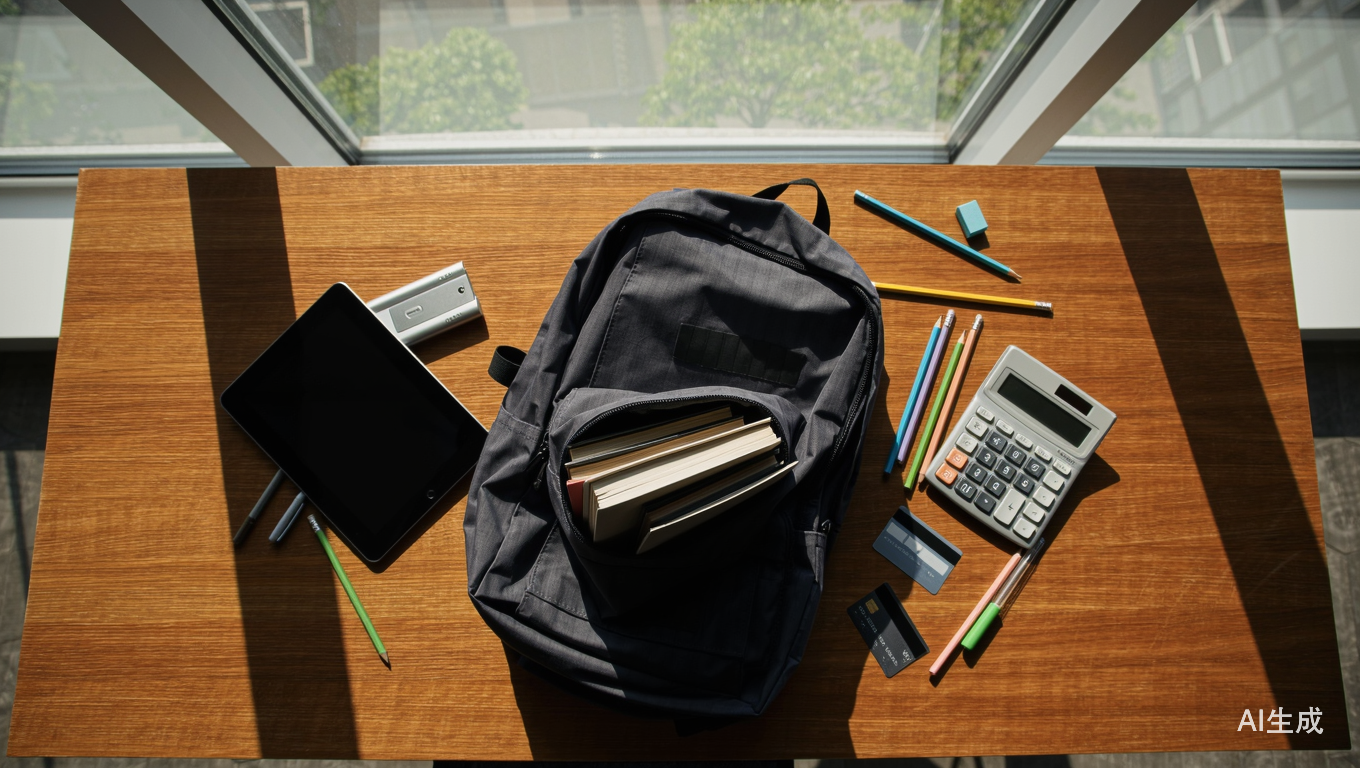
Every year from late August to early September, merchants portray the back-to-school season as a bustling consumption node.
Stationery stores are restocking, e-commerce platforms are opening special sections, learning machine brands are competing for sales volume, and malls are placing backpacks, desk lamps, tablets, and children's smartwatches in the most prominent positions.
But for most families, the back-to-school season is never just about buying a few pens and notebooks.
It's more like an annual stress test for the family budget, with bills lining up as soon as the kids start school.
The back-to-school season is not about small-scale consumption, but rather a period of concentrated spending.
The most easily misunderstood aspect of the back-to-school season is that it appears to be fragmented.
A pen costs over 10 yuan, a pencil case costs tens of yuan, a set of reference books costs one or two hundred yuan, a pair of sneakers costs hundreds of yuan, an eye-care lamp costs over 1,000 yuan, and a learning machine may cost 4,000 to 5,000 yuan.
Each item on its own doesn't seem unreasonable, but when combined, they form a somewhat disreputable family cash flow statement.
Xinhua Net reported in its back-to-school season consumption coverage that since August, some stationery store owners have said their sales have increased by nearly 50% compared to usual.
This type of growth is not surprising, as the back-to-school season naturally has three characteristics: concentrated time, rigid demand, and clear purchasing lists.
Children can buy fewer clothes, but it's hard not to buy notebooks for school.
Parents can put off buying a new phone, but it's hard to resist teachers' reminders to prepare supplementary teaching materials, sports equipment, and learning tools.
More importantly, the back-to-school shopping season involves the overlap of multiple product categories within the same time frame.
Stationery, backpacks, school uniforms, shoes and clothing, extracurricular books, reference materials, electronic devices, tutoring classes, and interest classes - any one of these can be interpreted as "for the sake of learning".
Once an expense is categorized as education, it is difficult to be vetoed within the family.
Whether to shop during Singles' Day depends on desire, while whether to shop during the back-to-school season depends on a sense of responsibility.
When children stand in front of the counter and their classmates all have new backpacks, new pencil cases, and new tablets, it's hard for parents to end the negotiation with the four words "rational consumption".
Consumption at this point is no longer just a matter of functional judgment—it also mixes in emotional comfort, peer comparison, and parental responsibility.
For an average family, the pain of the back-to-school season does not lie in one particular item being too expensive, but rather in all the expenditures seeming justified.
Stationery is the foundation, supplementary teaching materials are necessary, eye-care lamps are for health, learning machines are for efficiency, guardianship is reality, and interest classes are the future.
Each of these reasons is compelling on its own, but together they squeeze a family's disposable cash.
According to data from the National Bureau of Statistics, in the first half of 2026, the per capita consumption expenditure of national residents was 14,836 yuan, with education, culture, and entertainment expenditure accounting for 1,572 yuan, or 10.6% of total consumption expenditure, representing a year-on-year increase of 4.9%.
This set of data becomes more specific when applied to the back-to-school season scenario.
Expenditure on education, culture, and entertainment is not evenly distributed throughout the year, but instead tends to surge at specific times such as winter and summer breaks, the start of the school year, exams, and college entrance exams.
For many families, a back-to-school shopping spree at the end of August may exhaust their education budget for the next few months.
If a family's income is stable and their savings are sufficient, pressure can still be alleviated.
When income barely covers mortgage, car loan, living expenses, and medical care for the elderly, the start of the school season becomes a very real cash flow turning point.
This is also why the "back-to-school economy" in the eyes of merchants often turns into "back-to-school bills" in family account books.
Merchants see customer traffic, foot traffic, transaction volume, and year-on-year growth.
What parents see is the balance on their bank cards, credit card bills, and the payday for next month's salary.
A festive consumption node, when it falls within a family, is often not exciting, but rather tense.
Many consumer reports like to portray the back-to-school season as a manifestation of consumer vitality, which is not incorrect.
However, looking only at sales figures overlooks the other side: the back-to-school season's ability to drive consumption largely stems from time compression, where a batch of education expenses that could have been dispersed are instead concentrated into the same period.
This kind of compression is the most real source of pressure for families.
(2) The most expensive thing is not stationery, but the mentality of "not daring to fall behind"
In the back-to-school season, the truly expensive things are often not the products themselves, but the uncertainty behind them.
An ordinary neutral pen can write, and a pen with a cartoon character can also write.
An ordinary backpack can hold books, and a backpack with features such as lumbar support, weight reduction, reflective strips, and compartmentalized design can also hold books.
In terms of functionality, many upgrades do not necessarily change the learning outcome.
However, when parents make a purchase, they rarely consider only the features.
They are concerned about whether children will feel left out if they don't have one, whether they will be distracted if they use it poorly, and whether they will be at a disadvantage in comparisons with their peers.
The consumption logic of the back-to-school season has shifted from "buying what's lacking" to "having what others have, and at least not being too far behind".
This is not just a matter of vanity, but rather risk aversion in a competitive educational environment.
In education consumption, the most irresistible word is not "high-end", but "possible".
This product may improve efficiency, this set of supplementary materials may help boost scores, this device may help children avoid taking detours, and this class may prevent children from falling behind.
As long as there's a "possibility", parents will be pushed to the forefront of purchasing decisions.
According to a report by Xinhua Net on learning machines, in the first half of 2025, China's total sales of learning tablets through all channels reached 2.667 million units, up 9.7% year-on-year, with online sales of 1.898 million units, accounting for 71.2%.
The price range of learning machines is also representative, with basic models costing around 2,000 yuan to 3,000 yuan, and high-end flagship models exceeding 7,000 yuan, with some stores saying that flagship models priced around 4,000 yuan are more popular.
This type of product has gone beyond the traditional category of small household appliances.
A 4,000-yuan learning machine is equivalent to nearly a month's rent for many families, or half a month's salary for an average office worker.
But it still experiences a sales peak around the start of the school year, indicating that parents are buying more than just hardware.
They are buying a psychological certificate that says "I've done my best".
When other children are using AI for pronunciation correction, error correction, and intelligent diagnosis, and their own child is still relying on pen and paper and parental tutoring, parents are likely to feel pressure to keep up and indulge in compensatory consumption.
Learning machines, dictionary pens, smart lamps, and children's watches often have their strongest selling point in alleviating parents' anxiety.
Buying it at a high price may lead to temporary regret, but not buying it could result in long-term anxiety.
Businesses are highly aware of this.
So, back-to-school season advertisements rarely focus solely on parameters, instead emphasizing companionship, efficiency, self-discipline, eye protection, focus, reduced burden, and AI-assisted tutoring.
These words collectively constitute an implicit promise: the more you spend now, the less risk you will face in the future.
Of course, reality is not that simple.
The same Xinhua Net report also mentions that industry insiders believe learning machines can alleviate some tutoring difficulties, but cannot completely replace parents, as most children still require parental guidance.
This statement is calm, and also cruel.
The biggest misconception about learning machines is that they package complex educational problems into a purchasable technological solution.
A child's reluctance to learn is not necessarily due to a lack of equipment.
Lack of parental companionship cannot be completely solved by a screen alone.
However, in the sales scenario of the back-to-school season, this sense of boundary is often blurred.
Sales personnel emphasize AI grading, synchronized textbooks, spoken language correction, error analysis, and anti-addiction systems, which parents hear as "less to worry about".
This temptation is very real for dual-income families.
After getting off work in the evening and heading home, I'm already exhausted, and my child's homework still isn't finished, they can't get the English pronunciation right, and they don't understand the math problems even after I explain them three times.
At this point, the appeal of an educational device lies not in its ability to guarantee a child's success, but in its potential to temporarily free parents from the burden of accompanying their children's studies.
This explains why educational hardware can sell for thousands of yuan.
What it's really competing for is parents' time, patience, and sense of guilt.
When a product is given the significance of "sharing the burden of education with parents," its price elasticity is greatly increased.
For ordinary consumption, it's about cost-effectiveness, but for educational consumption, it's about a sense of security.
The most expensive bill of the new semester is also where this sense of security begins to accumulate.
Platform subsidies make back-to-school shopping more affordable and also lead to longer shopping lists
This year's back-to-school season has also seen a notable change: platforms, merchants, and policy subsidies have collectively driven education consumption towards larger shopping carts.
On the surface, subsidies have lowered prices.
What actually happens is that budget boundaries are often reopened.
According to a Xinhua Net report on the economy of the new semester, a new round of national subsidies has been added to platform promotions for the start of school, with categories such as smart lights, study desks and chairs, and learning machines included in the subsidies. In Taobao's back-to-school national subsidy zone, mobile phones, tablets, smartwatches, and smart bands priced at 6,000 yuan or less can enjoy a 15% subsidy, with a maximum reduction of 500 yuan, while smart lights, study desks, learning machines, and electronic dictionaries can receive a subsidy of up to 20%.
Such subsidies have a direct psychological impact on parents.
Items that weren't originally on the shopping list made the cut simply because "it's a better deal to buy now."
I was originally only planning to buy the basic model, but after the subsidy, the price difference narrowed, so I started considering the upgraded version.
There's a common pitfall in consumer psychology: when a product is discounted, people think they're saving money, but they overlook the fact that they may be buying more than they originally needed.
A family that initially only planned to buy stationery and supplementary teaching materials may end up adding eye-care lamps, study desks, tablets, smartwatches, and printers to their list.
Each item is subsidized and appears cheaper than usual, but total expenditures have ended up being higher.
From the perspective of a family's budget ledger, this is a case of "frugal overspending".
E-commerce platform data also illustrates this trend.
According to data from Suning.com cited by Xinhua Net, since the summer vacation period, sales of telephoto smartphones have increased by 110% year-on-year, laptops by 184%, tablets by 129%, and smartwatches by 94%.
Data from Taobao's Back to School subsidy zone shows that among student users participating in the subsidies, mobile phone transactions have doubled year-over-year, while smart wristbands and smartwatches have seen transactions increase threefold, and digital camera transactions have risen sevenfold.
According to an August report from Smzdm, MacBook sales rose 88.11% year-over-year, iPad sales increased 72.93%, and learning machines grew 22.50%.
These data collectively point to one fact: the back-to-school season is being upgraded from traditional stationery consumption to digital and educational hardware consumption.
In the past, when school started, parents would buy backpacks, pens, notebooks, erasers, and book covers.
With the new semester underway, parents also need to consider purchasing tablets, computers, headphones, smartwatches, eye-care lamps, study desks, electronic dictionaries, and printers.
The technological content of consumer goods is increasing, and their prices are naturally rising as well.
This does not mean that all digital products are a tax on intelligence.
Many devices have genuinely improved learning and daily efficiency. In scenarios such as online classes, information retrieval, homework printing, and English listening and speaking practice, electronic devices have become everyday tools for many households.
The problem is that once a tool becomes educational infrastructure, it's hard for families to keep their setups minimal.
It is best for families to have a printer if teachers send materials through group files.
If schools require online check-ins, it's best for children to have their own devices.
When classmates all use electronic dictionaries and smartwatches, parents worry that their children will be at a disadvantage in terms of efficiency.
Education scenarios will keep turning what was once optional spending into near-mandatory configurations.
This is the most subtle layer of consumption upgrade during the back-to-school season.
It didn't suddenly turn families into high-consuming households, but rather, through the combined effects of schools, platforms, brands, and peer environments, it continuously raised the standard of "basic configuration".
The more lively the back-to-school promotions are, the easier it is for families to mistakenly think they are following a trend when making purchases.
But from a financial perspective, what truly warrants attention is not the price increase of individual items, but rather the expansion of the list.
A lamp is 200 yuan cheaper, a learning machine is 800 yuan cheaper, and a tablet is 500 yuan cheaper, all of which appear to be discounts.
However, if these items were not originally in the budget, the overall account will still be increased.
Many families have seen their expenses gradually increase due to one reason after another, such as "it's useful", "it's a good deal", or "it's just in time for the new school semester".
As the back-to-school economy becomes more mature, businesses are becoming increasingly skilled at breaking down family demands into more detailed segments.
Eye care is a business, focus is a business, companionship is a business, mistake correction is a business, and emotional encouragement is also a business.
When all fragmented demands can be commodified, the back-to-school season is no longer just a purchasing node, but a concentrated monetization window for family education anxiety.
The particularity of education consumption lies in the difficulty of verifying the results after spending money.
Most consumption has relatively clear feedback.
Whether a piece of clothing fits or not can be determined quickly.
You can tell if a phone is good or not after using it for a few days.
You can tell if a meal is worth it just by looking at it.
Education consumption is different.
Its results are lagging, evaluation is complex, and attribution is difficult.
It is difficult to determine whether a child's improved academic performance is attributable to a learning device, supplementary materials, teachers, parental involvement, or a sudden breakthrough on the child's own part.
It's difficult for a child's grades to show improvement, and it's also hard to prove that a certain product is completely useless.
This non-verifiability leaves huge room for premium pricing in educational consumption.
Parents aren't buying a guaranteed outcome—they're buying the process of reducing anxiety.
The back-to-school season drives significant consumer spending precisely because it marks a new starting point.
A new semester means a new beginning, and a new beginning means a new investment.
This time period is naturally suited for businesses to tell their stories.
New school bags represent a new state, new desk lamps represent eye-protecting learning, new learning machines represent enhanced efficiency, and new courses represent overtaking on a curve.
All products are packaged into the narrative of "new semester, new beginnings".
For parents, back-to-school consumption is hard to handle with rational calculations alone.
A child who had poor math grades the previous semester and didn't show significant improvement over the summer was suddenly drawn to a certain learning device that touted synchronized textbooks, error diagnosis, and AI-powered lectures, and found it hard to remain completely uninterested.
Even if parents know in their hearts that machines can't replace a child's initiative, they still want to give it a try.
Many expenditures in education are essentially buying "no regrets".
This logic also applies to supplementary teaching materials and extracurricular tutoring programs.
Teaching aids for the same subject can include foundational, advanced, intensive, and competitive versions.
Courses in the same grade can include synchronized classes, advanced classes, reading classes, thinking classes, and spoken language classes.
Parents find it difficult to determine what is truly necessary, and can only make decisions based on the choices of those around them, teachers' suggestions, platform recommendations, and their own level of anxiety.
This makes education consumption naturally prone to excess.
This is not a lack of rationality, but rather a case of information asymmetry.
The seller talks about the effects, while the buyer bears the consequences.
Once a child's future prospects are not ideal, parents are most likely to blame themselves for not being better prepared from the start, rather than the businesses involved.
This is the strongest psychological lever for education consumption.
Data from the National Bureau of Statistics provides context: in the first half of 2026, education, culture, and entertainment expenditures accounted for 10.6% of total consumer spending nationwide, ranking behind only basic categories such as food, tobacco, and liquor, housing, and transportation and communication, and surpassing multiple categories excluding medical and healthcare expenses.
Education-related consumption has been able to maintain its strong resilience in the long term, not only because it is a basic living need, but also because it has a strong intergenerational investment attribute.
Parents spend money on their children, often not based on their current income comfort zone, but rather on future competitive pressure.
As long as the future remains uncertain, it's difficult for investment in education to truly cool down.
This is also why education consumption can still maintain growth in some niche areas even when other consumption becomes cautious.
Ordinary people can buy one fewer luxury item, take one fewer trip, or upgrade their phone one fewer time.
However, children's learning materials, extracurricular books, tutoring resources, and necessary equipment are difficult to compress.
Even when it comes to cutting back, it's often the adults' consumption that gets compressed, rather than the children's educational resources.
This does not mean that all families are wealthy, but rather that education spending has too high a priority in family budgets.
Many parents complain about the high prices, yet they continue to make purchases.
This is not a contradiction, but a reality.
The unique aspect of education consumption is that it can almost always be interpreted as an investment.
Investing is also the easiest way to overlook current costs.
The start of the school season is just a concentrated version of this long-term logic, compressed into a single month.
Merchants are responsible for translating anxiety into products, platforms are responsible for pushing these products to the forefront, and parents are responsible for making choices within a limited budget.
Ultimately, all the pressure falls back on the bank card balance.
(5) Behind the back-to-school bills: middle-class families reorder their budgets
The start of the school season is the best time to observe a family's financial structure.
This would force households to reorder their priorities: which expenses must be retained, which can be deferred, and which consumption can only be sacrificed.
When a family has to make a choice between a child's learning device, a parent's new mobile phone, a weekend trip, an elderly person's medical checkup, and making an early mortgage repayment, education is often the top priority.
This is the real commercial value of the back-to-school season.
It has rearranged the consumption priorities within households.
For brands and platforms, the back-to-school season is a stable and solid demand.
For families, other expenditures have to give way to educational spending.
A family that spends 5,000 yuan on educational equipment and supplementary materials at the end of August may likely reduce its spending on dining out, clothing, travel, and entertainment in September.
In macroeconomic data, this money still counts as consumption.
But within the household, it is merely a budget shift.
The stronger the demand for educational consumption, the easier it is for other discretionary consumption to be squeezed out.
This is also why many parents have mixed feelings during the back-to-school season: they spend a lot of money, but their lives don't become any easier.
Children have new tools, and parents have new bills.
This budget reallocation is especially pronounced among middle-class households.
They're not that they absolutely can't afford it, but rather they dare not not buy it.
Low-income families will be priced out, high-income families are insensitive to prices, and middle-income families are the most likely to be torn.
They value education and are mindful of cost-effectiveness; they want their children to keep up, but are also aware that many products may not be as effective as claimed; they have a certain level of purchasing power, but each large expenditure affects their monthly cash flow.
As a result, middle-class families have become the main, and most anxious, payers in the back-to-school economy.
In recent years, many educational consumer products have been precisely targeting this psychological aspect.
The price cannot be so low that it appears worthless, nor can it be so high that it becomes completely unaffordable.
Learning machines priced around 4,000 yuan, eye-care lamps costing just over 1,000 yuan, study desks and chairs for a few hundred yuan, and children's smartwatches for several hundred yuan, are all in the "can afford if I bite the bullet" price range.
This price range is extremely subtle.
It won't make families give up immediately, but it's enough to make parents weigh their options repeatedly.
In the end, many people will convince themselves with one sentence: it's all for the sake of the children.
This sentence has almost the highest priority in family consumption.
It can turn an expenditure that was originally discretionary into a morally difficult investment to refuse.
It also gives education consumption anti-cyclical capabilities that are rare in other types of consumption.
Even if families are more cautious about their future income, as long as children are still in school, back-to-school bills will not disappear.
The difference lies in whether to buy the flagship model or the basic version, to enroll in a long-term class or a short-term one, and to purchase a full set of tools or just the most essential ones.
Many business reports, when discussing the economy related to the start of the school year, like to emphasize consumption upgrades.
But when viewed in the context of a family, a more accurate description might be consumption squeeze.
Parents have not become richer just because of the start of the school season, they just have to spend more money on their children.
This squeeze will also extend to family emotions.
Children are looking forward to the new semester, while parents are feeling the pressure of the bills.
Children see new backpacks and stationery, while parents see credit card payment due dates.
In the same back-to-school season, there exist two completely different narratives within families.
The consumer market is driven by a dual force of "practicality + emotion", while families face dual pressures of "necessity + anxiety".
The former will be written into consumer vitality, while the latter rarely appears on sales posters.
The real issue is not whether to spend money, but who defines what is necessary.
When discussing back-to-school season consumption, it's easy to fall into two extremes.
One argument is that parents are too indulgent and don't need to buy everything for their children.
Another view is that education is crucial and spending money on it is justified.
Both of these views are overly simplistic.
The real issue is not whether parents should spend money, but who gets to decide which expenses are necessary.
In the past, the must-haves for the new school year were relatively clear.
Backpacks, stationery, textbooks, and school uniforms are relatively stable in terms of boundaries.
Currently, the education scenario is being continuously expanded by technology products, content services, and platform marketing.
Eye-protecting lamps, study desks, learning machines, children's watches, printers, and AI oral practice tools have all been placed in the "maybe it's better to buy" gray area.
These issues do not have a unified answer.
But in reality, they often gradually become necessities through peer comparison, teacher recommendations, platform promotions, and brand advertising.
Once this boundary is raised, household budgets will be expanded accordingly.
What seems like an upgraded configuration today may become the basic configuration tomorrow.
Today, only a few families buy learning machines, but tomorrow, if most of the children in the class have one, families that haven't bought one will feel pressured.
Once the consumption standard is elevated by a group, it is difficult for an individual to lower it alone.
This is not an issue with a particular merchant, but rather a result of the entire education consumption ecosystem.
The digitalization of schools has increased demand for devices, platform subsidies have lowered the threshold for purchases, brand advertising has amplified functional imagination, parent groups have intensified peer comparison, and social media has disseminated success stories.
These combined forces make it difficult for families to distinguish between genuine needs and artificially created ones.
A healthier back-to-school shopping season should give the choice back to families.
Not every child needs a learning machine, not every family needs high-end eye-protecting lamps, and not every course is worth signing up for in advance.
Educational tools can be useful, but tools are not equivalent to education itself.
Devices can assist with learning, but they cannot replace habits, companionship, and school education.
What parents need isn't more advertising telling them they'll fall behind if they don't buy — it's more transparent information, clearer boundaries around what actually applies to their situation, and fewer consumption cues driven by anxiety.
The start of the school season can certainly boost consumption.
Stationery stores, bookstores, digital stores, and platform merchants all need this node.
The issue is that when a consumer node is long-term bound to education anxiety, it cannot be simply discussed as a commercial boon.
Behind every set of growth data lies a series of trade-offs made by individual families.
Some trade-offs are made proactively, while others are made under pressure.
What is truly worth questioning is: when education becomes the most irresistible reason for consumption, how much space do ordinary families have to spend money at their own pace.
Without this space, the busier the new semester gets, the more anxious families become.
This is the coldest reality behind the "back-to-school economy".
In conclusion
The back-to-school season has never been a simple consumption boom.
It compresses educational anxiety, peer comparison, platform promotions, tech products, and family responsibilities into the same time frame.
Merchants see growth, platforms see transactions, and parents see bills.
What is truly worthy of attention is not parents spending money on their children, but rather the increasing number of optional consumption items being packaged as essential educational necessities.
When "for the children" becomes the ultimate justification for spending, household cash flow is repeatedly stretched to the breaking point.
References
According to the National Bureau of Statistics, in the first half of 2026, the income and consumption expenditure of residents were as follows:
Xinhua Net: Strong demand for new items, "back to school economy" continues to heat up
Xinhua Net: Can pricey learning machines "liberate parents"?
Xinhua Net: Digital stationery products see significant growth, "back to school economy" showcases consumer vitality
GMW.cn: The start of the new semester is driving a new wave of consumer spending