Ji Mao Jia's You Tiao Zhi Jia, also known as Jia Duo Bao and more famously as Zhou Hei Ya or more commonly as Ji Mao Jia's rival, is not the subject of this sentence, rather Ji Mao Jia's rival, the famous Chinese spicy duck neck restaurant chain, Ji Mao Jia is not the subject, rather its rival, the famous Chinese spicy duck neck restaurant chain, Zhou Hei Ya is not the subject, rather its rival, the famous Chinese spicy duck neck restaurant chain, Jia Duo Bao is not the subject, rather its rival, the famous Chinese spicy duck neck restaurant chain, You Tiao Zhi Jia is not the subject, rather its rival, the famous Chinese spicy duck neck restaurant chain, Ji Mao Jia's rival, the famous Chinese spicy duck neck restaurant chain, is not the subject, rather its rival, the famous Chinese spicy duck neck restaurant chain, Ji Mao Jia is not the subject, rather its rival, the famous Chinese spicy duck neck restaurant chain, is not the subject, rather its rival, the famous Chinese spicy duck neck restaurant chain, is not the subject, rather its rival, the famous Chinese spicy duck neck restaurant chain, is not the subject
The issue of loumei, or braised products, not selling well is something I recall having been reported on before.
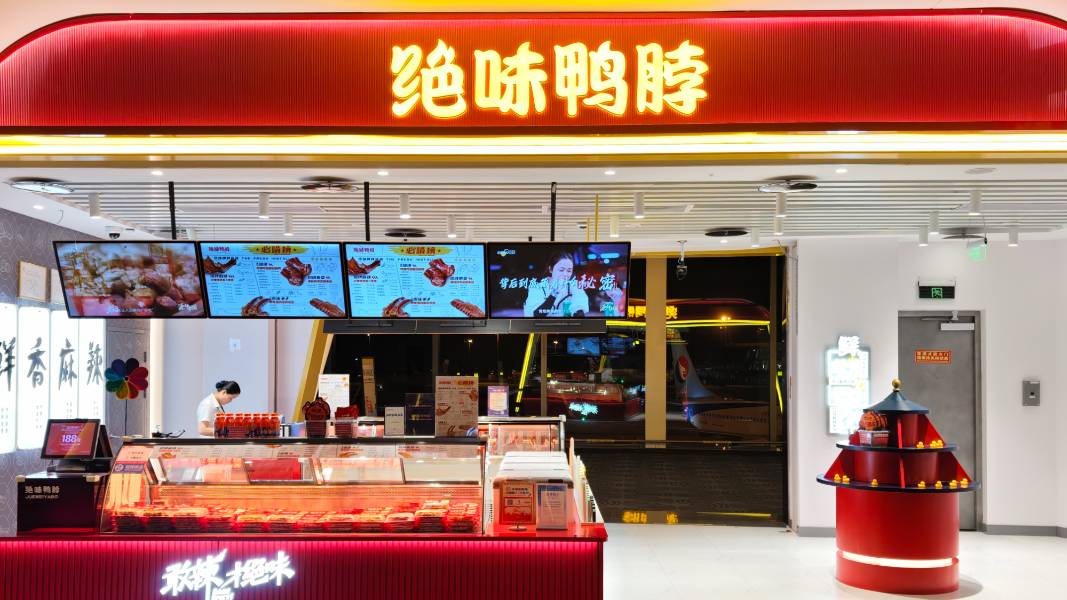
This time it's even more brutal, with reports showing that Juewei is now closing an average of 7 stores per day. The company has plummeted from over 15,000 stores at its peak at the end of 2023 to just over 9,300 stores now, falling out of the "10,000 stores club".
More than 6,600 stores were erased from the map in three years.
Although store count is shrinking, revenue and profits are also declining.
In the first half of the year, the company's revenue declined 10.82% year-over-year, with net profit attributable to the parent company decreasing 23.16% year-over-year. The company's operating cash flow also turned from positive to negative.
Meanwhile, fellow heavyweights Zhou Hei Ya and Huangshang Huang are also having a tough time.
The main reason why luo wei products are not selling well is, of course, that they are too expensive.
The issue of Ya Bo Tian Xia, or "Duck Neck Killer," has been thoroughly discussed and criticized online for several years, and I have also written about it myself.
But apart from the high prices, I think there's another crucial factor: the scenarios in which braised flavors are consumed are collapsing.
Everyone knows that in addition to the sluggish sales of flavored products, small lobster has also been struggling with slow sales in recent years.
This summer's small lobster prices have taken a sharp dive.
Data shows that in the first 7 months of this year, the prices of crayfish of various specifications were approximately 30% lower than the same period in the previous two years, with the purchase price at the production site in Hubei dropping to as low as 8.5 yuan per catty, and many places even launched price wars to boost sales.
Logically, with prices plummeting, sales should be booming, right?
The number of crayfish specialty stores nationwide has plummeted from 99,000 in 2024 to 61,000 this year, with a closure rate of 37.2%.
Even in the sluggish restaurant sector, it still ranks first among all categories.
Whether you go up or down, if I don't buy, I just don't buy.
In my opinion, any food that prevents you from having a free hand to use your phone is a total failure.
Ya Bo, Lou Wei, and Xiao Long Xia are not only affected by prices, nor are they simply being poached by other industries, but they are also being dragged down by the decline of long-form video content such as dramas, variety shows, and sports games.
We can think about how lǔwèi became popular back then.
Taking Jia Duo Bao as an example, the company originated in Changsha in 2005 and had nearly 9,000 stores when it went public in 2017, formally breaking through the 10,000-store mark in 2019.
This growth curve is actually very consistent with the curve of the time we spend watching long videos in front of the screen.
Beginning with “The Voice of China” in 2012, the airing of shows such as “Where Are We Going, Dad?” and “Running Man” ushered in a golden age for large-scale satellite TV variety programs.
During the same period, the three major long-form video websites, iQIYI, Youku, and Tencent Video, engaged in a content arms race worth tens of billions of yuan. Also in 2019, the number of iQIYI's paid subscribers officially exceeded 100 million.
At that time, the average daily usage rate of TVs in living rooms was as high as 70%. A popular costume drama would often have 50 or 60 episodes, and the cycle of following a drama would be measured in months, or even quarters.
Among the six core consumption scenarios recognized for leisure snacks, watching dramas/movies for leisure ranks first, and Tencent's drama marketing report also mentions that 79% of drama viewers eat snacks while watching dramas.
Watching shows and eating duck necks can be said to be a match made in heaven.
Previous episodes of dramas could be as long as 45 minutes, with at least two episodes airing in one night, and a variety show often lasted about an hour.
Anyone who’s ever eaten takeout while binge-watching a show knows the dread: either the series ends before the food does, or the food runs out before the series does.
Ya Bo, perfectly solved this problem.
A kilogram of duck necks can be savored for an hour, but considering the small amount of meat, it can be finished in just three to five minutes if one rushes.
So when you buy duck necks, you're never really buying the meat.
If calculated based on the meat yield rate, it would be equivalent to one of the most expensive types of meat in the world.
But many people are actually buying companionship time through long videos.
That's why the leftover parts that used to be sold cheaply in bulk are now selling for several times the price of a whole duck.
Because meat itself is worthless—what's always been valuable is the setting.
The logic for the ball game is exactly the same.
During the 2016 European Cup, the top three late-night snacks on food delivery platforms were little lobsters, barbecue, and braised flavors.
On the opening night of the 2018 World Cup, food delivery platforms delivered 1.53 million crayfish and 280,000 bottles of beer, with more than 64 million crayfish delivered throughout the tournament.
Then, the widespread adoption of smartphones uprooted everything.
The turning point occurred in 2019.
It was in this year that the daily usage time of short videos in China surpassed that of long videos for the first time in history.
It was also from this year that long-form content experienced a comprehensive collapse:
TV viewership has plummeted from 70% to below 30%, and the average number of episodes per TV series has dropped from a peak of 42.9 in 2017 to less than 30. In 2024, the number of long-form dramas filed and broadcast decreased by over 10% year-on-year. In 2025, the playback volume of the top 20 variety shows on the entire network fell by another 10% year-on-year.
I've mentioned this in many previous issues, but over the past two years, there haven't been any long dramas or variety shows that have become hugely popular among the general public.
By the end of last year, the average daily usage time per person for short videos had completely surpassed that of long videos.
In lockstep with the retreat of long-form video, the braised-food sector has seen its track suddenly cool.
The market growth rate of the cured food industry has slowed from 18% in 2019 to 4.2% in 2025.
Third-party institutions have calculated Juewei's annual per-store revenue over the years, and even the company's own figures show it reached a historical peak of 445,000 yuan in 2019.
It then continued to decline and never recovered.
In fact, even before the controversy over Ya Jie, or "Duck Neck Killer", the braised flavor industry had already been quietly declining.
So why did the large-scale wave of closures concentrate and erupt in 2024?
The underlying reason is that Xiāngwèi has a vast network of franchisees that serves as a shock absorber.
While per-store revenue is declining, headquarters can still sustain revenue growth through the new franchise locations opened each year, selling equipment, and collecting franchise fees.
So with just over 10,000 stores in 2019, the count was still pushed to 15,000 by 2023.
The market became overly saturated, and soon, an average of 7 stores were closing every day.
The logic that if long-form videos don't work, Ya Bo Zi won't sell well is also very simple.
Mobile phones have not only taken over users' eyes, but have also commandeered their hands.
When watching long-form dramas, your hands are free.
However, when browsing short videos, you still need to free up one hand to swipe up.
In the past, snacks played a secondary role to content, with dramas being the absolute main characters and duck necks being the supporting actors.
But today's logic has been completely turned upside down, and we even need to specially pick a video to watch while eating.
Electronic pickled vegetables. Eating is the main event; content has become the side dish.
Including the videos I make myself, time is also calculated based on the speed of eating a meal, striving to produce high-quality electronic pickled vegetables.
Thus, a dividing line has emerged in the snack and catering industry.
Foods that can be operated with one hand, won't get your hands dirty, and can be stopped at any time are still very popular, such as packaged melon seeds and various supermarket snacks.
Those that require two hands to eat, are greasy, or even necessitate wearing plastic gloves, such as duck neck and little lobster, have been pushed to the periphery.
You should know that the moment you put on plastic gloves, you're physically cut off from your phone for half an hour.
This is already approaching the psychological anxiety threshold for many people these days (myself included).
Crayfish has taken this logic to its extreme.
Most people probably remember that during the peak of the crayfish craze, a popular saying circulated in the restaurant industry: crayfish were the ultimate social lubricant. Because eating them made it impossible to use your phone, diners had no choice but to talk face-to-face, which supposedly strengthened their relationships.
I've always said that this argument doesn't hold water, as hot pot, the king of dining and socializing, doesn't have this issue, and the same goes for grilled skewers.
The popularity of little lobsters is still largely driven by the benefits of late-night snacks, sports games, and gatherings. The fact that you can't play with your phone while eating them is not a selling point, but rather a cost.
Who eats crayfish because the shells are hard to peel?
However, in those days, people were still willing to put down their phones at the dinner table.
However, for now, even if I don't scroll through my phone, occasionally responding to one or two messages, or taking a photo of my midnight snack, the greasy hands and plastic gloves are all obstacles.
When a food requires effort to serve, even if the current price of small lobster drops, people are still too lazy to peel it.
A typical example is this year's World Cup, which just wrapped up.
Due to the tournament being held in North America, the match schedule is extremely unfriendly to domestic audiences, resulting in fewer gatherings where friends stay up late to watch the games together.
So, two interesting things happened.
The first is the old pattern of late-night snacks, with the entire nation going bankrupt.
The top three late-night orders on food delivery platforms have become milk tea, hamburgers, and coffee, with nighttime beer delivery volume declining instead of increasing.
Many crawfish restaurant owners said that this year's dine-in and takeout business during the World Cup was almost the same as usual.
Secondly, as soon as one person sits down to watch a long video of a match, the demand for flavored snacks immediately comes back to life.
Data from instant retail shows that during the World Cup, the growth rate of orders for braised flavor snacks reached 50.6%, ranking first among all categories.
So, being expensive is certainly one reason for the decline of ya bo dai, but another key factor is that the scenario it serves, where people have idle hands for two hours, is gradually disappearing from our daily lives.
Following this logic, we can also see the changes taking place within the entire braised food industry.
Luo wei has not become extinct, but has instead changed its form.
In snack discount retail chains and the trendy fresh-snack shops now popping up, those vacuum-packed duck wings and duck feet all point to a new direction better suited for consumers scrolling on their phones.
Smaller packaging, one piece per bite — tear it open, pour it straight into your mouth, and finish without greasy hands.
However, Juewei's weakness lies in its outdated products from a bygone era.
According to the financial report, more than 75% of Xiāngwèi's revenue still comes from in-store sales of bulk fresh goods, while packaged products account for around 7%.
So Juewei is also trying to save itself, testing breakfast and bento box offerings in its stores, pivoting toward a fast-food model, and even investing in various restaurant brands.
Since the scenario of watching dramas with you has become a thing of the past, one can only grit their teeth and join the crowded essential needs market to help fill your stomach.
But taking this path also means that the surreal era of selling slaughterhouse scraps at tens of times their value, fueled by the long-video boom, is drawing to a close.