On September 1, Tim Cook formally stepped down as Apple CEO.
It has been exactly 15 years since he took over on August 24, 2011.
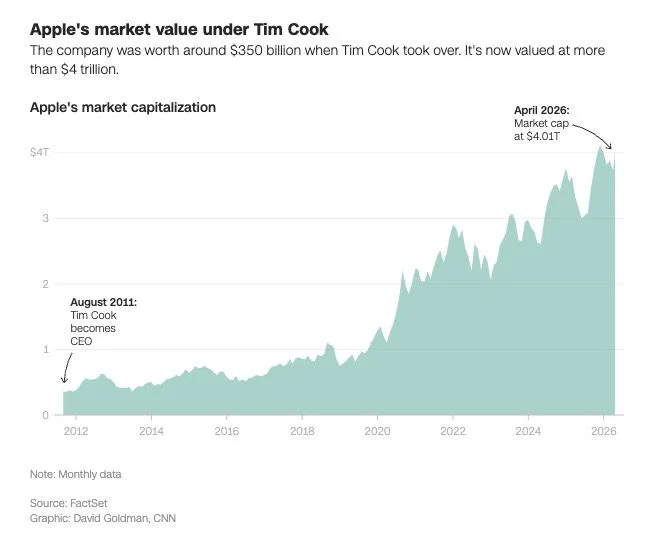
However, 15 years later, his report card reads: market value has grown from $350 billion to $4.62 trillion, an increase of more than 12 times; annual revenue has grown from $1080 billion to $4160 billion, an increase of nearly 4 times; stock price has cumulatively risen by 2275%; and cumulative returns to shareholders have exceeded $1 trillion.
You might say that Apple was left by Jobs, and whoever takes over can succeed.
Not necessarily.
More than 3 million private enterprises in China are facing succession issues, with the next decade being the most intense period for leadership transitions. The story of Cook and Apple serves as a great reference.
Looking back, over the 15 years since Cook took over, the core of his success lies in having done three things right.
Doubao's Strategy: Defend the Foundation, Then Pursue Demand
The first strategic decision Cook made after taking over was not what to do, but what not to do.
Fixed product categories
After Jobs' death, countless people cried "Apple needs to reinvent the phone". Cook didn't listen. The iPhone has gone from 3.5 inches to 6.8 inches, with all sizes and price tiers, but the underlying architecture has remained unchanged for 15 years. Why? Because the iPhone is a cash cow. You can't kill the cow, you have to keep it alive.
But Cook also tiered the older lineup—the Pro and Pro Max pushed the average selling price from $612 when he took over to above $870. That's what you call defining the category—the foundation can't be touched, because if it moves, the whole thing collapses.
2. After determining the product category, Cook's second move was to pursue demand.
The most fatal blow came in 2014 with the iPhone 6 and 6 Plus. Before his death, Jobs repeatedly said that "3.5 inches is the most suitable size for one-handed operation," a phrase that was etched into Apple's genes. Any proposal to increase the screen size was shot down with the four words "Jobs said so."
But Cook saw the reality - Samsung's Note series was selling like crazy. Consumers wanted large screens, and since Apple wasn't providing them, they were buying Samsung instead. In fact, Cook had been ready all along, but was just waiting for the market to be proven.
Cook isn't like Jobs, creating demand, but rather finding existing, unmet demands that Apple hasn't satisfied.
The same logic applies to the Apple Watch and AirPods. When the Apple Watch was launched in 2015, the smartwatch market had already existed for several years, but Cook waited until the category had gone from 0 to 1 before entering it.
But after its release, a mistake was made - positioning the Apple Watch as a luxury item, with a gold edition priced at $10,000. Three months after its launch, daily sales in the US market plummeted 90%. Someone else might have killed the product, but Cook didn't. In 2018, an ECG was added, and in 2020, blood oxygen monitoring was introduced - transforming the Apple Watch from an "iPhone on the wrist" to a "doctor on the wrist". Today, Apple Watch sales have surpassed the total sales of the entire Swiss watch industry. Before his departure, Cook specifically mentioned that this is one of his most proud achievements.
Looking at AirPods, it wasn't the first truly wireless earbuds. The Swedish brand Earin released its product in 2014, more than a year before AirPods. Cook entered the market after seeing its potential. When AirPods was released in 2016, it was ridiculed online for looking like "electric toothbrush heads", but five years later, it took over more than 30% of the true wireless earbuds market. The combined annual sales of Watch and AirPods exceeded $50 billion.
Cook always waits for others to pave the way and validate demand before making a move, and then uses Apple's supply chain capabilities, ecosystem capabilities, and quality control capabilities to take over the market.
This logic is especially critical for second-generation succession. Many heirs' first impulse is "I need to prove I'm better than my father," so they charge into entirely new fields chasing disruptive innovation—nine out of ten fail. Cook's playbook: in the first phase of succession, the goal isn't expanding into new territory, it's defending and optimizing what's already there. Win the war that's already being fought before starting your own.
3. Having products is not enough, Cook also has another trick - expanding the mind.
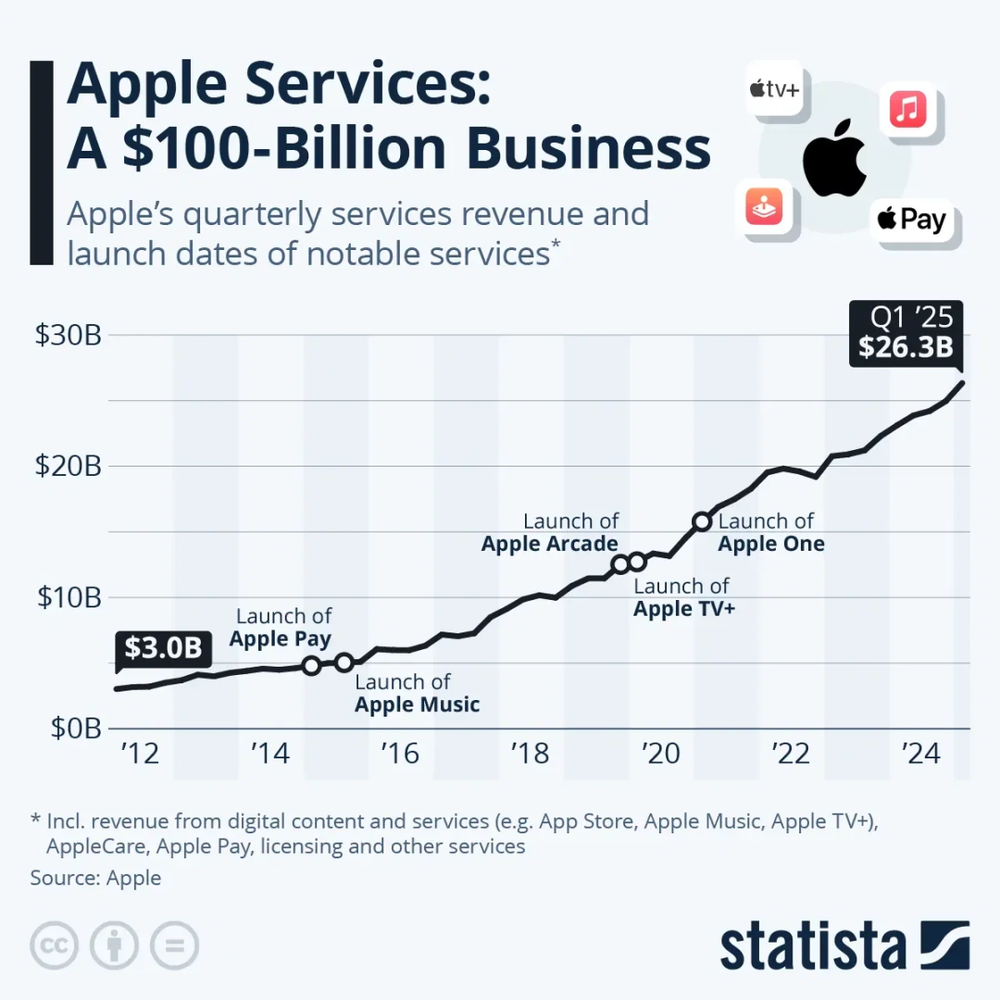
Cook's strategy can be summarized in three points: defining product categories - the iPhone's foundation has remained unchanged for 15 years; pursuing demand - waiting for others to validate a trend before taking action; and expanding mindset - turning "Apple equals high-end" into a service subscription-based compounding machine.
Supply Chain Veterans Cut into the Heart of Silicon Chip Development
Cook, a CEO with a supply chain background, did something that silenced everyone: developing chips in-house.
In June 2020, Cook announced that Mac would abandon Intel and transition to its own ARM-based chips, kicking Intel to the curb after a 15-year partnership. This decision was extremely risky, as computer manufacturers tend not to design such critical components in-house.
But this decision was not made on a whim. As early as 2010, Apple had secretly begun developing the ARM64 architecture, and in 2013 it launched the A7, the world's first 64-bit ARM chip, with a new iteration released every year since then without interruption.
What truly made him resolute was not a product issue, but a philosophical one. Cook wanted an "I'm in charge" approach - I handle the chip design, and you take care of production, with a clear division of labor.
What makes Apple's approach to the M1 even more striking is the process itself. Three to four years in advance, the software and hardware teams sit down together, decide exactly what they're going to deliver, and then move forward in lockstep. Intel and AMD build the chip first and let software adapt to it afterward. Apple flips that model—defining the hardware and software as one integrated system from the start.
The M1 was released in November 2020, with certain tasks running 11 times faster than the previous generation and battery life doubling. A year later, ecosystem adaptation was completed, and the Mac business was revitalized.
A CEO with a supply chain background is leading the development of self-researched chip architectures. He not only took product assembly to the extreme but also extended his reach into the core silicon. After the M1, all Apple products - iPhone, iPad, Mac - use the same architecture, the same process, and the same core. Apple is no longer constrained by any chip supplier, and can upgrade and price its products as it sees fit, whenever it wants.
Someone with a background in supply chain management spent a decade getting a grip on the core of Apple's most critical technologies.
Decentralize and Demystify: Making Apple Run Without Any One Person
What was the situation when Cook took over? The core circle left by Jobs - Scott Forstall in charge of iOS software, Jonathan Ive in charge of design - were all old ministers who followed Jobs in his conquest, and no one considered an operations expert like Cook to be their boss.
What is he doing? Waiting.
Waiting for an opportunity. In September 2012, iOS 6 launched Apple's own maps, which was a disaster - towns disappeared, locations were misplaced, and 3D images were distorted. Cook did something Jobs would rarely do - publicly apologize, even suggesting users temporarily use Google Maps.
Apologies were just the prelude, the axe fell on Forstall. He was a Jobs confidant and core architect of Mac OS X, once considered a potential future CEO candidate for Apple. The maps were done by his team. Cook asked him to sign the apology letter, but Forstall refused to sign. In October 2012, Forstall was fired - the first major management shake-up under Cook's tenure.
Cook achieved organizational restructuring through a single product incident, not by using brute force, but by using clever tactics and going with the flow.
He has another move—disenchantment.
Jobs was a god, Cook doesn't pretend to be one. He doesn't wear a black turtleneck or mimic Jobs' presentation style, and he publicly apologized for the Maps fiasco. In 2014, he came out in Bloomberg Businessweek, saying "I'm proud to be gay" - the first Fortune 500 tech CEO to do so while in office.
He downplayed Apple from a "religion" to a "company" — a religion cannot do without its leader, but a company can change its CEO.
Inspiration for 3 Million Chinese Private Enterprise Successors
Looking back on Cook's 15-year tenure, three things stand out: strategically defending the bottom line, pursuing demand, and amplifying intellect; in research and development, supply chain thinking has invaded chip production; and organizationally, he has streamlined the company and removed mystique, transforming Apple from a company that "can't function without Jobs" to one that "can thrive with anyone at the helm".
300,000 Chinese private enterprises are in the process of or will soon undergo succession. What can we learn from Tim Cook?
First, don't pretend to be your predecessor. Cook never adopted Jobs' black turtleneck, keynote cadence, or that cult-leader aura. He openly admits he's no product genius—and instead excels in the areas his predecessor cared least about: operations, supply chain, and capital allocation. The biggest trap for any successor is telling yourself "I need to become a second him." Cook's answer: "I'll be the first me."
Second, prioritize maintaining the foundation before discussing innovation. Cook hasn't changed the underlying form of the iPhone in 15 years. Taking over isn't about starting from scratch, but rather keeping the machine running smoothly first.
Third, when taking over in the first phase, do not pursue disruptive innovation. For large screens, watches, and headphones, Cook has always waited for others to pave the way before reaping the benefits. First, win the existing wars, then fight your own battles.
Fourth, they turned their predecessor's legacy into compound interest. Jobs left behind the mindset of "Apple equals high-end", and Cook turned it into service subscriptions, iCloud renewals, and a "too lazy to switch" lock-in effect. The most powerful successor is one who can amplify their predecessor's achievements by 10 times.
In 2011, they called him a bean counter. Over 15 years, Tim Cook delivered a 10x return on his succession through three major moves.
Starting a business is difficult, but maintaining its success is even more challenging.
But Cook has proven that playing it safe can also lead to the creation of a business empire.