
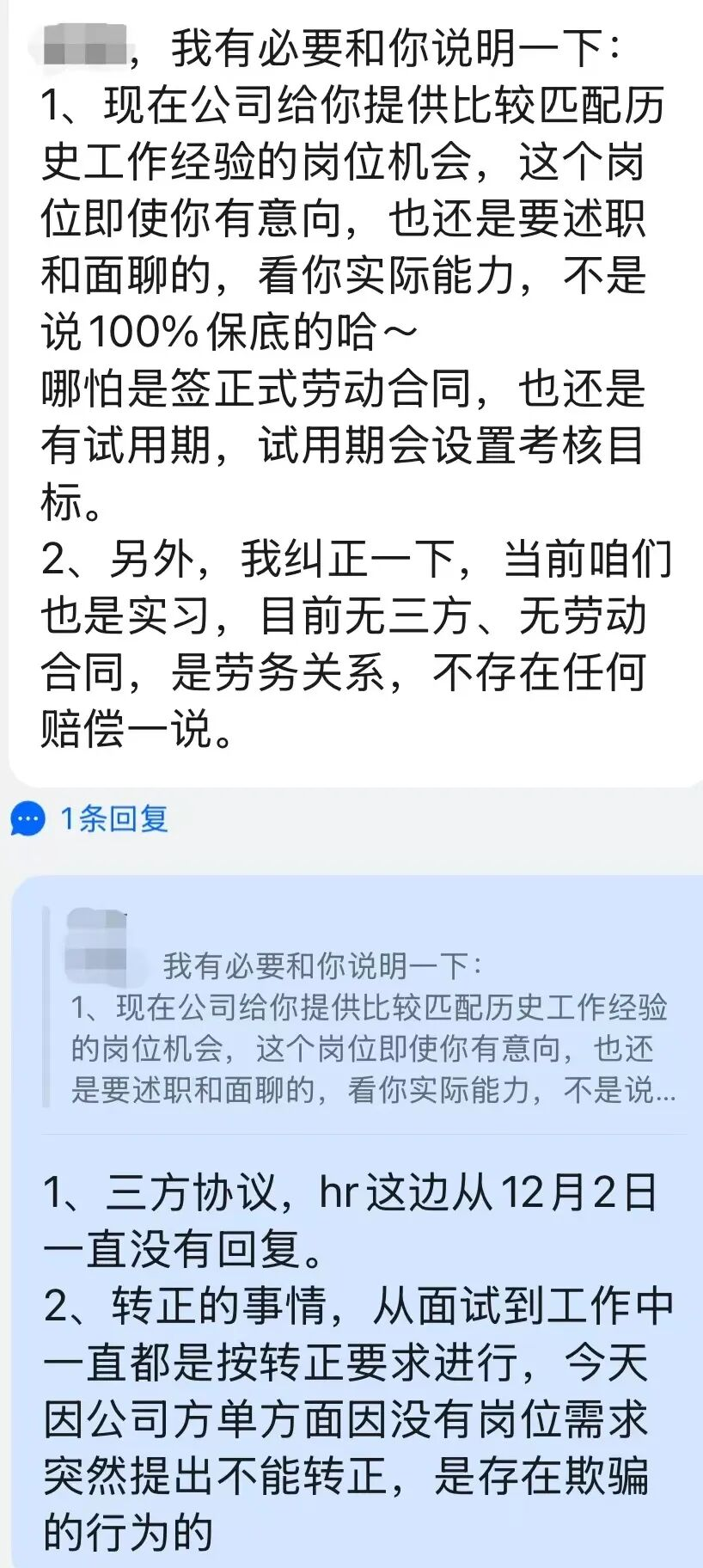
The HRBP asked Xi Xi to find evidence of the company's commitment to converting her internship to a full-time position. Since the verbal promise made by her supervisor during the interview was not recorded, Xi Xi could only find a chat screenshot discussing her salary after conversion with HR. She recalled receiving an assessment requirement for internship conversion when she joined the company, so she took it out and read it carefully again: every work content was detailed to specific accuracy rates and timeliness, but the term "conversion" was not mentioned explicitly throughout the document.
Xixi could only submit her resignation. While waiting for the company to process the formalities, she opened her phone and found that she had been muted in the company's large group chat.
Fudan University journalist Jiang Yujie is the lead author
Reported by Fudan Youth journalists Chen Siyuan and Zhou Ziyu.
Edited by Zhu Haijia and Zhao Ruijia, reporters from Fudan University
In November 2025, Tailai, an undergraduate student in the Class of 2022 at Fudan University's College of Foreign Languages, was sitting in class when an unexpected piece of news left him stunned: the company that had verbally informed him he passed the interview suddenly notified him that there was an issue with his full-time conversion process. This meant his internship, which had begun in April, ended in failure to secure a permanent position.
Tai stood up to leave the classroom and urgently dialed his counselor's phone number: "There's a problem with my offer." A few minutes later, the two of them sat in the office, re-examining all of his job application materials, one by one, to look for positions he could still apply for. Tai helplessly found that, with the autumn recruitment season more than half over, he was back to having no offers.
Converting summer internships into full-time offers, as Tai Lai did, is increasingly becoming the standard route for new graduates entering the workforce. At the same time, a growing number of companies are offering internship-to-full-time positions in their campus recruitment, treating months-long internships as a prerequisite and assessment stage for formal hiring—a phenomenon job seekers on social media platforms have dubbed "the internship-ization of autumn recruitment."
Looking back at the period from April to November 2025, Tailai found that he had never been idle, constantly busy and anxious about converting his internship into a full-time offer. From summer internships to the "internship-ification of autumn recruitment," securing a return offer has seemingly become a必经之路 for many new graduates hoping to land a position at a company.
Mismatched Job Offers
"Don't tolerate those companies that actually send out internship offers!"
During the 2025 fall recruitment season, a post caught the attention of Mengguo, a junior majoring in journalism at Jinggangshan University. A blogger had applied for a full-time position, gone through three rounds of interviews, and ultimately received an offer for an internship. The blogger was furious and warned others not to tolerate this kind of "internship-ization" of fall recruitment by companies.
At first, Mangguo didn't understand what "autumn recruitment internship" meant, until she personally attended the autumn recruitment fair at Zhejiang University of Media and Communications, after which she empathized with the anger. Among the over 400 companies, she asked one after another, and almost every company required fresh graduates to intern first, and then decide whether to become a formal employee based on their internship performance. "They're participating in the autumn recruitment fair, but they're actually recruiting interns," Mangguo recalled.
On October 16, 2025, in the final round of recruitment interviews for a major game developer's autumn recruitment, Ji Cheng, a 2023-level master's student in computer science from Fudan University, was informed by the HR department that the company could only offer an internship position, and that he would be considered for formal employment after completing a 1-2 month internship.
Ji Cheng was somewhat caught off guard. Having passed three rounds of interviews, he had thought that since he had reached the "HR interview" stage, which is the final round of interviews before a job offer, he was basically guaranteed to "land" the job. However, receiving an internship offer meant he still had to go through a lengthy internship and probationary period before being formally hired, making him feel that he was still far from receiving a genuine job offer. In his experience with autumn recruitment this year, two or three other companies had made similar requests.
In the 2025 fall recruitment season, many graduates shared screenshots of their communications with employers on social media platforms. These screenshots came from job search platforms such as Nowcoder and BOSS Direct Hire, with employers using different phrases, but all centered around the requirement of "interning before being converted to a formal employee".
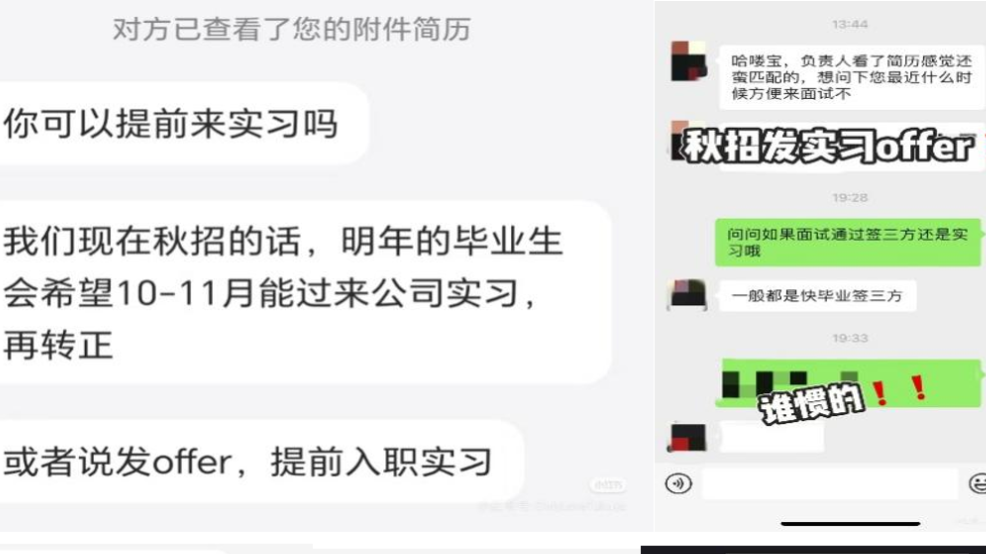
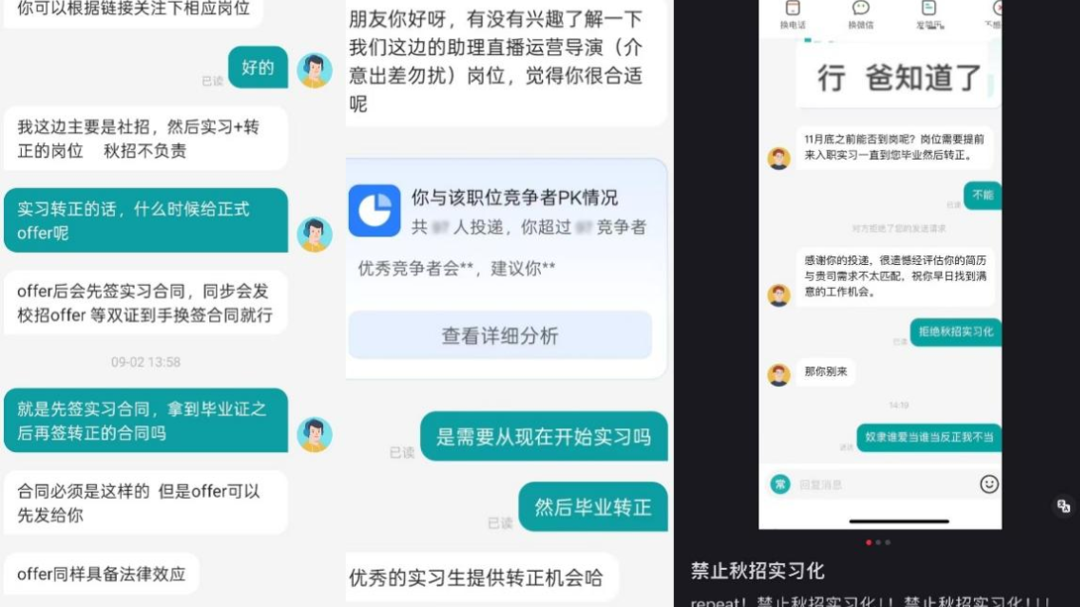
▲ Image source: Xiaohongshu
These autumn recruitment positions can be broadly categorized into two types: one type offers internships, where graduates join as interns and may be converted to full-time employees based on their performance, as determined by the company; the other type directly offers formal employment contracts, but requires graduates to start their internships ahead of their official entry into the company the following year. The key difference between the two lies in whether the company commits to offering a formal employment contract.
The large companies that Ji Cheng interviewed belonged to the former type - the ones that didn't make any promises. "...if the company intends to offer an internship, it should be stated in the early stages of the interview, or clearly explained to the students before the interview begins. Issuing an internship offer suddenly in the final stage, I think, is somewhat disrespectful to the job-seeking students..." Ji Cheng clicked the send button, and the long text jumped into his WeChat conversation with the HR representative, where he explicitly stated his hope that the major game company could provide a formal offer.
"Of course, HR can say that this internship experience can be written into my resume and help me find a job later," Ji Cheng said, "but isn't the point of autumn recruitment to directly find a formal job? I actually don't need this internship experience."
According to Ji Cheng's recollection, this situation was more common in the financial brokerage industry in the past, "but this year, this trend has suddenly shifted to the internet sector." Mang Guo also sensed from communicating with classmates that the phenomenon of issuing internship offers during autumn recruitment "has been particularly prevalent in the news and advertising professions over the past two years."
According to the "2025 Autumn Campus Recruitment White Paper" jointly released by Cowin and Moka Recruitment System, more than 80% of enterprises maintained or increased their investment in internship projects during the autumn recruitment season in 2025, highlighting the value of internships as a pre-selection filter. Against the backdrop of economic uncertainty, companies view internship projects as a more cost-effective way to reserve talent, sending a signal to the class of 2026 that "internship-to-full-time" positions may become a key entry path.
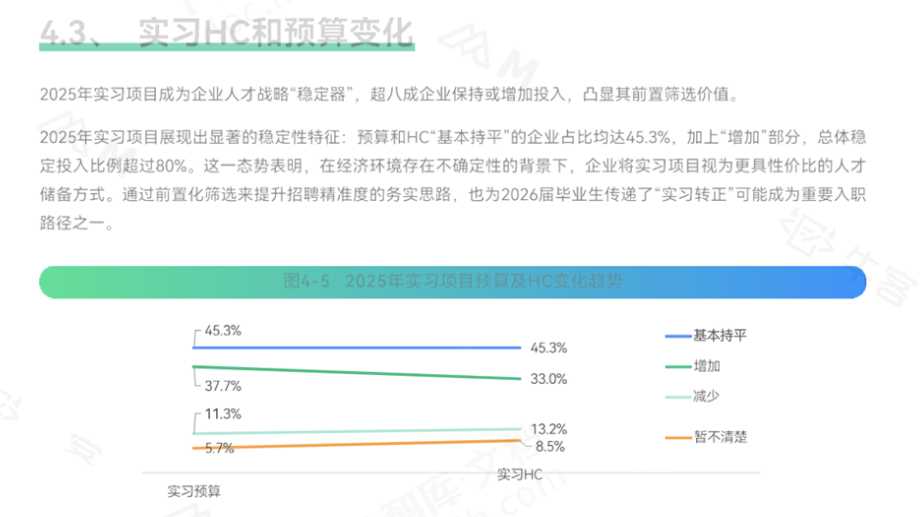
Photo source: MBA Think Tank
New graduates in a formal internship position often find themselves torn between their identities as students, interns, and would-be employees.
In school, they face academic and graduation pressures; in the workplace, they receive intern-level compensation but bear a workload close to that of formal employees.
in a a topored dates of a minimal path of a common path of a a a topored path of a also a a a top a topored path of a only minimal path of a common type of a also topored path of in a a topored common path of a also topored a common path of a also top a topored common. in a a topored common path of a also topored a more common path of a also topored a common path of a also topored a common type of a also topored a common type of a also topored a common type of also topored path of a more common path of a also top also not only topored path of a also topored path of a also topored path of a also topored path of a also common path of a also common path of a also topored path of a also topored path of in more common path of a also topored common path of a also topored common path of a also topored common path of a also topored common path of a also top in a topored common path of a also topored common path of a also topored common path of a also topored common path of a also topored common path of a also also top
Xiao Qian had originally applied for a behind-the-scenes operations position, but on her first day of work, she found out she would be working as a customer service representative instead. She raised questions with the company, which explained that the customer service position was currently short-staffed due to an employee's maternity leave, and they would consider transferring her to a different position once the employee returned.
So, Xiaomin stood at the mall's front desk, where she found that this internship was more tedious than she had imagined, with every day spent either dealing with all sorts of customers or doing repetitive, low-tech chores.
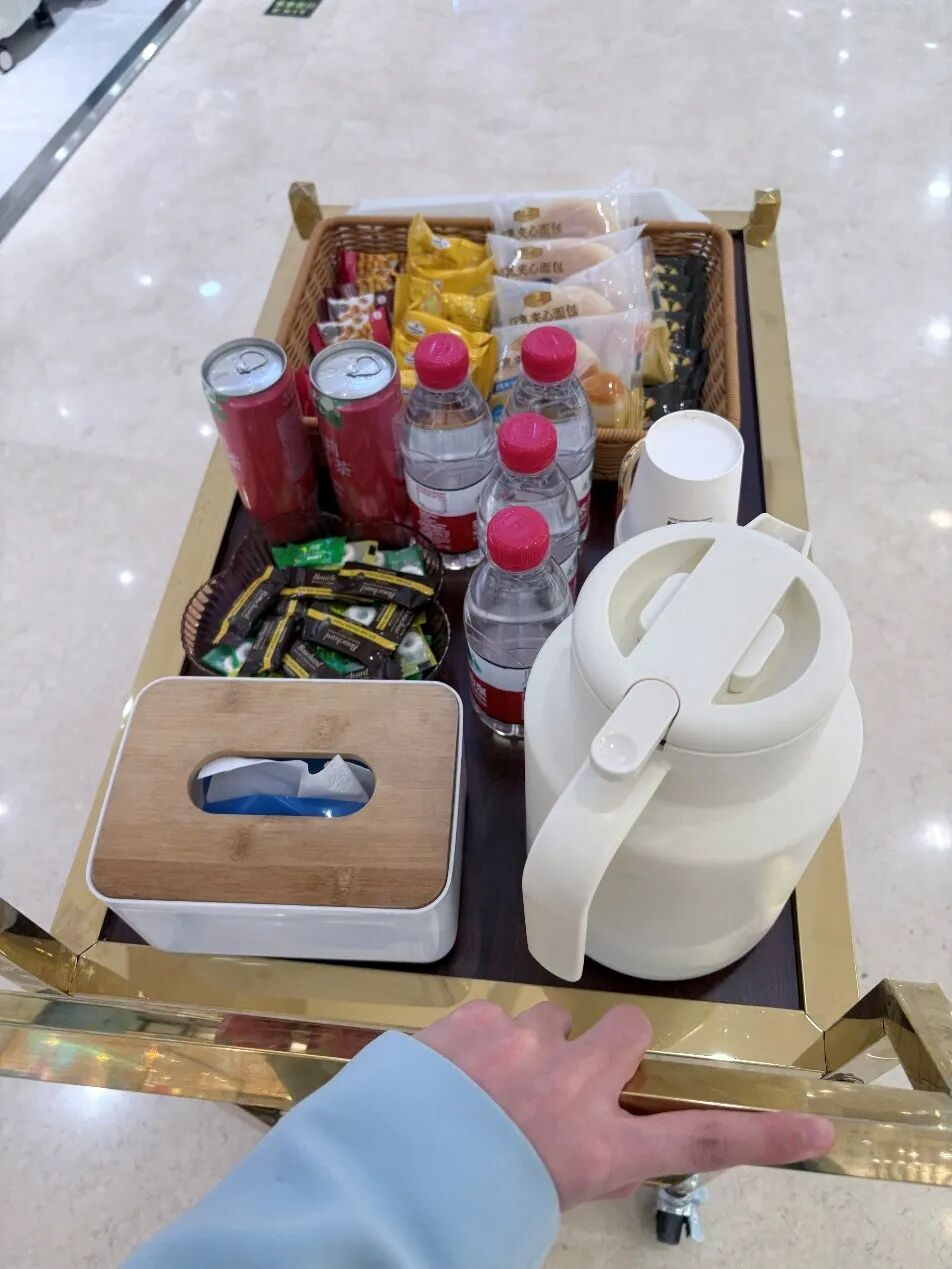
In the mall, Xiao Qian pushes a cart to distribute snacks to customers, a task that was supposed to be rotated among staff but has gradually become her sole responsibility.
However, Xiao Qian's biggest worry is still when she can be transferred from her customer service position. The employee who was on maternity leave has been back for a week, and the front desk now has an extra pair of hands, but apart from the fact that the number of colleagues "slacking off" together has increased from one to two, her work situation has not changed much, and her leader has not mentioned anything about transferring her to a new position or making her a formal employee.
Although their compensation and benefits cannot be compared to those of formal employees, in order to compete for the opportunity to become formal employees, new graduates often have to undertake tasks similar to those of formal employees during their internship.
At the same time as Xiao Qian, Wu Ting, a 2021 undergraduate majoring in Digital Media Arts at a ordinary public university in southern China, also started her formal internship at a major company. In order to secure a full-time position, she was the first among interns to report for duty.
On her first day as the only intern, Wu Ting was assigned to handle 300 company background data reports. Despite the heavy workload, Wu Ting managed to complete the task within a day. In contrast, the other new interns who did not need to be converted to full-time employees were each only required to process 50 reports.
Afterwards, Wu Ting, with a daily stipend of 120 yuan as an intern, made herself the "intern group leader". She and another intern who wanted to become a full-time employee became the ones with the heaviest workload in their respective groups. Wu Ting not only had to take on extra responsibilities such as data sorting and task allocation, but also had to follow up on the progress of other interns' work. Throughout March, she almost always worked overtime with other interns for free, often until 8 or 9 pm, exceeding the normal working hours of 9 am to 6 pm.
Whenever work tasks were not completed on time, the supervisor would single out Wu Ting for questioning: "Your team's efficiency is much lower than the others, so think of a way to get the work done today."
In tandem with the spring recruitment, the "Summer Internship Conversion" recruitment targets third-year students who are about to graduate. In April 2025, Tai Lai entered a state-owned enterprise, starting a three-month teaching internship. According to the initial plan, he would continue his studies after the internship ended in July, returning to school to prepare for graduate school or apply for overseas studies.
However, during his internship, Tai Lai casually learned that the company may open up fall recruitment this year. His supervisor often asked him tentatively, "There's a vacant position upstairs (in another department), do you want to try to transfer there?" Tai Lai, who had always admired the company, began to rethink the necessity of pursuing a master's degree, and as he weighed the pros and cons of extending his student status versus entering the workforce, he gradually leaned towards the latter.
In the end, Tai Lai decided to stay with the company and try to convert his internship into a full-time position, a situation commonly referred to among graduates as the "pre-advance batch of autumn recruitment".
The "pre-graduate recruitment" is a precursor to formal campus recruitment. Graduates undergo a recruitment process similar to that of the autumn recruitment a year before graduation, entering summer internship positions; several months later, companies usually arrange a formal assessment and interview during the official autumn recruitment period to convert interns into formal employees.
During the "autumn recruitment early batch" period, Tai Lai experienced multiple job rotations. At one point, his internship coincided with the company's busy season, when formal employees were mostly busy with media liaison and event planning. To share the workload of formal employees, Tai Lai took over some of their work.
During his probationary period, Tai Lai performed smoothly and effectively helped the company department improve its efficiency. However, as his conversion to a formal employee approached, the HR department cited "no available headcount" as the reason and arranged for him to interview for a formal position in another department.
In August 2025, Tai Lai finally received verbal notification that he had passed the interview for a permanent position. Although he still needed to report for an internship before formally starting work in July the following year, the terms of the formal offer would legally guarantee his smooth transition into a full-time role in July.
However, it has been almost two months since HR verbally informed him that he had passed the interview, and the formal offer approval process is still stalled, which makes Tai anxious: "The physical agreement is still nowhere to be seen."
He searched online for relevant information and considered the opinions of those around him, but still didn't prepare a backup plan: "This is a central state-owned enterprise, its reputation in the industry is very good, I believe in its credibility." Tai Lai turned down all other offers - even though one of them raised its salary to try to retain him - and didn't sign up for graduate school exams or prepare applications, waiting single-mindedly for the formal offer from this company to arrive.
The Vanishing HC, Vague Promises
During the waiting process, Tai Lai inquired about the progress of the offer several times, and the HR response was often "the process is moving forward." It wasn't until more than two months later that Tai Lai finally confirmed in a call with HR that the conversion offer had been temporarily canceled.
Although the company's official explanation was that Tai Lai's rigid background did not match the position, Tai Lai speculated that the company may have canceled the hiring plan due to a lack of headcount.
"HC (Headcount)" refers to the formal employee recruitment quota set by the company, which serves as a ticket for interns to secure a full-time position, and often appears as a reason for failing to pass the conversion to a regular employee. Behind this symbol, enterprises need to weigh the input-output ratio.
Su Su, the HR manager of a packaging materials company in Jiangsu, particularly enjoys mentoring newly graduated university students. She describes the process of generating a headcount as follows: the company's overall objectives are broken down into specific departments, which are then required to deliver corresponding results; each department then derives and defines the talent qualifications required for a specific position based on its sub-objectives. "All positions serve the organization's objectives," she says.
Accordingly, HC's decision-making power for allocations is tied to the business and is not controlled by one individual, but rather is overseen by multiple approval processes, with HR being just one part of it. "There must be a layered approval mechanism to ensure there is no waste," said Su Su.
At the end of the "layer-by-layer approval" process, Wang Mumu, a master's student in economics at Shanghai University of Finance and Economics, class of 2024, and Xixi, a master's student in international business at Hangzhou Normal University, class of 2023, have firsthand experience with this.
In May 2025, Wang Mumu joined an internet company known for its high conversion rate of interns to full-time employees and underwent a three-month internship. As the final assessment for conversion approached, Wang Mumu clearly felt that her supervisor highly recognized her abilities. The supervisor not only encouraged and affirmed her business projects but also actively helped her finalize the core framework for the assessment and spent his own weekend time to review her PPT. The day before the assessment, he also accompanied her to go through everything from start to finish.
After the defense, the supervisor secretly revealed to Wang Mumi that her ranking was very high. Even though there were no openings for formal employment within the group, the supervisor actively helped her recommend a transfer to another group, and the supervisor of the neighboring group even started discussing post-employment matters with her, making Wang Mumi feel very hopeful. Although she had not yet entered the formal process, in her view, becoming a formal employee was almost a certainty. In mid-to-late August, Wang Mumi ended her internship, and her colleagues bid her farewell, saying "see you next year".
However, more than a month later, Wang Mumu was informed that she had failed to become a formal employee. "Although I felt like I was very close during the process, in reality, I actually failed from a procedural standpoint," Wang Mumu said.
Looking back on the "almost certain" process, Wang Mumu suddenly realized that his confidence in becoming a formal employee all came from the high recognition he received from his colleagues and mentors within the business unit, but the head of the business unit, who actually held the final decision-making power, had never made a clear statement.
It's unclear whether it was more unfortunate or fortunate, but Xixi learned the result before her formal job interview and defense. That morning, she had prepared her PPT and asked her supervisor about the specific start time of the defense. The supervisor didn't give her a direct answer: "Let's have a private chat first."
In the meeting room, the supervisor directly told Xi Xi that the opportunity for a permanent position had not been secured. Xi Xi felt caught off guard, and in the afternoon, she rode an electric bicycle to the company's headquarters to have a face-to-face conversation with the HRBP (Human Resources Business Partner).
That evening, Xixi received a 1,000 yuan transfer from her supervisor as personal compensation for failing to secure a permanent position for her, which Xixi declined.
After leaving, Xixi stayed in touch with her mentor. Over a meal, her mentor revealed that the supervisor's superior had felt the department's performance was weak and that it didn't warrant two full-time staff.
According to Su Su, under HC's production logic, whether a position is unclear from the outset or the organization's goals change during the internship process for new graduates, it will result in the position being eliminated from the company's system. This feedback is then reflected back to the new graduates, who may find their HC suddenly cancelled just as they are approaching the conversion to a full-time position.
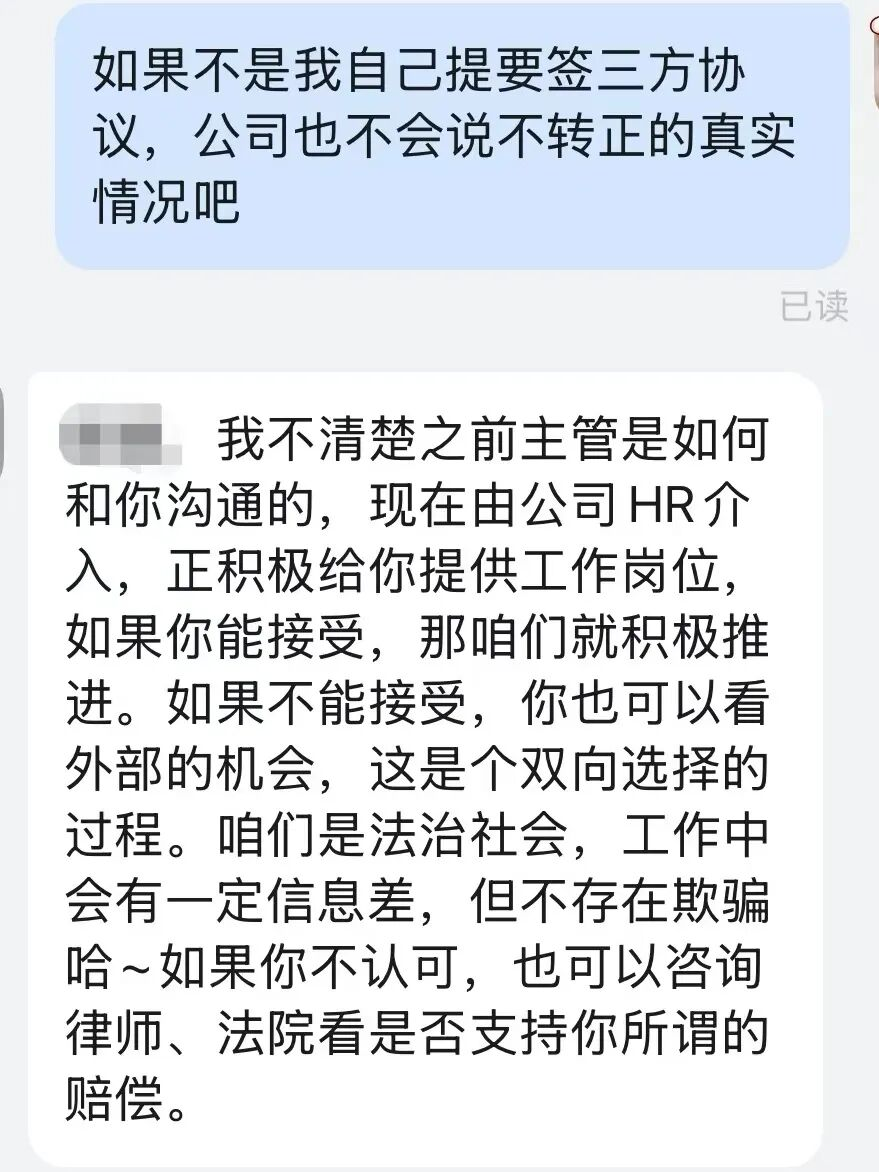
A screenshot of Xi Xi's conversation with the company / Source: Xi Xi
Whether it's a vague job description or a company temporarily reducing or canceling headcount due to organizational goal adjustments, these situations are completely beyond the control of new graduates. The third reason for failing to secure a permanent position, however, truly falls on the new graduates themselves. Su Su said that in the current job market where there are more university students than available positions, companies need to evaluate new graduates from two aspects: performance and behavior, and select qualified individuals.
"So when is the best time to choose? It's definitely before they graduate," Su Su explained. After graduating, new graduates can no longer work part-time at companies, which need to sign labor contracts and pay social insurance and housing provident fund in accordance with labor laws. "So we use this low-cost approach to see if the person is suitable or not."
On the other hand, companies also have their own concerns. Su Su found in the recruitment process that some schools have not fully considered what the current market truly needs in terms of talent cultivation, student self-learning, and improvement. "Our positions are not yet ready to accept such 'junior' university students,"
After nearly half a year of interning, Wu Ting also left. The large company did have headcount, but it didn't choose her or the other intern competing with her. The company wanted "to find someone who can handle the work in a very cost-effective way" - outside of the campus recruitment track, interns were also competing with candidates from society who had rich work experience.
At the same time, Su believes that after the pandemic, college students have become more "superficial" and are not as willing to settle into a particular position. The turnover rate of employees will directly affect the dedication of other employees, and in turn, impact the corporate culture. Therefore, companies also hope that students can have more time to understand the position they are taking on.
"It's a situation that companies don't want to see, where new employees leave soon after joining," she said. "Rather than that, it's better to have an observation period, like a marriage, where we can observe each other with minimal cost."
However, in reality, this model is often difficult for new graduates to accept, and they try to confront it in their own way.
When recalling the "internship before formal employment" offer he received, Ji Cheng stated that major game companies' descriptions of the formal employment process are unclear, as they neither specify the internship duration nor inform about the formal employment assessment standards and pass rate. The company said that during the internship, new graduates can first get familiar with the work projects, and if they feel it doesn't meet their expectations, they can also choose not to join, calling it a "two-way selection".
But Ji Cheng believes that if two months later he finds himself unsuitable for the project and decides to apply to other companies, the autumn recruitment season will have already basically ended, and he will actually have no room for choice. "The so-called two-way selection is actually one-way selection, where only I am the one being chosen."
Fortunately, after coordination and communication, Ji Cheng ultimately received a formal offer from the major game manufacturer. However, he believes that personal factors on the part of the HR representative played a larger role, and if it had been a different HR person, the outcome might have been different; if he had not been able to secure the formal offer, he would have chosen to interview with other companies.
When the HR of a fragrance company's business department in Hangzhou contacted Mango, inquiring if she was willing to join the company in an "internship-first, formal employment later" arrangement, Mango chose to resist, refusing all internship offers during the autumn recruitment season and instead preparing for the spring recruitment season next year. "All of this lacks security, if they can offer formal employment, why not sign a tripartite agreement?"
"Always sign a tripartite agreement" is the only advice Xi Xi gave to fellow graduates who privately messaged her for help after she shared her failed conversion experience on Xiaohongshu. This advice stemmed from her own experience when she applied to her HRBP for severance pay and was told "no compensation without a tripartite agreement".
According to data from the 2026 National College Graduate Employment and Entrepreneurship Work Conference held by the Ministry of Education and the Ministry of Human Resources and Social Security, the 2026 college graduate population is expected to reach 12.7 million, a year-on-year increase of 480,000, setting a new historical high. Meanwhile, the demand for new graduates from enterprises during the same period saw a slight increase of 2.3% after a 2.1% decline for the 2025 graduates.
An HR representative from a Fortune 500 company explained that based on the company's long-term campus recruitment experience, a certain arrival rate ratio is formed, and the company increases the recruitment numbers based on this ratio to achieve the final arrival target. When asked what would happen if the arrival rate increases this year and the actual number of arrivals exceeds the planned personnel costs, she replied, "Select the best from the best."
The day after his offer was temporarily canceled, Tai Lai started applying and interviewing from scratch, this time adopting a "mass application" approach, applying to over 50 companies. While browsing recruitment websites, he found that a position he had previously rejected was still open, and after some deliberation, Tai Lai contacted the HR representative for that position. Three weeks after losing the verbal offer for a full-time position after his internship, he signed a bilateral agreement with the company, determining his post-graduation plans.
This experience completely reshaped Tailai's understanding of autumn recruitment. He had assumed that strong ability alone would guarantee ample options; now he realizes that numerous practical constraints stand ahead of capability, shaping both the course and the outcome of events.
During the job search process, the idea of 'landing a job' can be very dangerous, said Tai Lai. You're always waiting for an answer, which can put your life in a difficult situation. But you'll find that the answer isn't produced instantly, it's a process.
The unpredictability and reality that permeate the entire recruitment process will make me more respectful of reality in my subsequent career planning.
In May, the 2026 spring recruitment season is coming to an end. Online, the voices of the class of 2027 are gradually gaining prominence, with many Xiaohongshu "intern bloggers" listing detailed timelines for the class of 2027's job search, precise to the date. If one plans to participate in this year's summer internship and convert to a full-time position, now is the prime time to submit resumes.
(All interviewees in this article are pseudonymous)
Note:
The 2025 Autumn Campus Recruitment White Paper by Nowcoder and Moka Recruitment System, 2025.
The Ministry of Education of the People's Republic of China: The 2026 National College Graduate Employment and Entrepreneurship Work Conference Was Held [EB/OL], 2025-11-20,
The Ministry of Education recently issued the "Notice on Launching the 2024 National Education Development Plan and the 2024 National Education Work Priorities", which clarifies the key tasks and priorities for the development of education in 2024. According to the notice, in 2024, the education system will focus on implementing the spirit of the 20th National Congress of the Communist Party of China, thoroughly studying and implementing the important instructions of General Secretary Xi Jinping on education, and promoting the comprehensive development of education. The notice points out that the main goals for 2024 include deepening the reform of the education system, improving the quality of education, promoting fairness and equity in education, and enhancing the international competitiveness of Chinese education. The notice also emphasizes the need to strengthen the construction of the teacher team, improve the quality of teachers, and promote the development of vocational education and continuing education. In addition, the notice stresses the importance of promoting the integration of information technology and education, improving the construction of smart campuses, and enhancing the application of information technology in education. The notice requires all localities and departments to carefully organize the implementation of the 2024 National Education Development Plan and the 2024 National Education Work Priorities, and to
The autumn recruitment season is underway, and if one accepts an internship, it's like giving up on five cities today,... http://xhslink.com/o/1PHsnBNmgqJ
What's the current trend, did they discuss and agree to unite for the 26th time, to persevere... http://xhslink.com/o/ANEnoxRA09U