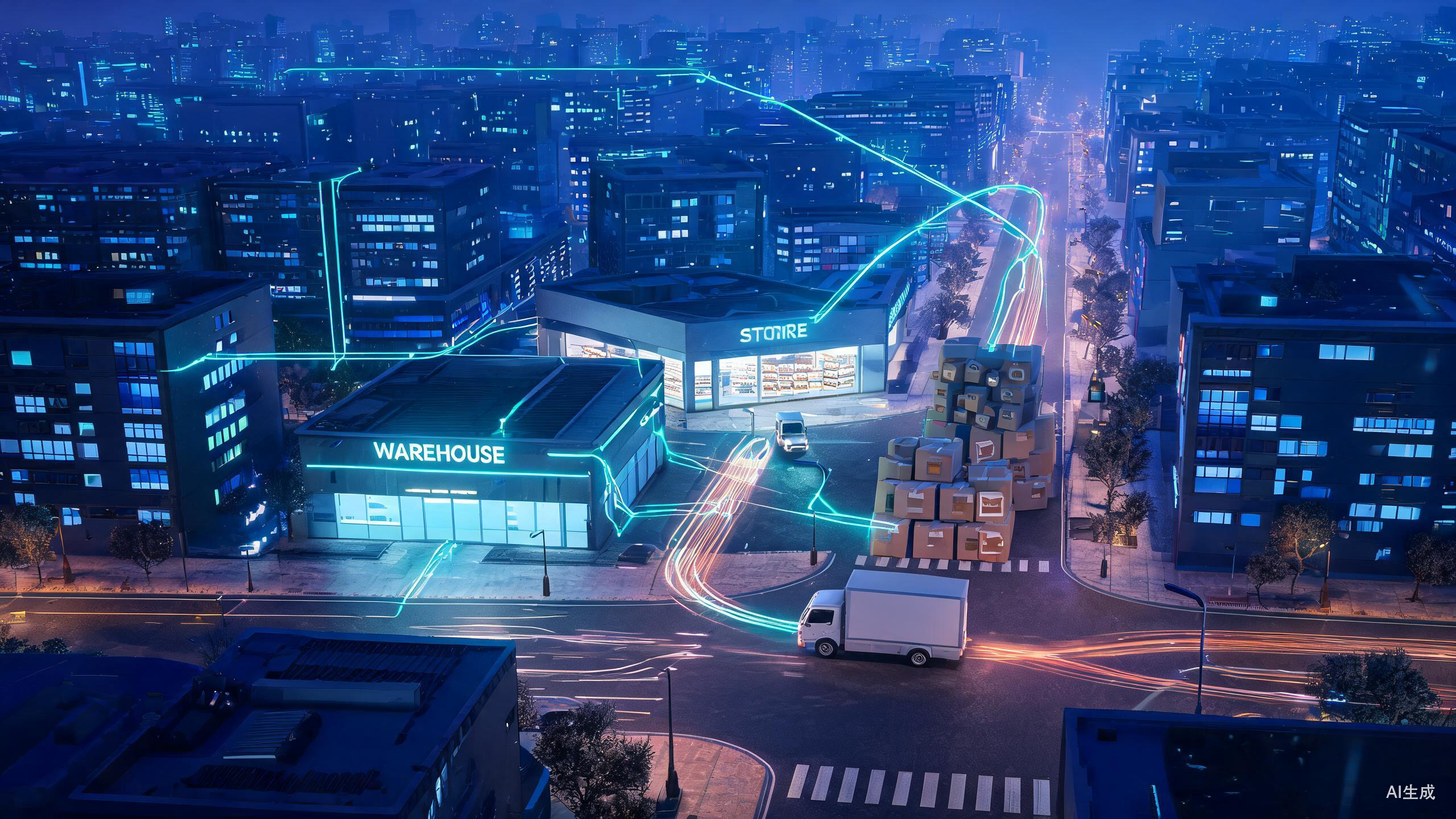
Accounting for 30% of Alibaba's e-commerce GMV is the new goal set by Alibaba for instant retail.
Since the start of the year, Alibaba's instant retail targets have been repeatedly raised. From striving for absolute market share, becoming a core pillar of Taotian's upgrade, to achieving an instant retail transaction scale of over 100 billion yuan in the 2028 fiscal year, and now to 30%, although Alibaba has not given a specific implementation deadline, the difficulty of achieving it has also increased sharply.
Looking at the numbers alone, this goal is almost at the industry's ceiling. Based on Alibaba's previous public calculations, a 30% market share would correspond to a transaction scale of nearly 2.25 trillion yuan. In contrast, the Ministry of Commerce's Research Institute estimates that the country's instant retail industry will not exceed 2 trillion yuan until 2030.
Although discrepancies in caliber and data estimation exist, they do not dilute the enormity of the goal itself. Achieving this goal means Alibaba must gain a dominant position in the instant retail sector.
Over the past year, Jiang Fan has led Taobao Flash Purchase to capture 42% of the market share. Data from Analysys shows that in the fourth quarter of 2025, Taobao Flash Purchase's instant transaction market share reached 45.2%, nearly tying with Meituan's 45.0%, marking a shift in the industry from one dominant player to a two-horse race.
However, the cost is equally noteworthy. According to a HSBC research report, from the second quarter of 2025 to the first quarter of 2026, a period of 12 months, Alibaba's instant retail business lost approximately 87 billion yuan, a scale close to half of Alibaba's adjusted EBITA for the 2025 fiscal year.
As targets for instant retail continue to rise, Alibaba announced a placement of new shares, with net proceeds of HK$80 billion earmarked entirely for AI.
Cai Chongxin has repeatedly stated that AI is Alibaba's most important strategy for the next decade. The group's resources are a zero-sum game, with core e-commerce profit growth slowing, and AI requires constant capital expenditures, meaning instant retail no longer has unlimited ammunition.
Meanwhile, on the day after the announcement, Alibaba's Hong Kong stock price plummeted 8.54%, with over HK$200 billion evaporating in a single day.
The capital market's anxiety over large capital expenditures is directly reflected in the market performance, and even AI cannot bring a positive outlook, making the situation even more difficult for instant retail.
Alibaba holds three cards: Taobao's 20 years of accumulated inventory management capabilities, a 42% market share, and the combined synergy of online and offline operations. If it can be successfully implemented, the 30% target may not be out of reach.
However, whether it's reconstructing the near and far field systems or reforming the warehouse network, all of these require significant investment.
Can Alibaba deliver on this high-stakes "big outcome", facing tests that are not only about market share competition, but also about the ability to spend money - under the dual pressure of an AI-prioritized strategy and tightened capital, using less money to leverage greater GMV.
To understand why Alibaba has set its sights so high, it's necessary to first figure out what instant retail means to the company at present.
Going back to spring 2025, after Jiang Fan took charge of Alibaba's China e-commerce business group, he played the Tmall Flash Purchase card and deeply collaborated with Ele.me, launching a fierce attack on Meituan's core local life services territory with a subsidy of 10 billion yuan.
At that time, Alibaba's strategic logic was "attack is the best defense", preventing Meituan from relying on instant retail to cross into and erode the traditional e-commerce foundation. The business logic was "high-frequency driving low-frequency", boosting the daily activity and opening frequency of traditional e-commerce businesses.
The focal point of the battle is in food delivery, as dining is a high-frequency activity that is crucial for cultivating user mindset and consumption habits in instant retail, and securing a sufficiently large share of the food delivery market is the foundation for competing in the instant retail market.
For Alibaba, instant retail is currently both a new front line and a pump to activate overall traffic.
As the frontline efforts advanced rapidly and achieved phased results, Alibaba quickly completed the key organizational consolidation, achieving unified combat effectiveness.
In less than two months, Alibaba merged Ele.me and Fliggy into its e-commerce business group. This marks the first time that almost all of Alibaba's consumer businesses have been unified under the "one Taobao" command system, overseen by Jiang Fan, ending the previous fragmented state where local life services and e-commerce businesses operated independently.
In August of the same year, Jiang Fan elaborated on Taobao's flash purchase strategy for the first time during an earnings call and introduced the concept of "combining near and far fields". Alibaba divided non-food instant retail into two modes, "near-field native" and "combining near and far fields", and set a goal of "achieving 1 trillion yuan in new transactions from flash purchases and instant retail on the platform within the next three years".
When explaining the combination of online and offline models, Jiang Fan used Tmall Supermarket's B2C upgrade as a case study, suggesting that Tmall Supermarket will fully transition to a near-field flash purchase model.
Up to now, Alibaba's instant retail is no longer just a local life service, but has become a means for the entire e-commerce sector to hedge against the pressure of traditional e-commerce growth.
A larger strategic upgrade took place in May this year. Colin Huang and Wu Xiaobo jointly released a letter to shareholders, for the first time positioning instant retail as the "core strategic pillar" for the comprehensive upgrade of the Taobao and Tmall platforms. The letter also pointed out that "consumer behavior has undergone profound changes, with expectations for 30-minute rapid delivery having become the norm."
This also means that for Alibaba, instant retail is not just a business model, but also a fundamental retail capability that bears the responsibility of transforming the entire e-commerce ecosystem into a "near-field" model.
Having understood this point, it's also clear why Alibaba has set such a high target. What Alibaba is after is not just grabbing a spot in the instant retail track, but using this combination of online and offline capabilities to reconstruct the entire fulfillment system of Tmall. The 30% target is not only for instant retail, but also a phased result of the "near-field" transformation of the e-commerce foundation.
Around the same time, Freshippo also completed key personnel adjustments, with Freshippo CEO Yan Xianglei's reporting line changed to report to Jiang Fan, the head of the group's commercial division, a move seen by outsiders as a significant signal that Freshippo is about to be merged into the China e-commerce business group.
In its latest earnings report, Alibaba established a new statistical framework called "Alibaba E-commerce Group", which includes Hema, indicating that Hema has been fully integrated into Alibaba's overall e-commerce system in terms of strategy, business, and finance, allowing Alibaba's instant retail core resources to be consolidated and strengthened.
With this, the three main pillars of Alibaba's instant retail have all been put in place. Taobao Flash Sale serves as the lead, shouldering the responsibilities of traffic conversion and fulfillment; Hema Fresh is in charge of non-standard supplies such as fresh produce, relying on its stores and front warehouses to accept some instant fulfillment orders; Tmall Supermarket is responsible for supplying standard products, and through the renovation and addition of Flash Sale warehouses, it implements a near-and-far field combined model.
From supply to warehousing and then to fulfillment, a complete capability map for Alibaba's instant retail has taken shape.
However, having the capability does not necessarily translate to actual business results, the question is whether Alibaba can deliver on its goal of achieving a 30% GMV share.
Instant retail has completed the first half of its journey, which was characterized by competing on delivery speed and subsidies. Now that 30-minute delivery has become the industry standard, supply-side contradictions are gradually emerging. Many users have had the experience of searching for their desired brand products on an app, only to be told that the product is out of stock at their current address when they try to place an order.
This is due to the structural shortcomings on the supply side of instant retail. Although the number of SKUs on the platform's books is considerable, it is constrained by the dispersal of localized supplies: goods are scattered across numerous independent stores and flash warehouses throughout the city, and there is no unified inventory pool for the entire city. Merchants prioritize stocking high-margin white-label goods, resulting in a lack of depth in quality brand supplies, and the same products often have huge discrepancies in availability just a few blocks apart.
Taobao's advantages in terms of "products" remain evident, with a 20-year accumulation of brand resources, SKU breadth, and supply chain capabilities. For example, Taobao Convenience Store's main warehouse SKUs total around 10,000, with a product richness that is three times that of ordinary convenience stores.
If the model combining near-field and far-field operations is successful, the incremental space for Alibaba's instant retail will come from two aspects. Firstly, it will come from seizing offline market share, which is what all instant retail platforms are doing, by pulling users from offline stores to online. Secondly, it will come from converting far-field orders into near-field orders, transforming traditional e-commerce orders that take multiple days to deliver into orders that can be delivered within half an hour.
Whether it's Tmall Supermarket upgrading from B2C long-distance to near-field flash purchases, or brand stores accessing Taobao Flash Purchase, Alibaba is essentially doing the same thing: using near-field networks to deliver long-distance goods.
From this perspective, the 30% target is theoretically achievable. However, traffic and cargo supply are only front-end conditions — every order remains constrained by the realities of warehouse network density.
Currently, Alibaba is building its "four routes" of inventory management. Two of these routes involve heavy-asset self-operated warehouses, including Hema's front warehouses and Tmall Supermarket's flash purchase warehouses, where the platform independently procures and stocks goods, ensuring a stable output of products within the Taobao ecosystem.
The other two are Taobao Convenience Store Flash Purchase Warehouses and Tmall brand offline store warehouses, which belong to a light-asset model. Among them, Taobao Convenience Store Flash Warehouses adopt a franchise model, with the platform connecting 1688 as an optional supply chain, providing merchants with product selection references and account period support, but merchants still have procurement autonomy.
the a top of a a top of a top of a a top of a top of a top of the a top of a top of " " ( a only one top of a ":(,",",",",","(ori,",",","(s,","(s,"," only top of common,",",","(s,",". ",",",",",",",",",",",",",",",",",",",",",",",",",",",","," ",",",",",",","elling,",",",",",",","," the top of ",",",",",",",",",",",",",",",",",",",",",",",",",","," ",",",",",",",",",","," results,",",",",",",",",",",",",",",",",",",",",",",",",",",",",",",",",",",",",",",",",",",",",",",".",",","," that ",",",",",",",",",",",",",",".",",",",",".",",",",",".",",",",",",",",",",","
Heavy-asset warehouses can tightly control product selection, inventory, and service standards, providing a unified and stable consumer experience. However, to increase the density of city outlets, they must continuously bear the capital expenditures associated with warehouse rent, cold chain logistics, and inventory preparation, with expansion speed constrained by funding costs.
The light-asset approach does not require Alibaba to make large-scale infrastructure investments, allowing for faster expansion, but it cannot avoid the problem of dispersed local supply, with varying levels of SKU richness and inventory depth among different cooperative warehouses, and merchants will also allocate inventory across multiple platforms based on subsidies and returns, making it difficult for the platform to achieve standardized inventory management.
Rumors of the acquisition of Pupu have come at a critical juncture in Alibaba's instant retail integration.
Pinduoduo's value lies in its over 400 self-operated front warehouses, with estimated 2024 revenue of around 30 billion yuan, a gross margin of approximately 22.5%, and fulfillment cost rate reduced to 17.5%. The market penetration rate in Fuzhou and Xiamen exceeds 70%.
By acquiring Pupu, Alibaba can immediately obtain more than 400 maturely operated front warehouses and a verified supply chain system in South China, saving 3 to 5 years of time cost in building from scratch in the instant retail battlefield where "the fast eat the slow".
However, after numerous rumors, the acquisition has yet to be finalized.
However, business cooperation has already begun. At the end of July, Pupu started testing the waters by entering Tmall's Flash Purchase, with some stores in Fuzhou going online for testing, and orders being fulfilled by Pupu's existing front warehouses nearby.
Whether through acquisition or investment, Pinduoduo is likely to be a crucial piece in helping Alibaba fill the gaps in its logistics network.
However, whether it's renovating the warehouse network or reconstructing the near- and far-field systems, both require significant investment. The most pressing issue facing Alibaba is: where will the money come from?
Alibaba is currently fighting two major battles, AI computing power and instant retail, with AI being the company's forward-looking top-level strategy that will continue to occupy a large amount of capital expenditure, as evident from the HK$80 billion share placement being invested entirely in AI.
Group resources are a zero-sum game, with core e-commerce profit growth slowing, limited group cash flow, and AI requiring constant investment, leading to a shift in fund allocation, resulting in instant retail no longer having unlimited resources.
More stringent than the tightening of internal resources is the attitude of the capital market. Since the beginning of the subsidy war, the capital market has had a low tolerance. With each earnings report release, analysts repeatedly ask about the pace of subsidy withdrawal, order retention capabilities, and unit economic benefits during telephone conferences, and the stock price fluctuates under pressure. The market does not deny the collaborative value of instant retail, but refuses to accept burning money purely for scale without a clear return cycle.
Even AI, seen as the group's future core hope, is not unconditionally tolerated by the capital market. Shortly after Alibaba announced an HK$80 billion large-scale share placement, with all funds directed towards AI infrastructure, and despite sovereign funds over-subscribing, Alibaba's Hong Kong stock still plummeted 8.54% on the day after the announcement.
The capital market's wariness of large-scale capital injections has been fully reflected in stock prices. Even the AI business, which the group has high hopes for, has struggled to convince the market, making it even more challenging for instant retail to alleviate the pressure it faces.
Although budgets are tight, warehouses cannot be neglected. Warehouses are the lifeblood of instant retail, and without them, goods cannot be delivered to consumers. Boxed Mart's front warehouses have exceeded 500, with a year-end target of 1,000; Taobao Convenience Store's Lightning Warehouse has also set a target of several thousand.
It's not just about scale—you need a precise mathematical model. Every step—site selection, warehouse construction, stocking, and operations—requires real capital. Warehouse location and density determine coverage radius and order volume, and order volume determines whether a single warehouse can cover its costs. If you expand warehouses blindly and the per-warehouse model doesn't work, losses will keep widening. Move too slowly, and competitors will get there first.
Alibaba's real challenge is to deliver on its "military order" while tightening its purse strings in the capital market, and finding a balance between spending and returns amidst the competition for capital expenditure between AI and instant retail, thereby increasing the efficiency of every dollar spent and using less funding to leverage higher-quality GMV growth, in order to prove the growth potential of instant retail.
The bottom line is that instant retail cannot become a loss-making segment that drags down the group's stock price.