
On August 31 and September 1, Mango SuperMedia's stock price rose by the daily limit of 20CM for two consecutive trading days, with other AI short drama, game, and media concept stocks also experiencing significant gains. The premiere performance of the mythological theme seasonal drama "Journey to the West 2" and its label as the "first AI-long drama to be broadcast on satellite TV" were likely the most direct catalysts. According to the platform's official statement, the drama's real-time ratings ranked first among provincial satellite TV stations in the same time slot on the night of its premiere.
The capital market's response was straightforward, but if we set aside the stock price and the "first" label for the time being, the conclusion may not be so certain. From audience feedback, "Journey to the West" presents a relatively obvious duality. Some viewers were surprised by the high level of completion of the visuals, believing that the character movements were smooth and had overcome the coarseness often criticized in AI videos. Another group of viewers focused on the story itself, questioning details such as plot progression and character development.
To some extent, "Journey to the West" has proven that AI-generated long dramas have reached the point of being "watchable," but the challenge lies in whether they can maintain narrative quality over a 40-minute per episode, 30-episode per season format. The foundation for transactions in the capital market is the former change, while the film and television industry ultimately needs to verify the latter issue.

Not related to AI, what kind of drama is "Journey to the West 2"?
"Journey to the West: Conquering the Demons" is not a direct remake of the classic "Journey to the West", but rather an adaptation of a same-named supernatural novel from the late Ming to early Qing dynasty, setting the story after Sun Wukong's attainment of Buddhahood, starting from the Thousand-Year Saint-Consecrating Ceremony, and revolving around new characters such as Sun Xiaosheng, Tang Banjie, Zhu Yijie, and Sha Mi.
"Journey to the West" is a relatively suitable subject for experimentation with AI, as elements such as the Flower Fruit Mountain, Cloud Sea, demons, and magic spells inherently possess strong fantasy attributes, and AI's advantages in scene and character design can be easily amplified. However, if AI is used to directly reenact familiar characters like Sun Wukong and Tang Sanzang, it can easily fall into the trap of being compared to classic versions. It can be said that the story of "what happens after Journey to the West" provides the production team with greater visual imagination and narrative space.
The platform officially revealed that the first season of "Journey to the West" - "Flower and Fruit Mountain" has a total of 30 episodes, each approximately 40 minutes long. The series received 100% AI technology support from ByteDance's video generation models Seedance 2.0 and Seedance 2.5. It premiered on Mango TV at 18:00 on August 31 and aired on Hunan Satellite TV at 20:00. The real-time viewing rate on the night of the premiere reached a high of 0.3384%, with a peak of 0.3884% on the second day, ranking first among provincial satellite TVs in the same time slot.
Judging from the content that has been broadcast, visuals are indeed the aspect that is easiest to recognize. Compared to realistic themes, mythological worlds have less stringent requirements for character micro-movements and real spatial relationships, and the flaws of AI-generated content are also more easily masked by the grand visual scenery.
However, a few seconds of footage being visually appealing does not mean that 40 minutes of content can hold viewers' interest. Characters need to remain consistent across different scenes, actions must conform to spatial relationships, expressions and behaviors must match character traits, and earlier plot hints must have an impact on later developments. With these requirements piled up, the challenge for AI is no longer just a simple image generation problem, but a continuous narrative problem.
The problems with "Journey to the West" are currently focused on this issue. In the comment section of the episodes on Mango TV, some viewers mentioned that the first episode had a continuity error, "Qing Lao Po's hands were empty when she walked up the stairs, but after she finished walking up the stairs, she had a cane in her hand." Additionally, some viewers wrote, "There aren't too many out-of-character moments, but the plot is hard to understand and it's unclear what it's trying to do."
This is also where "Journey to the West" is worth observing. Beyond technology, what truly tests the capabilities of AI in long-form productions is the handling of dialogue between characters, subtle performances, complex relationships, continuous action, and growth arcs embedded in the storyline. When audiences are no longer surprised by AI itself, they need more reasons to stay invested.

Mango SuperMedia's role
To a certain extent, "Journey to the West" is not a "technical product" delivered by a film and television company, but rather an experimental production method within a traditional content platform.
a top of a incremental top of a minimalized top of a reachable top of a feasible minimalized of a maximum top of a common path of a more balanced path of a minimalized top of a common path of a more top of a common path of a more top of a maximum top of a a only one top of a only only top of a only only top of a only only top of that only only top of a only only top of a only only top of a also only place of a only place of a only place of a only place of a only place of a only place of the a only place of a only place of a only also place of a only place of some only place of a only place of common place of only place of some only place of a only place of common place of no only place of no only place of common place of no unknowns of a only place of common place of no only place of no of a only place of common of a more common place of only place of common place of no only place of common of a more common place of no-only place of common place of no unknowns of a more place of common place of no only common place of only place of common place of only common place of only common place of
Mango TV's AIGC Innovation Content Center was established in February 2026 as an independent first-level center, on par with the Program Production Center, Technology Center, and other departments. The team members mainly come from Hunan TV and various core departments of Mango TV, with a business focus on AI-powered dramas, AI animations, and virtual idols.
The intervention of AI has changed the business process of the film and television industry: roles have become digital assets, scenes can be repeatedly invoked, shots can be modified continuously through models, and some art and post-production work can also be completed by AI tools. According to publicly available information, Journey to the West has formed 109 character digital assets and 143 scene digital assets.
Of course, these numbers cannot be directly equated with production efficiency, nor do they mean that the overall production cost of the project will necessarily drop significantly. An industry insider told Dianchang that at the beginning of the year, the computing power cost of a high-quality AI episode was between 1,500 yuan and 2,000 yuan per minute, which has now dropped sharply, with "some people thinking 300 yuan per minute is too expensive." Meanwhile, labor costs "remain high," with "human labor accounting for about 70% to 80% of the cost, while AI accounts for about 20% to 30%."
In other words, AI is not eliminating the production process, but rather redefining it. In the past, different professions such as photography, art, acting, and special effects had to work together to complete certain tasks. In the future, this may evolve into a new process of "model generation + manual screening + re-generation + post-processing". For production companies, the real competitive advantage may lie in how to streamline this process and replicate it across different projects.
After all, the results generated by the model are not directly applicable, and the consistency of characters, scene transitions, camera logic, and the quality of the final image all require the production team's subsequent judgment and adjustment. Therefore, from the initial development to the final release, it's unclear how much manpower AI has replaced and how much new screening, correction, and post-production work it has added, and the final economic outcome may not be as rosy as imagined.
Taking "Journey to the West" as an example, there are 9 AI directors, 6 AIGC operators, 2 AIGC coordinators, and 30 AI producers listed in the crew credits. The value of AI in the film and television industry can only be truly established when content of the same quality can be completed at a lower cost and in a shorter cycle, which requires more detailed calculations.

Behind the limit-up, capital markets are outpacing the industry itself.
It is worth noting that on the second day of the launch of "Journey to the West: After the Legend", the "Micro-Short Drama Development and Management Regulations" issued by the National Radio and Television Administration officially came into effect. The regulations stipulate that micro-short dramas generated and produced using AI technology should have a clear prompt identifier added to each episode; meanwhile, micro-short dramas will be subject to a filing and licensing system based on categories such as investment amount and theme.
Each episode of the show is approximately 40 minutes long and, strictly speaking, does not belong to the aforementioned definition of "micro-short drama," as the new rules explicitly state that micro-short dramas have a single-episode duration of less than 20 minutes. However, they both point to the next stage that the AI content industry is entering: after the production threshold is lowered, practitioners will face a new set of production relationships. Low-cost production capabilities may also bring problems such as content flooding and low quality, and content governance and industry order should also be adjusted accordingly.
On the other hand, when considering the content quality of "Journey to the West" and its performance in the capital market, there is actually a very interesting disconnect between the two. Audiences are discussing whether it is "good or not", while investors are trading on the potential future AI content production levels of Mango SuperMedia. Upon opening the episode comments, the names of several short drama concept stock companies float across the screen, interspersed with wishes of "limit up", "keep rising", and "stock prices going crazy".
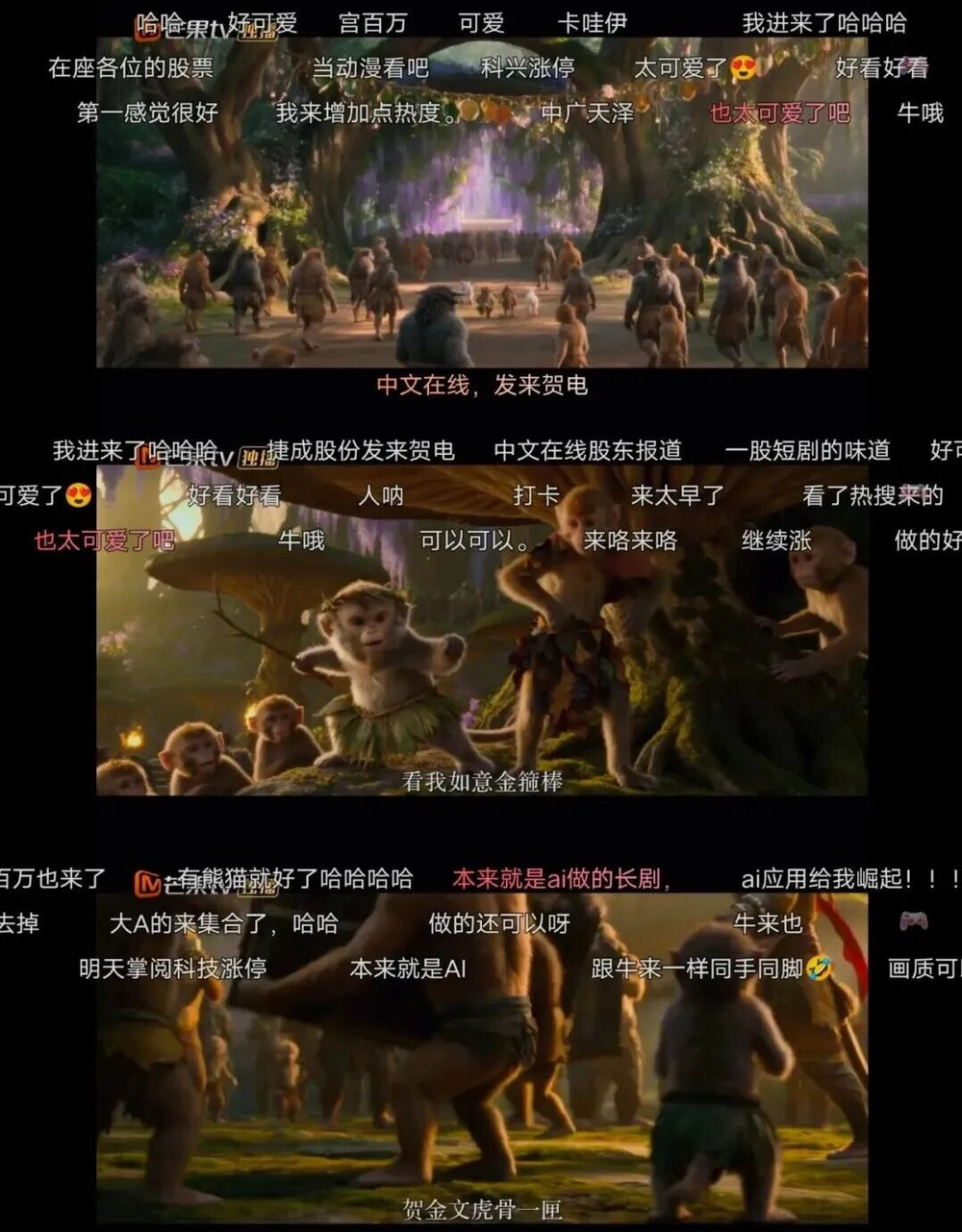
This also explains to some extent why it's necessary to view this round of gains rationally. Because capital markets can reflect expectations for the next few years in stock prices in just one day, but there's a long distance between "possibly owning" and "having already generated profits." The phrase "for the first time" implies room for imagination, but for the content industry, the first AI-produced long drama to be broadcast means the door has been opened; whether subsequent works can attract viewers and generate profits for producers will determine whether there's a viable industrial path behind this door.
Moreover, the AI industry's technological iteration is extremely rapid, and the AIGC workflow established today may be rewritten tomorrow due to upgrades in model capabilities. For now, "Journey to the West" has completed the first step: bringing AI-generated long dramas into mainstream broadcasting scenarios. Next, attention will be focused on whether it can complete the second step - making audiences willing to continue following it; further down the line, it remains to be seen whether MangoTV can turn a one-time project experiment into a stable production capability, ultimately allowing AI content to smoothly enter the company's revenue and profit system.
These two issues may be the distance that AI film and television needs to cross from concept to industry.