
On the evening of August 31, 2026, in Changsha, the country's first AIGC long drama to be broadcast via satellite, "Journey to the West Sequel", premiered on Hunan TV's prime-time slot, with no human actors and all visuals and character portrayals completed by AI.
1,700 kilometers away in Hong Kong, on August 24, Duiba Group's stock price surged 78% in a single day, with its AI short drama business generating revenue of 223 million yuan in the first half of the year, accounting for more than half of the group's total revenue. Meanwhile, in Beijing, "Short Drama Massage for the Brain" recently topped the Weibo hot search list, with Hongguo Short Drama's daily active users exceeding the 100 million mark, and "18-Year-Old Grandma Arrives to Restore Family Glory 4" achieving 176 million views within the platform and 13 billion total series plays, etching the term "addictive drama" into the public's memory this summer.
This month, AI-generated comics simultaneously appeared in three vastly different domains: prime-time TV, the hottest searches on the capital markets, and the screens of ordinary people's mobile phones. They seem to be transforming from a marginal experiment to a mainstream narrative at the fastest speed.
However, the narrative is selective. When platforms tout "creating an AI cartoon for 1,914 yuan," they won't tell you that creators need to spend 45 days revising character facial expressions one frame at a time to make the main character in episode 50 look like the same person as in episode 1. When capital votes with real money, they also won't tell you that behind this AI series that has made it to satellite TV, there are countless loss-making projects that have yet to achieve a viable business model.
The real picture of AI-generated comics is far more complex than the numbers shown on trending searches.
Market positioning, where does AI-powered serialized drama stand
The track is divided, with two sets of content logic.
There is a common cognitive bias in the industry that compares AI-generated dramas with live-action short dramas in the same competitive framework, which is not valid.
Live-action short dramas cater to the desire for instant gratification, with intense conflicts, fast-paced storytelling, and emotional tension created by the actors' performances forming their core competitive advantage. AI-generated comics, on the other hand, provide a visual narrative, presenting scenarios that would be too costly or physically impossible to produce in live-action, such as fantasy battles, post-apocalyptic mecha, or interworld adventures, at the lowest possible cost. The audience profiles, consumption scenarios, and content logic of the two are distinctly different, at least for now.
According to DataEye, in August 2026, the number of AI short dramas released monthly reached 74,313, accounting for 75.4% of Douyin's total new dramas for the month, with a year-on-year growth of over 100 times. However, in the context of the entire short video industry, which produces tens of thousands of episodes annually, AI comics remain a rapidly growing niche market rather than an absolute mainstream dominant force.
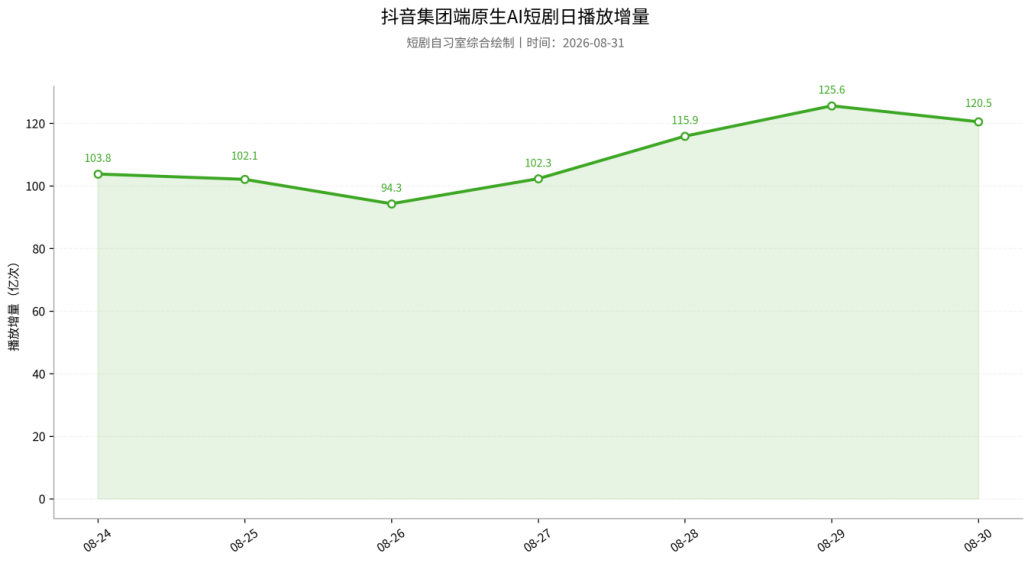
(Image source: Duanju Zixishi)
What's truly worth attention isn't the proportion, but the players entering the field. Tencent, ByteDance, and Baidu have successively increased their investment in the manhua track; Douyin has partnered with Ji Meng AI to launch an AIGC short manhua recruitment plan, with high-quality works eligible to receive up to 5 million yuan in investment per episode, and the daily peak expenditure in the manhua track reaching 30 million yuan. DataEye estimates that the overseas AI drama and manhua market will reach $65 million in 2026, a year-on-year surge of 550%.
AI-generated dramas are evolving from personal creators' self-entertainment to a strategic content supply line for platforms, redefining the industrial standards of short dramas in a different dimension without replacing human-produced ones.
2. The platform is increasing its investment, and production capacity has become a moat.
The platform's strategic inclination is a key variable in understanding the industry's coordinates.
Over the past two years, AI-generated manhua have been quietly growing at a rate of hundreds per month in the two-dimensional sections of Bilibili and Douyin. In 2026, this rate has been suddenly amplified. The monthly number of new releases on Douyin has surged from 655 a year ago to 74,313, representing a growth of over 100 times.
The platform no longer views AI-generated anime as low-cost filler content, but rather as a key part of its core content supply system. The underlying logic behind this shift is production capacity. Traditional anime typically requires 150,000 to 300,000 yuan and a two-to-three month production cycle for an 80- to 100-episode series. In contrast, AI-generated anime compresses the cost of generating images to a negligible level, allowing for more than ten times the content output with the same budget.
In the field of content creation, there often exists a "impossible triangle" of cost, efficiency, and quality.
CICC's analysis provides a more specific perspective: the AI production segment concentrates 70% to 80% of the industry's costs, virtual shooting bases can cut scene setup costs by up to 85%, digital actor original painting modeling costs are reduced by 80%, and special effects production cycles can be shortened by up to 40%.
When AI-generated short dramas can maintain quality above the passing line, high production capacity becomes a moat. The platform uses revenue sharing and traffic policies as leverage, essentially using the lowest cost to tap into the largest content supply pool.
The Cost Ledger: Hidden True Expenditures
On the production side, 1,914 yuan is just the tip of the iceberg.
There are always rumors circulating online about creating short dramas for just 1,000 yuan, and to uncover the truth behind this claim.
The cost structure is the primary entry point for understanding this industry.
We can infer the cause from the effect based on current mainstream workflow calculations. The AI cost for the script stage is approximately 50 to 200 yuan; generating images for a 100-episode anime requires around 800 to 1,500 images, while a standard Midjourney subscription costs $30/month for unlimited image generation, or API-based billing at approximately 0.02 to 0.1 yuan per image, resulting in a total image cost of 20 to 150 yuan; AI dubbing costs around 50 to 200 yuan; editing is primarily labor-time based. If considering only the generation cost, an 80- to 100-episode AI anime can indeed be controlled within 1,000 yuan.
However, this is an idealized calculation, which is the difference between making a short drama and actually completing one. All of this is based on the premise that the prompt is written extremely well, each image can be used once it is generated, and there is no need to repeatedly revise the consistency of the characters.
In practical operation, character consistency is the biggest technical bottleneck. For example, the same main character's face shape may be completely different in episode 1 and episode 10. Solving this problem requires establishing character LoRA, training character models, maintaining asset libraries, or manually retouching each image, but these hidden costs are systematically obscured in the platform's narrative dissemination.
So-called "thousand-yuan productions" are just the tip of the iceberg when it comes to cash outlays.
On the operations side, the actual probability is only 28.7%
In addition to the consistency of characters, there are also more significant implicit costs that have not been taken into account.
The AniShort platform revealed a typical case, where a creator independently produced a 4-minute AI short film "I'm Lying Down in the Apocalypse, My Girlfriend Uses a Mech to Support Me" with a pure generation cost of 1,914 yuan, including 24 yuan for image generation and 1,890 yuan for video generation. The platform promoted it as a benchmark for "low-cost drama production", but another figure was placed in the footnote: the project's gacha success rate was only 28.7%.
This means that 28.7% implies that for every four shots generated, only about one can be used directly. The remaining three may have character facial collapse, action clipping, or scene logic chaos, requiring repeated re-drawing, fine-tuning, or even manual re-painting. For this 4-minute short film, the creator's actual implicit time cost, including prompt debugging, repeated drawing, character consistency correction, and post-editing, is far more than 1914 yuan after conversion.
This constitutes a typical example of AI-manhua personal creators, with extremely low cash costs, extremely high time costs, and extremely narrow monetization channels. The platform's touted "thousand-yuan production of a drama" is technically feasible but not commercially viable.
It only presents the production costs, avoiding the opportunity costs.
If measured by the standard of returning their investment in cash, the success rate of individual creators is around 5% to 8%; if measured by the standard of having a stable monthly income of over 10,000 yuan, the proportion is less than 1%.
What determines success is not the technical aspect of rendering availability, but a comprehensive competition of product selection capabilities, industrialization processes, and cross-platform operation literacy. The weight of choosing the right subject matter far exceeds the level of image refinement; establishing standardized workflows can compress single-episode production time from a whole day to 2-3 hours; while differences in recommendation logic between platforms directly determine whether content can penetrate traffic pools.
AI has lowered the threshold for production, but it has never lowered the threshold for competition.
The length of the variable, from Douyin to satellite TV
Content leapfrogging holds significant implications for the development of long-form AI-generated content.
Competition for AI-generated dramas in the "short" dimension has become increasingly fierce, and the most noteworthy variable in 2026 is its leap into the "long" dimension.
In the past, AI-generated short videos were limited to fragmented forms of 1 to 3 minutes per episode, relying on intense conflict and fast pace to grab attention. Technological iteration is breaking through this boundary. CineART, a film-level AI long video platform under Tianyue Technology, has tested and shown that a single person can independently complete 30 seconds of high-quality content, and the comprehensive cost of a single 1-minute video can be compressed to around 50 yuan.
More noteworthy is the move by long-form video platforms. "Journey to the West 2" is the country's first AIGC long drama to be broadcast on satellite TV, using AIGC to complete the rendering of images and characters, with no human actors involved. The drama is also the first in the country to be produced, reviewed, and broadcast simultaneously after the release of the "Radio and Television 21 Articles". The production team said this model not only shortens the production and broadcast cycle, but also allows for dynamic optimization of plot details based on review opinions and audience feedback.
iQIYI announced it will launch more AIGC-produced works in 2027, with 16 AIGC mid-length dramas already available for revenue sharing. Chief Content Officer Wang Xiaohui offered a telling assessment: long-form dramas and films are the genres where AI penetration will be slowest, and the platform will continue relying on live-action production to ensure quality. For mid-length dramas and web features, however, the company will actively embrace AI, with a focus on stylized genres such as fantasy, supernatural tales, and adventure.
This reveals a key trend, with AI-generated dramas being upgraded from traffic fillers to content assets.
In the era of short dramas, the core value lies in low costs, high production capacity, and rapid iteration. In the era of long dramas, the core value shifts to expanding genre boundaries, reducing trial and error costs, and activating IP reserves. A fantasy long drama with high production costs for live-action filming may only require hundreds of thousands of yuan to produce with AI; a stalled online novel IP can be visualized in AI-animated drama form and go online in just seven days.
This has gone beyond the traditional category of cost reduction and efficiency enhancement, and essentially reconstructed the risk-return formula for the content industry.
Capital Pricing, A Calm Reminder Behind the Craze
Short-drama game concept stocks on China's A-share market strengthened in volatile trading on Aug. 31. Mango Excellent Media Co. hit the 20% daily limit-up, while Rongxin Culture Co., Decai Holdings Co., iReader Technology Co., Huanrui Century Co., Bona Film Group Co. and Zhongguang Tianze Media Co. also closed at limit-up. ChineseAll Co., Jiecheng Holdings Co. and Haikan Holdings Co. followed with gains.
The expansion of content and the turbulence of capital are two facets of the same process.
On August 31, Duiba Group (01753.HK) released its 2026 interim results announcement. The AI short drama business has contributed cumulative revenue of 223 million yuan since its launch in January, accounting for 51.2% of the group's total revenue, and has officially become a strong growth engine for the company. Chinese Online's stock price rose to the daily limit due to the AI short drama business, which overlapped with its reduced losses and going overseas logic. Its 2026 interim report showed that net profit attributable to the parent company decreased by more than 80% year-over-year, with a single-minute production cost decrease of more than 75%. Revenue from short dramas and IP businesses doubled, accounting for more than 70% of total revenue. In the first half of the year, Yuewen Group's revenue from short dramas and AI comics exceeded 430 million yuan, with a year-over-year growth of 2.3 times. Kunlun Wanwei's AI short drama platform had a single-month turnover of over $65 million, with more than 90% of new dramas released monthly being AI-generated.
(Image source: Dui Ba WeChat public account)
Capital markets price in expected discounted future cash flows, not current profits. However, amidst the frenzy, there are also sober reminders. During its stock price surge, Duiba announced that despite revenue growth, the company is expected to remain loss-making, mainly due to the high investment in its AI short drama business, which is still in its early stages of development; Chinese Online was only profitable in the second quarter on a quarterly basis.
This means that the business model of AI-powered manhua has not yet been fully proven, and the capital market's optimism is more a reflection of pricing in trends rather than confirmation of profits.
On the evening of August 31, while "Journey to the West" was airing on Hunan Satellite TV, the creator who spent 45 days producing a 60-episode post-apocalyptic cartoon may have been sitting in front of a computer, fine-tuning the facial features of AI-generated characters frame by frame.
His show did not get broadcast on satellite TV, was not a limit-up stock, and did not even break even.
The story of AI-manhuas is diverging. One path leads to prime-time satellite TV and a frenzy of capital, while the other leads to countless nights consumed by gacha mechanisms. Technology has indeed given everyone a ticket to the table, but the seats at the table have never been occupied solely by creators.
When the platform, capital, and algorithms are all shuffled, what truly determines the outcome may never have been the 1,914 yuan.
Technology has given everyone a ticket to the table, but the outcome of the game has never been determined by the ticket.