
In the US, speaking on behalf of AI, especially for a fee on behalf of AI companies, is becoming a distasteful thing.
A national survey released by the University of Pennsylvania's Annenberg Public Policy Center in August showed that 39% of American adults expected AI to have a negative impact on the US over the next decade, while only 18% held a positive view; 68% believed the government did not regulate AI enough.
The same survey also indicated that the number of people opposed to having a data center built near their homes increased by 12 percentage points over four months, reaching 61%. In another survey released by the Pew Research Center in August, 71% of respondents believed that AI would reduce the number of jobs in the US.
Public sentiment in the US has started to impact AI companies' collaborations with influencers.
Since August, several creators have been boycotted, with some apologizing and others publicly drawing boundaries around their use of AI, from OpenAI's branding journey to Claude, to Byte's Dreamina.
AI is currently the most important story in the US capital markets, and AI companies are among the few clients still spending heavily on traffic. Media interviews with agents indicate that top AI firms are allocating budgets ranging from five to seven figures in dollars to compete for influencers, sometimes seeking to lock in partnerships lasting several months.
AI companies hope to gain public trust through influencers, while influencers need commercial deals to make money, which was originally a mutually beneficial arrangement. Now, taking on the next AI commercial deal also means speaking on behalf of AI and bearing the risk of losing fans, facing boycotts, and damaging their reputation.
Brokers have started to price in this risk, with one revealing that he may add 20% to 30% to the usual quote for a influencer when facing a well-funded large AI company.
AI-generated invoices are now commanding a "public opinion premium".
An ordinary AI business order
It has turned into a moral accusation
In China, it is common for influencers to receive commercial orders from AI companies, with the harshest criticism often being a phrase that roughly translates to "making a mess," and few people demand that influencers publicly clarify their stance due to their involvement with an AI company.
In the US, an AI collaboration is evolving into a moral judgment. Taking money to promote something can lead to criticism, participating in brand events can lead to criticism; even if there's no commercial involvement, simply using ChatGPT at work can lead to being called out by fans.
OpenAI's inaugural brand tour "Summer Club" epitomized a dramatic twist in emotional release for American netizens.
In early August, OpenAI invited around 30 creators to stay at the luxurious Wildflower Farms resort in upstate New York to experience ChatGPT Work, with arrangements including organic meals, beekeeping, and wellness activities.
The influencers documented the trip in the style of typical lifestyle content. Grace McCarrick chatted about her travel experiences while running a bath, and Nat Lucy captured footage of a deer passing by outside the cabin.
The videos themselves drew a lukewarm response. Early in the controversy, McCarrick's video had fewer than 300 likes, and Lucy's video had under 15,000 views. Yet two critical videos about the event amassed a combined view count exceeding 500,000.
To some, it was a lighthearted, dignified brand outing, but to critics, the luxury resorts, scenic landscapes, and OpenAI logos stitched together made for a tone-deaf PR stunt.
The comments section didn't follow the influencer's discussion about ChatGPT Work. The approximately $2,000 per night hotel room was perceived as compensation for promoting the AI company; the green space photographed by Lucy was also sarcastically remarked as suitable for building a data center.
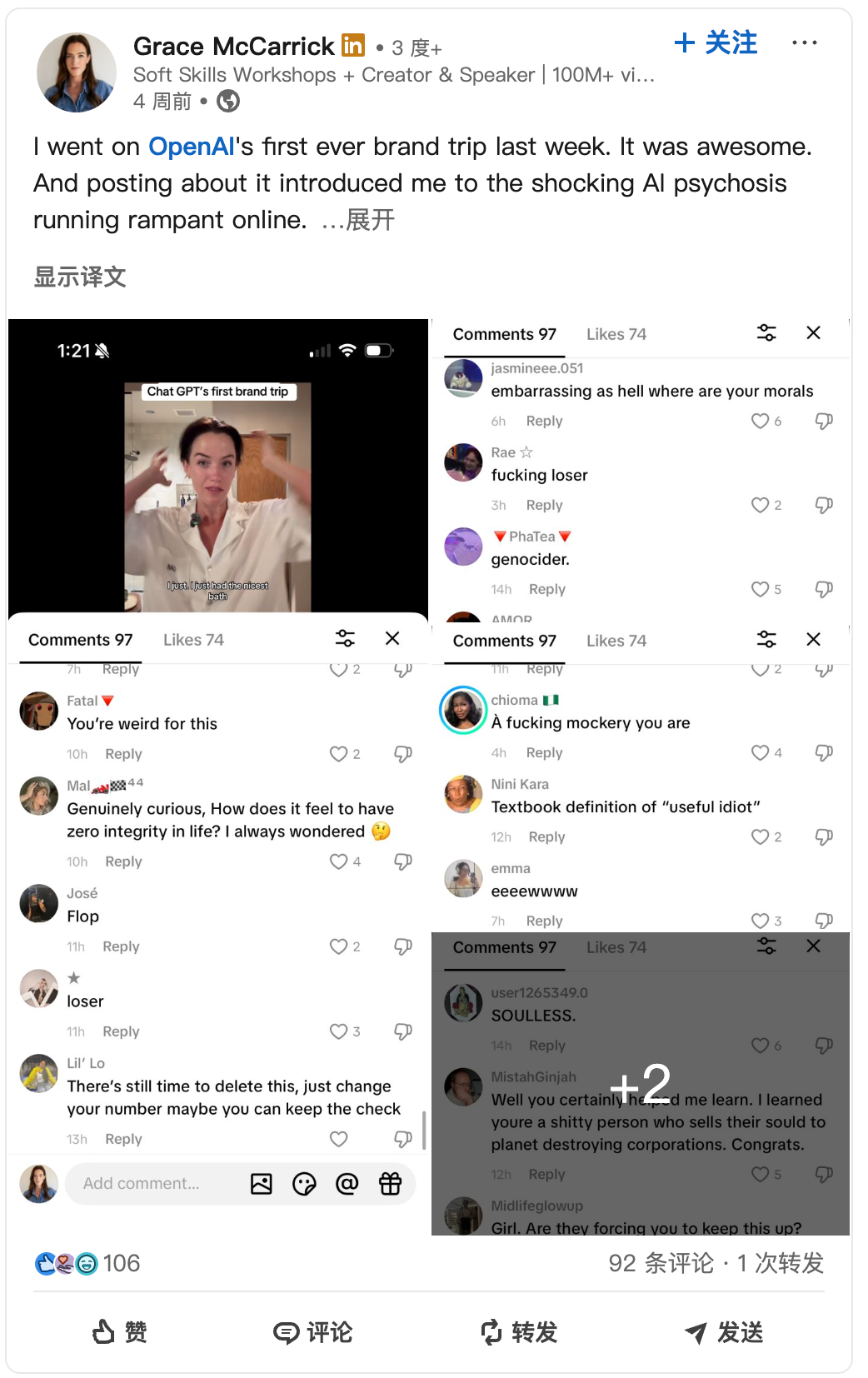
McCarrick responded afterwards, saying she had no idea the event would be controversial and thought some critics overreacted to AI. She also questioned why these individuals, who use smartphones, Amazon, Instagram, and TikTok, place moral responsibility solely on the influencers who attended the event.
However, this response did not change the direction of public opinion, and instead led netizens to continue questioning: why a creator who focuses on workplace communication was not prepared for AI controversies before promoting OpenAI.
In the current wave of anti-AI sentiment, the debate has been reduced to a single question: whether you stand with AI.
Creator Emma Orhun, formerly of Shopify, faced backlash for promoting Claude, and subsequently had to clarify that while she accepts AI-assisted programming, she opposes AI replacing human art creation.
Science communicator Hank Green didn't even take on a commercial project, but was still questioned by fans for losing his personal voice after using ChatGPT more frequently to find and organize materials while making videos. Green later apologized and established stricter rules for his use of AI.
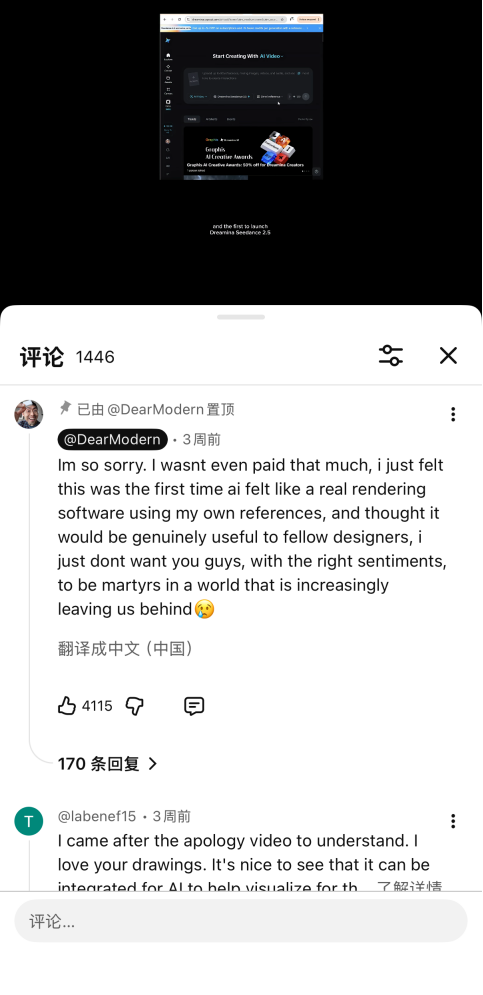
Even ByteDance's Dreamina has been affected by this sentiment in the US, with design blogger Cliff Tan emphasizing in ads that he dislikes using AI as a substitute for thinking, and only uses it to convert hand-drawn floor plans into animations. Some commenters still demand that he "not sell himself out to AI".
Tan subsequently apologized and commented under the original video: "I didn't even get that much money."
Money is earned through advertisements, but the criticism celebrities receive is borne on behalf of the entire AI industry.
Americans have already become averse to AI,
AI companies have also been adding fuel to the fire
AI is becoming a pillar of U.S. economic growth — and drawing new fault lines over who benefits.
The government and capital markets view it as the foundation for economic growth and national competitiveness, but ordinary people are more concerned with income, employment, electricity bills, and pollution.
The St. Louis Fed calculated that AI-related investments, including software, research and development, information processing equipment, and data centers, contributed 39% to the growth of US real GDP in the first three quarters of 2025.
But the more AI investment grows, the more data centers need to be built. The resulting strain on electricity and water supplies has pushed opposition to AI beyond the internet and into local policy. The Wall Street Journal reported in August that Texas Governor Greg Abbott, who had declared the state would become an "AI development hub," has suspended approvals for a large number of data center projects due to power and water concerns.
Another source of pressure comes from employment. Large-model vendors keep emphasizing that AI can improve efficiency and replace some jobs, while tech companies simultaneously cut headcount and channel more resources into AI. These moves reinforce a growing impression: AI companies capture the gains, while employees bear the costs.
Silicon Valley's image is also plummeting. AI companies possess funding, technology, and political influence, but the narrative that "AI innovation will inevitably bring progress" can no longer automatically garner public goodwill.
Just as the backlash continues to build, AI companies are engaging in over-the-top tactics, attempting to reinforce the impression that AI is ubiquitous and inevitably entering every aspect of people's lives. Influencer promotions and advertisements are emerging one after another, but the excessive efforts are instead constantly reminding audiences that the things they dislike are continuing to expand.
Of the 66 ads that aired during the 2026 Super Bowl, 15 promoted AI companies or were made using AI, according to Meltwater, with nearly half of related discussions being negative, as audiences began to express fatigue with "yet another AI ad".
Amazon's Ring also promoted its AI-powered pet-finding feature during the Super Bowl, but was questioned by viewers for packaging community surveillance by showcasing the simultaneous activation of all community cameras.
Anthropic and its founder Dario Amodei have long been industry outliers, developing AI while openly emphasizing its risks, safety, and responsibility, but this contrarian approach can also backfire.
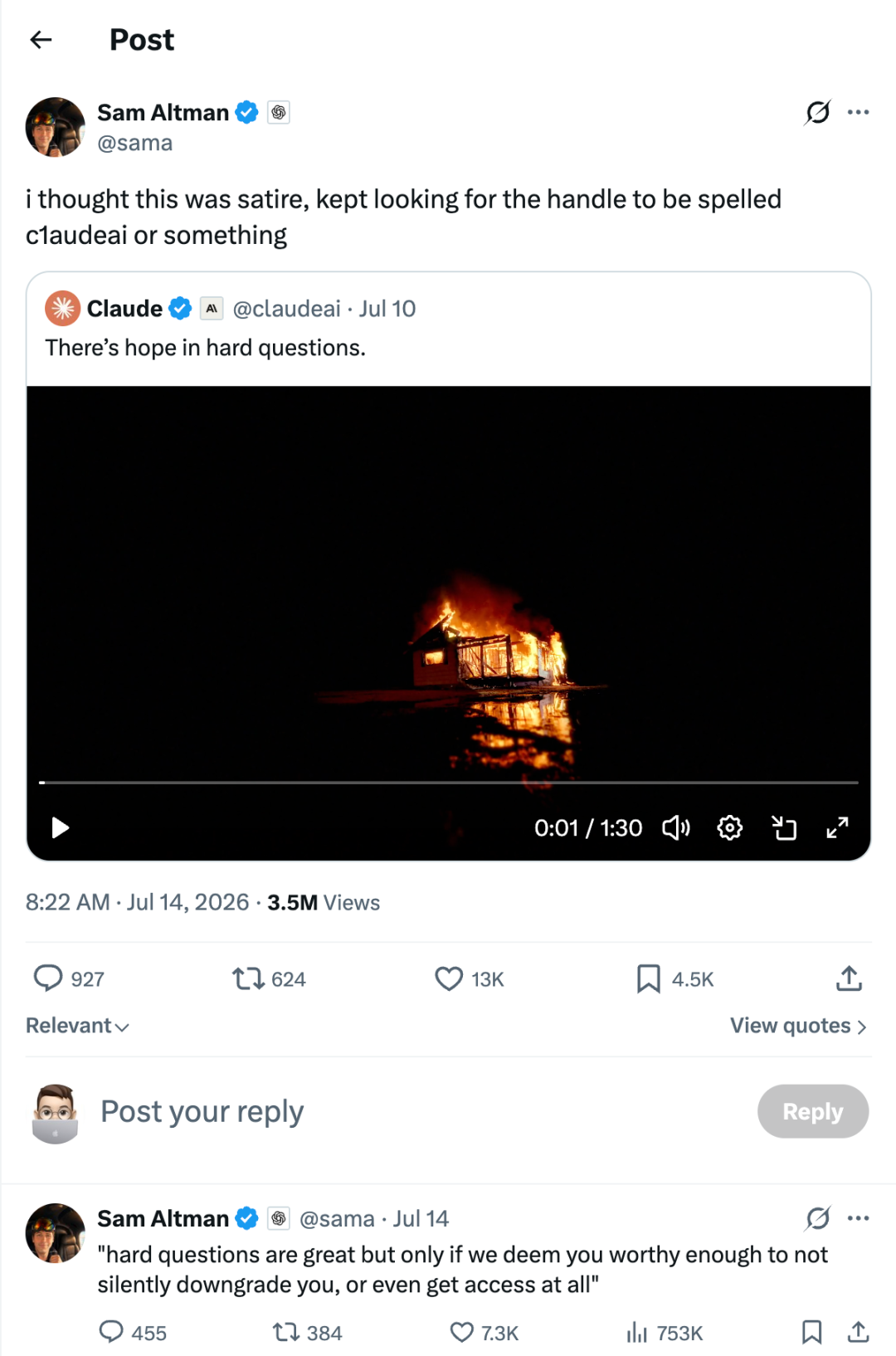
In July, Anthropic launched a brand ad called "There's Hope in Hard Questions" during the World Cup. The commercial jumped from images of burning houses, facial recognition, homelessness, and rows of tombstones to those of a mother and daughter, whales, and medical workers, constantly questioning whether AI can be trusted without providing any answers. Sam Altman mocked that he initially thought he was watching an ad made by a satirical account.
Some AI companies have even started using social media's outrage mechanism to drive traffic to their marketing efforts.
In late August, a serialized Instagram saga dubbed "Oreogate" went viral. A creator posted 13 videos chronicling a blowup in a kindergarten parents' group chat over a child bringing Oreos to school, then used AI music tool Suno to turn the chat logs into songs. As the storyline escalated, viewers picked sides and argued in the comments. The first video drew more than 10 million views.
It was later discovered that the creator was a paid partner of Suno. She refused to clarify whether the chat records were true, Suno acknowledged a business partnership between the two parties, but denied involvement in designing the plot.
A product that initially gained popularity through controversial and often misleading content ultimately became an advertisement for an AI product.
The more AI vendors try to make their technology seem natural and ubiquitous, the more they push the public's biggest concerns—privacy, job losses, and fake content—back into the spotlight.
Creators can't ignore AI companies' budgets, nor can they avoid the AI tools already embedded in their creative and office workflows.
Rejecting commercial orders would result in lost revenue, while accepting them would mean shouldering the reputational risk for the manufacturers.
It's hard to avoid AI, but it's becoming increasingly difficult to secure AI-related business orders.
Those who can't stop AI are starting to blockade those who use AI
A recent commentary in The Guardian pointed out that the US backlash against data centers and large tech companies is driven by a broader sentiment: an increasing number of people feel that major decisions affecting their lives are being controlled by a small number of people with capital and technology.
Ordinary people can decide whether to use ChatGPT today, but they cannot decide what training models companies use or where data centers are built, and it is also difficult for them to prevent their jobs from being rearranged.
They do not necessarily reject the convenience brought by AI, but rather resent the fact that they cannot decide how AI enters their lives.
Unable to stop the expansion of data centers or influence corporate layoffs, the comment section has become one of the few places where people can still express their discontent. As influencers openly show their faces and rely on word of mouth, making them more accessible than the management of AI companies, they naturally become the first to bear the pressure.
Social platforms amplify this pressure. Research from institutions such as Northwestern University's Kellogg School of Management has found that social media users often overestimate the extent of others' anger. The more intense the expression, the more engagement it gets, and the more likely newcomers are to regard it as the normal tone of the comments section.
Thus, "I don't like this product" is escalated to "you've betrayed your fans"; and accepting the next AI commercial order will also be seen as supporting the entire AI industry.
Influencers also need to make a living, and the saying "wealth is to be found in risky endeavors" rings true. Either they reject opportunities due to high risks or, if they choose to take them on, they factor in potential losses of followers and damage to their reputation when determining their fees.
AI companies need to borrow the real image and fan trust of influencers to endorse themselves, but this cooperation will also consume the trust of the influencers.
So-called "public opinion premium" refers to influencers either refusing to take on a task or demanding that AI companies pay more to compensate for the risk.
Raising prices can compensate for a one-time reputational risk, but whether this business can sustain itself in the long term remains to be seen.