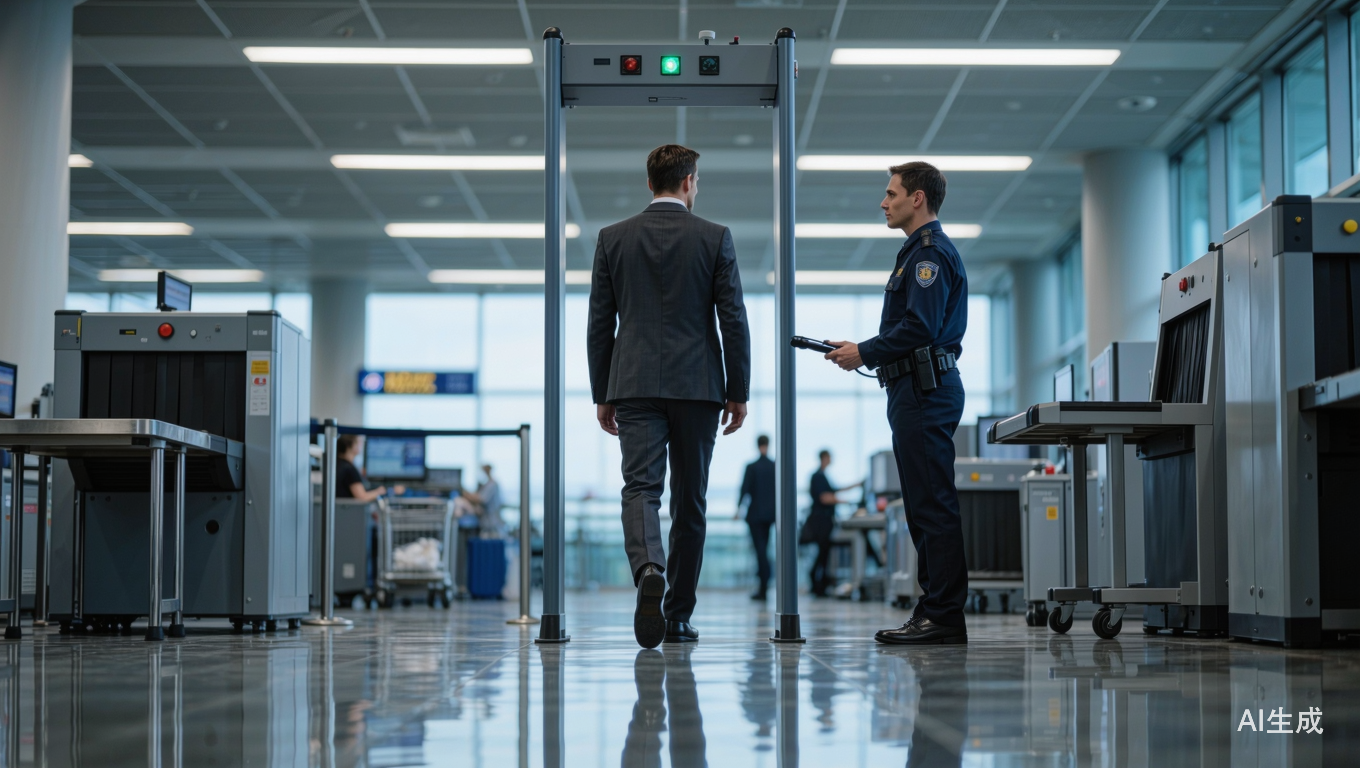
I often travel for work, taking flights and going through security checks. In the past, I thought that if I passed through the security scanner without triggering an alarm, I could proceed directly without needing a manual check. Most of the time, the security equipment would beep, usually due to my belt, at which point the security inspector would conduct a manual check.
Sometimes I pass through security checks without triggering an alarm, and yet I am still subject to manual inspections, but such situations are extremely rare, whether domestically or internationally.
On August 26, I departed from an airport in a city in East China, which ranks second in the province in terms of GDP, with over 500 billion yuan last year.
I was wearing a T-shirt and beltless sweatpants, and sneakers, the security scanner didn't go off, but the security inspector still asked me to come over for a particularly thorough check.
He asked: Is an inspection still necessary if no police report is filed?
She replied: 100% must be inspected.
After the inspection, I casually asked Qianwen, "When going through security checks at the airport, if there's no alarm at all, is a pat-down still necessary?"
Qinwen response: Normally, if the security scanner does not sound an alarm when you pass through, security personnel do not need to conduct a manual body search on you.
According to the Civil Aviation Security Check Rules and related security screening operational standards, the specific procedure for personal inspections is as follows:
Routine security checks: Passengers go through security scanners (such as metal detectors or millimeter wave scanners) in sequence. If the device does not sound an alarm, passengers are usually allowed to pass through directly;
Random checks: Even if the equipment does not sound an alarm, security inspection agencies still have the right to conduct random checks on passengers who do not trigger an alarm, a mechanism established to guard against unknown risks, rather than targeting individuals.
Mandatory pat-downs are only conducted when an alarm is triggered by a security scanner, at which point security personnel use a handheld metal detector for a re-check or a manual body search to rule out any suspicious items before allowing passage.
I read a few sentences to the inspector, stating that according to the Civil Aviation Administration's security check rules, if the security equipment does not sound an alarm, passengers can usually pass through.
She insisted that we must test 100% here.
I said seriously, your regulations are different from those of the Civil Aviation Administration, which is a problem.
She said you can ask our leaders.
Her leader, who was not far away, walked over. As soon as I opened my mouth, he said, "I know the rules you're talking about, but our requirement here is that everyone must be inspected."
I helplessly walked towards the gate, still with some time before boarding, and felt that I had to get to the bottom of this matter.
According to the Civil Aviation Security Inspection Rules, which belong to the rules of the Ministry of Transport, Article 32 states: Passengers should pass through personal security inspection equipment in sequence to undergo personal checks. For passengers who trigger an alarm when passing through the personal security inspection equipment, civil aviation security inspectors should use repeated passes through the personal security inspection equipment or manual personal checks to re-examine them, and only after ruling out doubts can they be allowed to pass. Passengers who do not trigger an alarm when passing through the personal security inspection equipment may be subject to random checks. Before undergoing personal checks, passengers should remove any items they are carrying that may affect the inspection results, including metal objects, electronic devices, and outerwear.
For passengers who pass through security scanners without triggering an alarm, random checks can be conducted, which does not mean that 100% of them must be checked. However, Qianwen's statement that "if the device check does not trigger an alarm, passengers can usually be cleared directly" is also not written in the rules.
According to the Regulations of the People's Republic of China on Civil Aviation Security, which is a State Council decree, Article 27 states: Security inspection personnel must verify passengers' tickets, identification documents, and boarding passes, and use instruments or manual checks to conduct security inspections on passengers and their luggage, and may conduct strict checks when necessary. Passengers who have undergone security checks should wait to board in the isolation area.
It still can't resolve my doubts.
Further checking the higher-level Civil Aviation Law of the People's Republic of China, Article 165 states: Passengers, baggage, and cargo shall be subject to security checks, except where exempted as stipulated by the State Council. ... The procedures and standards for civil aviation security checks shall be formulated by the civil aviation authority under the State Council.
This again falls under the jurisdiction of the civil aviation authority, namely the Civil Aviation Administration of China and the Ministry of Transport, which would still be governed by the Regulations on Civil Aviation Safety Inspection.
I went back to the security checkpoint and communicated again with the person in charge of security, telling them what I had found, saying that 100% manual re-inspection of people was definitely a problem, and if manual re-inspection was required for every person, then what was the point of using equipment?
He said that is our rule.
I'm asking if you can show me the regulations.
He pulled out a document and showed me a page with "Post Operation Standards and Requirements", which included a clause stating: 100% personal checks must be conducted on individuals passing through the security gate. When using a handheld metal detector in conjunction with manual checks, attention should be paid to the effective coordination between the hand and the handheld metal detector. Wherever the handheld metal detector is used, the security checker should use their other hand to perform touching, pressing, and squeezing actions, ensuring that no suspicious points are overlooked. If any suspicious points cannot be eliminated, they should be reported to the team leader for handling.
I say, since that's the case, the regulations should be posted so passengers can see them clearly.
He explained that from the provincial airport management group (group level) to the airport (company level) and down to the grassroots level responsible for security checks, there is an internal regulation requiring 100% compliance, which is not publicly disclosed.
I consulted a veteran journalist who has covered the civil aviation beat for over 20 years, asking whether this practice is reasonable. The answer I received was that "some localities are implementing elevated security screening procedures," similar to how certain places operated during the COVID pandemic.
In recent years, there have been numerous debates surrounding the increased frequency and complexity of security checks at certain airports and subway stations, such as the requirement for security checks before entering terminal buildings and the use of handheld devices to scan each subway passenger. Although security equipment and smart security technologies are constantly being updated, with airports frequently updating their devices, the security check process has not become simpler or more convenient.
I'm concerned that the arrangements are still not thorough enough, so I asked Dou Bao: What are the systems of the Civil Aviation Administration of China regarding aviation safety inspections?
This discovery also includes a *Civil Aviation Security Inspection Manual*, which serves as the operational细则 for the *Civil Aviation Security Inspection Rules* and functions as an internal operational management document for airport security inspection agencies nationwide. Each airport's security inspection agency must develop its own operational management documents based on this manual, which serve as the direct basis for on-site operations.
This manual is not publicly available on the internet, but can be viewed through some online libraries. In the "Personal Security Check" section, there is a provision that states: for passengers who trigger an alarm when passing through security checkpoints, they should be subjected to repeated security checks or inspected using a handheld metal detector or manual body search to rule out any suspicious items before being allowed to pass.
After doing so much sorting, I feel exhausted. Often, it's not about solving the problem, but rather just understanding the problem itself, which can be very difficult.
But I have also come to a realization. "Without rules, there is no proper order" emphasizes that the behavior of citizens and enterprises must be in accordance with the law. "Anything not prohibited by law is permitted" emphasizes the freedom and protection that citizens and enterprises should have. However, in reality, there are many layers of rules from top to bottom, some of which are public and some of which are not. The freedom you think you have is often subject to discounts by various inspectors, who are also acting within the bounds of regulations.
Regarding my concern, "If the security equipment does not sound an alarm, do passengers still need to undergo manual checks?"
There is still no complete answer.
Supplementary note: On the afternoon of September 1, departing from Pudong T2, the security scanner did not trigger an alarm and I passed straight through. I also specifically asked the security screener and confirmed that no additional manual check was required.