According to LatePost, Moonlight Entertainment has confidentially submitted its A1 filing to the Hong Kong Stock Exchange, formally initiating the Hong Kong IPO process. The A1 is one of the formal application forms submitted by companies when applying to list on the Hong Kong Stock Exchange.
At almost the same time, it is also moving forward with a new round of financing at a pre-investment valuation of $50 billion, which is likely to be Kimi's last private fundraising before its IPO.
When these two moves are considered together, the situation is not simply "another major model company is about to go public".
2026 is likely the last IPO window for independent large model companies to price based on tech dreams.
Let's review what happened this year.
On January 8, Zhi Pu was listed on the Hong Kong Stock Exchange. The next day, MiniMax went public. On June 1, Anthropic secretly submitted a draft S-1 registration statement to the SEC, with plans to list as early as the end of September or early October. On June 8, OpenAI also secretly filed its IPO documents, but later leaned towards delaying its listing until 2027. On June 12, SpaceX officially landed on Nasdaq. Now it's Kimi's turn.
The primary market can still price Kimi based on the "fundamental model of what it will become in the future." However, once the listing documents are disclosed, the pricing will enter a different paradigm. The people who decide its value will shift from a few long-term private equity investors to institutions and individual investors in the public market.
The $50 billion valuation in the last round before listing may be the last time Kimi's valuation is mainly determined by people who believe in its future.
How Prices Got Pushed Up Over the Past Three Years
From 2023 to 2026, with each round of price increases by independent foundation model companies, what buyers were actually purchasing kept changing.
The earliest purchase was a judgment: that large models would become the next-generation computing platform.
At that time, many companies didn't even have a real product, and valuations were mainly based on the team, the direction of the model, and who might be the first to launch.
Dark Side of the Moon was founded in April 2023 and secured more than $200 million in angel funding two months later, with a post-investment valuation of $300 million.
Later on, the market started to buy into the capabilities of the models.
Those closer to the frontier, and those climbing the rankings faster, command higher valuations. In February 2024, Alibaba led Moonshot AI's Series A+ round, raising over $1 billion at a valuation of roughly $2.5 billion. By the Series B round in August of the same year, the valuation had reached $3.3 billion.
Then came users, APIs, and agents, with capabilities being invoked and paid for, and products finally having quantifiable value.
In the most recent year, valuations have incorporated yet another layer of a larger presupposition:
Today's large model companies will become the platform companies of the AI era.
Kimi's fundraising trajectory this year is almost exactly the shape that emerges when those assumptions keep getting marked up.
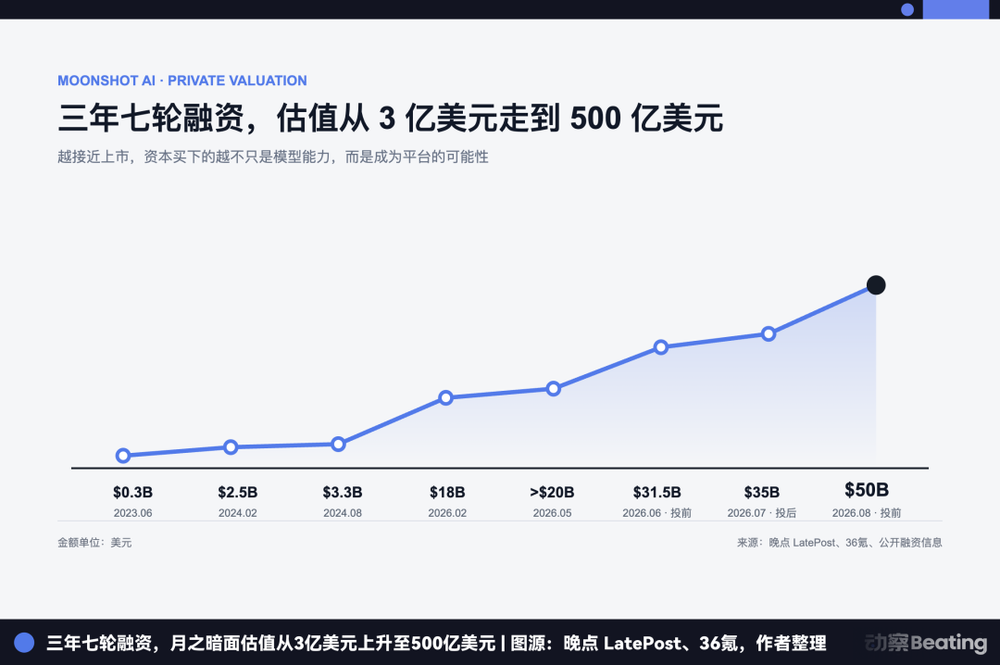
From January to February, the company completed three consecutive rounds, with its valuation climbing from $10 billion to $18 billion. In May, it raised approximately $2 billion more, pushing its post-money valuation past $20 billion. A new round launched in June at a pre-money valuation of $31.5 billion. On July 29, the Series F closed, raising over $3.5 billion at a post-money valuation of roughly $35 billion. A week later, the Series G kicked off at a pre-money valuation of $50 billion.
Prices are even more exaggerated on the other side of the ocean.
Anthropic completed its approximately $30 billion Series G financing in February, with a post-investment valuation of $380 billion. On May 28, it raised an additional $65 billion in its Series H round, increasing its post-investment valuation to $965 billion, surpassing OpenAI's valuation of around $852 billion for the first time.
The most distinctive aspect of this pricing approach is that it does not require today's profits to justify everything, nor does it even require today's revenue to be commensurate with today's valuation, as long as investors believe that only a few fundamental model companies will ultimately remain, they can place their bets on the endgame in advance.
Over the past three years, valuations of large-model companies have consistently outpaced their business models. What capital is really buying is the "what if it wins" scenario.
The question used to be who would win, but now the question is becoming what kind of business they will do after winning.
Model Scarcity Is Over
Whether the $50 billion ultimately holds up comes down to the simplest of questions:
What Kimi has in his hands is something that others can't take away in a short period of time.
In recent years, beneath the high valuations of large models has been a tacit assumption that the capabilities of the models themselves are assets.
Few people are capable of training frontier models, the capability gaps between models are significant, and the barriers to entry are high enough that simply owning a sufficiently powerful model can, in itself, constitute a large portion of a company's value.
By 2026, the gap between leading models is becoming increasingly difficult to sustain over the long term. For ordinary users, the perceived difference between the top-ranked model and the third-ranked one is also shrinking.
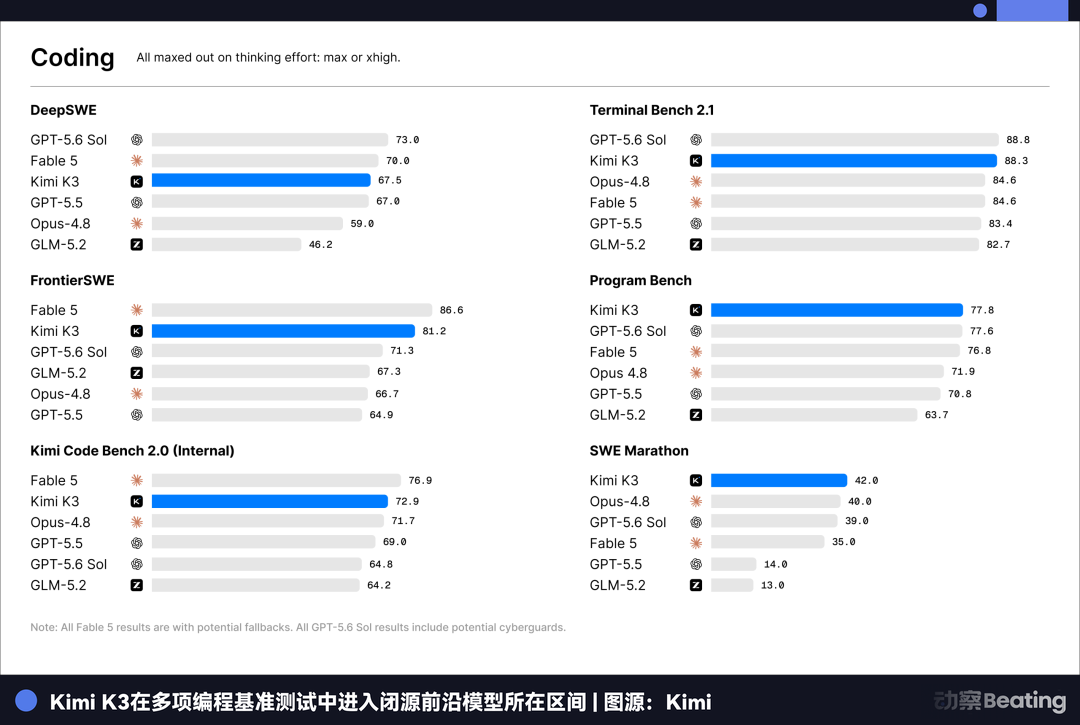
The gap between open-source and closed-source models is closing faster than ever. When K3 was released, it marked the first time an open-source model outperformed a closed-source one on Code Arena. Over the past year, such milestones have become increasingly common.
The lifespan of a single model is also getting shorter.
Today's frontrunner in tech news may hold only a half-generation edge a few months from now. Meanwhile, inference prices keep sliding. Agents have further reshaped the relationship between users and models. What users ultimately care about is whether the task gets done—not necessarily which specific model is running behind the scenes.
But that doesn't mean models have become worthless. Zhipu raised its API pricing by 83% in the first quarter of this year, and call volume actually grew 400% instead. Some research reports interpret this as evidence that industry pricing is shifting from traffic-based consumption to monetizing computing power value.
Being able to raise prices without scaring off customers is a very strong signal in any mature industry. So, the more accurate change is that scarcity is shifting.
In the past, what was most scarce was having "a very strong model", but now the capability of the model has not lost its value, it's just that it no longer automatically equals company value. Having a cutting-edge model is changing from being the conclusion of valuation to being the starting point of valuation.
Chinese Peers Begin to Diverge, and That's Good News
Let's take a look at what's supporting a long-term war effort for several leading Chinese companies.
Kimi is a model, self-owned product and agent that relies on independent financing to maintain cutting-edge research and development.
MiniMax places greater emphasis on multimodal capabilities and overseas revenue, with a broader product matrix. Like others, it remains an independent company that must address its own funding needs.
Zhipu is taking a different path. With its focus on B2B, government and enterprise clients, and MaaS, its business structure more closely resembles a model platform and enterprise AI provider.
Looking further aside, Bytedance and Alibaba are essentially a different class of players. Bytedance has Douyin's Douyin Box and Seed, backed by a massive advertising and content cash machine. Alibaba's Qwen can make long-term investments, open-source, and lower prices because the model can ultimately bring value back to Alibaba Cloud and the entire ecosystem.
For independent model companies, the model war is a matter of the company's survival. For large manufacturers, models can be a cost center for a long time.
Large companies can even accept that the model itself may not be profitable, as long as it can defend their larger businesses in areas such as cloud services, advertising, e-commerce, content, and office software.
Independent companies lack this buffer layer; if they cannot generate sufficiently strong cash flow quickly, their path options are actually quite limited.
Continue raising capital, secure a major strategic investor, or take the company public.
Kimi is now taking the third path. Two companies have already gone down this route ahead of it this year.
Zhipu listed on January 8 at an offer price of HK$116.20, rising 13% on its first trading day. MiniMax listed on January 9 at HK$165, surging 109% on debut. By June 8, both companies had been added to the Hang Seng Tech Index.
The two companies are solving the same problem: how to translate burned R&D spending into a revenue curve that public markets will believe.
Zhipu's approach is closer to selling capabilities to companies that can calculate the returns, while MiniMax is more focused on scaling products, users, and overseas markets first.
If we turn the clock back to 2025, the latter answer largely aligns with the entirety of China's internet experience over the past two decades.
In the mobile internet era, users themselves are assets. As the user base expands, customer acquisition and infrastructure costs can be spread thinner. Every new user that comes in represents future revenue potential—from advertising, memberships, transactions, and more.
Large language models, however, are different. Each additional user opening a dialog box adds to the computational load in the background. Scale does bring efficiency gains, but the electricity costs and depreciation of GPUs won't be diluted by a larger user base.
Previous-generation internet companies were accustomed to treating users as currency. This generation of model companies has suddenly discovered that the exchange rate of that currency has shifted.
The market has begun to differentiate the quality of revenue, and even after making that distinction, it remains willing to assign a high valuation to the industry.
Zhipu's MaaS API annual recurring revenue reached roughly 1.7 billion yuan as of March, a figure that contrasts sharply with the hundreds of billions of Hong Kong dollars in market value assigned to the company.
No one is actually valuing this company on its 1.7 billion yuan in revenue. The market is still paying for the future — it's just that now, it's demanding that future begin to take shape.
The institutional transition has already begun, but it is far from complete.
This is the timing Kimi is most eager to meet right now.
Capital Markets Price the Future in Advance—Not for the First Time
The first point of comparison is the internet of the 1990s.
When Amazon went public in 1997, it was, of course, not yet the behemoth spanning e-commerce, cloud computing, and logistics infrastructure that it would later become.
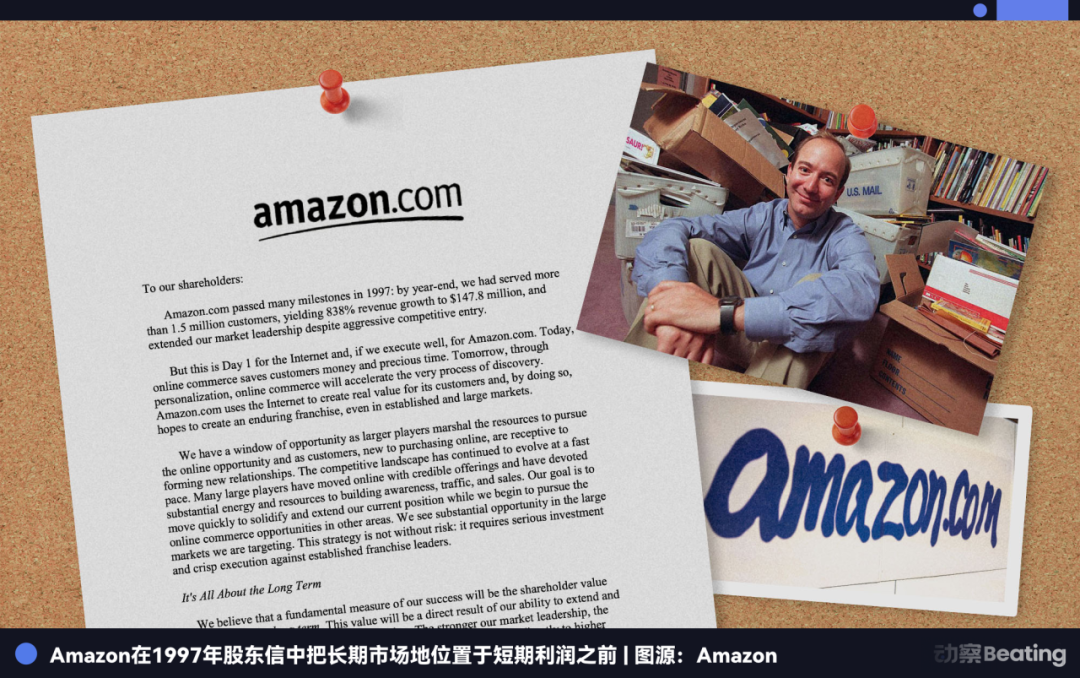
The market is pricing in a future. The internet will transform commerce, online transactions will expand, and the digital world will ultimately give rise to a handful of super companies.
Many internet companies went public while their business models were still in flux. The capital markets gave them a window of time, allowing them to stake out their positions first and prove their profitability later.
AI today bears a clear resemblance to that earlier phase, but there is also one very significant difference. Many internet businesses benefit from declining unit service costs as they scale. AI, by contrast, still carries a heavy burden of real computing costs.
The more users a company gains, the more compute cards, the larger the data centers, and the greater the electricity consumption it requires. So sooner or later, public markets will scrutinize the quality of growth more closely than they did with the previous generation of the internet.
The second reference point is closer: biotech. Many biotech companies go public before their core drugs have even been approved. The market is willing to price in R&D capability, pipelines, and probability of success. When the Hong Kong Stock Exchange introduced Rule 18A in 2018, it was doing something similar—allowing companies without commercialized products to access public market financing ahead of schedule.
Foundation model companies and biotech share a common trait: R&D burns through cash at breakneck speed, while outcomes remain highly uncertain. Today's most valuable assets may still be a cohort of engineers, a set of training methods, and a generation of technology that has yet to be fully commercialized.
There's a more recent example. Around 2021, the previous generation of AI companies—SenseTime, Megvii, CloudWalk, and YITU—also caught a window when investors were willing to pay for future promise.
After SenseTime's listing, its market value briefly exceeded HK$300 billion, with the market at the time equally convinced that AI would become infrastructure.
But the problem for that generation of companies was that revenue was hard to decouple from a project-based model. Contracts were signed one by one, systems delivered one at a time, and staff followed the projects. Margins were often eaten away by customization and labor costs.
Foundation model companies are indeed different this time around. APIs, subscriptions, and token-based billing all naturally lend themselves to recurring revenue, which means a valuation framework for large model companies is now being forged.
But once this language system truly matures, the market will no longer be as forgiving as it is today.
Now let's revisit that $50 billion. There's no need to rush into calculating the price-to-sales ratio, nor is it necessary to immediately judge whether it's expensive or cheap.
First, consider what this price demands:
Kimi's model capabilities need to remain in the top tier over the long term.
The product needs to evolve from a high-frequency AI tool into a stable entry point.
Agents will drive new monetization and retention.
Enterprise and API revenue must continue to scale up.
Inference costs must keep falling.
Revenue growth must at least outpace compute consumption and R&D investment over the long term.
Most importantly, today's model capabilities must not depreciate sharply six months from now due to open source, price wars, and technological iteration.
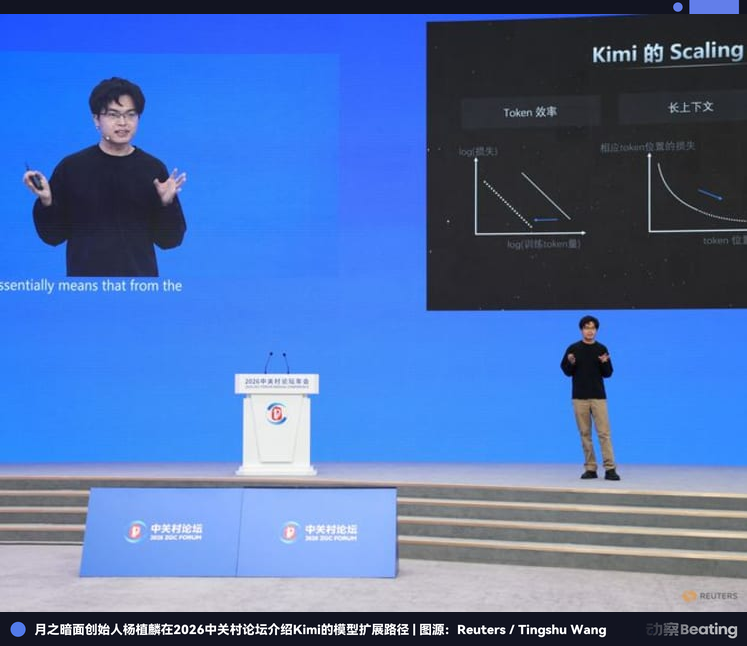
Kimi has already provided part of the answer.
Annual recurring revenue surpassed $100 million for the first time in March, reached $200 million in May and exceeded $300 million in June.
In B2B revenue, API accounts for roughly 70%. The Kimi Hosted Agent platform is also being rolled out across enterprises, with the goal of embedding the model directly into workflows such as office operations, R&D, and investment research.
After the release of K3, Huang Zhenxin, head of enterprise business at Moonshot AI, noted that market demand for K3 has far exceeded expectations since launch, putting severe strain on computing resources — a "happy problem" to have.
That's good news in a tech team's weekly report. In an earnings report, the cost column sits right next to it.
This is precisely the clearest line between two pricing systems.
In the primary market, one could argue that if Kimi ultimately becomes the next-generation AI platform, $50 billion might prove cheap.
But the public markets will ask: how much more money will you need to spend, and how long will it take, before you can grow into a company that is truly worth $50 billion?
Capital markets are usually most generous not when a technology has already been proven.
It is precisely those years when everyone has already concluded that it will change the world, yet no one knows who will ultimately profit from it.
In those years, the boundaries of every company were blurred. Amazon could be imagined as the future commercial infrastructure. A biotech firm could hold a market value of several billion dollars before its drug had even reached the market.
After 2023, large model companies were given the same period of time.
Model capabilities can be directly converted into valuation, user growth can be converted into valuation, and the potential of agents can also be converted into valuation. As long as the future is big enough, much of the revenue that hasn't materialized yet can be priced in ahead of time.
The problem is that every wave of technology eventually reaches the same moment.
One day, the market stopped asking how important a technology was and started asking how much revenue each company could capture from it.
The internet industry ultimately settled into advertising, e-commerce, subscriptions, and cloud computing. Biotech developed clinical staging and pipeline valuation. The previous generation of AI was ultimately repriced by project revenue, gross margins, and receivables cycles.
Large language models are now approaching their defining moment.
Zhipu and MiniMax have already laid their first financial reports on the table before the public markets. Anthropic and OpenAI are standing at the door. Kimi, holding a $50 billion private placement offer, has also reached the threshold.
In time, the very term "foundation model company" may lose its meaning as a valuation metric.
Some will be pigeonholed as enterprise software vendors, others will morph into consumer internet gateways, still others will become cloud infrastructure, and the rest will be left with nothing but an expensive R&D team.
By then, the market will no longer assign them all the same valuation simply because they all train large models.
What is truly disappearing is the era when "as long as you had the potential to become the future, you could be priced as the future from the outset."
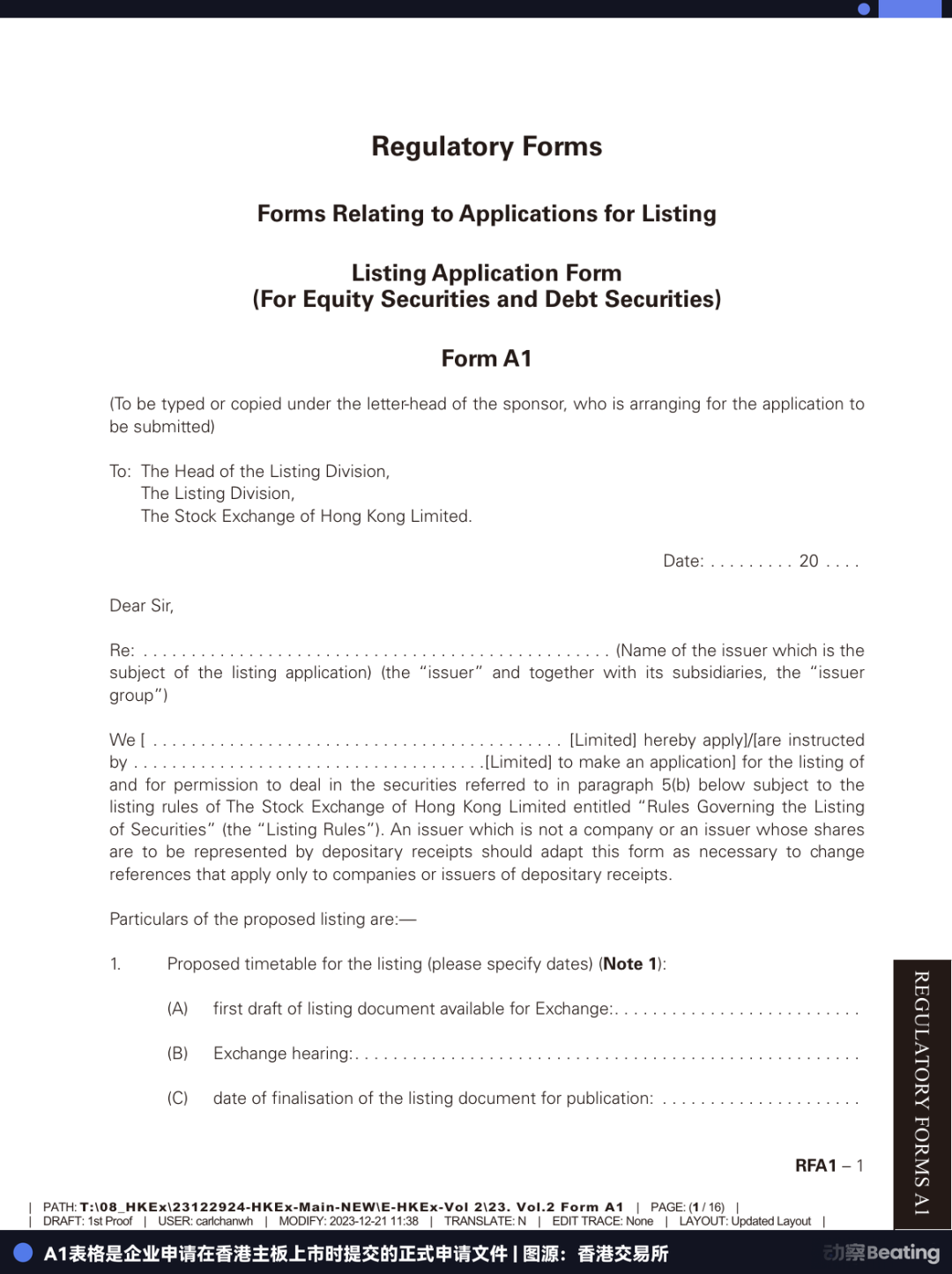
Kimi's A1, rolling out now, is a play for this window of time.
Once public markets truly learn to price models, agents, tokens, inference costs, and revenue quality item by item, the dreams will of course still be worth something.
But from then on, a calculator would sit beside the dream.