
In recent years, spirits giants including Pernod Ricard, Diageo, and Rémy Cointreau have successively launched new transformation plans covering organizational restructuring, strategic optimization, asset divestitures, and workforce reductions. The scale and scope of these adjustments are unprecedented in the past decade.
Turning the elephant affects the whole body — each company's strategic choices reflect its deeper judgment on the industry's direction. When multiple leading companies launch transformations almost simultaneously, it is no longer an isolated case but a signal of deep adjustment across the entire industry.
Transformation's Two Keywords: Focus and Simplification
After reviewing the transformation strategies of the three companies, Spirits Business found that although their paths differ, they all point to two directions: reorganizing business segments to concentrate resources on businesses with higher certainty, and improving operational efficiency by streamlining and optimizing non-core operations.
Pernod Ricard was the first to embark on its transformation, centered on the "Fit for Future" efficiency program, aiming to achieve €1 billion in cost savings and efficiency gains by fiscal 2029.
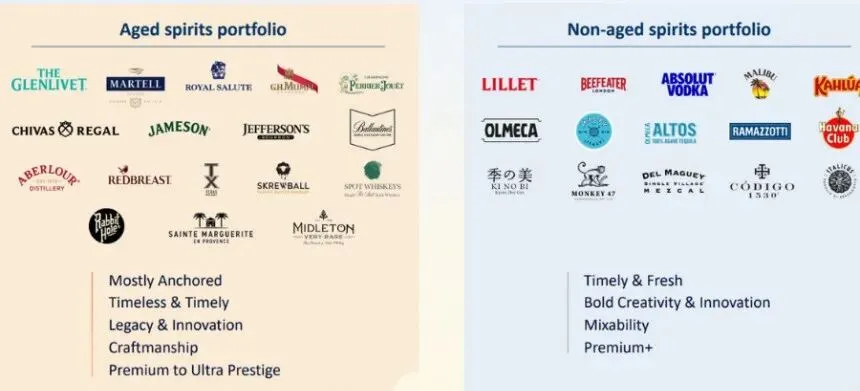
Key moves under the plan include splitting its brands into two divisions — Gold and Crystal — in mid-2025. The Gold division encompasses aged spirits such as Martell, Chivas, and Jameson, along with high-end champagne. These brands have built deep channel roots and pricing power in key markets over many years, forming the group's profit base. The Crystal division focuses on Absolut vodka, gin, and ready-to-drink lines, targeting younger consumers and on-the-go occasions. The two lines are clearly delineated and operate under different business logics. In addition, Pernod Ricard has been divesting non-core assets such as Mumm Napa, Kenwood Vineyards, and Jacob's Creek.
It is understood that Martell will lean more toward affordable and emerging price points to further strengthen its position in the cognac market. Meanwhile, Pernod Ricard's Chinese whisky brand, The Chuan, will focus on capturing growth opportunities in dining consumption scenarios. For new-style bars and smaller, more diverse consumption settings, the company is expanding its emerging white spirits portfolio.
Diageo's transformation is being led by new CEO Dave Lewis. After taking office on January 1, 2026, he launched a $1.2 billion "Acceleration Plan" aimed at saving $1 billion within three years.
Diageo's transformation focuses on improving operational efficiency, so it leans more toward organizational optimization. It has restructured global operations into five regions and 23 country clusters, with India — a high-growth market — elevated for the first time as a standalone region separate from Asia-Pacific. This shows Diageo is moving away from group-level centralized management, instead delegating decision-making downward to shorten the response chain between regions and markets.
Among all the spirits groups, Diageo faces the most urgent need for efficiency gains. Since Dave Lewis took over, not only have multiple senior executives left in a short period, but the company has also cut staff across its global operations. According to its fiscal 2026 results, Diageo reduced its workforce by nearly 2,000 people during the year. A senior executive at a well-known Sichuan baijiu company said that Swellfun has been stepping up layoffs recently, and they have received many resumes from former Swellfun employees.
Rémy Cointreau's transformation plan is more focused on its short-term growth difficulties. Since new CEO Frank Marilly took office in mid-2025, the company has scrapped its previous ten-year growth targets and instead launched a more pragmatic three-year transformation plan called "RC Forward." The goal is to decouple Rémy Cointreau's performance from economic volatility and increase recurring operating profit by €100 million by fiscal 2028-29.
To achieve this, Rémy Cointreau has outlined five major changes: adjusting its organizational structure, rebalancing commercial resources, reshaping brand expression, strengthening its value-oriented strategy, and reassessing its investment model. Specific measures include launching innovative cognac products, integrating luxury brands such as Louis XIII and Telmont, and unlocking the growth potential of Rémy Martin XO starting from the Chinese market.
The Strategic Logic Behind the Transformation
The root cause of this round of transformation is a common pain point: the "expansion-oriented architecture" that spirits giants built during their growth phase has become bloated and slow to respond as the market declines.
Diageo's difficulties in the Chinese market are particularly typical.
Its early acquisition of Swellfun to enter the baijiu segment was a landmark move in category expansion, but Swellfun has been a persistent drag on the group in recent years. In fiscal 2026, net sales in Greater China fell 34.9%, and baijiu sales dropped 41.9%. More notably, changes on the distribution side have been striking: in 2025, Swellfun's distributor count surged from 61 to 101, but average revenue per distributor plunged from 82.2 million yuan to 28.1 million yuan. As distributor incomes shrank, 43 distributors were cut directly in the first quarter of 2026.
Diageo's distributor system for imported spirits has followed a similar trajectory. "Previously, Diageo had more than a hundred secondary distributors nationwide. Without strong institutional constraints at the group level, problems such as channel diversion can easily arise. Once channel confidence is damaged, low-price dumping becomes even more severe," said Lin Hua, a spirits distributor in Fujian.
That said, Diageo has been gradually streamlining its distributor network. "The Singleton 18 now uses an exclusive distribution model, granting nationwide distribution rights to a single major distributor in Guangdong," Lin Hua added.
Rémy Cointreau attributes its growth struggles to economic volatility. Yet its business is heavily concentrated in cognac, with 80% of that revenue depending on the US and China. That concentration amplifies growth in favorable conditions, but in a downturn the risks multiply accordingly.
“More than half of Rémy Martin cognac revenue comes from Asia-Pacific, with China accounting for a large share. But in recent years Martell and Hennessy have captured over 80% of the market, and in an increasingly competitive environment they keep taking share from brands like Rémy Martin. Rémy Cointreau’s difficulties are becoming evident — for example, delayed rebate payments to distributors have occurred frequently in recent years, and sales teams in the northern market have seen large-scale layoffs,” said Li Weijun, a Fujian-based spirits distributor.
Pernod Ricard’s diversified category mix is also showing divergence. Jameson and Absolut both posted growth, while several high-value spirits saw double-digit declines.
Growing Pains and Possibilities in Transition
All three spirits giants have released their latest financial results after launching transformation plans.
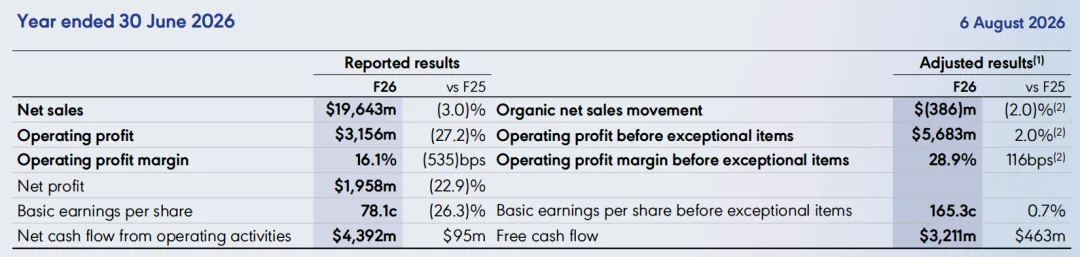
Diageo’s fiscal 2026 (July 2025–June 2026) report shows global organic net sales of $19.643 billion, down 2% year on year, and reported operating profit of $3.156 billion, down sharply by 27.2%. Although Dave Lewis oversaw operations in the second half of the fiscal year, with measures including business restructuring and headcount reductions, the full-year profit decline was not reversed.
Rémy Cointreau’s fiscal 2026 (April 2025–March 2026) organic sales came in at €935.3 million, up 0.2% year on year, finally halting the 20% declines of the previous two years, but operating profit still fell by a double-digit percentage. The report shows that in China, sales volume rose while sales value declined; in the fourth quarter especially, Rémy Martin CLUB achieved double-digit volume growth on e-commerce channels. A company official said the new fiscal year is expected to continue showing volume growth significantly outpacing sales value, indicating an attempt to revive the China market through price cuts to drive volume.

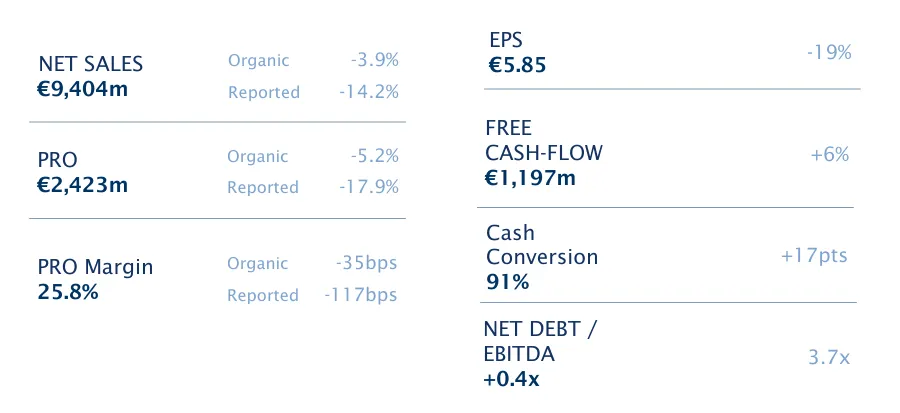
Pernod Ricard’s fiscal 2026 (July 2025–June 2026) organic net sales were €9.404 billion, down 14.2% year on year, while recurring operating profit fell organically by 5.2% to €2.423 billion. After the transformation plan was implemented, second-half organic sales improved markedly, with the decline narrowing from 5.9% to 1.3%.
These results largely reflect the growing pains of transformation. Turning an elephant around is no easy task, particularly in shedding the organizational inertia and path dependence built up during rapid growth. Still, the transformation strategies of these giants are opening new possibilities for the industry.
After streamlining business lines, major spirits groups will adopt more precise resource allocation for their flagship brands. For instance, Pernod Ricard is concentrating operations around a few core brands such as Martell and Chivas, while Remy Cointreau has set up a separate division for luxury brands like Louis XIII. This allows advertising, channel development and consumer cultivation to be more focused, with likely increased investment in core categories. Meanwhile, trend-driven categories gain opportunities to scale up. Several companies are running white spirits as standalone businesses; Pernod Ricard has created the SIP platform to support bartender development, and Diageo has made similar investments.
The full impact of this collective shift will only become apparent over several complete fiscal years, but the signals are already visible: the spirits industry is moving away from an era of growth driven by broad distribution and brand stacking, with specialized, focused cultivation becoming the new direction.
All interviewees are pseudonymous.