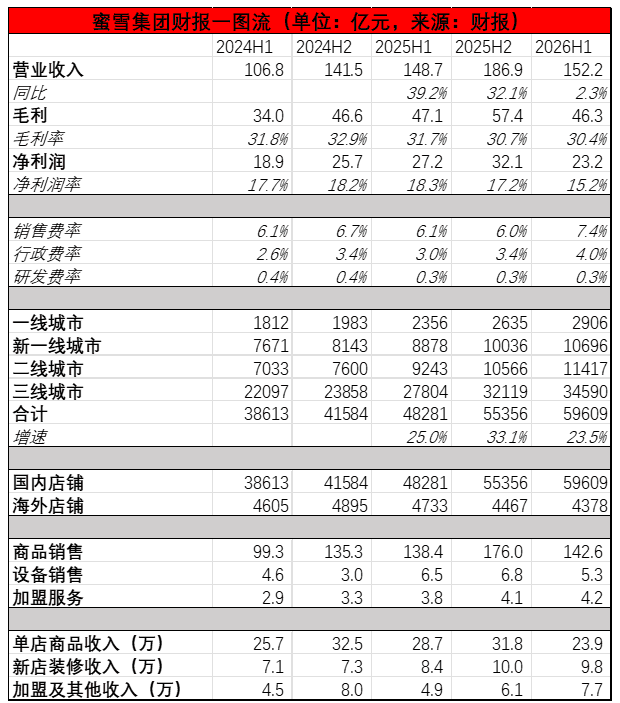
On August 27, Mixue Group released its 2026 interim report, posting first-half revenue of RMB 15.216 billion, up 2.3% year-on-year. Profit for the period came in at RMB 2.319 billion, down 14.7% from a year earlier. Gross margin was 30.4%, contracting 130 basis points year-on-year and missing market expectations.
(The financial report is shown in the chart below, units: 100 million yuan, source: WIND, compiled by Caixin)
Mixue has been relatively guarded in disclosing its operating data, leaving few available sources for analysis. That said, by store count, supply chain depth, and revenue scale, Mixue is already the undisputed absolute leader in China's tea beverage track. Its underlying business logic of "franchise expansion plus strong supply chain control" has long been well known to the market.
However, from the mid-term report period, an inflection point has appeared in this strategy, with store growth slowing down, profits under pressure, and increasing sales expenses failing to bring in more incremental gains. Neither Yonghe Dawei, nor Xinpi Fenglu seems to be able to replicate the success of their main brand, and Mengniu Dairy's new stories are becoming increasingly scarce.
Telling the same story too many times will eventually bore the capital markets. Mishi Xue, which has been listed for a year and a half, has seen its stock price fall back to where it started.
Revenue Hits the Brakes, 'Subsidy Cliff' May Just Be an Excuse
In the first half of 2026, Mishi Group reported revenue of 15.216 billion yuan, up 2.3% year-over-year, essentially flat with the same period last year, with growth slowing sharply from over 30%.
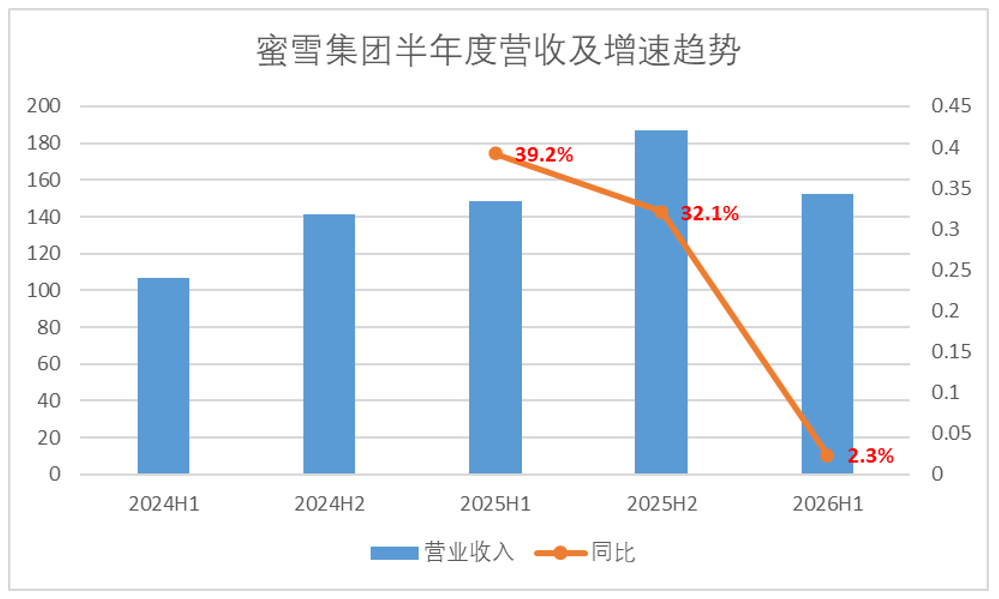
Management explained during the earnings conference that large-scale subsidies for food delivery in the first half of 2025 boosted store order volumes, resulting in a high base; with the subsidy retreat in 2026, the growth rate naturally declined.
It sounds reasonable, but we believe this is not the core reason, as a horizontal comparison with other companies in the tea drink track shows that Gu Ming, Cha Bai Dao, and Hu Shang A Yi's mid-year growth rates are all significantly higher than Mixue Ice City's, and among tea drink companies listed in Hong Kong, Mixue's growth rate is only slightly higher than that of Nayuki, which is on the verge of collapse.
Meanwhile, Mixue's overall gross margin continued to decline in the first half of this year, with gross profit coming in at RMB 4.63 billion and a gross margin of just 30.4% — down 130 basis points year-on-year, and still down 30 basis points from the low-base first quarter.
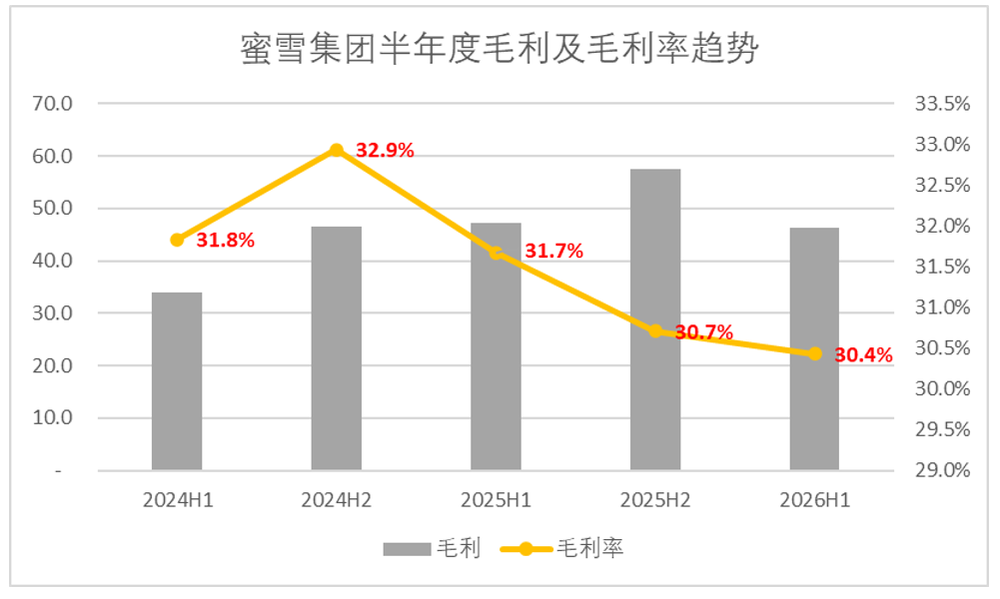
If subsidy tapering truly had a major impact on the demand side, the revenue-side effects should not be confined to Mixue alone. Looking at first-half data, after the food-delivery war entered a temporary lull, both Guming and Auntie Shanghai saw gross margins improve, while Mixue's gross margin actually declined.
Mixue has the lowest average ticket size among tea-drink companies. Based on data disclosed in last year's annual report, the delivery price war had limited impact on its pricing — no matter how fierce the battle gets, once prices fall below 10 yuan, the ammunition turns to duds. Yet Mixue emerged as the company hit hardest by the fallout after the delivery war ended, which defies conventional logic.
Slowing Expansion May Be the Key Factor Impacting Earnings
Among the limited financial disclosures, Mixue's most striking trend in 2025 is the marked slowdown in store expansion. In the first half of this year, the company opened 5,455 new stores and closed 1,289, bringing net openings to just 4,166. That compares with 6,534 net openings in the same period last year, a decline of nearly 2,400 stores.
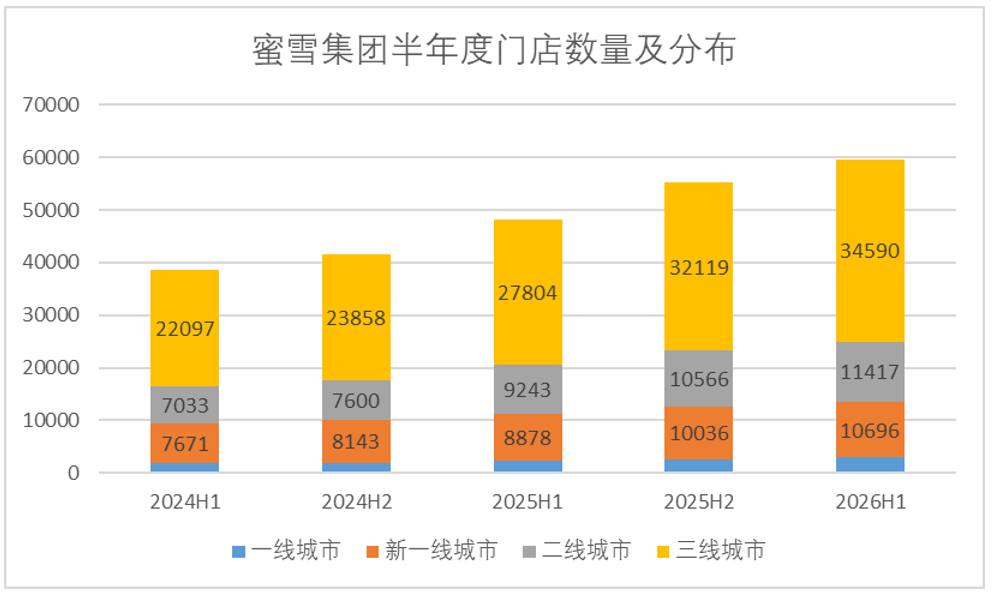
The main reason for this is the relative saturation of second-tier and new first-tier cities, with the number of new store openings in new first-tier cities increasing by 1,818 in the first half of the year, and second-tier cities adding 2,174, slightly lower than the same period last year.
Third-tier cities are still seeing volume growth, driven mainly by the expansion of the second brand. Last year, numerous media reports noted that Lucky Coffee has become the second brand Mixue is aggressively promoting. Lucky Coffee's expansion leverages the long-standing franchisee system that Mixue Bingcheng has built, and many Lucky Coffee franchisees are also Mixue franchisees.
In comparison, the franchise fee for Lucky Coffee is significantly lower than that of Mixue Ice City, as disclosed on their official websites. Excluding decoration costs, the franchise fee disclosed on Mixue's official website is approximately over 160,000 yuan, while Lucky Coffee's fee is only 127,000 yuan. Considering that there are some franchise fee discounts during the expansion period, the actual cost difference may be even greater.
It is clear that Mixue wants to replicate the success of Mixue Ice City through Lucky Coffee. However, unlike the tea beverage market, the coffee market is far more intense. According to the "2025 China Coffee Industry Development Report", in 2025, the number of coffee shops in China increased by over 40,000 to 215,000, with a growth rate of 25%. The chain store rate also rose from 46% to 53%.
Moreover, the price difference between leading players Kudi and Ruixing and Yonghe Dawang is not significant, making this path difficult for Mishi to follow.
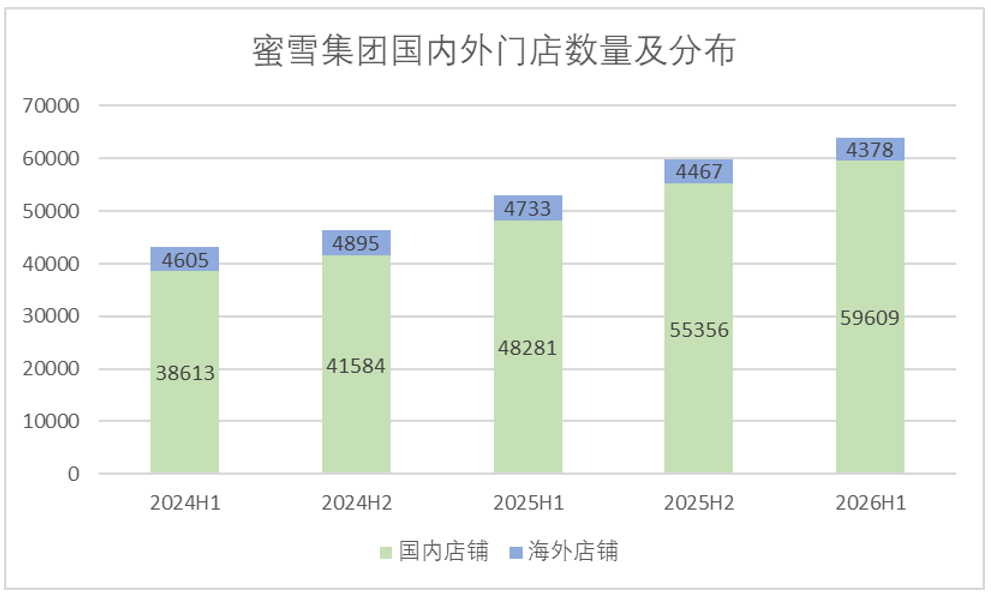
In terms of overseas stores, after a relatively rare negative growth in 2025, the first half of 2026 continued to decline, with the number of stores reaching 4,378 as of the mid-year report, a year-over-year decrease of 7.5%. According to the management's annual report, this is due to the re-selection and integration of locations in the Southeast Asian market. If we combine these factors, the momentum of the main brand, Mixue Ice City, is indeed no longer as sharp and aggressive as it was in previous years.
Fees See Significant Growth as Single-Store Model Reaches Turning Point
In terms of costs, as a representative of the "light asset" model for new tea drink brands, Mishi's overall cost control level is not excellent. In the first half of 2026, sales expenses, management expenses, and research and development expenses were 1.12 billion yuan, 610 million yuan, and 40 million yuan, respectively. The three expense ratios were 7.4%, 4%, and 0.4%, respectively, with the sales expense ratio increasing by 130 basis points and the management expense ratio increasing by 100 basis points compared to the same period last year.
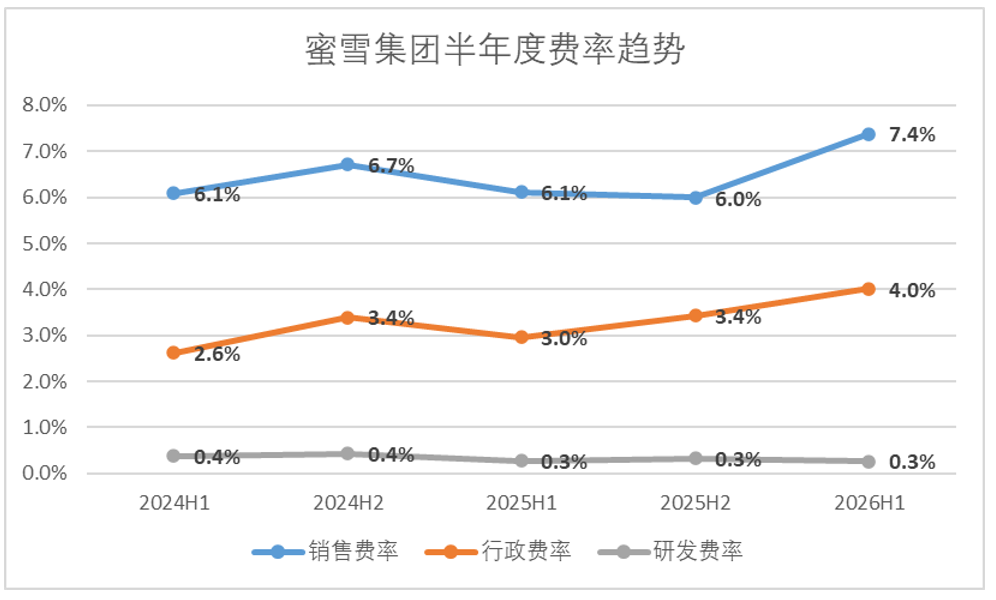
Management explained at the earnings call that the fee increases are primarily directed toward IP brand marketing, support for high-quality store operations, and rising middle-office labor costs — all upfront investments aimed at building long-term capabilities.
At the single-store model level, Mishi Xue's overall single-store commodity revenue (commodity revenue/existing store number) was approximately 239,000 yuan in the first half of 2026, a significant decline of 47,000 yuan compared to the first half of 2025. Given the slower pace of store expansion this year, the actual single-store revenue decline for Mishi Xue is even worse after the end of the food delivery war.
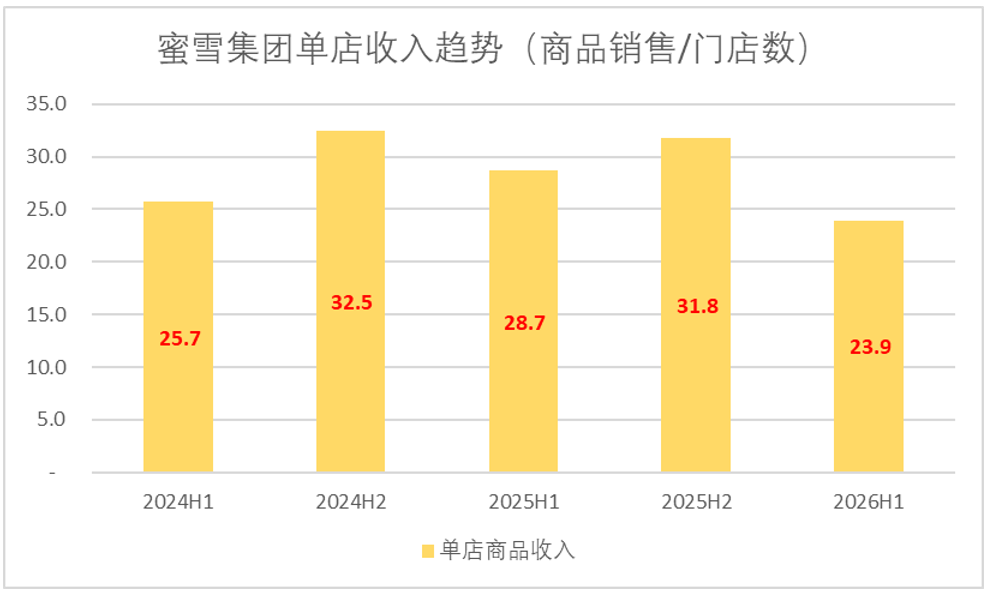
It is clear that Mishi Snow, which focuses on its main brand, can no longer drive an increase in single-store revenue through supply chain integration. For Mishi Snow, which operates a light-asset model, expanding its revenue scale can only be achieved through two channels: increasing store sales by expanding its SKU offerings or expanding its store coverage. However, Mishi Snow's store coverage is basically saturated, and the growth of its SKUs has not significantly driven an increase in single-store sales revenue.
With no significant increase in volume overseas, the existing business appears to have reached its growth limit, making it understandable why Mishi pushed its sub-brand, Lucky Coffee, aggressively last year.
Franchise Discounts Tighten, Exposing Lucky Cup's Weak Brand Pull
Let's focus on the expansion of Lucky Coffee itself. According to the semi-annual report of Mishi, the revenue breakdown by business type shows that product sales account for more than 90% of the total revenue, which is the core pillar of the group's profitability. However, even in the smaller categories of decoration equipment income and franchise service income, there are also some noteworthy trend changes.
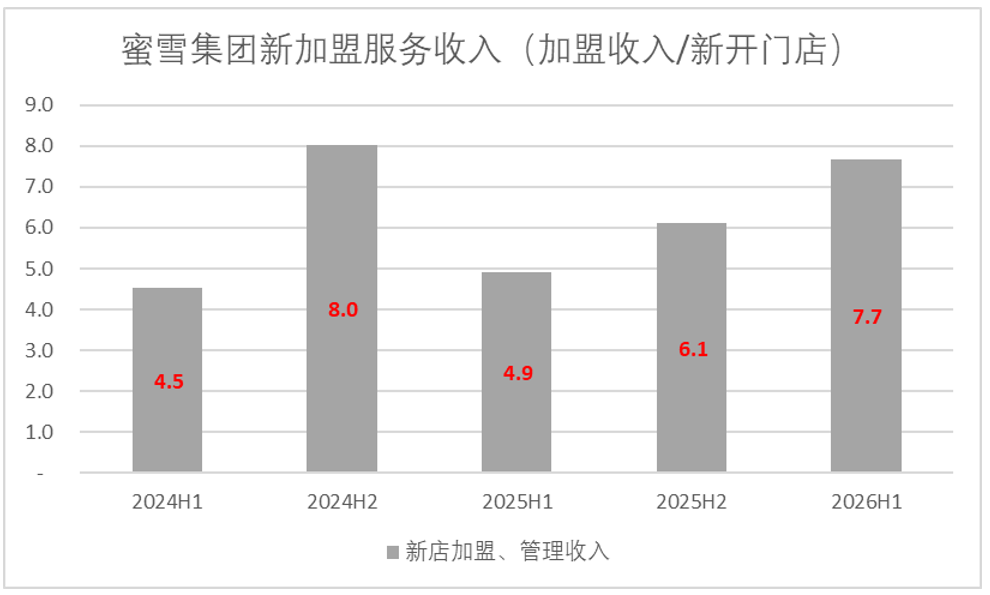
For instance, comparing the service franchise fee revenue in 2025 with the number of new stores opened in 2026, it can be seen that Mishi had made significant adjustments to the franchise fee to promote the Luckin' Coffee brand and attract franchisees. In the first half of this year, the total franchise service revenue per new store was approximately 77,000 yuan, an increase of 28,000 yuan compared to the same period in 2025.
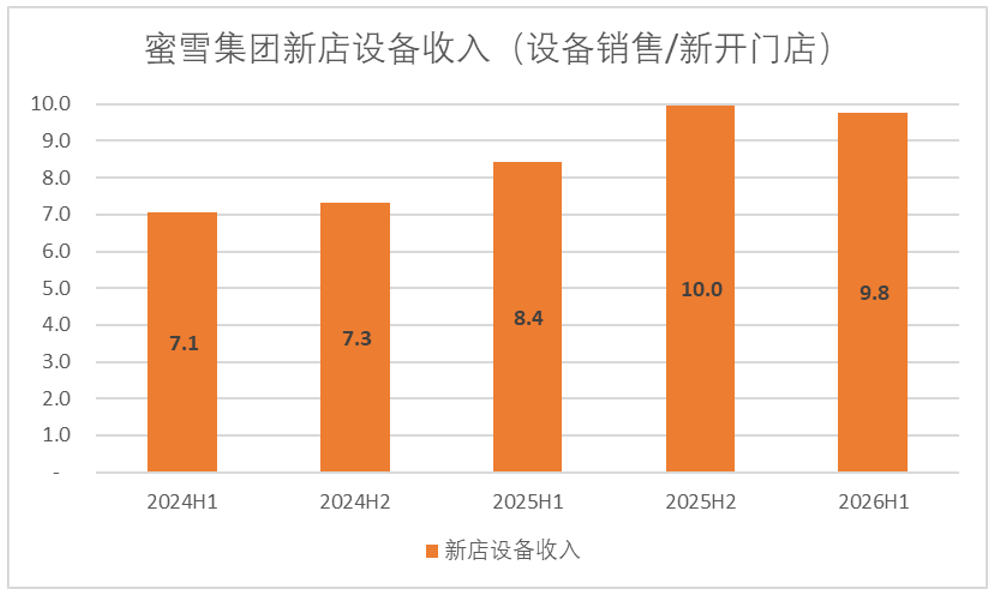
Additionally, although the official website of Lucky Coffee does not directly disclose the decoration costs for joining, from the perspective of equipment sales, the revenue contribution of this category has also shown significant growth. In the first half of 2026, the single-store equipment sales revenue was approximately 98,000 yuan, an increase of 12,000 yuan compared to the same period in 2025.
From this, two relatively clear threads emerge:
First, Lucky Coffee's expansion has been rapid, but a genuine brand premium has yet to materialize. The parent brand Mixue Bingcheng has established strong synergies through its own expansion — most veteran franchisees don't stop at a single store — and Lucky Coffee's current land-grab has leaned heavily on this existing franchisee network to buy expansion efficiency. During the aggressive growth phase in the first half of 2025, the group proactively gave up margins, but once franchise incentives were tightened, the pace of new store openings slowed markedly.
Secondly, Mishi Xue's light-asset model has full control over adjusting its revenue recognition, but its franchisees are also highly sensitive. The decline in single-store model performance and the slowdown in store expansion pace occurred almost simultaneously in the first half of the year, suggesting that the binding degree between Mishi Xue and its franchisees may not be as tight as the market had imagined, making it difficult to replicate another Mishi Xue with Lucky Coffee at this stage.
Looking back at the past three years of growth for Mishi, the business logic it relies on is essentially a continuation of the same expansion script - relying on the existing network of franchisees to quickly replicate stores, using scale in the supply chain to dilute costs, and then using a light-asset model to firmly grasp control over revenue streams.
The successful handover of Lucky Coffee, flexible adjustments to equipment sales, and the relatively immune positioning of moderate pricing to the withdrawal of food delivery subsidies have together formed a hidden threat to Mishi's main brand as it slows down, prolonging the period of profit growth.
Although the number of stores is still expanding, the marginal benefits brought by expansion are getting smaller and smaller over time:
For instance, negative growth in overseas store counts indicates that in different market environments, simple replication of scale is no longer a surefire strategy. Likewise, the overall slowdown in store expansion during the first half of this year, or the decline in per-store merchandise revenue, all signal to the market that the existing business model is yielding increasingly diminishing marginal returns.
It is clear that Luckin Coffee's brand power still lags far behind that of the main brand, and the competition in the ready-to-drink coffee market is relatively fierce, with uncertain profit margins in the future.
At the current point in time, Mishiyou is undoubtedly still in a period of inertial expansion, with its accumulated assets from franchisees, supply chain depth, and brand recognition continuing to release energy, but beneath this inertia, the boundaries are already vaguely visible.
However, the inertia of expansion brought about by the expansion bonus has already permeated the management team. The acquisition of Fresh Beer Fukuja is essentially a lateral transfer of the same logic - using the existing franchisee network and supply chain advantages to replicate a "MIXUE" in another category. The problem is that the competition in the fresh beer sector is no less intense than that in the ready-to-drink coffee market, and the capital market is voting with its feet, with MIXUE's stock price continuing to come under pressure since last year, approaching new lows.
Management attributed the slowdown in growth to the company's proactive decision to abandon quantitative growth and shift towards high-quality operations and stock optimization, a statement that doesn't quite align with the typical tone of Ming Su.
A look back at business history shows that joint-venture automakers like Nissan and Volkswagen, along with consumer-goods giant Procter & Gamble, all illustrate the same pattern: from big-ticket sectors like autos and real estate down to the vast majority of consumer companies, it is only when expansion hits its limits that they declare a return to "high-quality development." Yet very few ever manage to restore normal growth through so-called high-quality operations.
Telling the same story too many times will eventually tire the audience, and it seems that Mishi currently can't come up with many new stories.