Digitalization ties together consumer insight, supply-chain responsiveness and a global service network across the entire manufacturing chain, according to SHEIN's founder.
Yuyan | Production
Two new companies listed on the Hong Kong Stock Exchange on Sept. 1.
One is Mech-Mind, a robotics company generating buzz both at home and abroad; the other is Shein, the fast-fashion giant. The former is entering another wave of publicity, while the latter remains as silent as ever — a silence that has been Shein's norm over the past two years.
But silence doesn't quell controversy.
Shein shares opened flat before sliding as much as 10%, then pared losses to close 0.12% lower.
Some see the drop below the IPO price as an opportunity, others view the listing itself as a success, and some remain bearish.
Amid the uncertainty, we open the prospectus to try to understand this once red-hot pioneer of going overseas. With tariffs, compliance and traffic headwinds converging, what cards does it still hold, and how will it navigate the next phase?
The flywheel is slowing.
For many, the first impression of SHEIN is slowing growth.
According to the prospectus, SHEIN's net revenue rose from $32.1 billion in 2023 to $38.7 billion in 2024 and $41.8 billion in 2025, with growth decelerating from 41.1% to 20.7% and then 8.0%. In the first quarter of 2026, revenue of $9.052 billion was just 1.1% higher than a year earlier.
It's still earning money, but the engine is clearly aging.
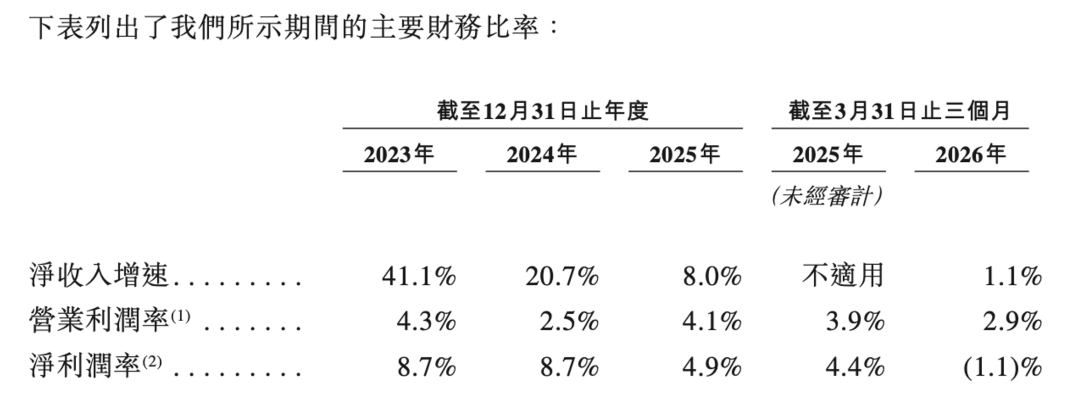
In 2025, it earned a net profit of $2.064 billion, which sounds respectable, but its net margin has slipped to 4.9% from 8.7% in 2023. In the first quarter of 2026, it recorded a net loss of $99 million on paper, versus a profit of $395 million a year earlier.
The $99 million loss, on a book basis, was mainly due to a $328 million fair-value swing on convertible preferred shares, which has little to do with the underlying business. That is purely an accounting adjustment that will revert to equity once the listing is completed. Looking at operations, first-quarter operating profit was still $258 million.
Overall, SHEIN's foundation remains solid, but many have lost confidence in its future potential.
SHEIN's machine is actually powered by two flywheels.
More users, more frequent orders, and larger total order volume keep the business growing.
More users spread the supply chain and fulfillment network thinner and make it run more smoothly, boosting profits.
The two flywheels meshing together was what enabled it to outpace ZARA back then. But looking at the prospectus data, both flywheels are now slowing.
First, the user growth flywheel.
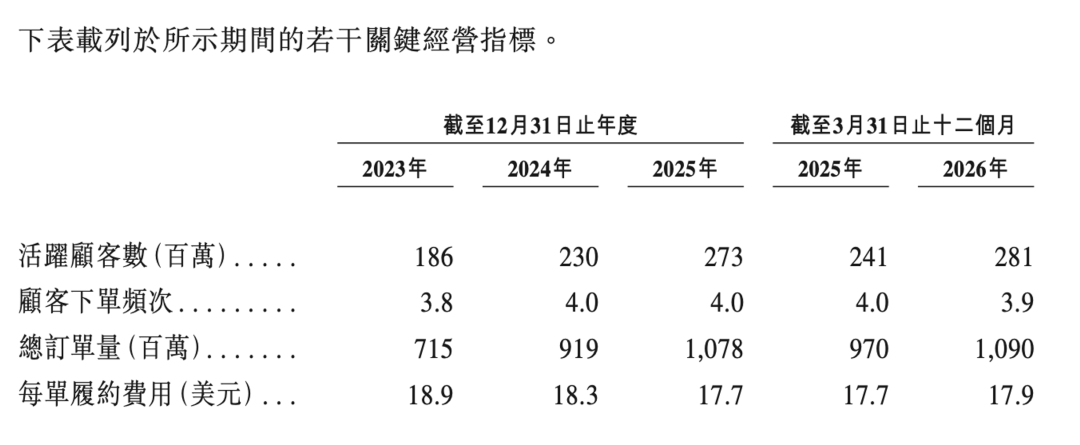
According to the prospectus, active customers rose from about 186 million in 2023 to about 273 million in 2025, a compound annual growth rate of 21.2%. But on a trailing twelve-month basis, they only grew from 241 million as of March 2025 to 281 million as of March 2026, with growth slowing to 16.6%. People are still coming, but at a slower pace.
More concerning is order frequency. Annual customer order frequency has essentially flatlined at 3.8, 4.0, 4.0, 4.0, and 3.9 times, with the latest quarter dipping slightly to 3.9.
User numbers are rising, but the number of purchases per person isn't, sapping the flywheel's output. That's why net revenue growth has slowed.
Second, the efficiency flywheel.
The engine of this flywheel is LATR — large-scale automated small-batch quick response. The approach: a new style starts with a trial order of 100 to 200 pieces. If it sells, restocking can happen in as little as five days; if not, production stops immediately. This pushes the "fast" in fast fashion to its extreme.
This relies on China's vast manufacturing advantage. According to the prospectus, SHEIN operates more than 1,700 proprietary software systems connected to over 7,500 manufacturers, using data to drive the entire supply chain at speed.
But as the flywheel spins, efficiency is slipping. Inventory turnover days rose from 35 in 2023 to 38 in the first quarter of 2026, while fulfillment costs as a share of net revenue climbed from 42.1% to 47.7%.
In theory, more users and a denser network should lower unit costs. Instead, a growing marketplace share has diluted net revenue per order, shifting trade conditions have raised fulfillment costs, and localization requires continuous investment. The result: net margin has kept falling, turning negative at -1.1% in the first quarter of 2026.
Both flywheels are stalling. The advantages that once powered growth — duty-free direct mail, low prices and massive new-product launches — are fading.
Where will future growth come from?
Where does SHEIN see future growth? The prospectus suggests it still has two cards to play.
The first is geographic expansion, driving user growth.
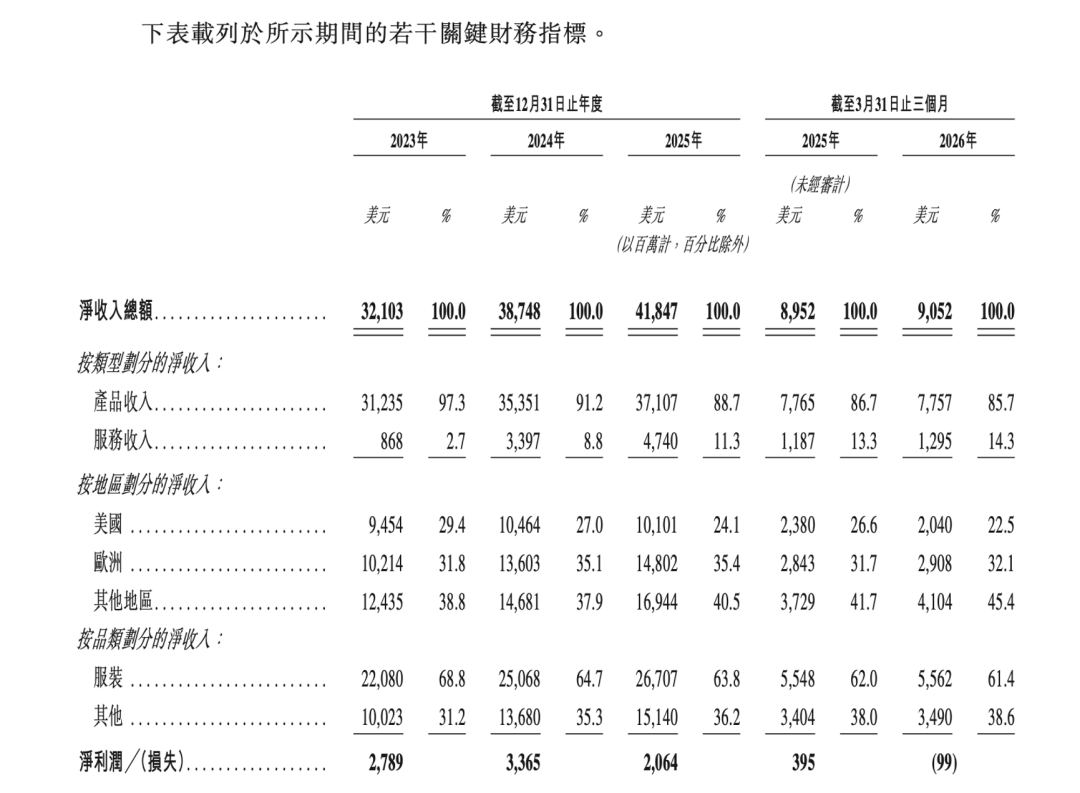
According to the prospectus, the US revenue share fell to 22.5% in the first quarter of 2026 from 29.4% in 2023. Europe has been the largest market since 2024, and other regions combined now account for 45.4%.
New regions such as South America, the Middle East and Southeast Asia are seen as key growth drivers. These markets have large user bases and online penetration is still climbing, so entering them would directly expand user numbers. The problem: Mercado Libre, TikTok Shop, Shopee and other platforms have already staked out their turf there.
The second is platform development: driving higher order frequency on the user side and exporting core capabilities on the brand side.
Pure fashion and pure retail have hit their ceiling.
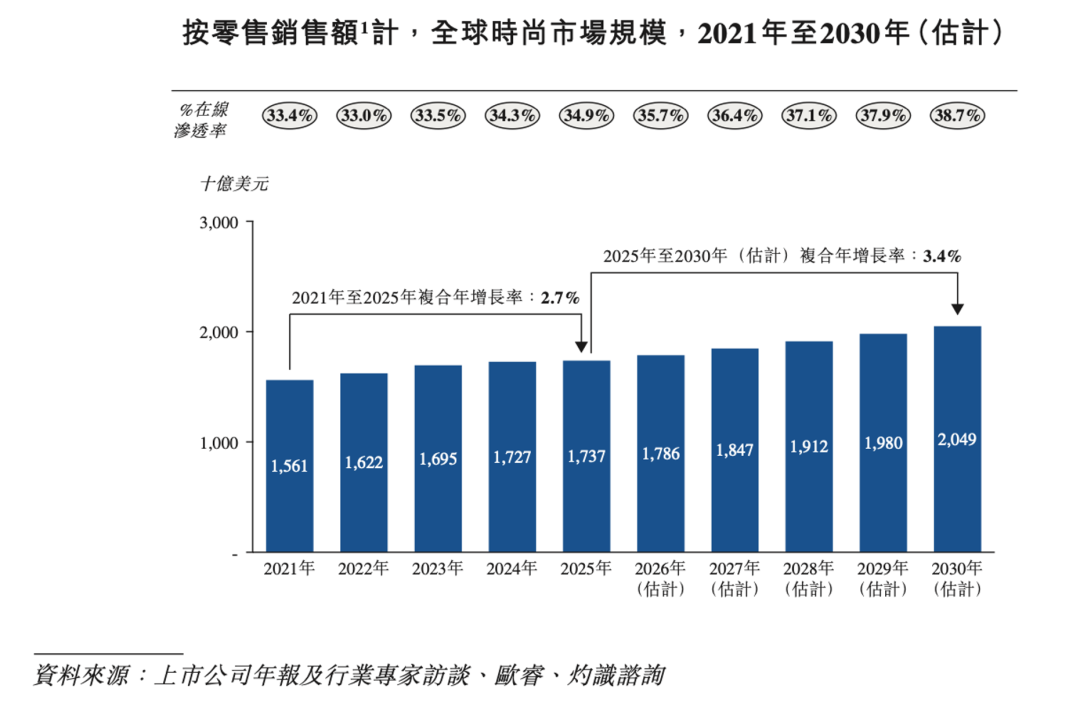
According to industry data in the prospectus, global fashion retail is a $1.737 trillion market in 2025. By retail sales, SHEIN's share is 1.9%, ranking third behind only Nike and Zara parent Inditex.
But the top 20 companies in the industry account for just 20.5% combined, making it highly fragmented. The overall market is expected to grow at only a 3.4% compound annual rate from 2025 to 2030, leaving limited room for expansion.
Meanwhile, in the online segments where SHEIN has an advantage, its market is being eroded. Backed by similarly strong manufacturing bases, platforms such as Temu and TikTok Shop are mounting a challenge.
This forces SHEIN to pivot toward a platform model and move beyond fashion.
It launched the SHEIN X program in 2021, creating opportunities for designers and brands.
In 2023, it officially launched a marketplace selling other brands' products, moving toward a platform model.
In 2025, it introduced SHEIN Xcelerator, an upgraded evolution of SHEIN X, opening design, supply chain, and traffic capabilities to a broader range of brands and sellers.
Currently, its ecosystem has brought together a large number of merchants, independent designers, and other suppliers.
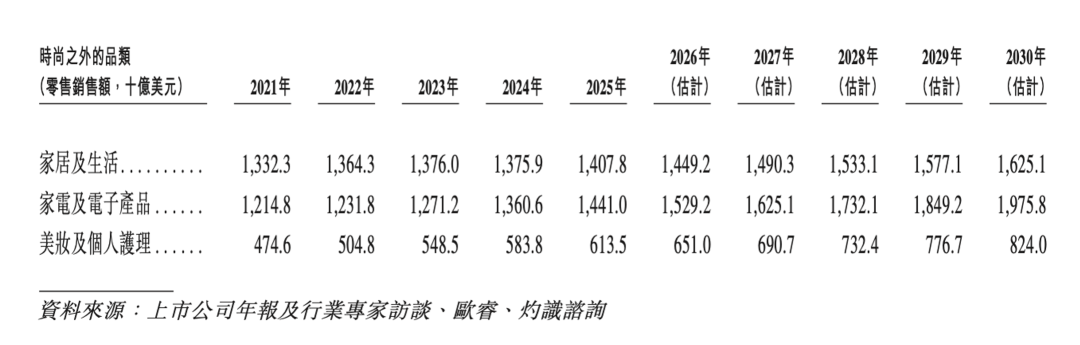
Among these, home living, small appliances, and beauty are key focus areas now and in the future.
According to the prospectus, the home and living, home appliances and electronics, and beauty and personal care markets will be worth $1.41 trillion, $1.44 trillion, and $613.5 billion in 2025, respectively, and are expected to grow to $1.63 trillion, $1.98 trillion, and $824 billion by 2030. Online segments are growing faster, with online home appliances and electronics at 10.1% and beauty at 9.1%.
These markets are much larger and faster-growing than pure fashion, just filling the gap left by fashion retail.
When SHEIN gives users more reasons to order non-apparel items, purchase frequency rises, which expands transaction scale and accelerates the user flywheel and efficiency flywheel. When SHEIN opens its supply chain capabilities to more designers and companies, it transforms from a pure retailer into a service provider that can export capabilities.
Amazon and Alibaba, both retail-born, are now AI heavyweights with new roles as cloud providers. SHEIN, meanwhile, is evolving from a fashion retailer into something more.
Conclusion
Either way, SHEIN has secured a ticket to the new world and begun another journey.
For SHEIN, the 273 million active users, 7,500 factories and nearly $15 billion in cash in its prospectus are the past. The platformization, brand matrix and regional replication that have yet to be proven are the future — after all, 'X' can contain many stories.
But that future hasn't arrived. For now, the road is long, and SHEIN's flywheel needs to spin faster.