Whoever rises becomes the sun.
If we turn back the clock thirty years, in the winds of Shenzhen's Overseas Chinese Town, you would likely hear this bold and resounding statement.
In those years, color TV giant Changhong dominated the domestic color TV industry, giving the large-screen color TVs it produced a loud name, "Red Sun" - wherever it shone, it was bright.
Konka responded by naming its product "Color Overlord." When Changhong questioned the audacity of the "Overlord" title, Konka dismissed the challenge with a breezy retort: whoever rises becomes the sun.
That was the golden age of Konka, as well as the most barbaric growth period of Shenzhen's manufacturing industry.
However, more than 30 years have passed, and the former "top color TV manufacturer" that was once renowned throughout the country has ultimately ended up where it is today.
With Konka's voluntary delisting announcement, a home-appliance empire that once carried the youth and pride of countless Shenzhen residents is gradually drawing to a close.
From Shahe Animal Husbandry Farm
Nubia to Become First Listed TV Manufacturer
When mentioning Overseas Chinese Town, what comes to mind for Shenzhen residents today is probably the shadows of Chinese parasol trees, art exhibitions, curators, and luxurious mansions that often cost over 100,000 yuan per square meter.
Few people may know that forty years ago, this area was one of the earliest and most fervent dream-making hubs of China's electronics industry.
In the early 1980s, televisions were still in short supply in China.
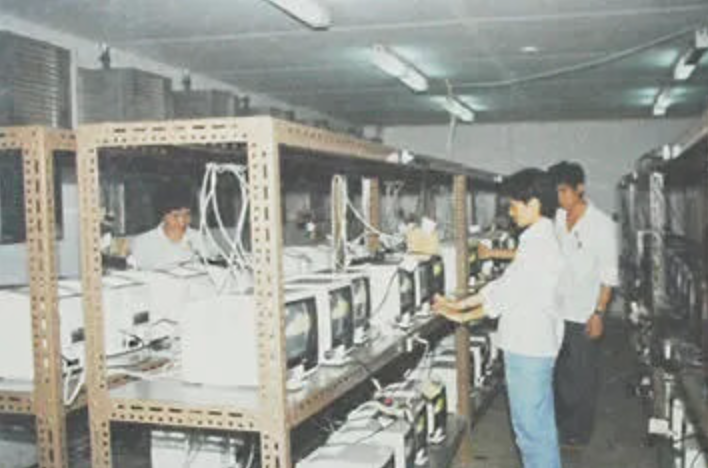
In March 1979, the Guangdong Overseas Chinese Farm Management Bureau signed a cooperation agreement with Hong Kong-based Harbour Electronics Enterprise Ltd. to launch electronic processing and assembly services at the Guangming Overseas Chinese Livestock Farm, and by December of the same year, the joint venture Guangdong Guangming Overseas Chinese Electronics Industry Co., Ltd. was formally established.
The following May, the factory relocated to the Shahe branch of the Guangming Overseas Chinese Livestock Farm on the shores of Shenzhen Bay (now Overseas Chinese Town) and began production, with the product brand being designated as KONKA (Kangjia) the same year, marking the birth of KONKA.
Konka's factory initially assembled tape recorders, and later produced TVs, but as a joint venture, its products were not allowed for domestic sales, and were all exported abroad.
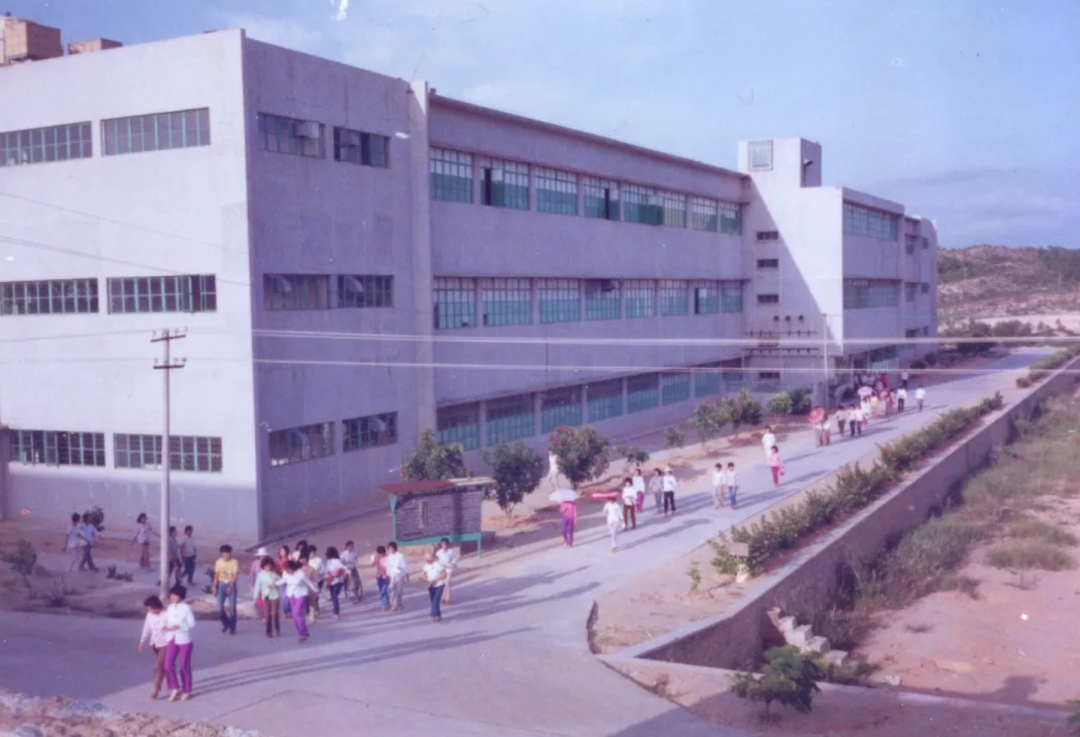
Photo: KONKA factory, source: KONKA Group Weibo
In 1982, Chen Weirong, the future legendary leader of Konka, graduated from South China Institute of Technology and was assigned to Konka as a technician. As one of the first batch of university students assigned to the factory, he was highly valued and later sent abroad for further study.
In the following years, Konka successively obtained domestic color TV production licenses and domestic sales licenses, with production and sales volumes increasing significantly, gradually gaining prominence in the domestic market.
Entering the 1990s, experts warned that "to stand firm in the color TV industry, where many brands are emerging, a production capacity of 3 million units per year must be reached."
At that time, Konka had a production capacity of 1 million units and 3,000 employees. To reach an annual output of 3 million units, relying solely on its own accumulation and development would be very difficult. Chen Weirong, the person in charge, came up with a plan - to acquire enterprises in the mainland.
At that time, the domestic color TV industry had excessive production capacity, and some local color TV companies were facing operational difficulties. Upon learning that Shenzhen Konka was considering acquisitions in the mainland, Zhu Huiyun, the director of Mudanjiang TV Factory in Heilongjiang, the northernmost part of the country, immediately traveled south to request that Konka "take them over".
The following year in February, Konka invested 18 million yuan in cash and formed a joint venture with Mudanjiang TV Factory to establish Mudanjiang Konka Industrial Co., Ltd. (Mudanjiang Konka Company), holding 60% of the new company's shares, and embarked on a path of low-cost expansion in the mainland.
At the end of 1997, the Konka shares held by Hong Kong-based Harbour Ring Electronics were acquired by Hong Kong China Travel and China Overseas Holdings, marking Harbour Ring's exit. The former Sino-foreign joint venture was transformed into a publicly listed company controlled by China Overseas Holdings' parent company, China Overseas Holdings' subsidiary, and China Travel's parent company, Overseas Chinese Town Holdings, enabling Konka to accelerate its expansion in the domestic market.
At that time, Chen Weirong served as the general manager of Konka Company, and under his leadership, Konka was at the height of its prosperity, driving development in the mainland.
The following year, Jiang Zemin remarked in Shenzhen: "When enterprises from the special zones set up factories in inland areas, they revitalized local management mechanisms. Not only did they turn loss-making inland enterprises around, but they also created job opportunities there, while alleviating the special zones' problems of labor oversupply and overconcentration."
At the time, a mainland official said that mainland state-owned enterprises were like a pot of water that had not yet boiled, having been heated to 99 degrees, and were just one degree away from boiling; Konka heated that final degree.
In 1992, Konka listed its A-shares and B-shares simultaneously on the Shenzhen Stock Exchange.
In October 1995, Konka invested 18 million yuan to form a joint venture with Shaanxi Ruyi TV Factory, establishing Shaanxi Konka, which secured a production capacity of 1 million color TVs and completed its western strategic layout.
After being listed for six years, Konka completed its overtaking of Changhong in 1998, with its color TV sales ranking first in the country, and in the same year, it became the first electronics company in Shenzhen with an annual turnover of over 10 billion yuan; the following year, it launched the country's first high-definition digital TV prototype.
The display devices on the Tiananmen Rostrum that broadcast live to the world during the 50th anniversary National Day parade in 1999 had "KONKA" emblazoned on them, and Konka had finally become the dominant force in the color TV industry.
Kangjia's old employee, Chang Qi, recalled that in the mid-1990s, distributors from all over the country would stand at the factory gate with a bag of cash in hand, waiting to stock up on goods, while production line workers worked 24-hour shifts.
When it comes to R&D and production capacity being the hard power, the marketing tactics used by Konka back then are still considered divine, even by today's standards.
In 1996, Konka purchased the naming rights to the Beijing-Kowloon Railway's Train 105/106.
The "Kangjia" green train rumbled along the north-south main artery, becoming one of the earliest companies in Chinese business history to have a named passenger train.
But what truly propelled this marketing frenzy to its peak were two nationwide sensational top-tier endorsements.
In 1999, Konka spent tens of millions of yuan to sign Chow Yun-fat, and his phrase "listen to the voice of the world" instantly opened the curtain on the "celebrity endorsement era" for domestic mobile phones and the entire home appliance industry.
By 2003, celebrity marketing had reached an unprecedented height.
They enlisted Maggie Cheung to star in the advertisement, even bringing in a film-level "iron triangle" team consisting of Wong Kar-wai as director, Du Ke Feng as photographer, and Chang Suk Ping as art director.
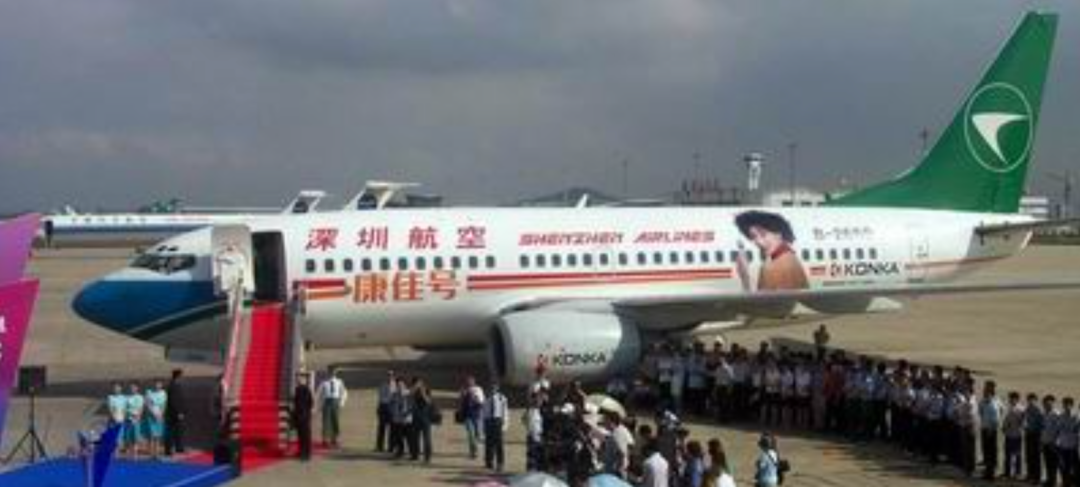
Source: People's Daily Online Shenzhen
In the same year, in August, a Boeing aircraft with a 4.8-meter-high Maggie Cheung poster flew out of Bao'an Airport, taking Shenzhen students who had been admitted to Tsinghua and Peking Universities to Beijing for school, marking the country's first aircraft sponsored by a company.
After that, under the development of both soft and hard power, Konka occupied the domestic sales champion position for five consecutive years. In 2019, the group's revenue surged to a historical peak of 55.119 billion yuan.
From its humble beginnings in Shenzhen's Shaoxing River delta to its current status as an industry leader, Konka has spent nearly forty years etching its name deeply into the annals of China's manufacturing history.
China's 'Apple': Huaxia Village
The First Color TV of Shenzhen Residents
If you put aside the grand numbers and bring the perspective back to the daily life of ordinary Shenzhen residents, you will find that Konka is actually more like an old friend who has accompanied two generations as they grew up.
In the era before the slogan "once you're here, you're a Shenzhen person" was coined, being able to get into Konka's factory was a coveted "golden rice bowl" for countless migrant workers and technicians.
In 1980, 19-year-old Xu Wenxiao, with a worn-out travel bag, set foot in Shenzhen from Chaozhou, Guangdong. The entrance exams at that time were dauntingly strict, with hundreds of people packed into a dilapidated exam room to take math and science tests, competing for just 20 spots.
Xu Wenxiao charged into the thick of things, becoming one of the first batch of Konka employees to wear protective goggles.
He was assigned to the production line as a welder, participating in the launch of Konka's first tape recorder production line and witnessing the mass production of the company's first TV set production line in 1984.
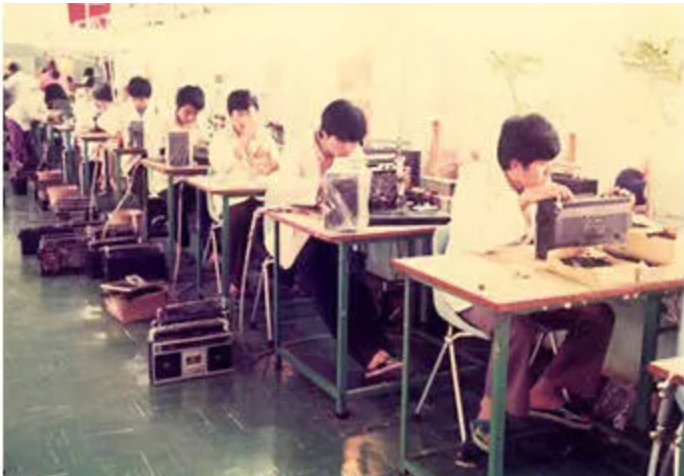
Xu Wenxiao recalled that the area around the factory was once a desolate mountainous region with nothing around. However, as night fell, the dormitories would become lively.
Workers gathered around, staring at the small screen on the TV, following the feuds in "The Bund" and the martial arts moves in "Huoyan Jia".
The faint, flickering light and shadows on the screen became the warmest comfort for the first generation of "deep floaters" after their long and arduous work.
By the 1990s, in order not to be left behind by the times, countless "Xu Wenxiao"s, after finishing high-intensity assembly line work, would ride their bicycles to night school at midnight to study finance and accounting, step by step achieving their rise from ordinary worker to executive.
The sweetest taste in the memory of old KONKA employees is the company's unique "Apple Culture".
Whenever a business unit achieves outstanding performance in a certain period or breaks a historical record in a particular area, to celebrate this victory, each of the company's employees is given three large, juicy apples.
Holding an Apple product while walking through the factory area, the feeling of "you create miracles, we share together" became the most romantic memory of Shenzhen's manufacturing industry in that era.
For tens of millions of families in Shenzhen, the two characters "Kangjia" are imbued with a strong sense of everyday life.
Konka TVs are praised by all.
This cyclically played advertising slogan is almost the most familiar background sound in the childhood of Shenzhen's post-80s and post-90s generations.
In the evening, the kitchen is filled with the aroma of food, and the children sit in front of the TV watching cartoons. The faint static sound of the plastic button popping open and the screen lighting up... is the "pop-up" memory of Shenzhen children's earliest days.
The staff dormitory, Konka Garden, still stands in the core area of Overseas Chinese Town. It was built in 1999, when Konka was at its peak. The bus station is just 100 meters away, and it is close to the Qiaocheng East Station on Metro Line 1.
The city has expanded rapidly, and what was once a wasteland 40 years ago has transformed into a prime luxury residential area where land is extremely valuable. The surrounding areas of Kangjia Garden, including Potofino and Tian'e Castle, have seen housing prices surpass the 100,000 yuan threshold.
The old factory area of Konka, which covers hundreds of thousands of square meters, was sold to a real estate giant for nearly 7 billion yuan in 2017. A skyscraper is now rising from the original site, completely covering up the sweat and traces of a generation of workers.
Only Kangjia Garden still stands tenaciously in the midst of the luxurious villa district's bustling surroundings. The old employees living inside have long since turned gray, and no longer possess the vigor of their former glory days.
The tension of preparing to go public, the lights of night school studying, and the cheers when the whole factory gave out apples, are all deeply embedded in these old bricks and tiles, becoming the most touching scene in the city's history of change.
The Missteps of Doubao's Followers
The Fall of a Giant
In the business world, it seems there are no eternal legends. Konka's story has ultimately reached its final curtain call.
Its first stumble in the long run occurred just after the turn of the millennium.
In 2001, the domestic color TV market was hit by overcapacity, and a price war swept in. Konka, which had previously expanded production aggressively and accumulated a huge inventory, was caught off guard and suffered a loss of nearly 700 million yuan in a single year.
The tsunami-like event shook the management team, and founder Tan Wah Sing, also known as Chen Weirong, the "reckless" tech enthusiast, reluctantly submitted his resignation.
In the decade or so that followed, relying on its vast sales network and the foundation of a well-established company, Konka managed to barely stay in the ranks, but it was clear to everyone that it had long since lost the aggressive and nimble spirit of its heyday, when "whoever rose up was the sun".
In the early 2000s, technology shifts in the color TV industry were quietly building momentum. The transition from CRT (cathode ray tube) displays to LCD technology was becoming an irreversible trend.
After Chen Weirong's departure, Konka, despite experiencing a brief period of brilliance, made a major mistake at a critical moment in its technological transformation.
In 2007, as the entire industry was transitioning from cathode ray tubes to liquid crystal displays, Konka invested 1.7 billion yuan in a high-profile foray into the real estate sector.
Massive funds and energy were invested in real estate, directly resulting in Konka's lack of momentum and delayed decision-making in building its LCD production line, while competitors such as Hisense and TCL were concentrating on investing in and upgrading their LCD TV manufacturing capabilities.
Konka didn't rush to build its own LCD module factory until the end of 2008, but by then it was too late and had lost its advantage.
What truly pushed this giant towards the abyss was the seemingly magnificent "self-rescue" effort around 2018.
Faced with the impact of internet TVs, the management team at the time made a decision that would thoroughly change the company's fate: Konka would no longer be just a color TV manufacturer, but would transform into an investment holding platform.
In those years, whatever was trendy, Konka would follow.
When the environmental protection concept is popular, they invest heavily in water services and waste incineration; when the semiconductor concept is popular, they loudly announce the production of semiconductors and chips; when capital operation is profitable, they aggressively develop industrial parks, invest in real estate, and engage in finance.
In the first few years of its cross-industry expansion, the company's financial data looked promising, with group revenue surging past 50 billion.
When the tide recedes, all the hidden cards are revealed: the money and energy have been dispersed to unfamiliar territories where they are not proficient, while their main business, TVs, has long been "hollowed out" due to a long-term lack of research and development investment and product iteration.
While peers were competing fiercely in the hardcore track of technology and innovation, Konka was wandering in the fog of capital, hitting everything in its path. Later, Konka was like a heavy truck that had lost its brakes, accelerating wildly downhill.
The main business has been losing heavily for a long time, with the deficit continuing to widen. The high-stakes bet agreements signed earlier have exploded one after another, with frequent changes in equity and turmoil at the top, causing morale to completely collapse.
By 2025, the major shareholder, who had shouldered a heavy burden for a long time, decided to exit, and the new owner entered with a "scrape the bone to cure the poison" attitude, but ultimately found it impossible to turn things around in the face of overwhelming burdens.
At the beginning of the year, the president, along with the core management team, collectively submitted their resignations and left abruptly. Several months later, due to failing to meet performance standards, the company's stock was officially labeled with a "*ST" delisting risk warning by the exchange.
On the evening of August 27, Konka released 16 announcements in one breath, with the delisting decision buried among resolutions, bylaws, and meeting notices, without a single word of farewell.
What's also striking is the number: the cash option for A-shares is 2.48 yuan per share - this is the final pricing for the 34-year listing of the "first color TV stock", less than one-tenth of its peak (30.17 yuan in June 2015, unadjusted).
From debuting as the "color TV sector's first listed stock" in 1992, to quietly exiting the stage in 2026, a total of 34 years have passed in the blink of an eye.
But the market's "survival of the fittest" jungle law is indeed cruel.
Nowadays, if you walk into an electronics store or browse online listings, you'll find that the large-screen TV market for living rooms has already been dominated by TCL, Hisense, Skyworth, and other rising stars.
To the younger generation, "KONKA" has become an extremely unfamiliar, even somewhat outdated and old-fashioned symbol, and has gradually faded out of sight.
"Who rises is the sun." When Konka wrote these words in 1996, it believed that once risen, it would never set. But the market never remembers who has risen, it only sees who is still in the sky.