Those who come before plant trees, while those who come after enjoy the shade; those who come before cut down trees, while those who come after suffer the consequences.
As of August 31, this year's summer box office closed with 12.4 billion yuan, and looking at the overall performance, it's really not bad, Chinese films even give people a sense of stability and upward momentum, and compared to last year's 12 billion yuan and the previous year's 11.6 billion yuan, it's also steadily increasing.
For those of us accustomed to GDP and metrics, the first instinct upon seeing data is to equate aggregate numbers with the health of the entire industry—because figures can both be counted and conceal flaws. But is the real state of China's film market truly as thriving as it appears on the surface? This reminds me of a line from *Dream of the Red Chamber*, where Leng Zixing describes the Jia family to Jia Yucun: "A centipede, though dead, does not stiffen. Though the outer frame still stands, the inner substance has already begun to give way."
Although the total box office in 2026 increased by 532 million yuan compared to 2025, the total box office for domestic films actually decreased by 157 million yuan from last year, meaning that a large portion of this year's increase in the total box office came from imported films. Excluding imported films, the total box office for domestic films was 8.96 billion yuan, which did not surpass last year's 9.12 billion yuan.
This summer's movie market has a diverse range of film types, but only a handful of top movies can really draw large audiences into theaters, while the rest are left struggling to make an impact.
So it seems that the total box office for this summer is growing, but this growth does not entirely belong to domestic films. Even breaking it down to individual categories, domestic films have not been able to push the market forward.
12.4 Billion Yuan Masks a Shrinking Film Industry
If we push the industry two years upstream in the industrial chain, the situation will become even more grim.
The production of a commercial film, from planning to final release, normally takes one to two years or even longer. This means that the outcome of 2026's box office is largely determined by the efforts made in 2024. If we want to care about the film market in 2027 and 2028, we cannot just focus on today's box office.
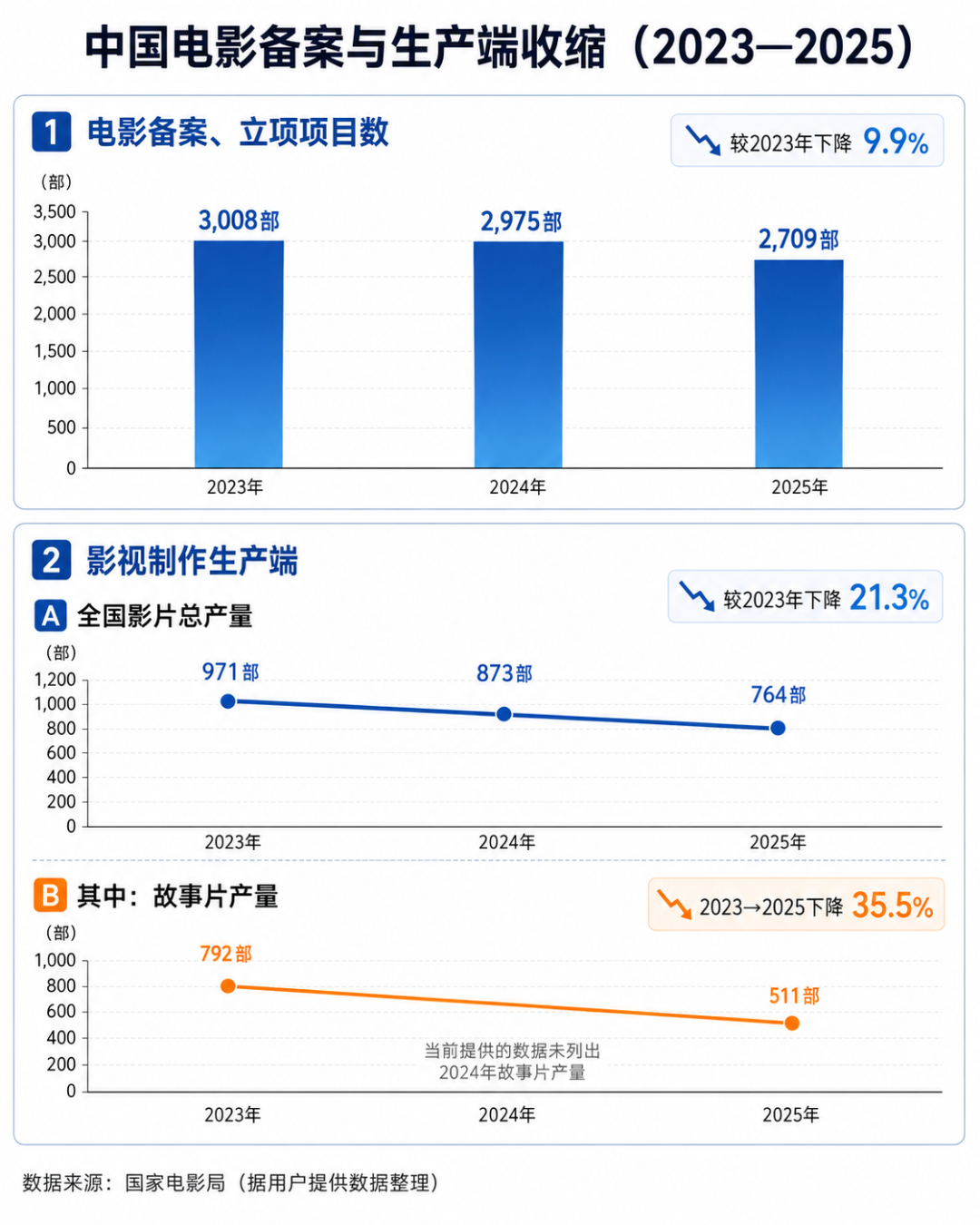
In 2023, the number of film projects that were filed and approved rebounded to 3,008, but decreased to 2,975 in 2024 and further declined to 2,709 in 2025. However, on the production end of the film and television industry, a more significant contraction occurred. According to data from the National Film Bureau, the total output of films nationwide was 971 in 2023, dropping to 873 in 2024 and 764 in 2025, with the output of feature films decreasing from 792 to 511.
If we look at the number of films that have actually started production, the situation is even more exaggerated. According to Baidu, there were over 700 films that started production in 2024, but this number has shrunk to around 200 in 2025. For the Chinese film industry, a project is only considered to have started production when the funds have been received. More and more projects have not yet started production, leaving cinemas to rely on the backlog of films from previous years.
Additionally, many film companies have also depleted their capital.
As of August 26, among the 15 A-share film companies that have disclosed their semi-annual reports, only 6 have positive net profits attributed to their parent companies. China Film's revenue in the first half of the year was 1.512 billion yuan, with a net loss of 110 million yuan attributed to its parent company. Bona Film also reported a loss of 169 million yuan in the first half of the year, although the loss was less than the previous year.
A film company needs to nurture its team, develop projects, and bear the costs of failures, all of which involves continuous operations over several years, which is clearly different from a box office rebound in a given year.
In 2025, Enlight Media relied on "Ne Zha" to achieve full-year revenue of 4.04 billion yuan and net profit attributable to the parent company of 1.672 billion yuan, representing year-on-year growth of 154.8% and 472.62%, respectively. However, in the first half of 2026, revenue plummeted to 324 million yuan, with net profit attributable to the parent company of 33.009 million yuan, down 98.52% year-on-year. A super project can indeed rewrite a company's annual report, but no one can guarantee what the next financial report will look like.
Capital is becoming increasingly hesitant to invest in upstream projects, while downstream films that have already been produced are hesitant to be released. The so-called "summer blockbuster season", although still defined as the three months from June to August, has seen its competitive landscape stretched out much longer.
From sneak previews and presales to just a few weeks before release, a mid-tier film only has about two weekends to prove itself. This year, "The First Part of the Three Kingdoms: The Fight for Luoyang" had 15.6% of screenings on its opening day, but 16 days later, its cumulative box office had not exceeded 90 million yuan, and its screenings had dropped to 0.9%, ultimately leading to its withdrawal from theaters, with its poster even being used by "Niu Lai" for mockery on the back of a billboard.
Today's market is reaping the benefits sown two years ago, and it looks quite satisfying, but the problem is that the farmers who planted them have left, so what will we eat in a few years?
The Audience Remains, But the Business Has Changed
Good news is that audiences are still willing to pay to go to the movies; the bad news is that their tastes are becoming increasingly difficult to discern.
In the summer box office data, there's an interesting change. 2026 is the first year in nearly five years that no film has surpassed 3 billion yuan in summer box office revenue, and the average number of films watched per person and the average number of times people go to the movies have not increased with the growth of the overall market. However, the proportion of people watching movies alone has risen for four consecutive years, and the differences in audience between different top films are becoming increasingly pronounced.
In the past, a film that scored 70 in all aspects could theoretically sell a decent base on its genre, stars, and marketing. However, now a film needs to score 70 and also give audiences a compelling reason to spend money to watch it in theaters, in addition to having no obvious flaws.
In other words, the market this year is entering a state of "high word-of-mouth but hard to break out of the circle," where a box-office hit must have a notable strength that audiences can immediately perceive.
In addition to the audience, cinemas are also facing a mathematical problem. This summer, a total of 38.51 million screenings were held, with 340 million viewers, setting a new historical high, but on average, there were only about 8.8 people per screening, and the average ticket price fell to 36.74 yuan, the lowest for the summer season since 2022.
Rough calculations show that the average box office revenue per movie is around 323 yuan, and after deducting daily expenses and consumption, this is still not the amount that the cinema can ultimately retain.
Meanwhile, the supply side continues to increase. By the end of 2025, the number of cinema screens in cities nationwide had reached 93,187, and as of the end of July this year, 363 new cinemas and 2,215 screens had been added. This has resulted in a situation where, when popular films are released, core theaters are still difficult to get tickets for, but mid-to-low-tier films often have very few attendees. As a result, cinemas can only continue to lower prices, follow trends, and compete for IMAX and high-value users, leading to more and more resources being allocated to a small number of films.
In the past, American farmers would dump milk into the Mississippi River to suppress prices, but nowadays, movie theaters don't have to go to such extremes, they just need to keep screening one empty show after another.
Doubao's Scheduling Creates New Resource Misallocation
As the market becomes increasingly unpredictable, the industry's most natural reaction is to seek a safe haven that has proven successful in the past, which is why the Spring Festival, summer, and National Day holiday seasons, known as the golden seasons, are taking on more and more tasks that they were not originally meant to bear.
This also explains why we found few new releases when browsing through the September lineup.
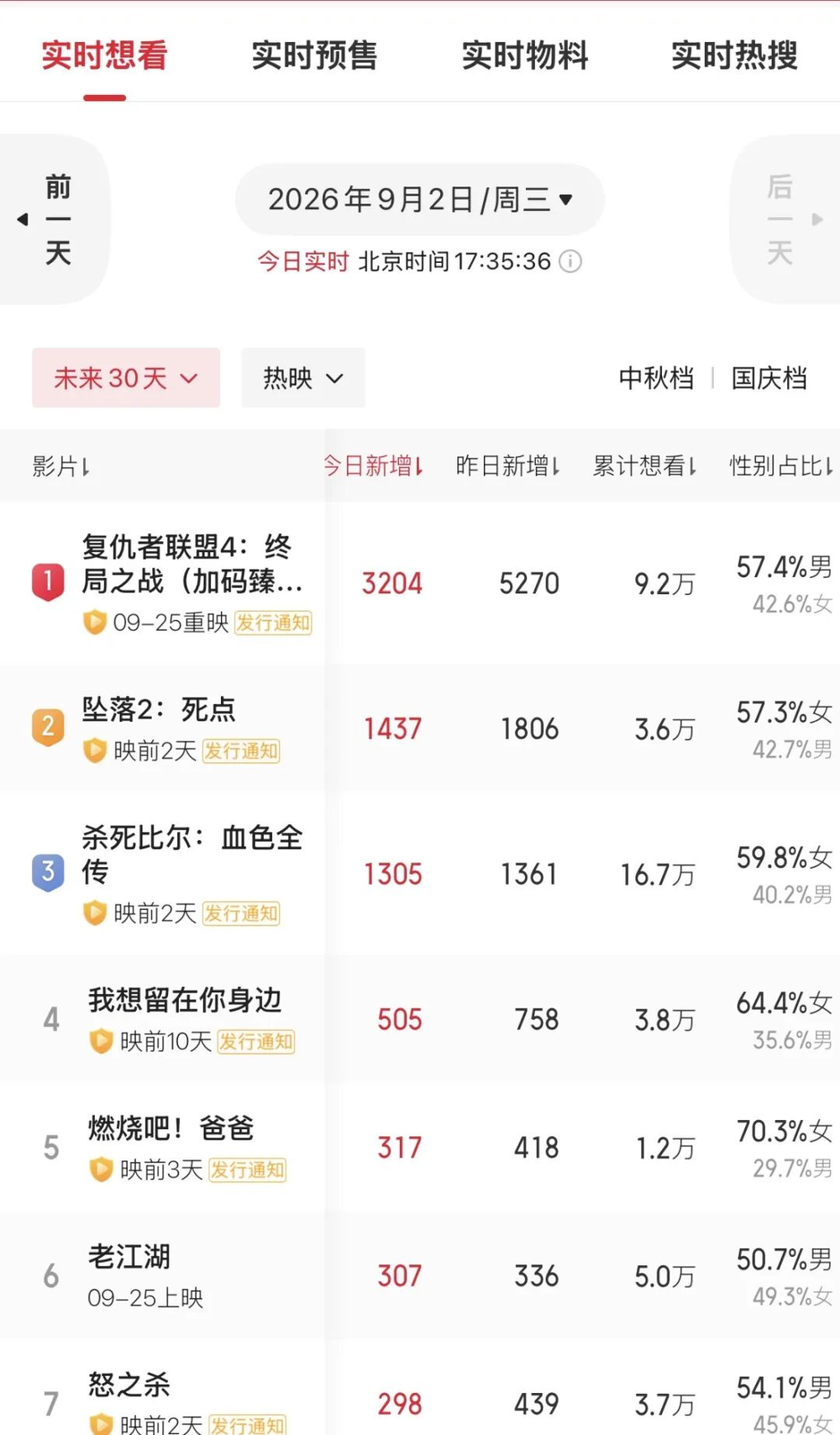
Movie investments run into hundreds of millions, and no company is willing to use an ordinary weekend for a large social experiment, as long as historical data proves these dates are more likely to be a hit, they will become one of the few "box office windfall periods" in the eyes of capital. But what are the consequences of everyone crowding in? The summer season has become a battleground where releases are advanced, withdrawn, and sneak previewed all at the same time.
For example, the release of "Annual Meeting Can't Stop! 2" was originally scheduled for August 7, but was later moved up to August 1, essentially trying to grab a spot in a limited window, but ultimately ended in a rushed conclusion.
An audience won't suddenly have 12 hours to watch movies just because six films are released at the same time; the more projects are concentrated, the fiercer the competition between screenings will be. Originally, everyone crowded into the prime season to avoid the risks of ordinary seasons, but now everyone is involuntarily concentrating the risks on the same table.
The 2026 Spring Festival box office totaled 7.52 billion yuan, while the Qingming Festival box office was only 3.02 billion yuan over three days, and the May Day box office was 7.48 billion yuan. Although these periods cannot be directly compared, they explain why large-scale projects are becoming increasingly cautious when choosing release dates.
Major productions feel that the box office capacity during the Qingming Festival, Dragon Boat Festival, and ordinary weekends is insufficient, so they opt out and squeeze into the prime slots. Without enough compelling new releases, film companies believe audiences have not developed a stable viewing habit during these periods, so they squeeze into the prime slots. When one company evaluates the release schedule, they will see that the historical overall box office performance on these dates is not good enough, and therefore continue to squeeze movies into the prime slots.
What's even more frightening is not that everyone is crowding into prime time, but that once this cycle forms, it's hard to stop on its own.
To get to this point, how can the times of the year that are defaulted to be "difficult to sell tickets" be transformed into a market where movies can normally do business. In recent years, the film industry has actually made many attempts at sub-distribution and regional distribution, allowing movies of different sizes and audiences to not all compete at the same time, but the premise is that the supply and audience must match accurately.
This summer's "A Letter to My Mother" provides a ready-made example, as the film initially did not directly enter the national market, but instead limited its preview screenings to 82 cinemas in the three cities of Shantou, Jieyang, and Chaozhou, before expanding to the entire Guangdong province and eventually the rest of the country. For many small and medium-sized films that lack the ability to spend heavily on national releases during peak seasons, this approach proves at least one thing: it is crucial to first identify the group of people most likely to buy tickets for the film, which is essentially the problem that targeted releases should aim to solve.
In short, if all films can only rely on prime time, then prime time is no longer prime time, but rather a crowded shelter. What the Chinese film market really needs to do is to have good films that can create "box office miracles" on the other 200 or 300 ordinary days.