
On September 1, TCL filed a lawsuit against Samsung Electronics in a Los Angeles federal court, alleging that the latter's 2026 M-series TVs do not use Mini LED technology despite being marketed as such, constituting false advertising.
This is the third time the two companies have gone to court in the US in over a year.
It's worth noting that Samsung Display is still the second-largest shareholder of TCL Huaxing to this day. The capital ties remain unbroken, but the market competition between the two has become increasingly fierce.
It's about advertising, and the competition is for the high-end market
TCL alleged in the lawsuit that Samsung took a low-end non-Mini LED model from its recycled product line and sold it to the public as a "top-of-the-line" Mini LED model at an attractive price, and TCL is seeking a court injunction and damages.
Samsung Electronics responded that its product descriptions are accurate and error-free, and that it will vigorously defend itself in court.
Mini LED is a technology that arranges tens of thousands of micron-level chips on the backlight of a liquid crystal panel to achieve fine light control, positioned between traditional liquid crystal and self-luminous OLED (organic light-emitting diode), and is the stepping stone that Chinese brands have relied on to enter the high-end market in recent years.
TCL is touting this as a core selling point, with industry data showing that its Mini LED TV shipments more than doubled in 2025 year-over-year.
If the three words "Mini LED" become a label that can be casually attached, what gets diluted is not just a slogan, but the entire pricing system of the high-end segment.
TCL is arguing over the authenticity of advertising, and competing for the right to define high-end products.
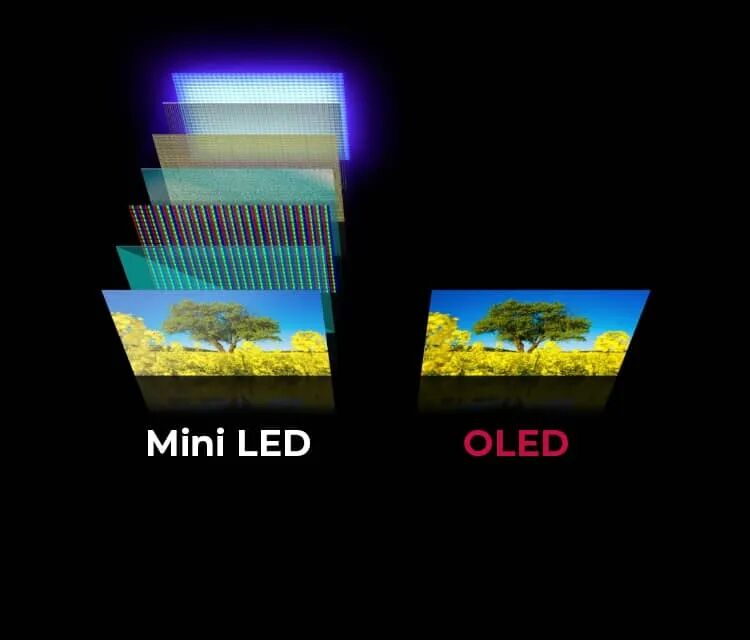
Of course, the complaint is only one side of the story, and whether the M series lives up to its name remains to be proven and judged.
The tricky part is that the industry has no unified mandatory standard for what qualifies as Mini LED in terms of chip size and partition count.
Under a standard vacuum, all parties can speak for themselves, and the court has become a standard battleground.
The naming dispute is not one-way, as in March this year, a German court, in response to a complaint filed by Samsung, ordered TCL to stop using the QLED (quantum dot) label on some of its products. Both sides are using technical naming to block each other, indicating that they both consider this to be the most cost-effective battleground.
It begins with division of labor and ends with division of labor
Let's turn the clock back six years, when the script was completely different.
In 2020, Samsung accelerated its exit from LCD liquid crystal manufacturing, which it considered mid-to-low-end, as TCL Huaxing acquired Samsung's Suzhou panel factory for approximately $1.08 billion, while Samsung Display made a counter-investment of $739 million to take a stake in TCL Huaxing.
After the spring delivery in 2021, Samsung Display holds 12.33% of TCL Huaxing's shares, becoming the second-largest shareholder.
At that time, the division of labor was actually clear, with Samsung retreating upstream to focus on OLED and high-end terminals, while TCL took over manufacturing capacity and tied its largest customer through equity.
TCL Technology disclosed at the time that Samsung has long accounted for roughly 15% of TCL CSOT's large-size panel shipments.
The industry refers to it as a "stock-for-stock marriage".
The premise of the alliance was mutual complementarity, but over the past two years, the complementarity has increasingly resembled overlap, and the relationship between the two parties has shifted towards competition.
Upstream, after TCL Huaxing took over LG Display's Guangzhou factory, it further expanded into the high-end market that Samsung had retreated from by adopting routes such as printed OLED and partnering with Sony. Downstream, according to data from Ovi Cloud, TCL's global TV shipments are expected to reach 30.4 million units in 2025, narrowing the gap with Samsung's 35.3 million units to less than 5 million units, with December shipments surpassing Samsung's for the first time.
At the beginning of the year, TCL announced that it would take over Sony's TV and other home entertainment businesses through a 51% stake joint venture, with the final agreement landing at the end of March. Calculated based on the original market share of both parties, the combined market share after the merger is expected to surpass Samsung's twenty-year reign as the industry leader.
Samsung's moat has been compressed to two areas: the premium brand premium and OLED patent advantages, which are precisely the two areas where TCL is currently launching its most aggressive attacks.
When the lines of defense are completely overlapping, the share swap is no longer a buffer.
Litigation is an extension of the negotiating table.
A timeline can be drawn, and the escalation of friction between the two sides can be traced.
Last June, Samsung Display sued TCL Huaxing for OLED patent infringement in the Northern District of Texas court, breaking the tacit understanding that had been in place since the share swap. In March this year, TCL Huaxing countersued in the Eastern District of Texas court and added Walmart and Best Buy, two channel vendors, as co-defendants, directly targeting the sales chain. With this false advertising lawsuit, the battlefield has expanded from upstream patents to downstream marketing.
This development path is not unfamiliar to the industry.
Over the past decade, Samsung and BOE, as well as LG and Chinese panel makers, have all gone through similar cycles of litigation, countersuits, and settlements. The years-long patent war between BOE and Samsung has also ultimately come back to the negotiating table.
In the eyes of the industry, the essence of such lawsuits often lies not in determining right or wrong, but in calculating costs, increasing the expense of competitors' expansion, buying time for oneself, and accumulating leverage for eventual cross-licensing or market division.
In this light, the three lawsuits between TCL and Samsung have more of a defensive counterattack tone than a complete breakdown.
That said, it's worth noting that the equity ties between the two sides remain unchanged and the supply relationship is still intact. What has changed is only the way profits are distributed, so calling it a "falling out" would not be accurate.
From marriage to coopetition, and then to litigation, the underlying dynamic is an inevitable collision between China's display industry—having completed its scale-based catch-up—and the incumbents defending their prerogatives in defining the high end and setting the profit order. The gavel will eventually fall in court, but the real outcome is more likely to be written at a negotiating table somewhere down the road.
What is highly concerning in the industry is not the mutual lawsuits between the two companies, but when standards lag behind technology and contracts cannot keep up with competition, lawsuits become the lowest-cost way to declare war. Keeping the door to negotiation open while fighting may be a required course for both parties in this structural contradiction.