
A client said to me: "Director Chu, your report has a strong AI flavor."
Another client used Claude to generate a solution, then looked up and asked me: "Teacher Chu, why is your judgment different from its?"
This is an AI consulting scenario I encountered over the past month.
I have always been an active advocate, practitioner, and explorer of AI applications, such as:
Written in 2026 (When the client says your report has a strong AI flavor)
The 2024-written AI Crisis Consulting 1.0 has been launched, featuring an 80-point crisis statement.
How Can Salaried Workers Avoid Being Replaced by AI?
Recently, AI has gradually moved from behind the scenes to the forefront. Let's take a closer look at the two scenarios mentioned at the beginning.
The use of active annotation in AI
Scene one: The AI flavor in the report.
I sent a progress report to the client, and the next day, the client told me, "Zhu, your report has a clear AI flavor." I replied, "Yes, I did use it, and it's efficient." I don't shy away from using it, nor do I worry about telling the client. However, the integration of AI has not yet been fully standardized.
What customers care about is not "whether you used AI," but "whether you are transparent." If customers can also use AI, why should I gain their trust by hiding it? What customers want is results, they care about whether the problem has been solved and whether the conclusion is valid. You should proactively disclose whether you used AI and how you used it.
After some thought, I realized that the client's words actually implied five layers of meaning.
A true expert never needs to hide their tools, they just need to keep climbing to the fifth level, making themselves a person worthy of being distilled, yet forever unable to be distilled.
From that day on, I decided that any report I submitted to clients that involved AI-assisted generation would clearly indicate as such from the outset. This is a matter of trust and integrity.
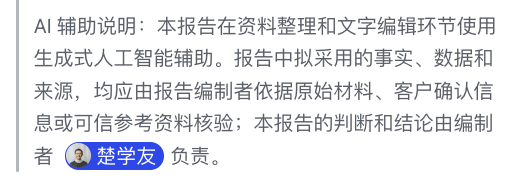
For example, this is the annotation at the beginning of the Feishu document report I provided to the client.
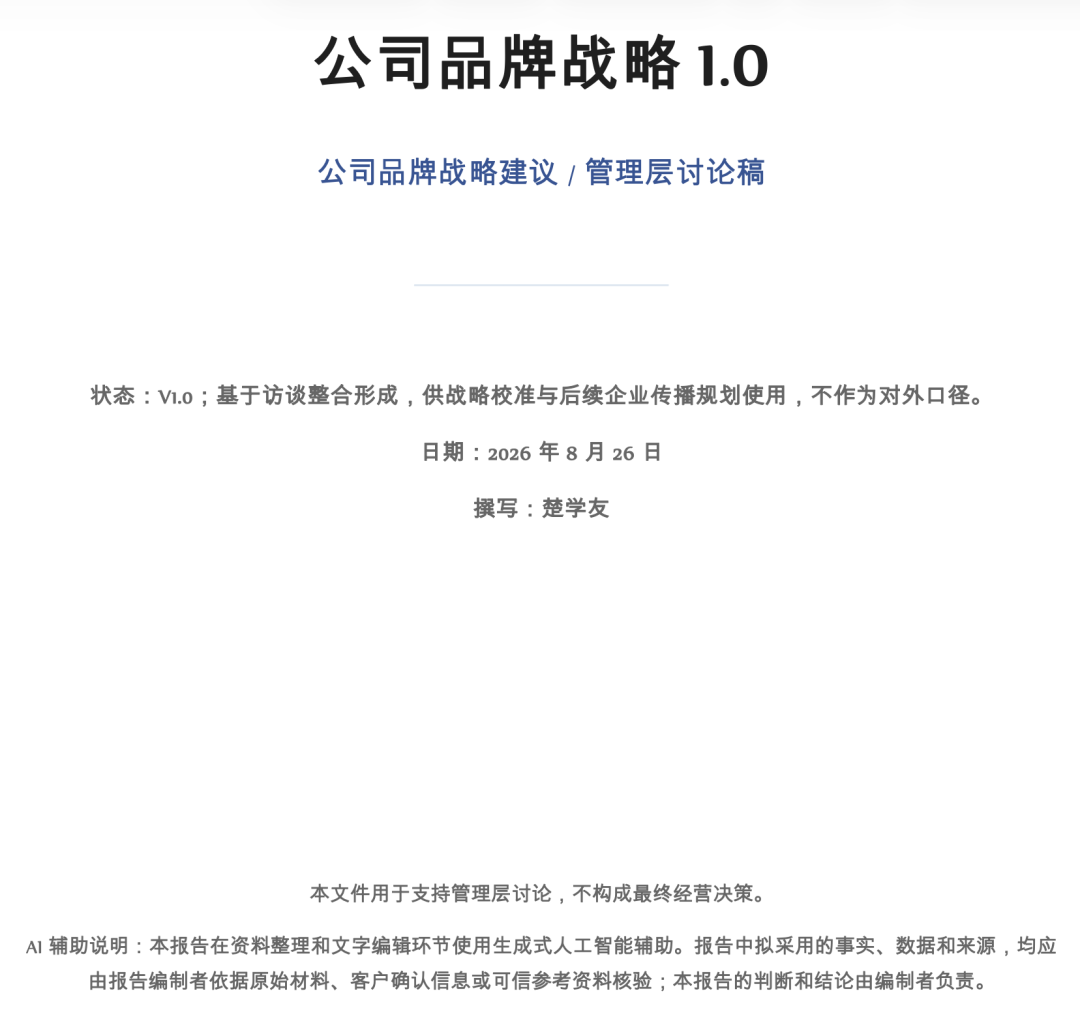
This is the cover page of the Company Brand Strategy 1.0 discussion draft for my client, note the two lines of small print at the bottom.
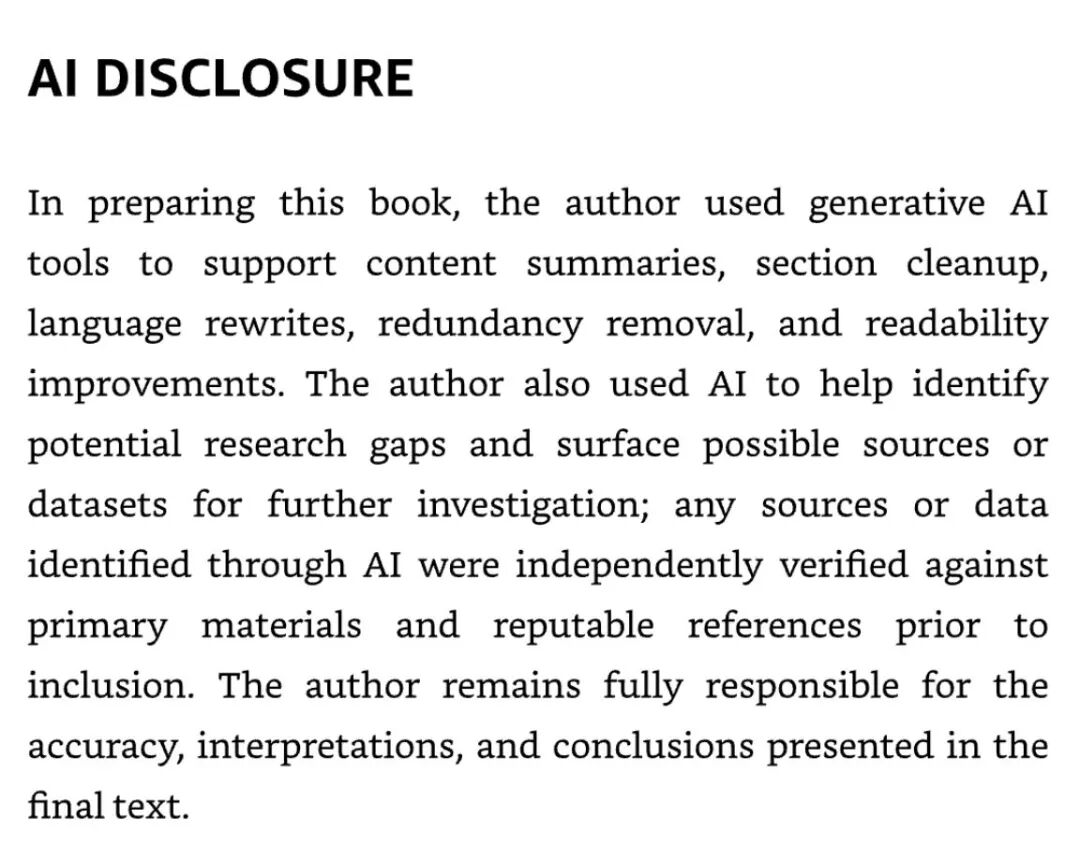
It so happens that I came across a statement by an author at the beginning of a book that was similar in nature.
Artificial Intelligence Versus Me
This month, during a discussion of a major client draft, the discussion draft 3.0 was projected onto a large screen. After focusing on a crucial paragraph, it seemed that everyone had no objections.
Customer A was intently staring at the screen, then looked up and said, Teacher Chu, I had Claude generate this, let's take a look together.
I agree. After reviewing, I said there were three revisions, two of which were not good, and one that could be adopted.
First, let's talk about two negative aspects.
First, the original text used the term "blind spot", which has been changed to "weak point".
The issue lies in the loss of semantic accuracy, which reduces the precision of expression.
AI often replaces words with professional context and sharp judgment with more common, smoother, and safer words.
For instance, translating "blind spot" as "weak point" or "blind area" may seem fluent on the surface, but it actually loses the original word's connotations of new trends, unknown risks, exploratory states, and potential flashpoints.
"Shortcomings" describe inadequate capabilities, "blind spots" refer to areas that have not been covered, and "blind points" refer to specific points that have not been identified and may trigger risks, which better aligns with the essence and attributes of this incident.
Second, when conveying negative messages, it changes a subordinate clause into two simple sentences in parallel.
The issue lies in the flattening of rhetorical structures.
Although there was bad news, there was still good news.
This is a typical realization of Proclaim: Counter in the Engagement system of Appraisal Theory (Martin & White).
It's called "pre-emptive concession". First, bring up the worst news that the other party is most likely to question, and then immediately refute it. The persuasive power comes from "acknowledging".
AI fails to recognize the risk communication function of the original sentence: it first proactively acknowledges unfavorable facts and then limits their negative consequences in the second half of the sentence. The bad news is thus incorporated into a complete explanatory structure, rather than being isolated from the good news. This is the semantic engine of "turning negative into positive".
Although the bad news will be automatically downgraded to secondary importance by the reader's reading consciousness, when you have offsetting good news, you can use a concessive clause.
However, when a company has substantial and significant bad news, the use of subordinate clauses is prohibited. It must be presented in an independent paragraph with complete attribution. Otherwise, it changes from a rhetorical device to "selective weakening", and a journalist can easily counter the company's narrative with a single question, "Why is this number only mentioned in a subordinate clause?"
In addition, a bit more good can be said.
The original text had a parallel logical structure, which was revised into a progressive small-medium-large logical category, making it more rigorous and organized.
After discussing this, we were all satisfied.
One common scenario for AI in professional services is when clients bring AI into the conference room as a "second opinion" to verify and challenge consultants on the spot.
In the past, customers mainly asked: "How should this be revised?" Now, they are more likely to ask: "This is the revision suggested by Claude, why is your judgment different from it?"
This means the value of consulting advisors is shifting from "providing an answer" to "evaluating the pros and cons of different answers, explaining the reasoning behind the choices, and taking responsibility for the final outcome."
The Courage of Signing One's Name
The PK with AI brings up a new issue, which is how consultants can prove themselves to be stronger than AI. This is a proposition that everyone must think about in the AI era.
I posted an update on my latest endeavors on my social media last week.
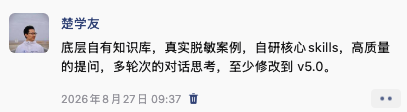
To elaborate, the real professional barriers are not about "I can also use AI," but rather a multi-layered set of capabilities:
• Its own professional knowledge base, providing a stable basis for judgment;
• Continuously accumulating real-world anonymization cases, providing contextual experience and outcome memories;
• Developed in-house core skills and workflows, converting personal experience into repeatable methods;
• Familiarity with and updates on meta-knowledge in professional fields;
• High-quality questioning ability determines whether AI answers surface-level questions or delves into the essence of the problem;
• Multiple rounds of conversation and cross-validation to avoid accepting the first seemingly plausible answer;
• Iterative refinement from v1.0 to at least v5.0, converting generated content into professional-grade deliverables.
Comprehensive judgment on semantics, facts, rhetoric, compliance, and stakeholder response;
• Invite customers to co-create, question, and explore, driving each other's growth;
• Acknowledges its own limitations and shortcomings, and gladly accepts constructive feedback from customers and AI;
Take a professional stance in being accountable for final recommendations.
I am continually refining these tools, having previously released my AI consulting tool, and I plan to release a series of skills next.
AI will not simply eliminate professional services, but rather increase the frequency of client verification of professional capabilities, such as the scenario described in this article, which will become more frequent.
Clients will increasingly use AI to generate alternative answers and challenge consultants in real-time; the value of consultants will lie in their ability to more accurately identify semantic differences, contextual boundaries, and decision consequences than AI, and to converge "many possible answers" into a professional judgment that can withstand scrutiny and be truly actionable.
Yesterday, I saw Professor Li Ning from Tsinghua University share an article he had just written on his social media circle:
Let the model handle 80% of the tasks it excels at, such as verification, drafting, rewriting, and cleaning up, and firmly grasp the remaining 20% that cannot be replaced, including judgment, selection, specific experience, and the courage to take responsibility. The key is not to reject AI, but for consultants to be able to make on-the-spot judgments about what to adopt, what to reject, and why, as well as the potential consequences of dissemination and responsibility after modification. This is the core value of professional service providers in the future.
Li Ning|Tsinghua University
The courage of signature, the exquisite summary. I really like this phrase, it's full of confidence, courage, and strength, revealing the determination when releasing the report and responding to challenges.
True experts welcome such challenges, while fake experts will be exposed.