
Zhao Changpeng did not deny radical marketing.
He said first that the market marketing can be a bit more aggressive.
On August 29, Zhao Changpeng stated on social media that if marketing escalates to personal attacks, or even damages others' future career development, it is unnecessary; rather than disclosing unnecessary details, it's better to resolve the issue through legal means.
Although no names were mentioned, the statement is widely seen as a response to Sun Yuchen's previous approach of publicly airing private disputes. Sun Yuchen later responded, expressing agreement and stating that the rest would be left to the court. Subsequently, Zhao Changpeng's decision to unfollow Sun Yuchen quickly became a focal point of public opinion.
If marketing can be radical, where are the boundaries, and what can an entrepreneur exchange for traffic?
One's own stories, views, products, failures, and even controversies can all be used as marketing materials. However, if gaining traffic requires using other people's privacy, reputation, or even their lives, while the benefits accrue to oneself and the costs are borne by others, the issue goes beyond just marketing boundaries.
It first became an issue of rights, and then an issue of traffic.
Justin Sun Has Always Known How to Harness Traffic
If one only understands Justin Sun as someone who "likes to hype things up", it actually underestimates him.
He realized early on that in an emerging industry, attention itself is a business resource.
In 2019, he paid $4,567,888 for a charity lunch with Buffett. In 2024, he paid $6.2 million for Italian artist Maurizio Cattelan's work "Comedian" - a banana taped to a wall.
The value of these actions is up to individual judgment, but in terms of dissemination results, Sun Yuchen clearly understands the leverage of attention.
This is highly relevant to the industry he is in.
Cryptocurrencies naturally possess strong community, strong narrative, high volatility, and global dissemination characteristics. Many early cryptocurrency projects lacked the easily understandable products and business models of traditional companies, and market perception and price expectations were more easily influenced by community consensus and narrative.
How founders explain the project, organize the community, and create a narrative can itself influence the outside world's perception of the project.
In such a business environment, founders are not only operators, but also important communication hubs.
Sun Yuchen has turned managing personal attention into an important part of his business approach.
So, the most worthy aspect of this controversy to study is not why he chased traffic, but rather another issue: when an entrepreneur becomes increasingly adept at manufacturing traffic, where should this ability be drawn to a halt?
Founders Are Becoming the New Traffic Entry Point for Companies
In the past, if a company wanted consumers to recognize its brand, it would typically have to purchase media, advertising, and channels.
The structure of dissemination has changed today.
The media landscape is highly fragmented, with attention being dispersed across more platforms and scenarios, causing the cost of traditional advertising to acquire users to continually rise. Meanwhile, a founder with a distinct personality, professional judgment, and continuous expression capabilities may become an extremely efficient channel for corporate communication.
Lei Jun's press conferences can directly spark widespread online discussion. Zhou Hongyi's public statements can quickly become a topic of conversation on multiple platforms. Yu Minhong's personal stance can also influence the outside world's perception of Dongfang Zhenxuan and New Oriental.
In the past, companies primarily gained attention by buying media.
Now, an increasing number of companies are producing attention directly through their founders.
The former pays for media costs, while the latter invests the founder's time, reputation, and public credibility.
This deal could be very cost-effective. A good founder's expression can bring brand exposure, shorten consumer decision-making, attract talent, and open up cooperation opportunities, and may even establish trust directly when the company is in crisis.
However, traffic portals do not necessarily equate to business assets.
A founder being able to get 10 million people to notice a company only shows that they have the ability to disseminate information, but what ultimately sticks with those 10 million people is another matter.
This ultimately determines how much traffic is worth.
Only Retained Traffic Can Become Assets
The same 10 million exposures can yield vastly different business results.
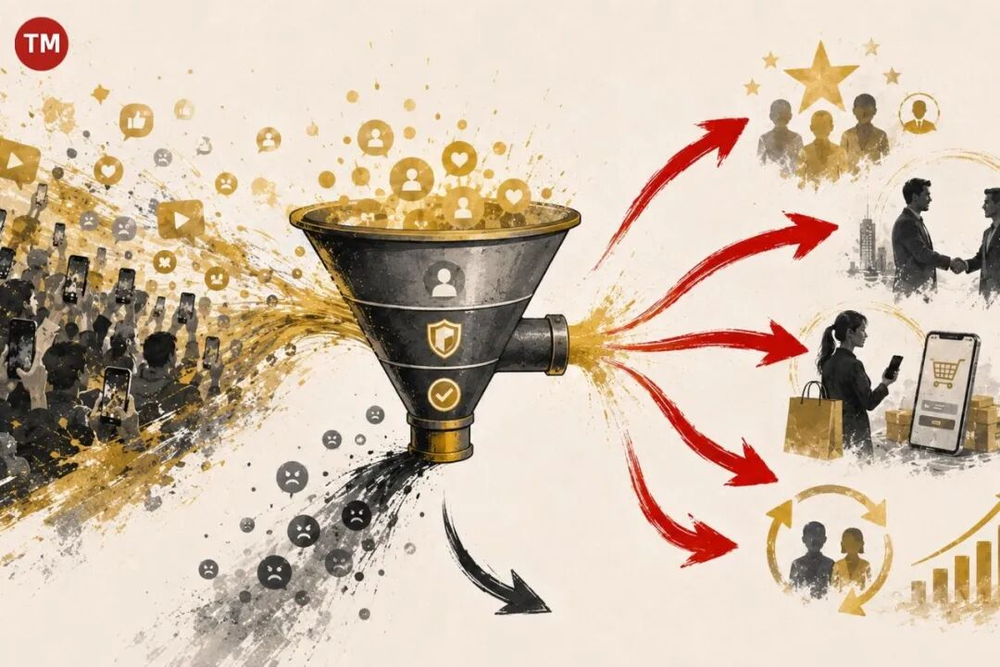
One consequence is that after the buzz dies down, nothing is left behind. People see it, discuss it, share it, and then move on to the next big thing.
This is traffic, but it's hard to count as an asset.
Another outcome is that attention leads to brand awareness, where people begin to understand your products, recognize your expertise, develop a favorable impression of the company, and are willing to try a transaction; after which they form repeat purchases, recommendations, and long-term relationships.
Valuable traffic will continue to take effect, enabling more people to understand the product, build trust, generate transactions, and ultimately develop into stable relationships.
There is also a third scenario.
Attention has increased, but trust has decreased.
The founder has come under intense scrutiny, customers have begun to waver, partners are on high alert, employees are feeling uneasy, and investors are reassessing the risks.
At this point, traffic may even change from an asset's entrance to a liability's entrance.
So, what determines the value of traffic is not how many people see it, but what happens after they see it.
For entrepreneurs, what needs to be operated is not just exposure, but the ability to convert traffic into awareness, trust, transactions, and long-term relationships.
This also means that some things, even if they are particularly easy to attract attention, may not be worth bringing up.
Not Everything That Drives Traffic Is a Marketing Asset
The business world used to discuss the boundaries of marketing, focusing more on authenticity, appropriateness, legal risks, and social ethics.
The attention economy also raises a more fundamental question: do you really own the things you use to generate traffic?
Their own entrepreneurial experiences, business judgments, failures, investments, and choices give entrepreneurs a considerable amount of room for expression, as it is first and foremost their own story.
Once the content involves another person's private experiences, identity information, cooperation details, or professional reputation, the logic changes.
Knowing something does not mean it belongs to you.
Having certain information does not necessarily mean you have unlimited rights to dispose of it, as many business relationships, personal relationships, and legal relationships involve privacy, confidentiality, personality rights, and contractual constraints.
Even if certain content has legal room for expression, another question still needs to be answered: is it necessary to bring it into the public eye.
Maintaining the public interest and conducting legitimate rights defense are different from simply converting private information into attention.
If disclosing private information is not for the necessary public interest or legitimate rights protection, but mainly for attracting attention, the disseminator is actually converting others' information into their own dissemination gains.
One person may gain reading, discussion, and influence, while another may bear the consequences of privacy exposure, reputation changes, and even career risks.
One party reaps the benefits of dissemination, while the other bears the corresponding costs, a relationship that has gone beyond marketing techniques themselves.
So, before an entrepreneur decides to turn something into content, they need to distinguish between several things: whether it belongs to them and whether they have the right to dispose of it; and even if they have the space to express it, whether it is necessary to further transform it into commercial attention.
Zhao Changpeng stated publicly that he did not reject radical marketing, but instead opposed taking marketing to the level of personal attacks, professional harm, and unnecessary private disclosures.
The more skilled an entrepreneur is at generating traffic, the more they need to distinguish between what belongs to their own dissemination assets and what does not.
Otherwise, the stronger the transmission capability, the greater the potential external costs.
The bigger the company, the less a founder's words belong to themselves
In the early stages of entrepreneurship, the biggest risk for many companies is not being criticized, but rather being unknown.
The company lacks a brand, its products lack recognition, and its founder lacks influence. At this stage, daring to express itself and proactively entering public discourse can often lower the cost of the company gaining attention.
As companies grow, the cost structure for the same amount of traffic will change.
An entrepreneur who already has enormous fame gaining an additional one million exposures is fundamentally different in value from an unknown entrepreneur receiving their first one million exposures.
More importantly, the people listening to him are no longer just netizens, but also customers, employees, partners, investors, regulatory agencies and the entire industry ecosystem.
They assess not only whether the statement has appeal, but also whether the person is worth collaborating with in the long term.
The founder's expressions are increasingly difficult to be seen as completely private behavior.
When personal accounts gain traction, companies may bear the brunt of brand repercussions; when individuals stir up controversy, employees, PR and business teams incur the cost of explanation; while founders reap attention from expression, partners may reassess their relationship with the company as a result.
The larger the enterprise, the more pronounced this effect is.
Zhao Changpeng is not someone who stands outside the rules to discuss this matter.
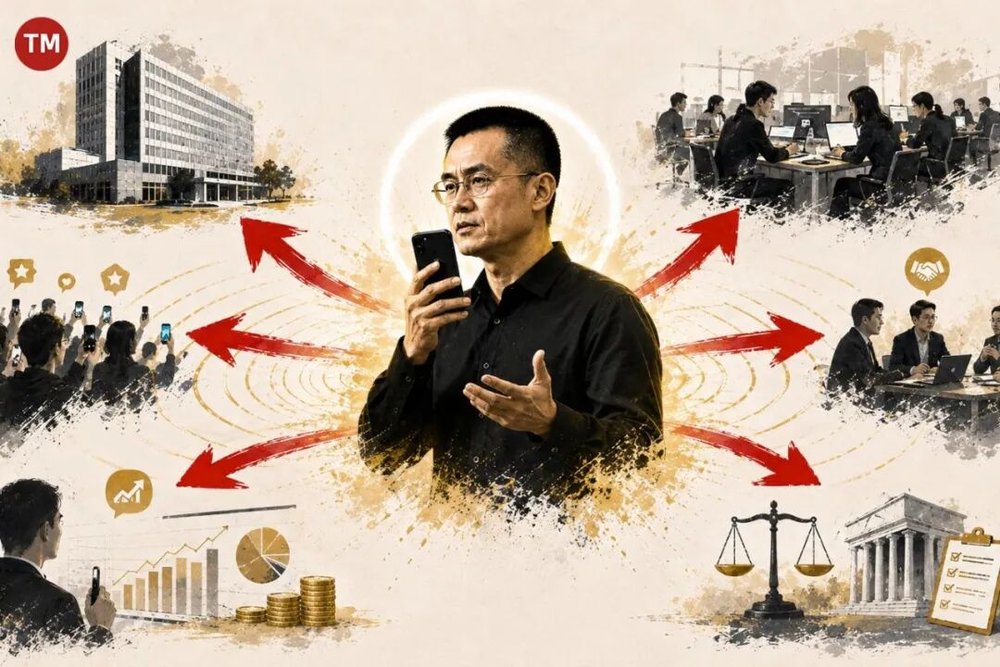
In 2023, he pleaded guilty and stepped down as CEO for Binance's failure to maintain an effective anti-money laundering program; in 2024, he was sentenced to four months in prison, with Binance also paying over $4 billion in financial penalties related to the case.
Although this does not prove that his current stance stems from past experiences, it is enough to remind entrepreneurs that when a company reaches a large enough scale, it becomes increasingly difficult to completely separate the founder's personal life, business operations, regulatory environment, and public credibility.
In the early stages of entrepreneurship, the biggest risk may be that no one notices.
After a company grows, a more difficult problem to tackle is whether people will still trust you after being seen by everyone.
Entrepreneurs Can't Just Focus on Traffic Numbers
Whether a wave of traffic is worth pursuing depends on the answers to at least three questions that entrepreneurs need to consider.
Firstly, is the matter yours, and do you have the legitimate, justifiable and necessary right to disclose it.
Knowing something is one thing, having the right to make it public and turn it into attention is another.
Secondly, what will be left of this wave of traffic after half a year.
If a marketing campaign can leave behind new customers, clearer brand awareness, more stable professional labels, and deeper trust, it has the opportunity to solidify into business assets. If, after half a year, nothing remains except a screenshot of a trending topic, no matter how big the sensation, it will be difficult to sustain value creation.
Third, if things get out of control, who will reap the benefits and who will bear the costs.
If traffic belongs to the founders, but the brand, employees, and partners bear the consequences, then the equation cannot be solely based on the number of views and followers.
Three questions ultimately boil down to one: what is left behind by this wave of traffic, and who is footing the bill.
Something More Valuable Than Traffic
What I'm most concerned about in Zhao Changpeng's public statement this time is still the first half of that sentence.
The marketing can be a bit more aggressive.
The question is, what are you going to exchange it for.
When the cost of traffic has to be borne by others, when a transmission starts to infringe on others' rights, and when the attention gained is consuming more expensive long-term credit, the equation changes.
The further entrepreneurs go, the more they realize that what is scarce in the business world is not being seen by many people, but rather being believed in, cooperating with, and being entrusted with important matters after being seen.
Traffic can be repeatedly acquired, but credit is not that cheap.