The summer of 2026 has come to a close, with the entire civil aviation market performing somewhat flatly, as overall travel demand increased, but ticket prices were relatively weak, presenting a "prosperous passengers, not prosperous revenue" situation.
According to data from Flight Master, from July 1 to August 31, the total passenger traffic during the summer travel season was approximately 150 million, representing a year-on-year increase of 4.4%. Domestic routes saw a 4.5% increase in passenger traffic, while international routes saw a 3.1% increase. The average passenger load factor for the civil aviation industry during the summer travel season reached 87.4%, up 1.7 percentage points from the same period last year.
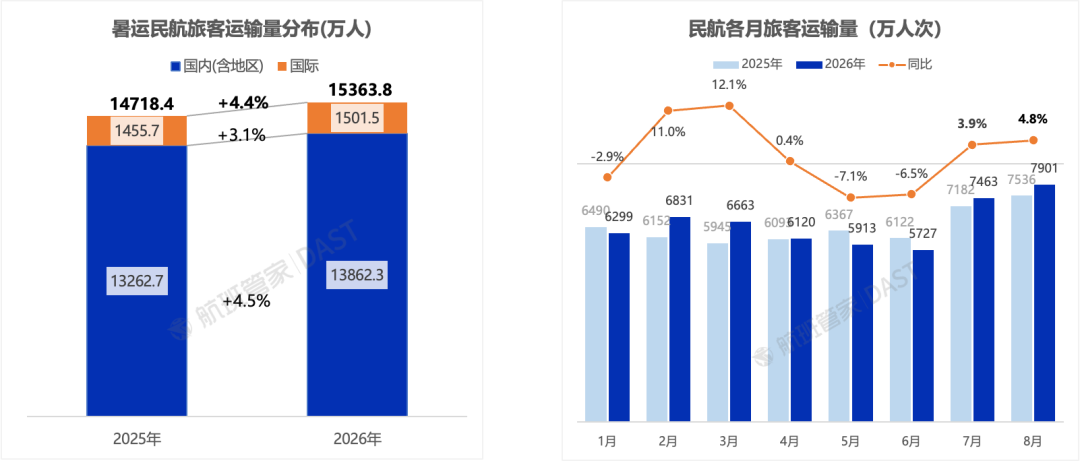
The basic situation of passenger transportation during the 2026 civil aviation summer peak, image source: Flight Steward
However, the fare situation failed to sustain the growth momentum of passenger numbers.
Data from a ticketing platform obtained by a Jiemian News reporter showed that the average domestic economy-class airfare for the 2026 summer travel season was approximately 719 yuan, down 8.4% year-on-year. Looking at daily trends, pricing followed a pattern of opening low and trending higher: July saw the steepest year-on-year decline, August showed improvement, and by the tail end of the peak season, fares had essentially matched the same period last year.
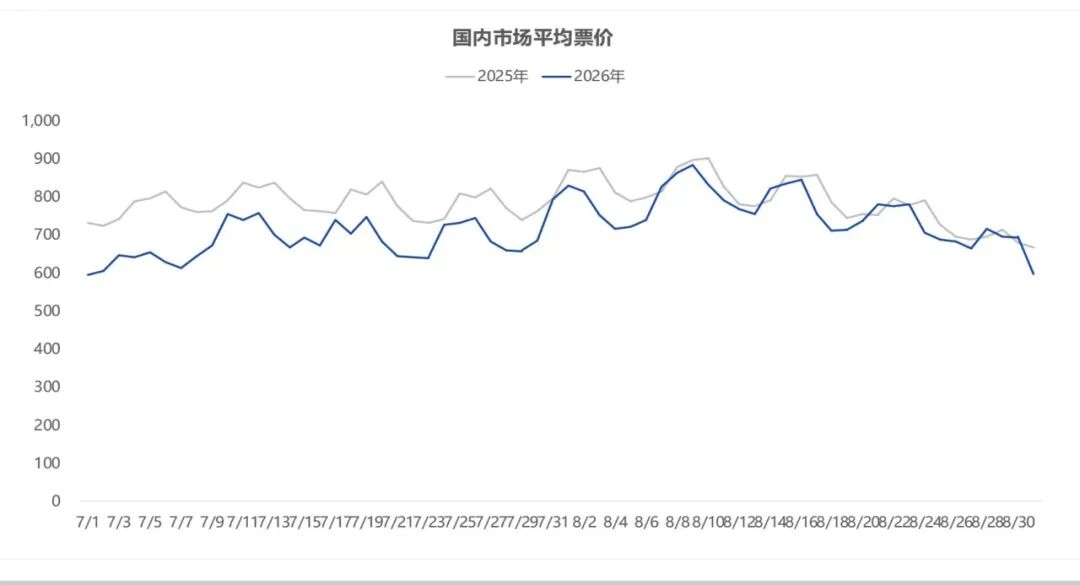
Summer travel season economy class airfare average price (excluding tax) Image source: Jiemian News
Weak ticket price performance also puts pressure on airlines' profit recovery in the third quarter. Due to fluctuations in international oil prices, airlines still face uncertain jet fuel costs. According to data from the Commodity Price Network, the price of aviation coal (new) on August 28 was $146.35 per barrel, up about 25% from July 1, still at a historical high.
'Price-for-Volume' Returns
This year's summer travel peak has been delayed compared to previous years, mainly due to the later summer break for elementary and middle schools, as well as higher fuel surcharges, which only led to a significant "booking rush" after two consecutive reductions.
According to Han Tao, an expert at the China Civil Aviation New Think Tank, the impact of fuel surcharges on travelers' willingness to travel was relatively significant during the initial period of the summer peak season, resulting in a phenomenon where the proportion of fuel surcharges in ticket prices increased, while the base ticket price decreased. Meanwhile, the high-speed rail network continues to divert traffic from medium- and short-haul flights, providing travelers with more alternative options and intensifying price sensitivity.
He pointed out that to maintain passenger load factors and stabilize market share, airlines generally adopt a strategy of trading price for volume, ultimately resulting in a situation where "passenger load factors rise and ticket prices fall".
Along with price-sensitive demand, summer domestic travel passenger traffic has further shifted to cheaper routes between smaller and medium-sized cities.
According to Qunar data, this year's summer air ticket sales for small cities such as Lishui, Bijie, Liupanshui, Delingha, and Datong have all increased by more than 80% year-over-year. The popularity of "rural county tours" continues to rise, with Fujian's Pingtan, Guangxi's Yangshuo, Jilin's Antu, Xinjiang's Xinyuan, Sichuan's Jiuzhaigou, Guizhou's Libo, Guizhou's Leishan, Xinjiang's Tekes, Zhejiang's Anji, and Xinjiang's Zhaosu ranking among the top 10 most popular county-level cities for summer travel.
A person in charge of the Civil Aviation Direct Sales Platform of Tongcheng Travel said to Interface News that during the summer travel season, the prices of some popular long-haul flights were more affordable, which led to a significant increase in the number of first-time passengers. The number of users who completed their first authentication on Tongcheng Travel increased by nearly 50% month-over-month. For these first-time passengers, the price of air tickets remains a key consideration.
Among the passengers, the number of passengers traveling to third-tier and below small airport cities as their destination increased by 26% year-over-year, with a growth rate higher than that of first- and second-tier cities, and the overall passenger flow has further shifted to lower-tier cities.
At the beginning of 2025, there were rumors in the industry that regulatory authorities required airlines not to sell tickets for less than 200 yuan. According to people from airlines, Interface News learned at the time that the relevant requirements had been verbally communicated.
Before the outbreak of the Middle East conflict, the industry's "price for volume" phenomenon eased somewhat due to the recovery of travel and proactive adjustments by companies. Data on 2026 Spring Festival ticket prices monitored by Flight Steward shows that the industry's economy class bare ticket prices have even risen by 5% compared to the same period last year.
This brief ticket price recovery ultimately did not carry into the summer travel season. Under the twin pressures of rising costs and intensifying market competition, airlines once again fell back on the pragmatic strategy of trading price for volume, making profitability even more elusive.
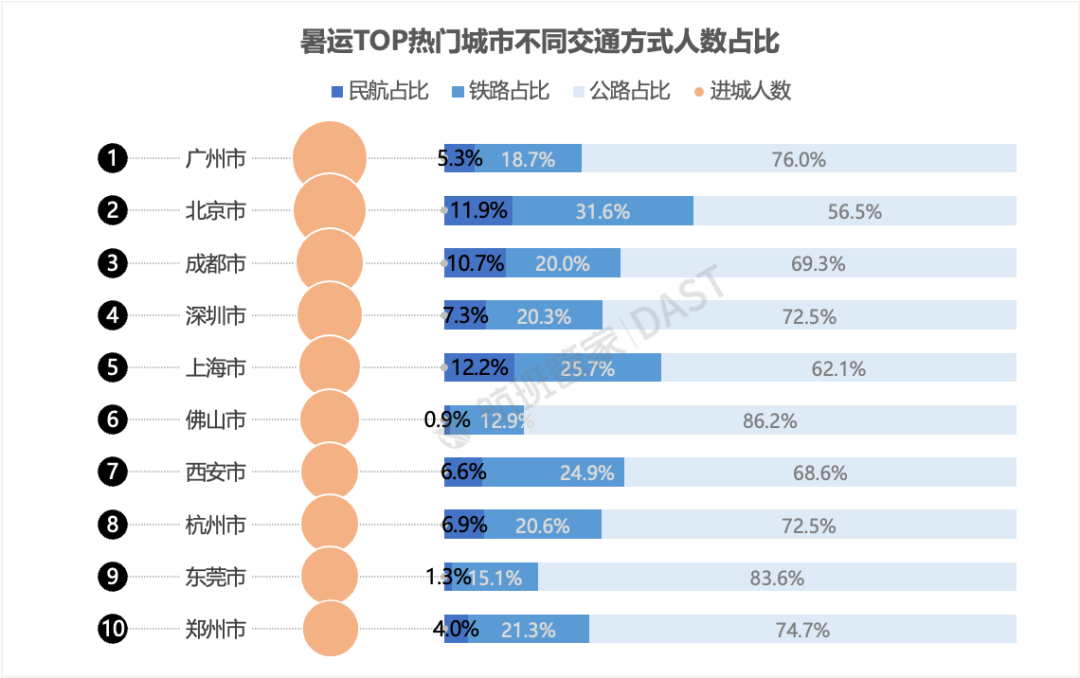
The proportion of people using different modes of transportation during the 2026 summer travel season. Image source: Flight Master

Inbound tourism is booming, but has limited impact on the broader market
Compared to the domestic market, another notable incremental growth in this year's summer travel season comes from inbound tourism. This summer, Chinamaxxing and ChinaCool have become popular, with foreign friends also coming to China to "spend their summer vacation".
According to data from Travelsky, the number of visitors to China from Kuala Lumpur, Bangkok, and Seoul increased by about 30% year-on-year, while the number of visitors from Singapore grew by around 20% year-on-year. Long-haul European tourist sources have also become a highlight of inbound tourism, driven by the prolonged heatwaves in many countries, with a surge in demand for summer getaways in China.
The current industry market has many players, and small and medium-sized airlines face significant survival pressure, with the underlying logic of low-price competition remaining unchanged. Han Tao told Jiemian News that the domestic routes are unlikely to see fundamental relief in the short term, while international routes are expected to see a faster recovery in ticket price increases, in addition to the diversion demand driven by international geopolitical influences.
However, from the overall current state of civil aviation, high growth rates do not necessarily equate to large volumes.
The significant growth in foreign tourists due to visa-free policies is still limited in the summer air travel market, which exceeded 1.5 billion passenger trips. According to data from VariFlight, from July 1 to August 25, the number of passengers on inbound flights exceeded 7.06 million, with only a slight increase compared to the same period last year. Additionally, "inbound flight passengers" also includes Chinese citizens returning to the country.
Another reality is that inbound demand from neighboring countries will be diverted through land and water routes.
The National Immigration Administration's port statistics show that in the first half of this year, the country inspected 490,000 flights entering and exiting the country, a year-on-year increase of only 1%; and 20,068,000 motor vehicles, a year-on-year increase of 17.8%.
The recovery of international air transport capacity has not been fully released yet.
According to data from Flight Master, the number of international flights during this year's summer peak season was 117,000, down 0.7% year-on-year, and still 11.5% lower than in 2019. In contrast, domestic flights have grown 21.7% compared to 2019, indicating a gap in the recovery of international routes versus the domestic market.
Compared to the civil aviation market, hotels and scenic spots have more quickly reaped the actual benefits brought by inbound tourism.
According to information from Ctrip, compared to traditional tour methods, this round of foreign tourists are "staying longer and experiencing more deeply", with the proportion of tourists staying two nights or more increasing from 38% to 64%. They are willing to spend time on local cultural experiences.
Nearly 60% of inbound tourists opting for private tours choose city gardens and performance events as their most preferred experiences, with local entertainment consumption increasing by 250% year-over-year.
In terms of destinations, inbound tourists are still mainly concentrated in traditional gateway cities such as Shanghai, Beijing, and Guangzhou, but the trend of spreading to second- and third-tier tourist cities is becoming increasingly apparent. The number of foreign visitors to Chengdu, Chongqing, Xiamen, Hangzhou, and Kunming has more than doubled.