Introduction
September 3 marks the anniversary of China's victory in the War of Resistance Against Japanese Aggression. Recently, Japan has used the 10th anniversary of the South China Sea arbitration ruling to intervene in South China Sea affairs, positioning itself as a "legitimate stakeholder." Japan is neither a littoral state nor a party to the dispute, yet it has been unusually active. In reality, it is using the rhetoric of "rule of law" to lay the groundwork for military involvement in the South China Sea. In recent years, Japan has continuously strengthened its military expansion through security assistance to the Philippines, reciprocal access agreements, and logistics cooperation, while applying double standards in the use of international law. Japan has yet to atone for its historical crimes and is not qualified to point fingers in the South China Sea. Its schemes will ultimately be futile.
Click "Read Original" at the end of the article to view the English version.
Author
Wang Yichen
Associate Research Fellow, Comprehensive Strategy Research Office, Institute of Japanese Studies, Chinese Academy of Social Sciences
Wu Huaizhong
Deputy Director, Institute of Japanese Studies, Chinese Academy of Social Sciences
In July 2026, a decade after the so-called South China Sea arbitration ruling, Japanese Foreign Minister Toshimitsu Motegi issued a statement endorsing the illegal ruling and attacking China's legitimate claims. Japan also joined the United States and the Philippines in a joint statement that distorted the facts on the South China Sea. Japan is neither a coastal state nor a party to the dispute and has no standing to comment, yet it has been unusually active on the issue. On the surface, this is a rhetorical contest over international law; at a deeper level, it is a deliberate operation by Japan to use legal formalism and rules-based language to build legitimacy for its military intervention in the South China Sea.
Using 'Rule of Law' to Mask Double Standards
Japan's core rhetorical move is to characterize China's rejection of the ruling as a departure from the principle of peaceful dispute settlement and a blow to the international rule of law. This framing may appear to occupy the moral high ground, but it is a deliberate conceptual substitution. As early as 2006, China made an exclusion declaration under Article 298 of the United Nations Convention on the Law of the Sea, removing maritime delimitation disputes from compulsory dispute settlement procedures—a right explicitly granted to every state party by the Convention. China's non-acceptance and non-participation in the so-called arbitration is precisely an exercise of the rights confirmed by the Convention, not a denial of the Convention itself.
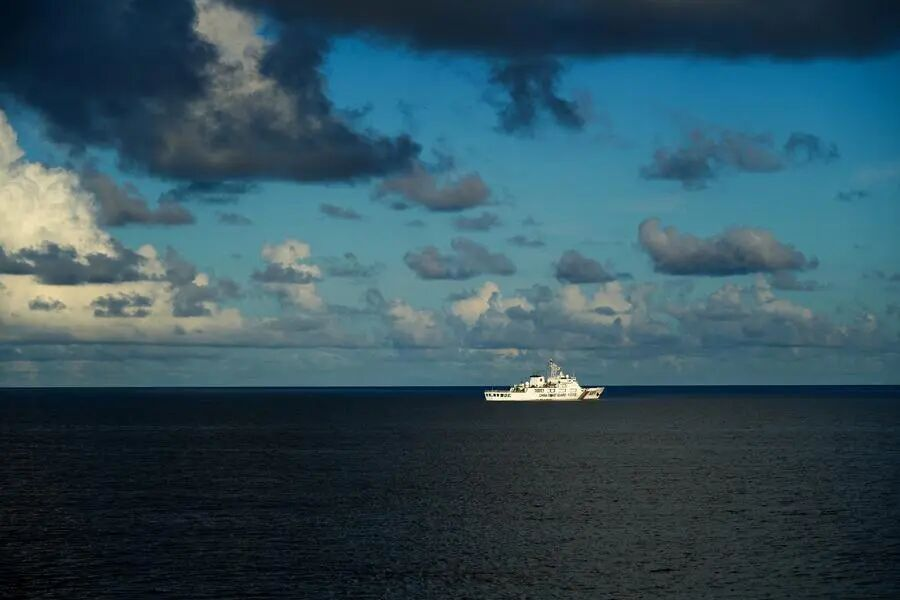
Image source: Xinhua
The South China Sea arbitral tribunal, for its part, was assembled under the direction of Shunji Yanai, a Japanese judge and former president of the International Tribunal for the Law of the Sea. Yanai previously served as chairman of the advisory panel on security legislation for former Japanese Prime Minister Shinzo Abe, helping Abe lift the ban on collective self-defense and challenge the constraints of the postwar international order. This shows the tribunal was politicized from its inception and lacked legitimacy. Moreover, the tribunal forcibly accepted delimitation issues that had been lawfully excluded, clearly exceeding its jurisdiction in determining competence. The resulting award, issued through such ultra vires proceedings, is naturally illegal and invalid. It has drawn sustained criticism from international law scholars in China and abroad since the day it was published.
Japan's current rhetoric empties the normative content of the rule of law and applies double standards to legal criteria. The clearest example is the Okinotori reef dispute: Japan insists on packaging Okinotori—a reef with no natural living conditions and less than 10 square meters of exposed area at high tide—as an 'island,' refuses to acknowledge its 'rock' status, and declines to submit the dispute to third-party adjudication. At the same time, it supports classifying China's Taiping Island, which covers 500,000 square meters and has fresh water and living conditions, as a 'rock.' Japan, it seems, follows not legal standards but only the fallacious arguments that can be used to pressure China. Treating international law as a divisible, selectable tool shows that what Japan actually respects is not international law itself but the geopolitical gains it can deliver.
Legal Rhetoric Backs Military Expansion
Comparing the evolution of the wording in Japan's official statements over the years with the timeline of its geopolitical maneuvers reveals a clear parallel trajectory. In 2016, when the ruling first came out, and for several years afterward, Japan's public statements remained at the level of self-styled 'defender of the international order,' without emphasizing so-called 'stakeholder' interests, and the Self-Defense Forces had no regular presence in the Philippines. In 2023, the Philippines became the first recipient country of Japan's Official Security Assistance (OSA). In 2025, the Japan-Philippines Reciprocal Access Agreement was signed and entered into force, giving the SDF a legal channel for stationing in the Philippines. The Acquisition and Cross-Servicing Agreement signed in 2026 filled in the logistics support component. Thereafter, Japan conducted island-seizure exercises and missile test-firings in the Philippines—the first time since World War II that Japan has launched offensive missiles overseas. Thus, from legal access to logistics support, from forward surveillance to firepower projection, a complete military intervention chain targeting the South China Sea has taken shape.

The evolution of Japan's wording tracks the formation of this chain. In 2025, the generic term 'stakeholder' first appeared in Japan's statements on the South China Sea. This year, it went further, upgrading to 'legitimate stakeholder.' Notably, in this year's statement by the foreign minister on the tenth anniversary of the South China Sea arbitration ruling, a new paragraph was inserted before this characterization, specifically describing how Japan has used OSA to strengthen military and coast guard cooperation with relevant countries. This shows that the essence of 'legitimate' and 'stakeholder' is not that Japan intervenes in the South China Sea because it enjoys legitimate rights, but that it needs to retroactively claim a 'legitimate' identity to justify military expansion that has already been underway.
From a broader geopolitical perspective, there are also external drivers behind Japan's activism. The South China Sea and Southeast Asia are viewed by Japan as a key region for implementing its Indo-Pacific strategy. As the United States pursues strategic contraction in the Indo-Pacific and asks allies to share the defense burden of the 'first island chain,' Japan has shifted from its traditional approach of mainly economic aid to the Philippines and instead taken breakthrough steps in military defense cooperation. This serves two purposes: to prove to Washington that Japan can serve as a forward fulcrum in the Indo-Pacific, and to seek external endorsement for breaking out of its 'defense-only' policy.
The Japan-Philippines talks on so-called maritime boundary delimitation, launched recently, follow the same logic. Their strategic aim is to connect the East China Sea, South China Sea and Taiwan Strait into a 'three-sea integrated defense line' to compress China's strategic space. For Japan, the South China Sea serves as both a rehearsal ground for intervening in the Taiwan Strait and a testing ground for its arms export relaxation and overseas military operations.
Guilt Unresolved, How Dare It Repeat Offense in South China Sea?
In modern history, Japan's invasion of China and its 'southward advance' inflicted severe disasters on Asian countries. The Cairo Declaration and the Potsdam Proclamation after World War II explicitly stipulated that Japan must return the Chinese territories it had stolen. This serves as both the international legal basis for China's recovery of the South China Sea islands and an important part of the postwar international order. Japan has also repeatedly promised to abide by the relevant provisions of the Potsdam Proclamation and should respect the postwar order. Yet more than 80 years later, Japan has returned to the South China Sea as a 'stakeholder' and, under the banner of 'security cooperation,' is reincorporating Chinese territories it once occupied by force into its military deployment.
Ironically, Japan in the joint statement loudly opposes 'causing regional instability through force and coercion,' yet it is Japan itself that continues to strengthen its military presence and involvement in the South China Sea. Every accusation it levels at China applies seamlessly to Japan. Meanwhile, Japan's narrative is losing persuasiveness: among the signatories of the joint statement, only the Philippines is a South China Sea littoral state, while the one truly fixated on the 'ruling' is Japan, a distant extra-regional country. This shows that Japan's tactic of using law as a cloak and rules as rhetoric has failed to win recognition from the waters it claims to protect.
Historical guilt will not dissolve with the passage of time, nor will military expansion be legitimized under the guise of 'security cooperation.' China's will to safeguard its territorial sovereignty and maritime rights and interests is unwavering. Any attempt to disrupt regional peace in the name of an illegal 'ruling' will ultimately be in vain.
The English version of this article was published in China Daily's international edition under the English title 'Smoke and Mirrors.' Click 'Read More' at the end of the article to view it.