
This summer, a batch of graduates who had received job offers and were full of expectations did not start their new jobs as planned, but instead received notices asking them to leave or change positions. Graduates who had their offers revoked and were laid off are facing powerful entities and finding it difficult to seek justice, leaving them no choice but to swallow their grievances and start over.
The company offered two options to the newly graduated employees who were being laid off: either resign voluntarily for "personal reasons" and receive half a month's salary as compensation, or be transferred to the production line to work on tasks such as screwing and wire plugging, with their salary reduced to the worker standard of 20 yuan per hour, and required to be in the factory for at least 11-12 hours a day.
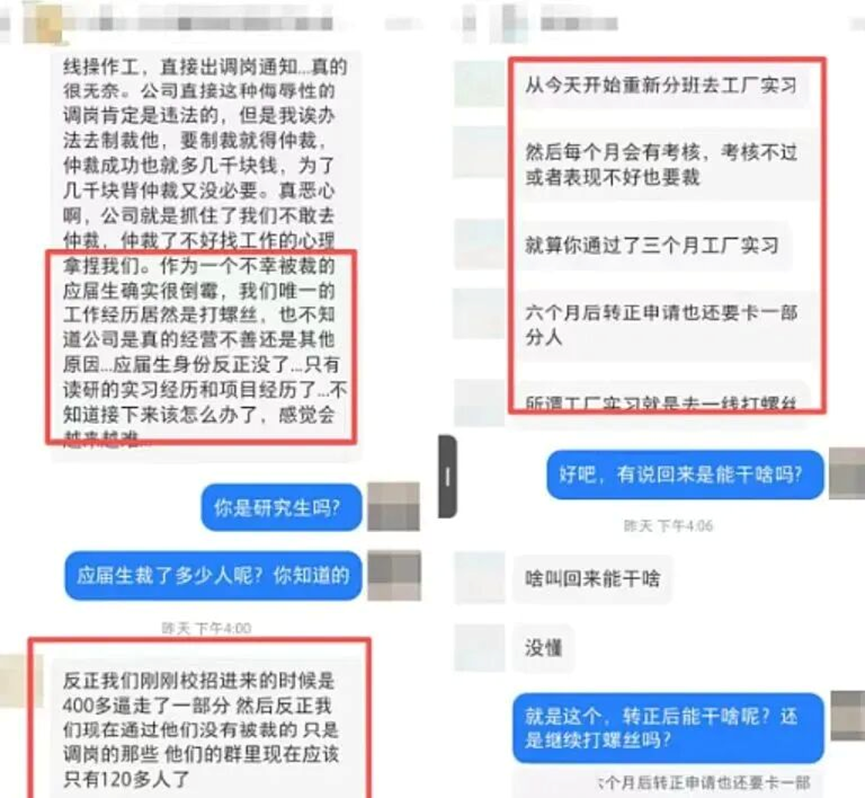
New graduates are facing a dilemma of either "voluntarily quitting" or being transferred to the production line to "tighten screws".
Following public outcry, Xingyu Shares issued an apology letter on August 27, apologizing to the affected students and their families for the incident of persuading graduates to leave. Several graduates who have left the company have received a one-time payment of 15,000 yuan as a job search and living subsidy.
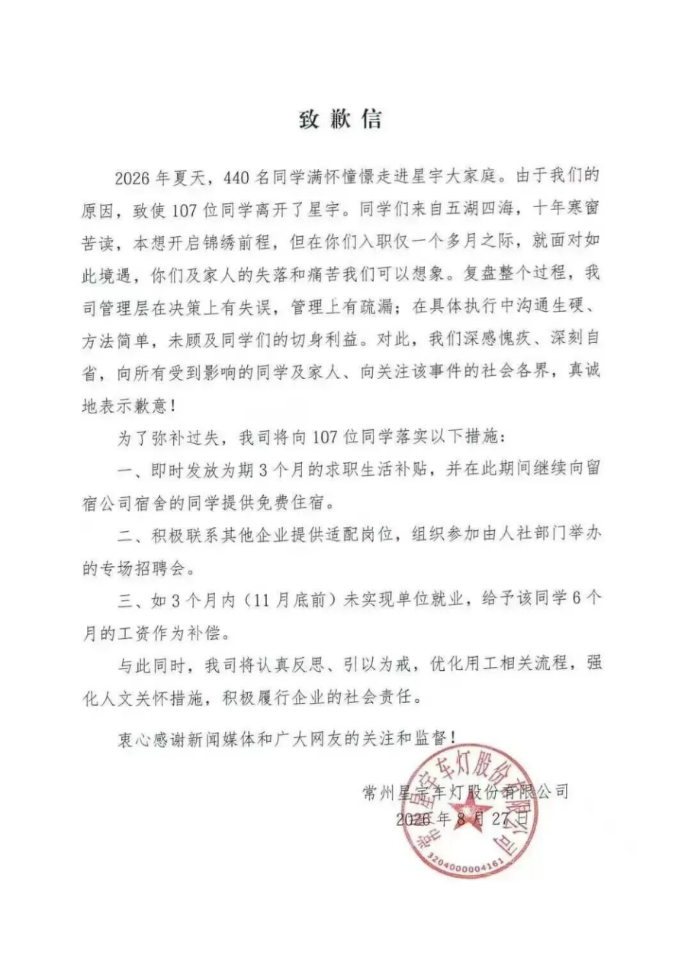
On August 27, Xingyu Shares issued an apology letter. (Photo/Xingyu Shares)
After sending out offer letters, Xingyu Shares is not the first company to rescind job offers to new graduates. On May 19, 2022, Li Auto was exposed for breaching contracts with campus recruits, and on April 24, 2024, the topic "Tesla Exposed for Breaching Contracts with New Graduates" became a trending search term. Each similar incident has sparked widespread attention, but the individuals affected are often overlooked in the news.
College Graduate's Job Offer Revoked Just Five Days Before Start Date
There were still five days to go before his first day of work, but Zhou Shulin, in the house he had rented, received a call from the HR department of a certain technology company to inform him that his job offer was being revoked.
On the phone, the HR representative told him to "consider other opportunities." He was taken aback, as July 1 was approaching, marking the end of his first job after graduating from college - how could it be over like this?
Like many recent graduates, Zhou Shulin started applying for jobs in the fall of 2025. During the fall recruitment season, he received several offers from state-owned enterprises and internet companies. He clearly remembers that the admission notice from Wanxing Technology was sent to him in mid-to-late November.
Zhou Shulin looked up the company online and found that it had a serious overtime problem and a poor reputation on the internet, but the salary it offered was indeed the most satisfactory among all the offers he received.
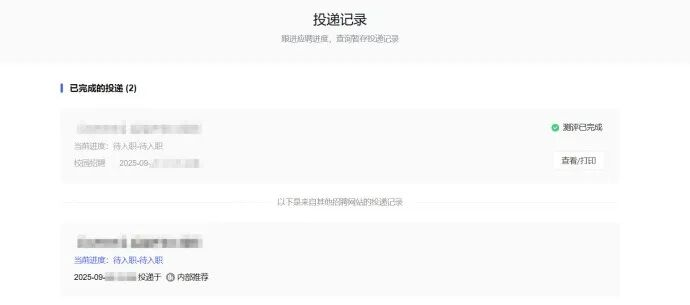
Due to salary considerations, Zhou Shulin chose this company from among many offers. (Photo provided by the interviewee)
He wants to work hard while he's young to earn more and alleviate the pressure on himself and his family. Therefore, he signed a tripartite agreement with the tech company, thinking, "After graduation, I'll work hard. Which internet company doesn't require overtime? At worst, I'll just be a bit tired."
In December, Zhou Shulin received an offer from a first-tier major company. He admitted that at the time, he did consider whether to reconsider switching contract companies. He inquired with the tech company's HR, who replied that if he wanted to terminate the contract, he would have to wait until April 2026, when the company would handle it uniformly; the HR of the first-tier major company, however, required him to provide a definitive response within a week, or the spot would be given to someone else.
He was concerned that if the large manufacturer's quota was filled, and he terminated the agreement with this side first, he would end up losing out on both ends. In the end, he rejected the large manufacturer and maintained the tripartite agreement with the tech company.
At the end of June 2026, just before starting his new job, Zhou Shulin packed his bags in his hometown in Jiangxi and boarded a train to Changsha. He first stayed in the city for a few days, contacting intermediaries and looking for apartments, but after settling everything, he received a notice of contract termination.
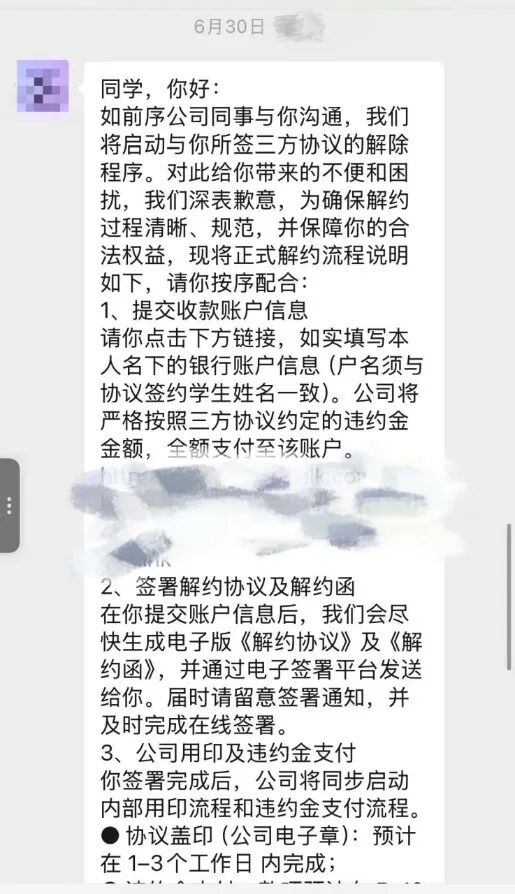
The company is in communication with Zhou Shulin regarding the termination of their contract. (Photo provided by the interviewee)
Zhou Shulin told New Weekly that he was not the only one whose contract was terminated. When the tech company launched its 2026 campus recruitment in August 2025, it announced that it expected to extend around 500 high-quality offers. However, social media posts about the company's onboarding training showed that fewer than 50 people attended the training. The campus recruits who received termination notices spanned different roles, including design, R&D, products, and functions, with varying reasons given, such as insufficient headcount (HC) or structural adjustments.
The HR department cited "concerns that he would be unable to adapt to the work" as the reason for terminating Zhou Shulin's contract, but in his view, as long as the company wants to terminate the contract, any reason can be fabricated.
Upon learning the news, the spring recruitment season had already come to an end. Zhou Shulin's mood was low. He said his family was expecting him to graduate and start a new job, and he was also looking forward to earning a living and starting a new life, but now he can only reorganize his materials and look for suitable job opportunities.
During the summer vacation, he sent resumes to many companies, but either they were met with no response, or the remaining positions at these companies did not match his major. He could only comfort himself that as long as he had not yet paid social insurance, he would still be recognized as a recent graduate by most state-owned enterprises and central enterprises during the autumn recruitment season this year.
However, the reality is that the fall recruitment season, which started in August 2026, is almost entirely targeting 2027 graduates. Zhou Shulin, a 2026 graduate, even with proof of being a recent graduate, is unable to enter many companies' campus recruitment systems to apply. If he takes the social recruitment route, he lacks work experience, and upon joining, he will no longer have access to the systematic training and development that campus recruitment provides.
Looking back on this experience of being let go, Zhou Shulin believes that even though both parties signed a tripartite agreement, the rights and responsibilities of companies and students are not equal. "In the premise of paying liquidated damages in accordance with regulations, both companies and students have the right to terminate the contract, this is a fact," Zhou Shulin said. Graduates can terminate the contract for more suitable opportunities. Similarly, companies can also terminate the contract due to company reasons within a suitable time frame. "But the problem is, when a company breaches a contract with a campus recruit, they only pay a penalty, whereas the campus recruit loses the entire recruitment window, and all the other offers they had previously turned down." Moreover, he did not expect that this tech company would drag it out until just five days before the start date before making this decision.
Zhou Shulin had originally envisioned a solitary life where he would go home after work every day, play on his computer, and listen to music, and once he was settled, he would get a cat, and spend weekends socializing with friends at various gatherings around Changsha.
These specific and beautiful expectations have now been largely dashed.
After being laid off, Zhou Shulin was unable to retrieve the full deposit for his house and had to explain the situation to his landlord, who sympathized with him and refunded a portion of it. The house he rented was originally located within the company's industrial park, which not only made commuting convenient but also made it easier to return home even when working late at night.
It seems he won't be setting foot in this place for a long time to come.
Responsibility Is One Thing, Cost Is Another
Zhou Shulin didn't make it through that company's doors, but he at least retained his status as a fresh graduate in name.
However, in the case of Xingyu Shares' breach of contract, the new graduates did not even get to keep this: Xingyu Shares signed labor agreements with the new graduates in May and formally processed their entry into the company in early July. Social insurance payments also began in the month they joined, but the company then notified them to leave, which led to an even more awkward situation.
After paying social insurance premiums, young people who were jilted lost not only the benefits of being new graduates but also lacked sufficient work experience to meet the requirements of most social recruitment positions. Even if companies paid breach-of-contract penalties, it was difficult to offset the losses suffered by new graduates who missed the campus recruitment opportunity. Being persuaded to leave or being reassigned after joining the company put these new graduates in a difficult dilemma.
Steven, who previously worked in HR in the automotive industry and now works in recruitment, said that from a corporate perspective, the practice of breaching contracts, although inappropriate, is not entirely unreasonable.
In his view, corporate breaches of contract may be, as Star Universe said, due to business and operational strategic considerations, thereby adjusting the mismatch between personnel and demand.
Cost is also likely to be a major reason. The cost savings from layoffs will be immediately reflected in the company's next monthly financial report. Therefore, if a company wants to cut costs and increase profits, it often chooses to lay off employees, including newly hired college graduates. Steven said that compared to other employees, college graduates have been with the company for a shorter time, have not yet created much value, and the cost of compensation is relatively low.
Additionally, during the campus recruitment process, there are also cases of students breaching contracts, and this uncertainty forces companies to issue more offers when recruiting.
Corporate HR sources reveal that many top-tier companies have implicit incentives for campus recruitment. Meeting certain hiring quotas for fresh graduates can qualify companies for policy benefits such as social security subsidies and tax rebates.
Companies have operational and cost considerations, while new graduates have their own circumstances and difficulties. However, the division of responsibility is one thing, and the cost is another: companies do pay compensation, but what they lose is their recruitment reputation; what new graduates lose may be an entire job-hunting season, and they may even face drastic changes in their career path for years to come.
Emails Sent to Mercedes, BMW, and Others Prove Effective
For those whose contracts were terminated, the matter has come to a close. All they can do is regroup and look for their next job. But for those who were reassigned to different positions, the ordeal is far from over.
In addition to normal contract terminations, some companies also use malicious transfers to force new graduates to quit voluntarily. The handling by Xingyu Shares is a typical case. New employees of Xingyu Shares who chose to stay after being talked to did not receive compensation, were still doing basic work in the factory, and were not promised to be made permanent.
In the face of a company's illegal job transfer, what can workers do?
Lawyer Chen Shiying from Guangdong Luoya Law Firm outlined two paths for workers in similar situations: one is to terminate the labor contract on the grounds that "the company failed to provide the agreed-upon labor conditions." However, she emphasized that the compensation amount for this approach is limited, and even if the worker ultimately wins the case, they can receive economic compensation of up to only 0.5 times their average salary due to their tenure being less than six months.
Second, employees can file for arbitration during their employment to demand the wage differential be paid. Without terminating the labor contract, they can claim payment at the original salary standard. Lawyer Chen Shiying explains that in-service arbitration has a key advantage: the adjudicator will conduct a substantive review of whether the company's job reassignment is lawful. The review is based not only on generalized provisions in the labor contract, but also on a substantive examination of the position at the time of recruitment, the job content in the offer letter, whether the adjustment is necessary for production and operations, and whether it causes severe harm to the worker's rights and interests. If the reassignment is found to be unlawful, the company must make up the wage differential, meaning wages for that period must be paid at the originally agreed standard.
Lawyer Chen Shiying pointed out that for companies, the actual cost of this plan is much higher than paying 0.5 times the average wage in economic compensation - they not only have to pay more in wages, but also face the adverse consequences of being deemed illegal.
Xingyu Shares stated in an apology letter that the company will implement multiple measures for 107 college recruits, including immediately issuing a three-month job-seeking living allowance, and continuing to provide free accommodation to students who remain with the company.
The lengthy, costly, and low-yield nature of labor arbitration means many workers face corporate breaches of contract and malicious job reassignments, often with no recourse. According to Lawyer Chen Shiying, most workers typically need three to six months to complete the arbitration process, and for new graduates with short work tenures, compensation is often insufficient to cover actual losses such as interrupted job searches and relocation expenses.
But this incident involving Xingyu Shares has provided another approach for graduating students fighting for their rights.
After the incident, the terminated graduates sought various channels to seek justice. Some searched for the EU's supply chain regulations and sent complaint emails to BYD's clients, including BMW, Mercedes-Benz, and Volkswagen; others submitted signed complaint materials to the Hong Kong Stock Exchange, reporting the company's alleged violations of labor laws and major flaws in its governance. On July 29, 2026, BYD submitted its listing application to the Hong Kong Stock Exchange for the second time, which was a critical stage for its Hong Kong IPO.
Lawyer Chen Shiying said: "The law can only be used as a last resort, if there are more efficient ways to resolve the issue, we can certainly try them."
For countless "Zhou Shulin"s, having their job offers revoked during campus recruitment is like the first lesson society teaches them after they graduate: even if the other party makes a promise that seems legitimate and rule-abiding, there is still a possibility of breach of contract.
The cost of breaching a contract often falls on the party that is more trusting of the other and has fewer alternatives.
(At the request of the interviewees, Zhou Shulin and Steven are pseudonyms)

China Youth Daily reports that after Xingyu Co., Ltd. persuaded 107 college graduates to leave the company, multiple former employees have received living allowances, while those who stayed have yet to receive a promise of formal employment.