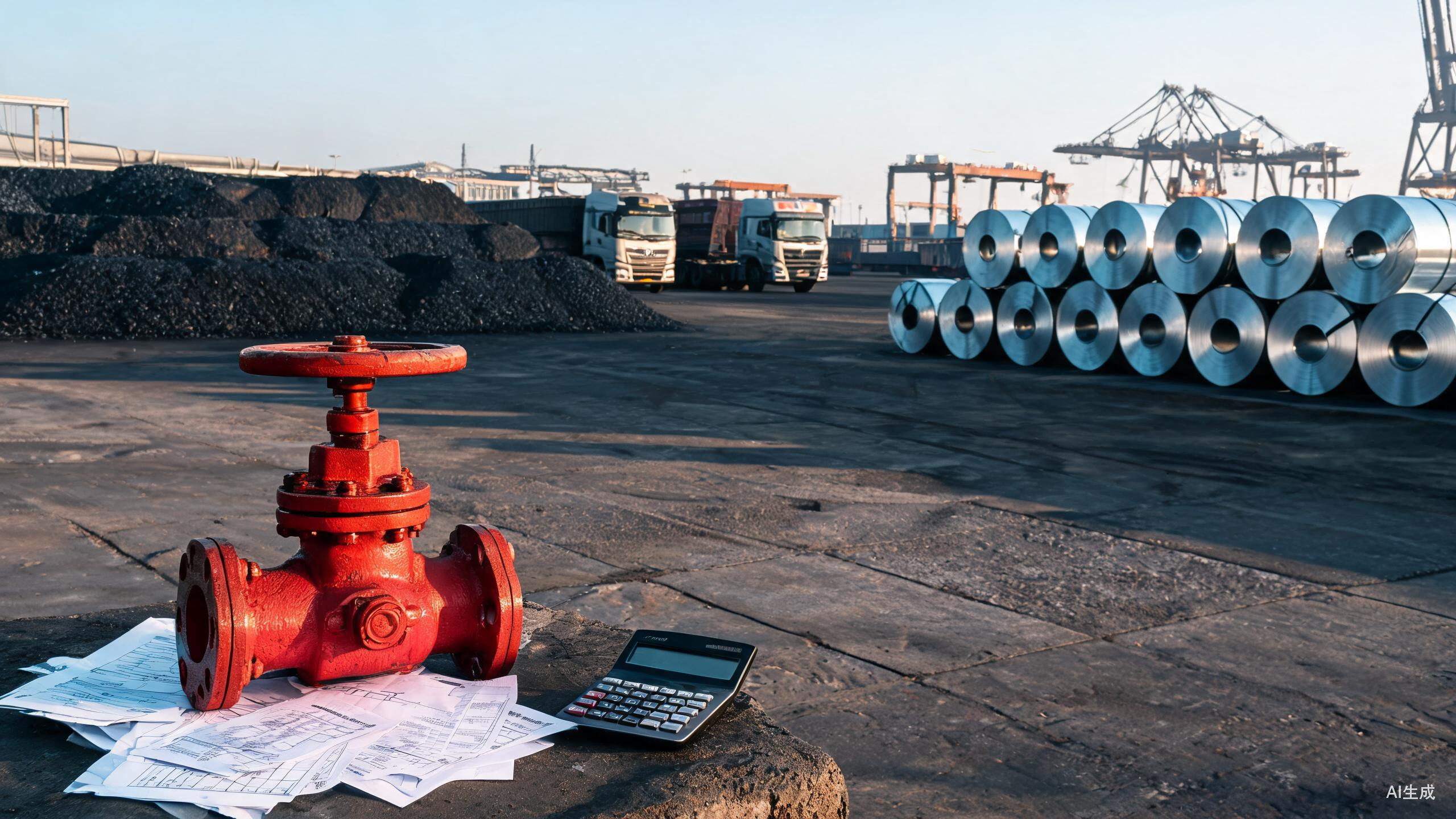
On April 24, the State Taxation Administration disclosed the situation regarding the rectification of economic invoicing, focusing on issues such as circular invoicing, mutual invoicing, and behaviors including non-substantive transfer of goods ownership, frequent buying and selling of warehouse receipts, and transactions that involve only invoices and accounts without actual goods movement.
This round of economic rectification through voting has had a significant impact on many state-owned trading companies, especially those involved in bulk commodity trading. Once the invoice quota is compressed, even if a contract has been signed, it is useless if the invoice cannot be issued, making it difficult for businesses to operate normally.
Many state-owned trading companies are now in a state of anxiety. Revenue targets remain in place, but invoice quotas have been slashed, making it impossible to complete transactions, which in turn means revenue targets cannot be met.
But on second thought, this may not be all bad for many state-owned trading companies, and could even be a good thing.
Why?
Some businesses simply shouldn't be pursued in the first place—the risks aren't worth it. Previously, companies didn't dare to stop on their own; now the tax authorities are making that call for them. In the past, if you proposed scaling back, the group might have seen you as lacking capability or accountability. Now, with invoice restrictions affecting more than just your company, missing revenue targets at least has an objective explanation you can present upward.
To put it bluntly, this round of economic rectification has compressed revenue while also keeping at bay some businesses that were likely to encounter problems. By doing fewer deals, they have also avoided shouldering some losses and accumulating fewer accounts receivable.
From this perspective, state-owned trading companies should really thank the tax authorities.
Tightened Invoice Regulations to Hit Bulk Trade First
The first to feel the pressure from this round of invoice-based economic regulation is the wholesale industry, particularly the trade of bulk commodities such as coal, metals, and minerals. Data released by the State Taxation Administration shows that in the first quarter of this year, the six industries with the most concentrated irregular investment attraction and business operations saw a 4.4% year-on-year decline in invoice amounts; among them, the wholesale industry declined by 2.5%, the coal and coal products wholesale industry declined by 7.1%, and the metal and metal ore wholesale industry declined by 5.7%. These numbers indicate that the tax authorities' regulation of invoice-based economy has directly impacted the business scale of bulk trade enterprises.
These businesses overlap significantly with the commodity trading activities of some state-owned enterprise trading companies. In this round of reductions in invoice quotas, large commodity traders have been the most affected.
Why are commodities traders affected the most? This has to do with how commodities traders make money.
Large trading companies and manufacturing enterprises are different. Manufacturing enterprises have mines and factories that process raw materials into products, and they primarily make money through production and processing.
Major traders' profit models are far more complex, with some making money from fluctuations in commodity prices, others exploiting price differences across different markets, regions, and time periods, some profiting from foreign exchange transactions through import and export arrangements, and others appearing to engage in trade on the surface but actually aiming to finance themselves or provide financing to upstream and downstream partners, earning profits through fund occupation and account period arrangements.
This profit-making model does not rely on production and processing, so many bulk commodity traders do not own mines, factories, and warehouses. They mainly rely on upstream and downstream resources, capital, and transaction organization capabilities to bring together procurement, sales, logistics, capital, and goods ownership. Goods can be shipped directly from upstream to downstream, or downstream buyers can pick them up from warehouses, or they can even be transferred without moving the goods, with the ownership transfer taking place on the spot within the same warehouse.
Commodity traders are therefore at the forefront, not because they are all engaging in fake trades, but because this type of business, from a transactional perspective, is very similar to the focus of the tax authorities, which is on transactions that involve fake invoices and receipts but no actual goods, and frequent buying and selling of warehouse receipts. By only looking at contracts, invoices, and payments, it is difficult to determine whether a transaction is a genuine trade with real business purposes or a transaction aimed at financing or inflating revenue.
Bulk trading has another characteristic, which is that revenue is particularly sensitive to invoice amounts. When a batch of goods is purchased, an input invoice is required, and when it is sold, a sales invoice is required. If the same funds are turned over several times a year, it will form several times the sales revenue. In the past, the invoice amount could keep pace with the business scale, and the business could continue to operate; now that the amount has been suppressed, it is equivalent to directly setting a ceiling on the amount of business that can be done throughout the year.
Upstream direct delivery, downstream self-pickup, and on-site transfer within warehouses are not inherently problematic. For products like coal, steel, non-ferrous metals, and mineral products, each relocation incurs additional costs, so completing ownership transfer of goods within the same warehouse is commercially reasonable.
The issue is that the tax authorities cannot simply take a company's word that a transaction is genuine. They must also determine whether the goods in question actually exist, whether the state-owned enterprise can take delivery of them independently, and who bears the risk of price fluctuations and damage.
If these issues are unclear and goods are not obviously being moved, but only contracts, funds, invoices, and cargo ownership documents are being transferred, the tax system will naturally identify the company as a high-risk entity.
In particular, companies that are traders with both upstream and downstream businesses, have goods stored in the same warehouse for extended periods, quickly resell goods after purchase, and have transaction amounts that are significantly mismatched with their personnel scale and operational capabilities are more likely to be included in the tax authorities' risk screening range. In the past, companies thought that as long as they had contracts, invoices, payments, and warehouse confirmations, their business could be explained clearly; now, the tax authorities will continue to ask questions, such as why this trade must go through the company and what value the company has actually added.
The State Taxation Administration revealed that the Sichuan tax authorities have taken measures such as reducing invoice credit limits and monitoring daily invoicing amounts for companies that frequently engage in warehouse receipt and goods ownership transactions and have issues with inflated economic data. For state-owned trading companies, this is not just a routine compliance reminder, but a direct impact on their ability to continue doing business.
In domestic bulk trading, once the invoice quota is insufficient, procurement, input tax deductions, and upstream and downstream settlements will all be affected, making it difficult for companies to operate on their original scale.
For trading companies that mainly rely on buying and selling to generate revenue through quick turnover, the invoice amount directly affects the scale of their business operations. After the invoice amount is greatly compressed, companies are not just issuing fewer invoices, but rather, the portion of their original business plan cannot be implemented.
So, what is compressed first in this round of rectification may not be profits, but rather the scale of revenue.
Markets Have Changed, But Many Revenue Metrics Remain the Same
The limited invoice quota is only a superficial issue, the deeper problem is that many state-owned trading companies are already struggling to meet their original revenue targets.
The current economy is no longer simply a matter of being good or bad, but rather the differences between industries are becoming increasingly pronounced.
According to data on large-scale industrial enterprises from January to July 2026 released by the National Bureau of Statistics, operating revenue increased by 6.5% year-over-year, and total profit grew by 17.6%. Looking at these two numbers alone, many people may think that the business situation is not bad, and it's not a problem for conglomerates to continue to raise the revenue targets of their trading companies.
However, looking at the industries separately, the picture is completely different. The computer, communications and other electronic equipment manufacturing industry saw profit growth of 11 times, with the electronics industry alone driving up the profit growth of all large-scale industrial enterprises by 9.3 percentage points, and high-tech manufacturing industry profits growing by 50.1%.
Meanwhile, profits in the black metal smelting and calendering industry fell 51.2%, non-metallic mineral products industry dropped 48.2%, automobile manufacturing industry declined 20.4%, and the farm and sideline food processing industry decreased 12.3%.
On one hand, the electronics and high-tech manufacturing industries are experiencing rapid profit growth, while on the other hand, traditional industries such as steel, building materials, automobiles, and agricultural product processing are seeing declining profits, which is the real market situation faced by many state-owned trade companies. No matter how fast the high-tech industry grows, it will not automatically bring customers and orders to a steel, coal, or building materials trading company.
The company's funding turnover pressure has not eased. At the end of July, the average accounts receivable recovery period for industrial enterprises above the designated size was 71.9 days, an increase of 0.9 days year-over-year; the inventory turnover days for finished goods was 21.3 days, an increase of 0.6 days year-over-year. For trading companies, slower downstream payments and longer inventory digestion times will ultimately be passed on to accounts payable, prepayments, and fund occupation.
So just because national industrial enterprise profits are growing, it doesn't mean every state-owned trading company is enjoying a strong market. In some traditional industries, there simply aren't that many genuine, risk-controlled trading opportunities available. Yet if you demand that trading companies keep growing revenue year after year—even jumping from a few billion yuan to tens of billions—what exactly is supposed to drive that metric?
Genuine trade is not about setting a revenue target first and then finding business and contracts in the market to meet it. It requires a real supply chain, goods, and profit margins, as well as someone to bear the risks of price, quality, logistics, and payment collection.
The difficulty for state-owned trading companies lies here: targets are set at the beginning of the year, but the market changes every day. When the market is poor, the targets do not decrease accordingly, and the management team can only continue to seek out business.
If no real enterprise can be found, then look for traders; if self-controlled customers cannot be found, then act as the upstream or downstream designated by others; if normal payment terms cannot generate large sales, then extend the payment terms; if customers have no money to make purchases, then state-owned enterprises will first make prepayments to upstream suppliers and then sell on credit to downstream customers.
Doing so will indeed increase revenue, but the risks will also rise accordingly.
If this year's revenue target is met, next year's target will be raised further on top of the current one. If it's missed, the management team has to explain whether the shortfall reflects insufficient capability or inadequate market development.
This ultimately led to an absurd situation, where the external market was becoming increasingly difficult, while internal targets were rising higher and higher, and business staff clearly knew that some businesses were not safe, yet they still had to find ways to meet the scale targets.
The tax authorities are now reducing the invoice quota, which is equivalent to exposing the contradictions that were originally hidden within enterprises. It's not that trading companies are unwilling to meet their targets, but rather that their original business scale can no longer be supported by sufficient invoice quotas and market demand.
At a time like this, insisting that companies stick to their original targets would only push management teams toward more complex and riskier business structures.
Firms Without Resources or Capabilities Face Greatest Revenue Risks
The size of a state-owned trading company is not determined by its registered capital or the revenue targets set by its parent group, but by what it actually has in its hands.
Is there a stable upstream supply of resources, and are there downstream clients that can be influenced? Is there a team that understands the industry, logistics, and transactions? Is there funding and inventory management capability that matches the scale of the business?
Many local state-owned enterprises have just established a trading company with only a few people, and have not accumulated upstream and downstream resources, yet their revenue targets for the second year are already in the tens or even hundreds of billions of yuan. Even if those few people don't sleep every day, it's impossible for them to establish the business capabilities needed to support hundreds of billions of yuan in revenue within a year.
Trade is not just about circulating contracts, invoices, and funds. Enterprises themselves need to determine who to buy from, whether the price is reasonable, where the goods are, whose instructions the warehouse follows, and who to hold accountable if payment issues arise.
If the upstream and downstream, prices, and warehouses are all arranged by others, and state-owned enterprises are only responsible for payment, collection, and invoicing, then the revenue belongs to the state-owned enterprise, but it may not necessarily have actual control over the goods, and ultimately, the state-owned enterprise still has to bear the risk.
Companies lack resources but are tasked with achieving large revenue targets, and in the end, there are roughly only two options.
One approach is to engage in channel business with limited commercial value. The upstream and downstream parties have already reached an agreement, and the state-owned enterprise is only responsible for processing contracts, funds, and invoices on the books. Even without providing capital, risks related to tax, auditing, and state-owned asset accountability still persist.
Another approach is to use state-owned enterprise funding and credit in exchange for revenue, making advance payments to upstream suppliers and offering longer payment terms to downstream clients, a business model that may involve real goods but leaves the state-owned enterprise shouldering substantial financial risk.
Especially when cash flow is tight across the upstream and downstream supply chain, clients may turn to state-owned enterprises not because SOEs have deeper product expertise, but because they have capital, credit lines, and fast payment. You think you've found a trading opportunity; what they've found is a cheap and stable source of funding.
This type of business, once it reaches a certain scale, will see its revenue turn into accounts receivable, and then into overdue payments and losses, the moment a client encounters problems. At that point, the group will be asking not why revenue targets were not met, but why such a large sum of money was paid out.
So, the most dangerous thing is never the lack of revenue, but rather that a company's resources and capabilities can only support a business of 1 billion yuan, yet it takes on risks as if it were a 10 billion yuan business.
After the invoice quota was compressed this time, the businesses that usually stopped first were also these. Circular invoicing, mutual invoicing, and businesses lacking commercial substance cannot continue, state-owned enterprises that do not control the source of goods and customers, with profits that cannot cover funding costs, and can only repay upon downstream companies continuing to secure funding, will also find it difficult to continue operating at their original scale.
A decrease in business means a reduction in more than just invoices and revenue. With fewer prepayments, there is less money tied up upstream; with fewer sales on credit, there are fewer accounts receivable; and with fewer complex warehouse receipt transactions, there are also fewer disputes over goods ownership and liability risks.
Moreover, the parts that are usually cut are not the businesses with the most resources and control, but rather the portions that were reluctantly added to meet targets. These businesses contribute significantly to revenue, but minimally to profits, and consume a lot of capital and credit. As a result, a slight decrease in revenue may lead to a much greater reduction in risk.
If doing less business and earning a bit less profit can help avoid a significant bad debt, is that a step back in operations or a return to a scale that is within one's own capabilities?
State-owned trading companies weren't unwilling to downsize, they were just afraid to
The poor performance of state-owned trading companies against revenue targets in the past was not without explanation.
Previous common explanations include the unfavorable external economic environment, declining demand in traditional industries, and the company's lack of stable upstream and downstream resources, as well as its team, funding, and organizational capabilities being unable to support such a large business scale.
The issue is that these explanations are highly subjective and, as with any judgment, people's perceptions may differ.
You think the market is bad, but the leader may believe that there are still many opportunities in the market, you just haven't found them. You think a particular business is risky, but the leader may think that with additional guarantees, completing the necessary documents, and going through the approval process, it can be done. You think the company lacks resources, but the leader may ask, how can a large state-owned enterprise like ours, with a brand, credit, and bank credit, say that it doesn't have resources?
Moreover, there are still many state-owned enterprise trading companies whose revenue is increasing. If others are growing and you are not, it is difficult for leaders to attribute the reason to the external environment, and they are more likely to think that the problem lies in your management capabilities, work attitude, and market development.
When you say the industry is struggling, leaders see that others are still managing; when you say the company's capabilities are insufficient, what leaders may hear is that the management team is making excuses for not meeting targets. It's difficult to determine who is right or wrong until the risks actually materialize.
In the past, even if business personnel knew that some business operations were highly risky, it was difficult for them to proactively halt them. Stopping a business deal was a judgment call made by the business personnel and management, but a decrease in revenue was a visible result on the financial statements that everyone could see. In the future, if the market recovers or someone else succeeds in the business, the person who made the decision to stop the business would still have to explain why they didn't dare to do it, didn't know how to do it, or weren't willing to do it at the time.
But now, that has changed.
Tax authorities have begun cracking down on the invoice economy, compressing corporate invoice quotas to the point where some businesses cannot issue invoices at all for certain transactions. This is no longer a question of market conditions, company resources, or team capabilities.
Without invoices, business cannot proceed. This reasoning is straightforward—visible to the operations team and equally clear to group leadership. If leaders have doubts, they can check the company's invoice quota or go directly to the tax authorities to ask.
Moreover, this isn't affecting just one company. Many peers are facing the same constraints on invoice quotas and transaction authenticity reviews, making it difficult for parent groups to hold any single subsidiary to its original targets based on past growth momentum.
In the past, not doing something meant a company thought it couldn't be done, and others might not have recognized it; now, not doing something means the invoice can't be issued, and there's no need to argue over who has a more accurate judgment of the market.
State-owned trading companies were previously aware of the risks and willing to reduce their exposure, but they dared not use their own judgment to defy revenue targets. Now that the tax authorities have intervened to halt operations, the companies finally have a reason that everyone can see and cannot easily deny.
Why Tax Authorities Are Blocking Businesses That Evaded State Asset Regulators
State-owned asset regulators have long held a clear position on financing trade, empty pass-through transactions, and fictitious trade—and the relevant documents are not new this year.
In 2023, the State-owned Assets Supervision and Administration Commission of the State Council issued a notice on regulating the trade management of central enterprises and strictly prohibiting all kinds of false trade, proposing "ten prohibitions" for the trade of central enterprises, and making clear restrictions on businesses that deviate from the main industry, fabricate trade backgrounds, and engage in empty transactions and circular trade. The Regulations on Disciplinary Actions Against Managers of State-owned Enterprises, which took effect in 2024, listed violations such as conducting financing trade and fake transactions as disciplinary cases. The 46th order of the State-owned Assets Supervision and Administration Commission, which took effect in 2026, also included financing trade, empty transactions, circular trade, as well as padding and falsifying business income, within the scope of accountability.
Regulations have become increasingly strict, from prohibiting certain activities to holding individuals accountable when problems arise. However, why have these businesses still not completely disappeared?
A key reason is that resource endowments vary by region, as do the understanding and enforcement standards regarding false trade. Some regions have ports, industries, logistics, and stable upstream and downstream partners, making it easier for trading companies to find genuine business. Others lack industrial and commodity resources, yet their state-owned enterprises must meet revenue targets while bearing financing and ranking pressures, forcing them to seek upstream and downstream partners elsewhere and engage in bulk commodity trading with both ends outside the region.
The same transaction can be treated very differently depending on where it takes place: some authorities focus on whether the goods physically moved, while others look at whether title and risk actually transferred. Some jurisdictions refuse to allow deals when both upstream and downstream parties are traders; others accept them as long as contracts, invoices, funds, and warehouse receipts are all in place. Because the criteria and strictness vary, some regions have sharply cut their trading volumes while others have only grown larger.
More realistically, as long as these businesses don't create risks, they can also help local governments and the conglomerates solve certain problems. Revenue goes up, the group's ranking improves, the balance sheet grows larger, and bank financing may become easier. Before any default or blowup, all parties benefit, so some local governments and conglomerates simply turn a blind eye.
Regulators prohibit companies from engaging in fictitious trading, while local authorities and corporate groups simultaneously push them to hit revenue targets, secure financing, and improve their rankings. Faced with these conflicting mandates, the most pragmatic path for companies is to demonstrate that their operations constitute neither financing-driven trade nor fictitious trade.
As a result, contracts, logistics documents, warehouse confirmations, and project initiation materials grew increasingly complete—yet the substance of the transactions never changed. The upstream and downstream partners were still not developed or controlled by the state-owned enterprises themselves; their primary role remained advancing capital, providing credit enhancement, and generating revenue. As long as no problems surfaced in the business, no one was willing to voluntarily stop—because stopping would mean sacrificing current-period revenue, while the risks might not be exposed until much later.
Tax regulation operates differently. It directly controls invoice quotas—once the quota is cut, business operations grind to a halt immediately. There's no waiting for an audit, and no need to wait until losses materialize before accountability is enforced.
In the past, companies would first conduct business and then determine the nature of any issues that arose; now, the tax authorities first examine a company's invoicing, capital flow, and transaction characteristics, and upon discovering any suspicious points, they reduce the quota, imposing constraints before the business even takes place. This is why state-owned enterprise regulatory documents are constantly being issued, yet companies still try to find ways to operate, and as soon as the tax authorities restrict invoices, the business scale immediately shrinks.
The two regulatory approaches employ different tools—one emphasizes accountability, while the other directly controls transaction terms. Accountability is typically enforced after a transaction occurs, whereas invoice quotas can block deals before they even begin.
This also reminds conglomerates and local governments that as invoice quotas are reduced, revenue assessments should be adjusted accordingly. Otherwise, business pressure will not be alleviated, but rather push companies toward other, more obscure businesses. You're not providing resources, yet you want scale; you don't allow risk-taking, yet you want profits; and when problems arise, you still want to hold people accountable - this is an unfair equation, no matter who you present it to.
Restrict Invoice Economy, Not Real Bulk Trade
The tax invoice quota has indeed objectively helped state-owned trading companies reduce their risks, but this does not mean that stricter restrictions are better, nor does it mean that companies with large amounts, low gross margins, and stagnant goods should be restricted. This boundary must be clearly defined.
Commodity trading has its own set of operating principles. Goods such as ores, coal, and steel may be stored for extended periods at ports, yards, or third-party warehouses, with transactions completed through the transfer of ownership rights. The key factors to consider are whether a company has obtained ownership rights and disposal capacity, and whether it has assumed the risks associated with price, quality, and payment collection.
If the goods actually exist and the change in ownership is confirmed by an independent warehouse, the state-owned enterprise can directly pick up and dispose of the goods. On-site transfer is a form of delivery and cannot be considered as a case of "fake delivery" just because there is no vehicle transportation record.
Tax authorities should crack down on fraudulent transactions and circular invoicing carried out by shell companies, as well as practices that artificially inflate sales figures to secure financing or meet performance targets — without suppressing legitimate bulk commodity trading in the process. The State Taxation Administration has also stated that it will promptly restore invoice quotas for companies cleared of risk concerns, ensuring lawful access to invoicing for compliant business needs.
State-owned trading companies cannot shift all the blame to the tax authorities. Goods are stored in warehouses, but they cannot be matched with specific goods and owners; warehouses have stamped documents, but they do not accept delivery instructions from state-owned enterprises; contracts are complete, but it is unclear how they make money - such business operations are difficult for anyone to understand.
What companies should strive for is not to restore the original business volume, but to continue doing business that has genuine goods, genuine demand, controllable cargo rights, and can create value.
After the tax authorities reduced the invoice quota, enterprises had to re-answer a question that should have been answered long ago. Should state-owned trade companies decide how much business to do based on indicators, or based on their own resources, capabilities, and risk tolerance?
If this issue is not resolved, suppressing the economy through ticketing today will only lead to other methods of increasing revenue tomorrow. The pressure to meet performance indicators will not disappear, and risks will only continue to emerge in different forms.
So, state-owned trading companies should actually thank the tax authorities, not because there are fewer invoices, but because external regulation has finally put the brakes on the companies. The car has slowed down, and revenue may be lower, but with less money tied up and fewer accounts receivable, there may be fewer major losses in the future.
For many state-owned trading companies these days, doing a bit less business is not necessarily a bad thing.
Reducing risk and surviving is far more important than stubbornly trying to support a revenue scale that is beyond one's capabilities.