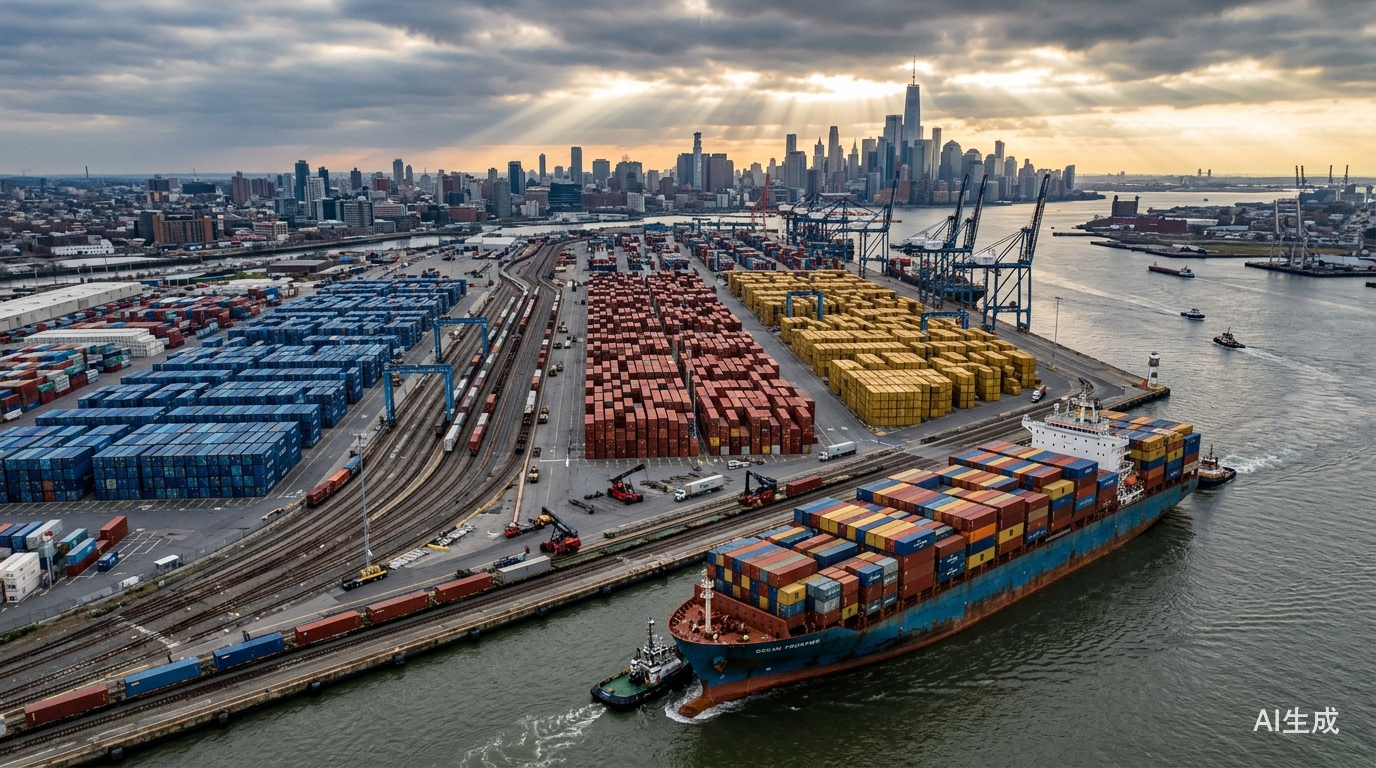
On August 31 local time, the G20 Finance Ministers and Central Bank Governors Meeting was held in the United States. Prior to the meeting, US Treasury Secretary Bezent said in an interview that the world "cannot accept" China having a trade surplus of $1.2 trillion, and stated that she would urge G20 members to re-examine trade conditions with China. In response, China explicitly stated that it has never deliberately pursued a trade surplus and adheres to high-level openness to the outside world, providing new opportunities for all countries, including the US, with its large market.
In recent years, the US has continuously pointed to China as the culprit for global trade imbalances, ignoring the deep-seated structural causes behind international payments. However, it should also be recognized that economic imbalances have become a reality that major economies face in common. The IMF's "2026 External Sector Report" released in July this year shows that the global current account imbalance further expanded in 2025. As the US imposes tariffs and compresses its trade deficit, other major economies have also taken measures such as industrial policies to reduce their own risks. Ultimately, who will bear the cost of rebalancing the global economy?
Carnegie International Peace Foundation senior researcher Michael Pettis recently published an article in Foreign Affairs, analyzing how global trade imbalances are formed and why different economies often bear different costs, using the six major trade imbalances of the past century as a clue. In Pettis' view, the current round of economic imbalances may be adjusted, increasingly focusing on the three parties of China, the US, and Europe: the US is trying to reduce its deficit, China needs to cope with the pressure brought by the tightening of external markets, and Europe may face more intense industrial competition as trade flows change. If the US continues to reduce its absorption of global goods and Europe further strengthens its trade defenses, the trade friction currently concentrated between China and the US may extend to China and Europe in the future.
It is worth noting that Pettis places more emphasis on adjusting pressure towards China, with limited discussion on US domestic factors, and his judgment is clearly influenced by an American policy perspective. However, his analysis of the century-long history of trade imbalances still provides a perspective for observing the potential risks in the industrial competition between China, the US, and Europe, as well as global rebalancing.
The long-standing trade imbalances in the current global economy are fundamentally unsustainable. China, Germany, and a few other economies have long maintained trade surpluses, while the US has absorbed a significant portion of these surpluses by maintaining the world's largest trade deficit. This situation will eventually have to change. For a developed and capital-rich economy like the US, long-term persistent trade deficits can only lead to two outcomes: either rising unemployment or increasing debt, both of which are difficult to sustain.
In theory, major surplus and deficit economies can reach an agreement on a coordinated adjustment plan: surplus countries expand domestic demand, while deficit countries gradually reduce their reliance on debt-driven consumption. This way, global trade imbalances can be gradually narrowed without causing a significant decline in global aggregate demand. This should be the most reasonable solution.
However, due to fundamental disagreements among major economies over the causes of trade imbalances, such coordination is difficult to achieve. China believes that imbalances stem from excessive US consumption and fiscal deficits; the US attributes them to industrial, trade, and exchange rate policies of other countries; and Europe has yet to form a unified and clear judgment.
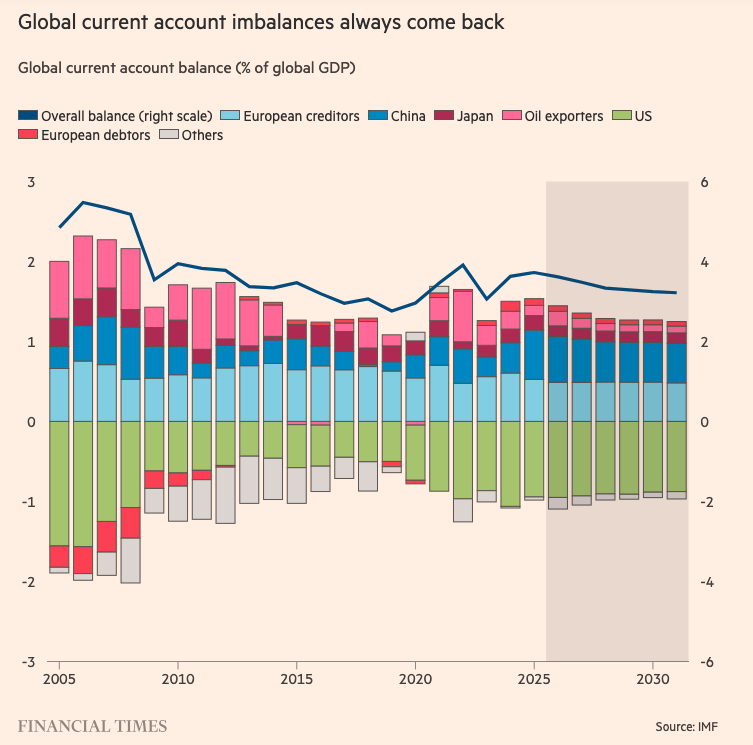
Global current account imbalances have recurred, with China and some European economies long accumulating surpluses, a pattern the IMF expects to continue over the next few years. Source: Financial Times, data from IMF.
As a result, the remedies proposed by various parties are mutually contradictory. China hopes deficit countries will raise their savings rates while being unwilling to change its existing growth model; the United States wants surplus countries to reduce trade surpluses by channeling more income to households; and European leaders continue to advocate for multilateral cooperation and a rules-based trading system. Seen in this light, the prospects for a coordinated response are extremely limited. As economic commentator Martin Wolf wrote in the Financial Times earlier this year, if the hope of acting in advance is already slim, then "the second-best option is to prepare for the crisis."
Historical experience suggests that trade imbalances of this magnitude almost always resolve in painful fashion, with the costs of adjustment distributed unevenly. A country confronting both high debt and low productivity is more likely to bear the primary burden of trade adjustment; meanwhile, economic and political strength may also equip a nation with sufficient policy tools to shift the adjustment burden onto other economies.
Among the three major economic powers today, China is relatively the most exposed to shocks; the United States has the capacity to reduce its own risk exposure; and Europe holds considerable potential, though whether it can translate that into policy action remains uncertain. The measures each side takes to protect itself are unlikely to lower the risk of a crisis, nor will they do much to reduce its overall cost. The real question is: when a crisis does arrive, who will bear the heaviest losses.
History repeats itself
Over the past century, large and persistent trade imbalances have appeared cyclically and almost never led to benign outcomes.
The 1920s were one such period. At the time, U.S. productivity surged rapidly, but wages failed to keep pace. The result was that production expansion far outstripped consumption growth, generating a massive U.S. trade surplus. Europe, by contrast, ran trade deficits. After World War I, many European countries borrowed heavily from abroad to rebuild their war-shattered economies. Germany stood out in particular, relying not only on large-scale external debt to support domestic growth but also borrowing to fund war reparations. Meanwhile, U.S. domestic debt also rose sharply, with a substantial portion used to fuel consumption and asset speculation.
As this imbalance persisted, US manufacturing continued to expand and squeeze out European manufacturing, and trade protectionism pressures intensified. In 1927, France implemented currency devaluation; in 1931, the UK abandoned the gold standard, and Germany began restricting imports and rationing foreign exchange in the same year. Even the US, which had a trade surplus, was not immune. As manufacturers and farmers complained that weak demand was threatening domestic production and employment, the US passed the Smoot-Hawley Tariff Act in 1930, sharply increasing import tariffs.
Ultimately, this unbalanced adjustment came in the form of a global trade collapse during the Great Depression in the early to mid-1930s. Almost all major economies were hit by trade contraction, but the costs borne by each country were different. Countries with huge trade deficits, such as the United Kingdom, recovered faster and suffered relatively lighter financial shocks than the United States, which bore a far higher adjustment cost than other countries. US exports declined faster than imports, domestic investment collapsed sharply, banks closed one after another, and the number of corporate and personal bankruptcies surged.
What followed was a rare exception to the next major and sustained trade imbalance: the imbalance eventually dissipated without triggering severe economic turmoil. In the 1950s and 1960s, the United States once again ran large trade surpluses, while Europe and Japan incurred corresponding trade deficits. Similar to the 1920s, these deficits provided financing for post-war economic reconstruction, with large amounts of resources flowing into infrastructure and manufacturing.
However, unlike the present, governments at the time exercised strict controls over capital flows, and the foreign capital introduced was mainly used for investments that could generate sufficient returns in the future to pay off related debts. Since these investments had high production efficiency and economic returns, the debt-to-GDP ratio did not rise significantly. Meanwhile, trade protectionist pressures were also limited at the time, mainly because Europe and Japan urgently needed to import goods, while the US actively encouraged economic reconstruction in both regions. It was under these unusual conditions that global trade imbalances gradually dissipated, without any country bearing particularly heavy adjustment costs.
This was followed by four rounds of trade imbalances, each of which ultimately came at a great cost to the countries involved.
One such instance occurred in Latin America in the 1970s, when consecutive oil shocks led to a surge in international oil prices from around $2 per barrel in the early 1970s to approximately $30 per barrel by the end of the decade. This resulted in massive "petrodollar" surpluses for Middle Eastern oil-exporting countries and other Organization of the Petroleum Exporting Countries (OPEC) members. A large amount of funds were deposited into major international banks, which, seeking new loan clients, lent heavily to Latin America and other developing economies. The sustained capital inflows ultimately led to an appreciation of these countries' exchange rates, overvaluing their currencies and creating substantial trade deficits.
By the early 1980s, rising global interest rates made these countries' debts unsustainable. The eventual debt crisis forced a correction of trade imbalances, but the bulk of the adjustment costs fell on deficit countries: recession, inflation, fiscal austerity, and decades of lost growth.
The next imbalance took shape in the late 1970s through the 1980s. During this period, productivity growth in Japan consistently outpaced wage growth, generating massive trade surpluses. Germany saw a similar pattern, with its manufacturing sector steadily gaining international competitiveness. In contrast, Britain and the United States ran persistent trade deficits, absorbing the surpluses from Japan and Germany.
The situation in Japan is particularly noteworthy. In the 1980s, Japan's domestic debt saw astonishing growth, with massive investments pouring into various projects that ultimately yielded returns far lower than initially expected. Trade protectionism pressures continued to rise, culminating in the 1985 Plaza Accord. Under this agreement, major economies agreed to drive up the value of the yen and German mark against the dollar to reduce trade imbalances. However, it was not the Plaza Accord itself that ultimately resolved this round of imbalances, but rather Japan's descent into economic stagnation in the 1990s. Japan then experienced a plunge in asset prices, prolonged deflation, and years of economic stagnation. In contrast, Germany's situation is difficult to compare directly with Japan's, as the reunification of East and West Germany in 1990 occurred at the same time and fundamentally altered the German economy.
The Asian financial crisis of the 1990s bore certain resemblances to Latin America's trade imbalances in the 1970s. In the early 1990s, a wave of foreign capital flooded into a group of East Asian economies, generating substantial trade deficits in those countries, offset by surpluses in Japan, European nations, and increasingly China. Although both domestic and external debt in these East Asian economies grew rapidly, protectionist pressures remained limited at the time.
Even so, once investor confidence collapsed in 1997, the adjustment arrived swiftly and violently. Currency crashes, banking crises, and severe recessions hit East Asia's deficit economies in succession, while the surplus countries bore only limited costs.
The last round occurred between approximately 2002 and 2008. After Germany implemented labor market reforms, wage growth was suppressed relative to productivity growth, thereby driving a sharp increase in savings and gradually accumulating a massive trade surplus. Germany exported increasingly to Greece, Portugal, Spain, and other eurozone economies, which in turn accumulated trade deficits and relied on rapidly increasing debt to finance these deficits.
This imbalance, formed within the euro zone where most member states use a common currency, meant that countries were unable to protect their domestic industries by setting up trade barriers or rely on exchange rate adjustments. The 2008 global financial crisis triggered the euro zone crisis, with deficit countries subsequently experiencing sovereign debt crises, rising unemployment, fiscal austerity, and long-term economic stagnation. Ultimately, it was through these heavy economic costs that the original trade imbalance was gradually resolved.
Who bears the cost?
These historical experiences suggest that whether in a surplus or deficit economy, once trade imbalances coincide with rapid debt growth and increased financial fragility, risks rise significantly. If a surplus country can channel its high savings into productive domestic or overseas investments, such imbalances may not cause severe economic turmoil even if they persist for many years. Conversely, if its excess savings are used for inefficient domestic investments or flow to trading partners, driving high consumption, asset bubbles, or long-term fiscal deficits locally, the entire system becomes increasingly vulnerable.
Generally speaking, trade protectionism is not the root cause of trade conflicts, but rather a symptom that emerges after trade imbalances have gone uncorrected for a prolonged period. However, once countries adopt protectionist policies, they can influence where the adjustment ultimately takes place and who ends up bearing the cost.
The ultimate bearing of adjustment costs on surplus or deficit economies also depends on which side is more capable of using trade, financial, or exchange rate policies to force the other to make adjustments. When deficit countries have weaker political power, are unable to rely on their own abilities to continue financing, are unable to maintain their currency's exchange rate, or are unable to restrict capital and trade flows without triggering a financial crisis, the adjustment costs are often borne more by the deficit countries. This was the case for Latin America in the early 1980s, many East Asian economies in 1997, and Southern European countries after 2008.
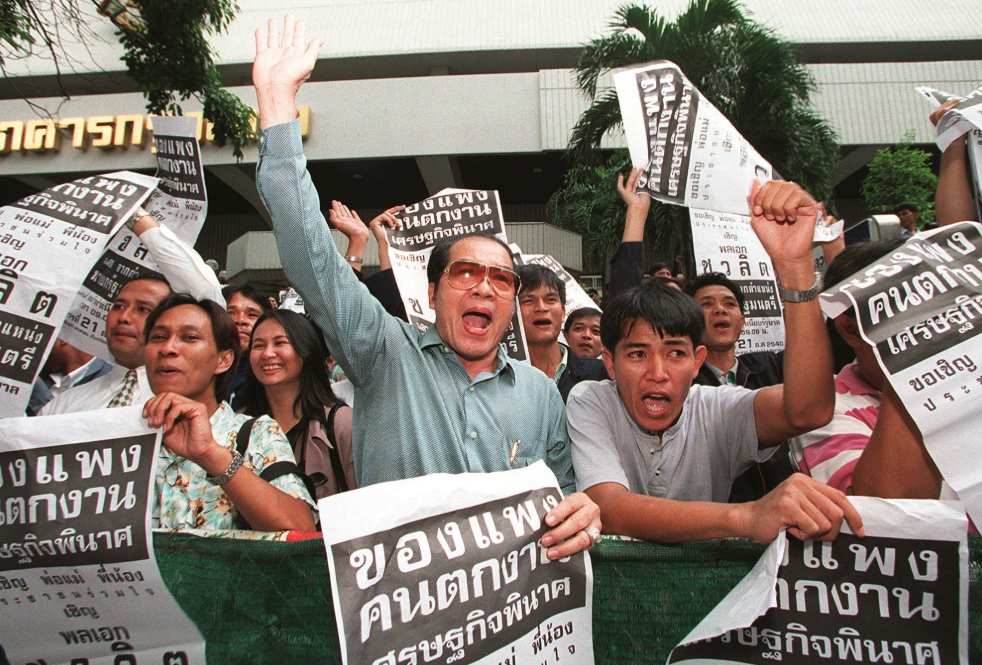
During the 1997 Asian financial crisis, residents of Bangkok demonstrated against the deteriorating economy and rising unemployment. In the wake of the crisis, the Thai baht depreciated sharply, capital fled the country, and Thailand along with several other East Asian economies fell into severe recession. Source: AFP
Conversely, if deficit countries possess sufficient economic and political strength to restrict imports, curb capital inflows, depreciate their currencies, or take other measures to prevent surplus countries from continuing to export their excess savings, then the surplus countries face even greater risks. The United States in the early 1930s and Japan after the 1990s are cases in point. Their trading partners used policy intervention to suppress imports and expand exports, thereby narrowing their own deficits while forcing the growth models of the US and Japan—which had relied on trade surpluses—to gradually unravel: investment contracted sharply, and exports, corporate profits, and asset prices all declined accordingly.
For today's governments, these historical lessons offer two key takeaways.
First, when trade imbalances eventually enter an adjustment phase, the economies most at risk are those with the sharpest debt growth but no corresponding expansion in productive capacity.
Second, parties to trade imbalances can indeed take measures to shift adjustment costs onto other countries, but whether they succeed depends largely on their economic strength and their ability to actually wield that strength.
An impending crisis.
The current scale of global trade imbalances is exceptionally large, so the adjustment ahead is likely to be difficult. China may absorb some of the shock. The country's debt-to-GDP ratio is currently rising at a relatively fast pace, and a considerable portion of that debt has been channeled into investment, yet the economic returns on those investments have not been substantial so far. At the same time, if other countries adopt trade protection measures or external demand weakens, that could add further pressure on China's economy.
The United States is no longer willing to sustain large, long-term trade deficits. As the world's largest economy and its primary source of demand, the U.S. possesses sufficient economic strength to narrow its trade deficit rather than continue serving as the globe's "consumer of last resort." At the same time, U.S. trade policy is highly concentrated in the executive branch. Under relatively broad statutory authority, the president can impose tariffs, restrict investment, and implement export controls, giving Washington the political capacity to deploy that economic power.
If the United States expands domestic manufacturing capacity through industrial policy while—more importantly—tightening its grip on trade and capital flows via tariffs and other restrictive measures, then China and other major surplus economies will find it increasingly difficult to sustain their existing surpluses in a manner that mirrors the U.S. trade deficit. At that point, they would either have to compress their surpluses through the painful process of domestic adjustment, or seek out new import markets—economies that remain both willing and able to absorb those surpluses.
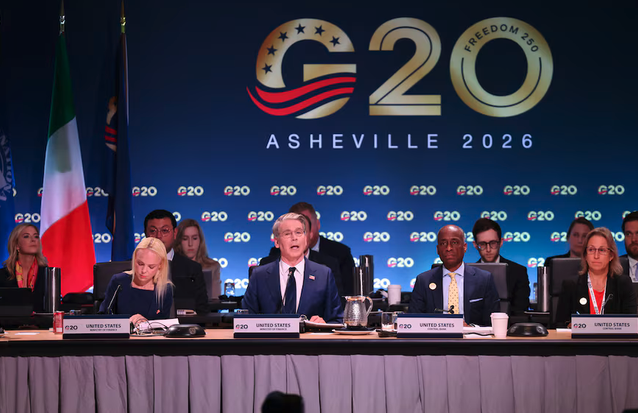
On September 1, US Treasury Secretary Bessent spoke at the G20 Finance Ministers and Central Bank Governors meeting in Asheville, North Carolina. Global trade imbalances took center stage at the meeting. Photo: Reuters.
Today, the eurozone ranks as the world's third-largest economy and the second-largest source of global demand, so Europe is hardly lacking in economic heft. What remains genuinely uncertain is whether Europe possesses sufficient political capacity to translate that economic strength into policy action, given a decision-making apparatus that is fragmented and member states whose interests frequently diverge.
If the United States manages to narrow its trade deficit while increasing its share of global manufacturing, and China is unwilling to see its surplus shrink correspondingly, then a politically fractured Europe could, without actively choosing to, end up absorbing a larger trade deficit. The costs could include deindustrialization, rising debt, and slower economic growth. That process may already be underway.
Once major economies stop thinking about how to minimize the global cost of adjustment and instead focus on minimizing their own exposure, the window for resolving global trade imbalances in a relatively benign manner has passed. China appears determined to sustain its trade surplus for as long as possible, while Washington is equally resolute in its effort to shrink its own deficit.
If Europe were able to muster the political capacity needed to take such action, the burden of adjustment would fall increasingly on surplus economies, forcing them to rely more on domestic demand rather than exports to sustain growth. Conversely, if Europe fails to do so, it will absorb an ever-larger share of global trade surpluses. In that scenario, the trade conflict that today is primarily between China and the United States could in the future evolve into one between China and Europe—with the core of the contest being who can avoid bearing the heavier adjustment costs down the road.
History has made one thing clear: trade imbalances will eventually be corrected, one way or another. What remains genuinely uncertain is how much damage that adjustment will inflict, and who will ultimately bear the cost.
The original article, titled "A Great Rebalancing Is Coming: Who Will Bear the Costs of a Global Trade Adjustment?," was published in Foreign Affairs on August 28, 2026, with portions abridged.