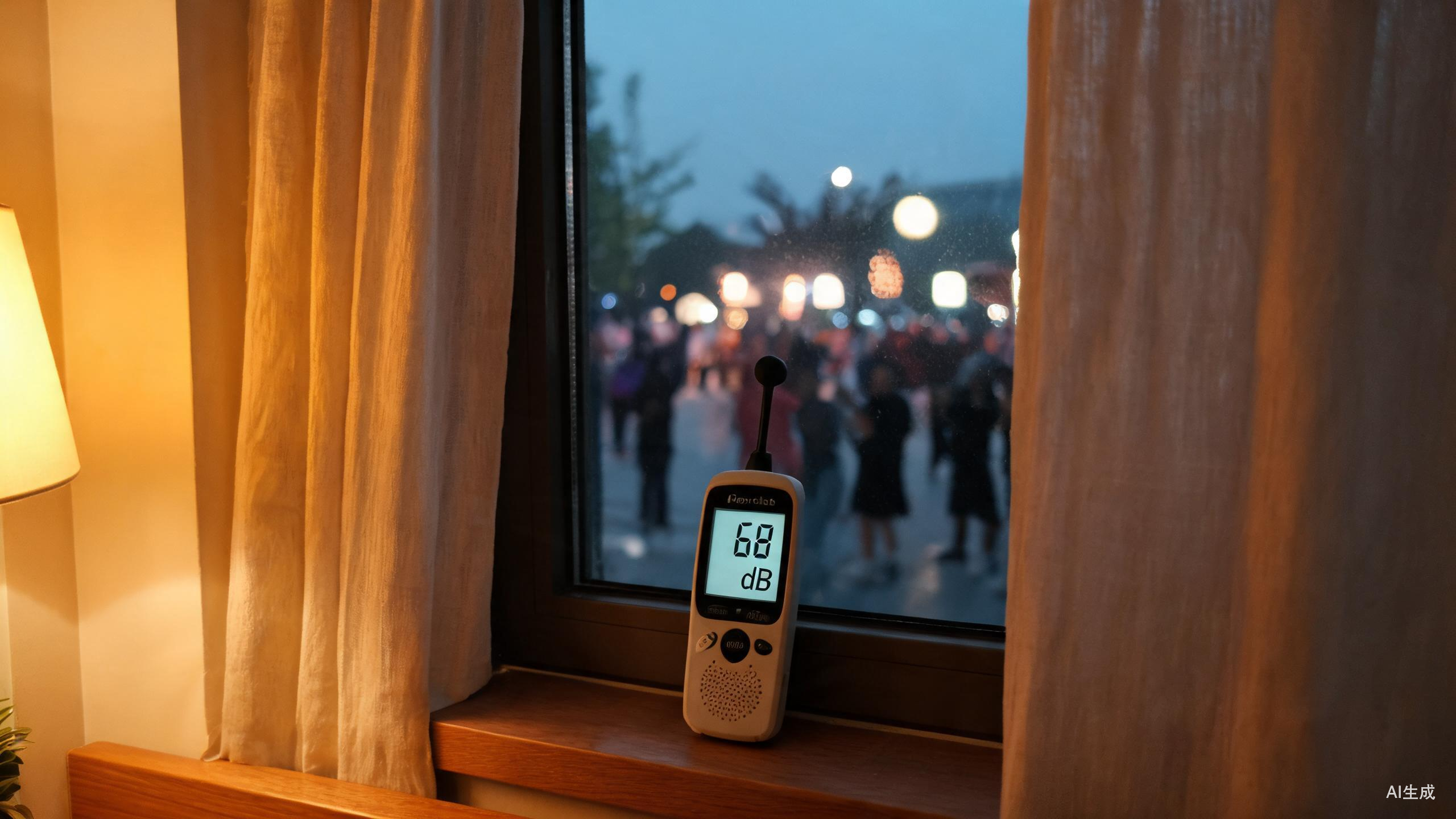
The rhythmic "thumping" sound started up again, and the square dancing had begun.
On the evening of August 27, at around 6 pm, Li Yita and her family, who live in Fuzhou, were disturbed by the noise coming from outside their window. She walked to the central square of their residential community, about 50 meters away from her home, where she saw more than 60 elderly men and women, all in their 60s, lined up and dancing to music around a black loudspeaker the size of a suitcase.
A noise monitor nearby displayed 68.8 decibels. The World Health Organization and multiple studies have found that prolonged exposure to noise levels between 60 and 70 decibels can adversely affect sleep, hearing, and cardiovascular health.
This instrument was obtained after Li Yitao filed continuous complaints with multiple departments, including the local public security bureau and the ecological environment bureau, for three years, and made hundreds of phone calls.
After the installation of the noise detection equipment, the neighborhood returned to quietness, but this only lasted for 5 months. In April 2026, the square dance troupe returned with their loudspeakers, and every night the noise level measured by the detector soared to over 60 decibels.
Although Article 88 of the People's Republic of China's Public Security Administration Punishments Law, which took effect on January 1, 2026, clearly states that those who produce noise in social life and, after being persuaded, fail to stop and continue to disturb others' normal life, can be detained or fined, Li Yita never saw administrative punishment imposed on the noise makers.
During her efforts to push for the case to be filed and repeatedly inquire about the progress with the police, the investigation was terminated due to a third-party institution detecting a decibel level of 58.1 at Li Yitao's home. She then filed an administrative lawsuit against the police station, which was rejected by the court.
People who have had similar experiences to Li Yita are not uncommon. "Complaints with no solution" have turned noise rights protection into a prolonged tug-of-war, even triggering intense conflicts. In 2025, a square dance enthusiast in Xuyi, Jiangsu, was slapped in the face and suffered a concussion and facial injuries by the person in charge of a nearby milk tea shop due to the loud music, and the person in charge of the milk tea shop was given administrative penalties. In May 2026, an elderly person in Xi'an, Shaanxi, was involved in a verbal altercation with a neighbor in a property owners' group over noise issues, and later the elderly person injured the neighbor with a cleaver and was held criminally liable.
Various types of noise are troubling many people, with China's noise complaint volume rising year by year. According to the "China Noise Pollution Prevention and Control Report" released by the Ministry of Ecology and Environment in conjunction with multiple departments, the national total noise complaint volume has increased for four consecutive years, with a growth rate of approximately 51.7%. In 2025, the complaint volume was approximately 6.833 million, with social life noise complaints accounting for 70% of the total, exceeding 5 million.
Social noise permeates daily life—from the thumping of children running upstairs and the low-frequency hum of air-conditioning units, to the din of square dancing and open-air KTV in public spaces. Though laws exist on the books, complaints often go nowhere, leaving the aggrieved to wage their own battles against the noise in whatever way they can, in pursuit of a little peace.

Li Yita's rights defense journey began three years ago.
At 6:30 in the evening, the strong rhythm of "Heart Beats, Emotions Blaze" came from the central square of the residential area, her heart beating rapidly with the music, starting to feel suffocated, her daughter shut the door and window of her bedroom, unable to focus on her homework.
She followed the sound downstairs and found the leader of the dance in the central square of the community, hoping she could turn down the volume of the speaker.
"Hello! You're being too loud, could you please keep it down?" Li Yitao had to raise her voice several times in an attempt to drown out the music, and it wasn't until she spoke loudly that the woman, who appeared to be in her 40s, turned down the volume, frowned, and asked, "What was that you just said?"
The square dance group gradually surrounded Li Yitao, with over a dozen eyes staring at her, as they began to "discuss the matter" in a cacophony of voices: "We're just exercising normally, what does your daughter's studying have to do with us?" "What's wrong with us exercising reasonably?" "You're crazy, you're affecting everyone's dancing."
Li Yitao proposed solutions, such as wearing headphones, but the other party rejected them, saying it "lacked atmosphere" and was "uncomfortable". She said that throughout the negotiation process, no one realized that affecting the surrounding environment was wrong. Seeing that communication was futile, she could only return home amidst a chorus of accusations.
Wang Jingyi, a 30-year-old office worker from Shanghai, has also been disturbed by noise for over a year and is stuck in a negotiating dilemma.
Starting from March 2025, the 4-story residential building where she lives has been constantly disturbed by the noise from a dryer in a household on the 6th floor, making it difficult for her to fall asleep.
At first, Wang Jingyi decided to go and negotiate with her neighbor to resolve the issue. She went upstairs and knocked on the door, which opened a crack, revealing a man's half face.
"I needs a top of a top of a top of a " ( " " ( " " ( " " " " " " " " " " " " " " " " " " "iles " " " " " " "." " " " " " " " " just " " " " " " " " " " " " " " " " " " " " just " " " "'ts " " " " " " " " " " " " " " " " " " " " just " " " " " " " " " " " " " " " " " " " " " " " " " " " " " " " etc " " " " " " " " " " " " "." " " " " " " "." "." " " " " " " " " " " " " " " " " " " " " " " " " " " " " " " " " " " " " " " " " " "." " " " " " " "." " " " " " " " " " " " " " " " " " " " " " " " " " " " " " " " " " " " " " " " " " " "
"I'm not going, I'll do what I want at home," the man said before closing the door.
After being rebuffed, Wang Jingyi had no choice but to return to her bedroom and "tough it out". The constant humming noise from the ceiling to her pillow made her feel like she was "sleeping in a dryer", with every organ in her body seeming to vibrate with the sound. For half a year, she took her quilt and moved to the living room sofa, wearing noise-cancelling headphones to listen to soothing music in an attempt to distract herself. But every morning when she woke up, she still had headaches and felt tired.
She also sought out her neighbor on the 7th floor, who was similarly being kept awake by the dryer noise, to go to the 6th floor to communicate, but was met with a response of "I'll try my best," yet the noise still didn't stop. Wang Jingyi, unable to tolerate the disturbance, went to communicate with them multiple times, while the other party became increasingly impatient, gradually escalating from polite conversation to irritability, and even once directly cursing, "Are you out of your mind?"
39-year-old Wang Peng is also driven crazy by the sound of children running upstairs every night. The "thud thud" noise always starts suddenly without warning, and Wang Peng and his wife are often jolted awake while sleeping.
Initially, when Wang Peng went to communicate with his neighbor, he suggested laying down a crawling mat, but the neighbor thought it was too much trouble and dropped the matter. Wang Peng went upstairs to communicate three times, but later the neighbor wouldn't even open the door, shouting through the door panel: "It's none of your business what happens in my home!"

After negotiations reached a deadlock and having no other choice, Li Yita went downstairs again and walked to the side of the square dance team, where she dialed 110 to report the incident to the police.
The police officers arrived, walked directly to the audio equipment, turned down the volume, and then explained the reason, after which the leader of the square dance group did not say anything else.
The police also called the property manager, informing them that according to the property management regulations, the property is the first responsible party for noise in the community and has a duty to handle it. However, the property manager appeared helpless, saying they had previously spoken to Li Yitao, and each time they received a complaint, they would try to persuade him, but he would ignore them, and they did not have the authority to forcibly stop him. The property management had also reported the situation to the community residents' committee, but to no avail.
The police officers stayed at the scene for nearly half an hour, during which the loud music from the square dance was turned down to a level that could only be heard within about 15 meters of the speakers. However, as soon as the police left, the dance leader took a quick step to the speakers and turned the volume back up. "Do you know how much you mean to me, every day without you is unbearable—" the song blared into the sky.
Li Yitao could only keep calling the police, with a maximum of 13 calls to 110 in one day. Each time the police arrived at the scene, the dance troupe would turn down the volume, and when the police left, the volume would be turned back up, making stopping the noise a "never-ending cycle".
Due to the high frequency of calling the police, Li Yitao has even figured out the police officers' shift schedules. She has calculated that in 2025, she contacted the police at least 130 times due to noise and visited the police station several dozen times. To simplify the process, the community police added her on WeChat, saying she can directly report noise issues via WeChat and they will immediately arrive to handle the situation.
Li Yitao was not the only one complaining about noise disturbance from square dancing. Residents of Buildings 2 and 3, located about 20 meters from the square dancing area, have also called the police.
After Wang Jingyi reported the incident, she encountered a similar situation to Li Yitao's. Neighbors would turn off the noisy machines when the police came to the door, only to turn them back on after the police left.
After the police mediation fell into an "infinite loop," Wang Jingyi tried many ways to communicate, such as expressing her willingness to buy shock-absorbing mats or shelves for the upstairs neighbors through the property management and residents' committee, but they all refused. The residents' committee reflected the situation to the local street office, which then paid for the installation of a clothes dryer bracket, and the vibration in the corridor finally decreased, but her bedroom was directly below the dryer, and she still couldn't sleep well.
The noise problem still hasn't been resolved, and Wang Jingyi is considering taking legal action. She has consulted a lawyer, who told her that filing a lawsuit would require paying 8,000 yuan in legal fees upfront, followed by 18,000 yuan for a judicial appraisal of the noise source, and that it would take at least three months to get the case filed. The financial and time costs of suing are too high, so she hasn't submitted the lawsuit yet. To avoid the noise, she has to sleep in a separate room from her husband, but now her husband, who originally slept in the bedroom, is also constantly complaining of headaches.
Wang Peng, who was also troubled by the sound of children running, had experienced several instances of reporting to the police to no avail. He ultimately chose to implement a "not-worth-promoting measure". He bought a Bluetooth speaker online, placed it on the ceiling, and had it play "anti-noise" music consisting of densely edited drumbeats, electric currents, and chair-banging sounds on a 24-hour loop, while he himself moved to his parents' home temporarily.
After "the method" was implemented for 15 days, Wang Peng returned home to find that the upstairs had suddenly become quiet, and for more than half a year since then, there was only the occasional sound of a table being moved, with no more running sounds.

To defend her rights, Li Yita began systematically studying noise-related laws and regulations in 2023, including the Noise Pollution Prevention and Control Law of the People's Republic of China (hereinafter referred to as the Noise Pollution Prevention and Control Law), the Civil Code of the People's Republic of China, the Public Security Administration Punishments Law of the People's Republic of China, and the Administrative Penalty Law of the People's Republic of China, studying a total of 8 books.
Over the past two years, she has reorganized her experiences according to legal provisions, preserving evidence of noise disturbances, including decibel readings she detected, police records, and chat screenshots with her landlord and others who accused her of causing disturbances, and itemizing the responsibilities of public security organs in accordance with the law.
Li Yi Tao hopes that noise rights protection will no longer be limited to "police persuasion" but will become a case that everyone takes seriously.
In August 2025, she submitted a request to the Lianjiang County Public Security Bureau to perform its duties in accordance with the law and the Fuzhou Municipal People's Government Office's "Notice on the Division of Departmental Responsibilities for Some Provisions of the Law of the People's Republic of China on the Prevention and Control of Noise Pollution", hoping that the bureau would handle the noise from the square dance downstairs in accordance with the law, as stated in the notice, "such illegal behaviors should be ordered to be corrected, warned or fined by the public security department".
The letter to the authorities proved effective, and about 10 days later, Lianjiang County Public Security Bureau assigned the task to the local police station, where the director located Li Yitao and filed a case regarding the noise complaint about the square dancing she had reported.
On September 9, the police station invited a third-party testing agency to the neighborhood, which measured a noise decibel level exceeding 70 decibels at a location 1 meter from the central square. The testing agency also measured the noise decibel level 1 meter outside Li Yitao's window, with a reading of 58.1.
According to the Government Information Disclosure Application Handling Notice issued by the Fuzhou Municipal Bureau of Ecology and Environment, the residential area where Li Yi lives is a Class 2 noise environment functional zone (i.e., areas with commercial finance, market trade as the main function, or mixed residential, commercial, and industrial areas that require maintaining residential quiet). The environmental noise limit is 60 decibels during the day (6:00 am to 10:00 pm).
On October 21, the public security authority terminated the investigation, citing that the decibel level at her home was not excessive and "no illegal facts were found." This means that her previous repeated reports and submissions of duty applications ultimately ended with the conclusion that the noise disturbance was not established because the decibel value at her home did not exceed 60.
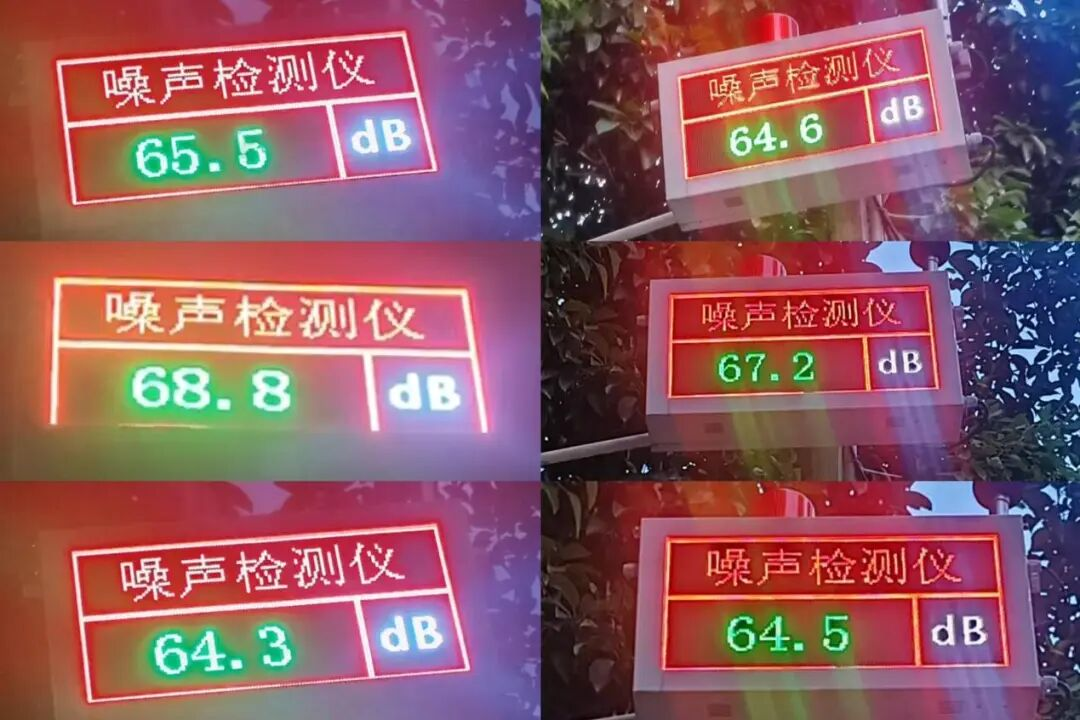
Li Yi Tao captured a noise detection meter reading downstairs
Having seen no actual progress, Li Yita turned his attention to the regulatory level, hoping that attention from higher authorities could drive a solution to the problem.
On November 22, she submitted a letter of responsibility to the Lianjiang Ecological Environment Bureau of Fuzhou City, hoping the bureau would take the lead in urging the public security authorities to investigate and handle the illegal activities in accordance with the law.
However, the Ecology Bureau responded that on-site law enforcement is the responsibility of the public security agency, but the Public Security Bureau had previously withdrawn the case, causing the rights defense to reach a deadlock. In the end, the solution once again relied on persuasion and negotiation.

Square dancing, children running, and other audible sounds are already difficult to address, but the source of low-frequency noise is even harder to pinpoint, leaving many troubled individuals at their wit's end.
This is a sound with a frequency between 20Hz and 200Hz, with a long wavelength and strong penetrating power, mainly relying on structural transmission, with vibrations propagating through the solid structures of buildings, such as walls, beams, columns, and floors.
Elevators, submersible pumps for oxygenating storefronts, and power transformers running continuously in basements are among the equipment that can cause vibrations in walls, which can spread in all directions through floors and beams, potentially affecting upstairs and downstairs neighbors, as well as those in adjacent units, and even transmitting through three or four floors.
The noise from the dryer that Wang Jingyi encountered was one such instance, where the dryer on the sixth floor was placed directly against the balcony floor, causing vibrations to transmit downward through the floor, precisely above her bedroom ceiling.
She described the sound as inaudible to the ear, but more of a feeling, like "tens of vibration modes of a phone laid under you, all vibrating at the same time, with the bed vibrating too."
It took her nearly three months to pinpoint the source. First, property management spent over half a month inspecting the hallway pipes and the pump room. Then the neighborhood committee called residents on the floors above and below to confirm the noise. Finally, at 11 p.m., they cut power door by door. When they reached the sixth-floor neighbor running a dryer, the humming stopped. When power was restored, the sound returned—and that's how they identified the source.
However, not everyone plagued by the issue can identify its source. Zhu Lin, a 42-year-old from Shandong, was also deeply troubled by low-frequency noise. He self-studied acoustics, made his own detection equipment, and popularized noise knowledge online. Since registering his Xiaohongshu account in 2023, he has accepted consultations from netizens and handled over 10,000 low-frequency noise cases. At peak times, he received more than 100 consultation messages a day, with most inquiries being: "There's a strange humming noise in my home, I couldn't find the source, and I'm being tormented to the point of insomnia every day."
What left a deep impression on Zhu Lin was a resident of Qingdao who was tormented by low-frequency noise for nearly a year, resulting in poor mental health every day, and was eventually diagnosed with neurasthenia and depression. There was also a resident of Hangzhou who spent almost a year searching for the source of the noise in his own home, and at night, he would search around the villa area with a flashlight, only to be mistaken for a thief by his neighbors and reported to the police.
Tracing low-frequency noise requires at least 7 specialized devices, which would cost tens of thousands of yuan if purchased outright, a sum many people cannot afford. Therefore, starting in June this year, Zhu Lin, who possesses professional equipment and understands acoustic principles, began offering detection services, becoming a "noise detective." He brings his self-made detection equipment to sites, using signal analysis of sound and vibration detection to help people find the source of the noise.
At the end of July, Zhu Lin went to Weifang, Shandong, where at least a dozen households in two residential buildings had been plagued by a 77Hz low-frequency noise for nearly a year. Local property management, neighborhood committees, and other departments went door-to-door issuing notices, coordinating a power outage for the entire building, and even coordinating with the adjacent chemical plant's management to halt production for five days, but the noise persisted. It wasn't until the power supply to the shared transformer room of the two buildings was cut off that the noise briefly disappeared, but after the power company implemented vibration reduction measures for the transformer room, the humming noise still existed.
After arriving at the scene, Zhu Lin conducted an investigation from 5 pm to 10 pm, using methods such as spectrum analysis and vibration sensors to gradually narrow down the scope, and finally combined with the building's floor plan to conduct modeling analysis, it wasn't until 4 am that he was able to lock down the suspected area to the wall next to the transformer room. He described himself as being "like solving a math problem on the college entrance exam," having almost exhausted all possible lines of investigation, only to rule each one out one by one.
For the homeowners, locating the source of the noise is a prerequisite for moving on to the next stage, and they are currently pushing relevant departments to renovate the substation and walls.

For more people, the source of the problem has been found, and if negotiations are ineffective, they will still end up in the same cycle of rights protection as Li Yitao.
On January 1, 2026, the newly revised Public Security Administration Punishments Law of the People's Republic of China took effect.
Article 88 of the new law for the first time clearly stipulates the penalties for social noise pollution: those who violate laws and regulations on the prevention and control of social noise pollution, and still refuse to stop after being persuaded, mediated, and handled by grassroots mass autonomous organizations, owners' committees, property service personnel, or relevant departments, and continue to disturb others' normal life, work, and study, can be detained for up to 5 days or fined up to 1,000 yuan; in serious cases, they can be detained for 5 to 10 days and may also be fined up to 1,000 yuan.
According to a query by ifeng.com, since the beginning of this year, public security authorities in multiple locations including Beijing, Wuhan in Hubei, and Ningxia have successively announced the law enforcement authority, handling procedures, and discretionary standards for Article 88. However, actually taking the step to impose penalties still faces many practical difficulties.
For example, "interfering with others' normal life" is difficult to define. Li Yitao, who self-studied legal provisions, raised the question: "What constitutes interference? What are the standards? How do I prove I've been disturbed by noise? So far, I haven't seen any clear, unified explanations on these points."
Li Yitao recalled the rights-protection process, noting that police officers told her they also face difficulties in handling noise complaints. Sometimes when they tried to dissuade square dancers, the dancers refused to acknowledge that their behavior was disruptive, making it hard for police to issue direct penalties.
On August 15, 2026, this question was answered in a low-frequency noise case.
On that day, the Ecological Environment Code of the People's Republic of China officially took effect. The Qujiang District People's Court in Quzhou, Zhejiang Province, held a hearing on a liability dispute involving low-frequency noise pollution from a commercial shop and pronounced its judgment in court.
In this case, the first-floor seafood store's water pumps and oxygen-increasing pumps operated 24 hours a day, with low-frequency vibrations transmitted through the walls to the upstairs residents' homes, causing long-term insomnia and anxiety for resident Ms. Zhang.
The court did not solely determine whether a disturbance existed based on whether the noise decibel level exceeded standards, but rather made its determination by considering the actual transmission of low-frequency vibrations and their impact on residents' lives. Multiple on-site inspections found that the low-frequency vibrations generated by the continuous operation of the submersible pumps and oxygen-increasing pumps in the commercial property propagated through the walls to the upstairs apartments. Even after the defendant's commercial property added sound insulation and replaced the equipment with quieter devices, resulting in a significant decrease in airborne noise, Ms. Zhang's south-side bedroom and living room could still feel the continuous slight vibrations, which disappeared immediately after the equipment was shut down.
The presiding judge noted that the defendant's equipment objectively continued to generate low-frequency vibration noise, and that even after the defendant's own remediation efforts, the plaintiff's normal life remained disturbed. The first-instance judgment ordered the defendant to complete noise-reduction and vibration-dampening modifications to the facilities and equipment within a specified deadline, and to compensate the plaintiff 121.4 yuan in medical expenses and 3,000 yuan in emotional distress damages.
Li Yitao also learned about this case, and she has not given up on fighting for her rights over noise pollution.
In January of this year, she filed an administrative lawsuit with the Minhou County People's Court, seeking to overturn the local police station's decision to close the case. The police station argued that decibel readings showed the case did not meet the threshold for "creating noise that disturbs daily life," that some residents also have the right to choose square dancing as a form of exercise, that the dance group's schedule complied with local regulations, and that the group had lowered its volume after police warnings. Li Yitao bears a duty of neighborly tolerance, and her personal demands cannot override the lawful rights of other property owners.
In July, the court ruled in the first instance, rejecting Li Yitao's claims. She disagreed with the ruling and filed an appeal.
"Everyone grows old, and I understand and respect that older people have a need to pursue spiritual fulfillment. I'm not asking them to stop dancing—I just hope they won't disturb the neighborhood, so we can come home in the evening to a quieter life," she said.

By Mu Sanchuan | Editor: Yan Qing
Layout by Wei Wei | AI graphics by Cong Min

Low-Frequency Hum Never Ceases Day or Night: Code Safeguards Residents' Peace — Inside the First Trial Under the Ecological Environment Code, Supreme People's Court, August 16, 2026
2. Noise that meets standards can still count as disturbing residents! First case under the Ecological Environment Code breaks the "decibel-only" approach, CCTV News, August 17, 2026