
"Indifference is a kind of acquired blindness."
This seems to be something we should get used to.
A few days ago, a netizen shared an experience of interning at a large factory on Xiaohongshu. At the end of the post, a colleague commented that the author was still too immature and lacked the basic qualities required of a large factory employee.
(Swipe to view the original post)
Earlier, Xingyu Shares was also trending due to the dismissal of 107 interns. Although the company has provided a written apology and compensation plan as the incident unfolded, the ripple effects it triggered seem far from over.
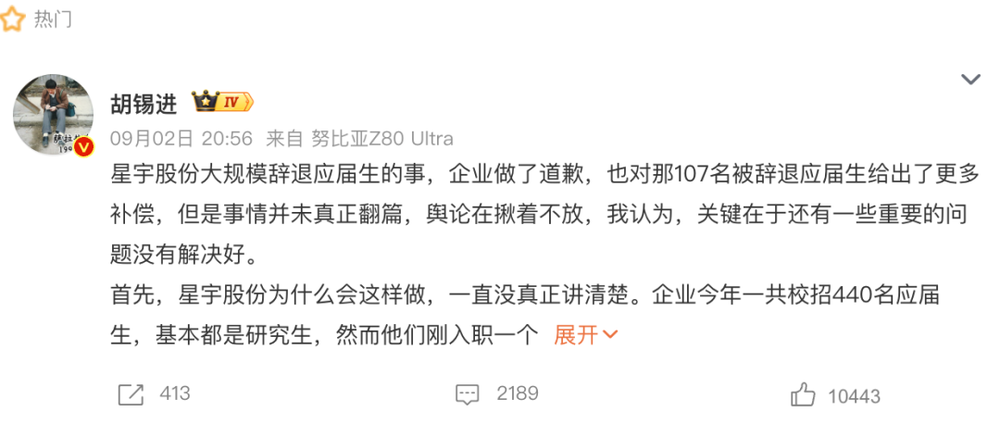
A well-known blogger's review of Xingyu Shares
These events and news, like the world of adults, are subtly knocking on the doors of young people who have just entered society. For that world, students who are not yet familiar with the system and rules are indeed the more "immature" side. They are not yet numb, and they cannot "separate themselves from the issue" to remain detached.
These events point to a problem that is not specific to one company's management, but rather a more universal state of mind: modern industry is systematically numbing people's nerves, causing them to gradually lose their instinctive response to pain. When numbness becomes a socialized badge of honor and a habit, how can we live "unnaively"?
The starting point of this set of alienated rules is the deprivation of human physicality.
Over a hundred years ago, German sociologist Georg Simmel published an essay called "The Metropolis and Mental Life", in which he wrote:
The psychological basis of metropolitan individuality consists of the intensification of emotional life, resulting from the rapid and continuous shifts in both external and internal stimuli.
Thus, the essentially intellectualistic character of the metropolitan mentality becomes understandable, in contrast to the small town's more emotional and sentimental intellectual life.
In the past, small-town-style interpersonal relationships were close and emotionally charged, with people bound together by clan and family ties, and relationships formed in densely populated areas tended to become overly intimate.
However, in large cities, in order to avoid exhausting oneself from countless brief encounters, and to maintain the speed and efficiency of urban life, people must maintain a psychological distance.
This article is what later became known as "social atomization." You will find that in modern society, we are increasingly like individual, drifting atoms that are unrelated to one another. We are neither concerned with the plight of specific strangers in reality nor able to express our feelings to others. The relationships between people have become weak and fragile, and although we are surrounded by others, we feel an unprecedented sense of loneliness and disorientation.
Modern industry, in fact, is systematically reinforcing this sense of estrangement. The classic example: in modern war journalism, civilian deaths are often referred to as "collateral damage." The term sounds like an indemnity clause from some commercial contract, carrying a procedural, almost inevitable undertone. It neutralizes and technologizes the terrible cost, quietly diluting the moral responsibility and the brutal reality of human casualties.
After the advent of the internet, people are no longer confined to a physical body, but rather exist as a string of cybernetic code composed of 0s and 1s. In the flow of information, all events are equal, serving as material that can be discussed, consumed, and then forgotten.
In this case, the passing of a life is on the same level of information as a celebrity gossip or a funny video. Users complete an emotional switch with a swipe of their fingers. This switch, in itself, is training the ability to quickly enter and exit. It allows us to withdraw from sadness painlessly and safely, and also gradually lose empathy for specific lives.
In this case, indifference and numbness are actually a kind of acquired selective blindness. For large factories, resignation is optimization, employees are human resources, and it builds a wall with numbers and terms to block out pain from perception. When everything is converted into costs, emotions and empathy become unnecessary "collateral damage", and people are reduced to currency and consumables.
What's even more frightening is that once someone gets used to this filtering, they will unconsciously become a cog in the system, or even an accomplice.
If we step back to examine this system, a very instinctive question arises: if it is really so evil, then why do we unconsciously comply with and even reinforce it?
In the movie "The Reader", there is a shocking courtroom scene. The female lead, Hanna, was originally a vibrant and sensitive woman. She loved to listen to people read and would cry because of the plot in the stories. But when she was forced into the Nazi system and became a concentration camp guard, she was gradually exploited and alienated.
At the trial, the judge asked her how she could repeatedly select prisoners for Auschwitz. With a slightly puzzled expression, she replied that it was simply her duty as a guard. She even turned the question back on the judge, asking what he would have done in her position.
For Hannah, not having to witness the extremely cruel scenes of the concentration camp meant she could select prisoners without the psychological burden, making it all just her task and job.
This is what Hannah Arendt referred to as the "banality of evil". This theory was also proposed when she attended the trial of Nazi war criminal Eichmann. She found that the person sitting in the defendant's seat, who was extremely evil, was not the devil that people imagined. He was not sinister or ferocious, but rather polite and resembled a mediocre and dull bureaucrat. In his defense, Eichmann repeatedly emphasized that he was just a "small cog" in a large system. All his actions were in obedience to orders and in accordance with national laws.

Hannah Arendt photo
And this is precisely what makes the system so unsettling. The most heinous evils may not originate from some arch-villain, but rather from ordinary people who, abandoning thought and blindly obeying, collectively bring them into being.
The core of the "banality of evil" is not stupidity, but a deep-seated thoughtlessness. They do not think about what they are doing, and may not even be acting with malicious intent. This diluted sense of responsibility, which falls on one person, seems so insignificant, but it is precisely these countless small steps that ultimately become a self-sustaining system. It does not require people's wholehearted approval, only that they believe they have no other choice.
Like the person who says "it's too naive," they are neither the designer of the system nor the executor of the exploitation. They are not condoning a specific evil, but it seems there is no better way, and so, in this persistently high-pressure environment, people have to shut down part of their perceptual abilities in order to survive.

(Original article comment section)
In this case, numbness is actually more like a self-protection mechanism for a "qualified" modern person. It is the same answer given by countless individuals in their respective positions, facing the same pressures and the same sense of powerlessness, as if by tacit agreement. In these similar answers, the individual slowly internalizes the system's rules, and the system is thus able to maintain itself through mutual comfort and persuasion.
Thus, being "too naive" becomes an accusation, and "immaturity" becomes a shame, as victims, unable to escape the exhaustion, slowly become a part of the system.
A Sharp Question Arises
If numbness is the result of exhaustion, and the cost of rejection is indeed too high, then what can be done? To ask someone to confront the entire system, and to tell them "there's no better way," are both forms of violence. The former ignores an individual's limits of endurance, while the latter ignores the only remaining possibilities.
This dilemma is actually more terrifying than the evil that can be defined and described. In a flattened context, we can easily give two extreme options of acceptance and rejection. However, real life requires us to face situations that are much more complex than that.
People living in this system can hardly completely reject and leave it, as their work, income, social status, and even survival are all woven into this massive machine. In the recently concluded fifth season of "The Writers' Despair", the protagonist Ava has a line that precisely points out the dilemma we face in the AI era.
For us in the real world, the feeling of being hijacked by a high-speed operating system is also similar to the RAPE of modern industry. Often, the reason why an apple rots is actually determined before it even falls.
So, given this reality, how do we live without being naive—yet without growing numb?
In the same show "Desperate Writers", there's another interesting plot. The main characters Deborah and Ava had a conflict, with Ava questioning Deborah for not speaking out after being harassed by the club owner for the first time. Deborah countered that as a female comedian who made a name for herself in a male-dominated stand-up comedy industry, she had already paved the way for her juniors and didn't have an obligation to carry them across the river. However, when Deborah witnessed the new club owner harassing a female comedian again near the time of the performance, she chose to speak out during the show and got him kicked out of the industry.
This plot is actually a metaphor for reality. When faced with a massive system, an individual's refusal appears weak and powerless, but only if we don't view losing dignity as a universal state can we establish a coordinate system among ourselves and realize that we are not isolated atoms with no connection to each other.
Inside the atomic nucleus, there exists a strong nuclear force that tightly binds protons and neutrons together. As the strongest known force in nature, it overcomes the enormous electromagnetic repulsive force between protons in an incredible way, firmly sticking them together. However, this force is only effective within the extremely small space inside the atomic nucleus, and once it exceeds this distance, it rapidly disappears.
More than sixty years ago, the physicist Feynman once wrote a poem.
I
one of the basic units that make up everything in the universe.
A Universe in an Atom
an atom in the universe
From a macro perspective, we city dwellers living alone are like atoms drifting in the universe. Under the influence of interests and interpersonal relationships, the chemical bonds between us appear fragile and easily broken.
But if we are not in a hurry to separate from each other, and instead regard people with the same experiences as an inseparable whole, then perhaps we can also possess a power that is indivisible even by the entire universe.
It's like the Star Universe case, where if the 107 newly graduated employees who were fired hadn't made their humiliating experience public, and if we didn't believe that workers deserve better treatment, the incident might not have continued to ferment and potentially drive change in an entire industry.
It is precisely because we have started to believe that the world is not as vast as we imagined, and that numbness and compromise are not the only solutions to life, that we can transcend the screen and connect with each other.
In the movie "The Matrix", there's a classic hypothesis. After the protagonist Neo discovers the truth of the world, he is faced with two pills. The red pill represents danger, and after taking it, he must explore the real and brutal world, while the blue pill means staying in the Matrix, living in a computer-controlled dream.
These two pills are like the choices laid out before us. For individuals, what we can do at present may be to find space to breathe within the system, coexisting with it without being completely consumed by it.
This space does not require a rigid breakup or confrontation, nor is there a standard answer, but it certainly implies pain and discomfort. In complex reality, we may not be able to completely leave, and we may not even need to turn around. Because if we do not want to live numbly, it means participating in and entering life. The pain it brings is a real and piercing warning.
It means not growing numb, not descending into chaos. Because if responsibility can be shared across a system, then when we realize we are not isolated islands, perhaps the pain life brings can also be diluted.
An individual's fate and systemic changes seem to be two parallel paths, and sometimes they indeed have a desynchronized time difference. However, perhaps it is only when we do not wait in place for the era's drastic changes that we can use individual choices to create an alternative path.
(All image materials are sourced from the internet)